


Monthly AI Papers: July 2026
31 Jul 2026 | Paper Review Monthly Papers Confidence-Guided Inference Speculative Decoding MetacognitionContents
Trends
July 2026’s selected papers share a theme of using model assessments to guide computation: one surveys metacognition, the monitoring and regulation of a model’s own processing, while two develop faster generation methods for large language models (LLMs). Their connection is operational: an assessment becomes useful when it informs a decision about further work. The metacognition survey examines whether self-assessment changes strategy or effort; Nemotron-Labs-Diffusion studies confidence-based token commitment and draft verification; DSpark predicts draft acceptance to allocate verification capacity. These decoding signals have specific prediction targets and do not establish general self-knowledge. 1, 2, 3
The two decoding papers combine parallel proposals with sequential dependencies. Autoregressive (AR) decoding generates tokens one after another; diffusion decoding iteratively fills corrupted or masked positions and can predict multiple positions in parallel. Nemotron-Labs-Diffusion trains both in one backbone and supports self-speculation, where its diffusion pathway drafts tokens and its AR pathway verifies them. DSpark uses speculative decoding, where a draft model proposes tokens for a target model to verify, with a lightweight sequential correction to improve compatibility among parallel proposals. Its confidence scheduler then chooses how much of each proposal to verify under the serving engine’s measured capacity.
Across these papers, the measurement target determines what a result establishes. Calibration measures whether confidence corresponds to correctness probability; metacognitive sensitivity measures whether confidence distinguishes correct from incorrect answers. Neither alone establishes useful control. The decoding studies similarly separate accepted proposal length, tokens per model forward, and measured serving speed. Nemotron-Labs-Diffusion reports device-specific gains at low concurrency alongside an oracle-guided analysis that uses costly simulations; DSpark separates scheduler-disabled draft comparisons from live-traffic measurements of its complete production system. The engineering implication is to evaluate both signal quality and the resulting action under the intended workload.
Top Papers in July 2026
1. Metacognition in LLMs: Foundations, Progress, and Opportunities
- https://arxiv.org/abs/2607.11881
- Metacognition in LLMs: Foundations, Progress, and Opportunities | Summary
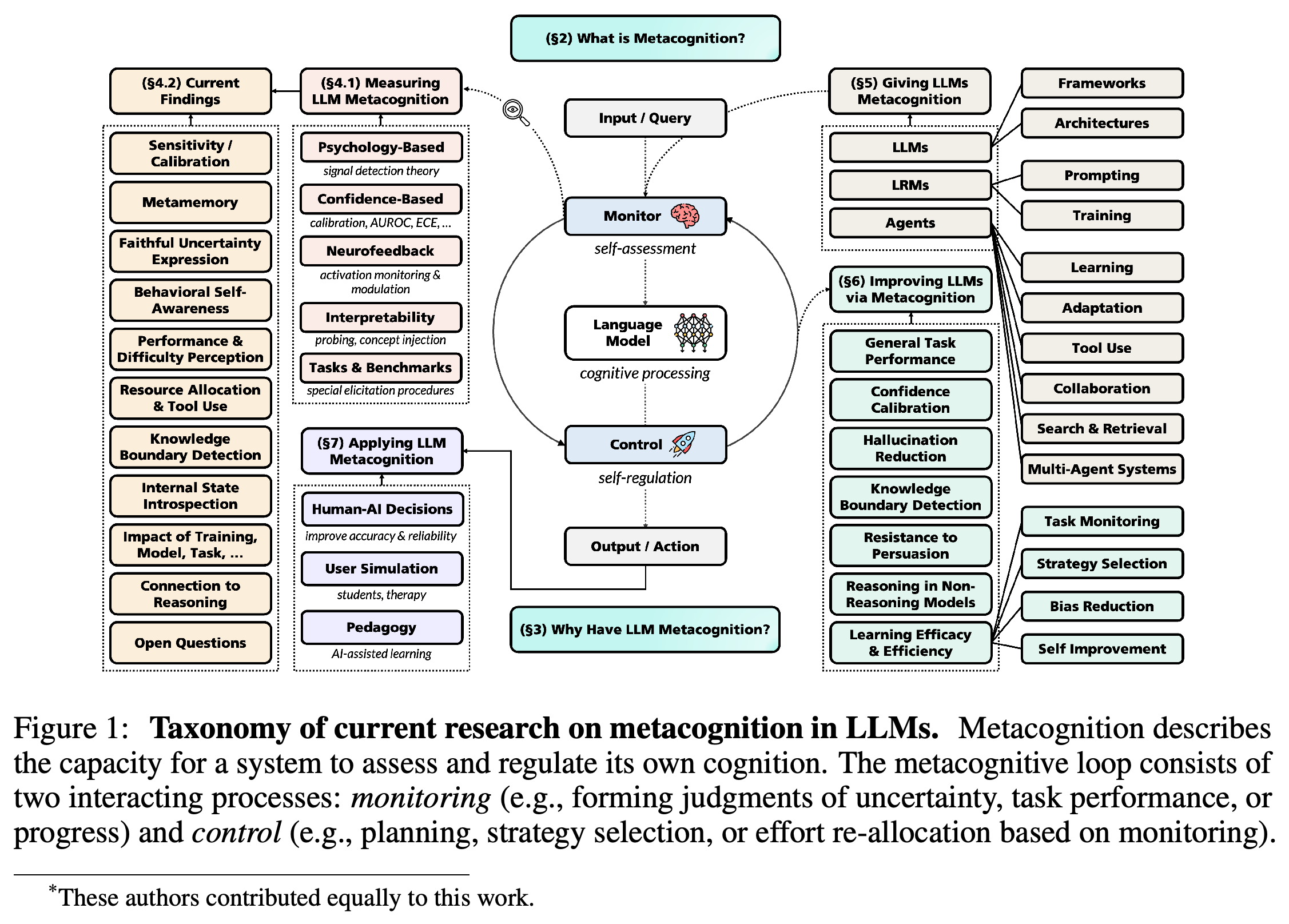
- Metacognition in LLMs: Foundations, Progress, and Opportunities organizes research around monitoring, which assesses uncertainty, knowledge, performance, or progress, and control, which uses those assessments to change strategy, allocate effort, or seek help. It is a survey of heterogeneous studies and reports no new experiments.
- The surveyed work generally finds weak to moderate metacognitive sensitivity and task-dependent calibration. Some studies identify information predictive of difficulty or limited awareness of internal processing, but better reasoning does not necessarily improve self-assessment, and available self-knowledge does not reliably produce adaptive action.
- Confidence elicitation materially affects measurement: one cited study finds that over 75% of verbal confidence responses on a 0–100 scale occupy just three values. Differences in tasks, models, temperature, and elicitation procedures limit cross-study comparisons; reflective text alone does not establish reliable monitoring.
2. Nemotron-Labs-Diffusion: A Tri-Mode Language Model Unifying Autoregressive, Diffusion, and Self-Speculation Decoding
- https://arxiv.org/abs/2607.05722
- Nemotron-Labs-Diffusion: A Tri-Mode Language Model Unifying Autoregressive, Diffusion, and Self-Speculation Decoding | Summary
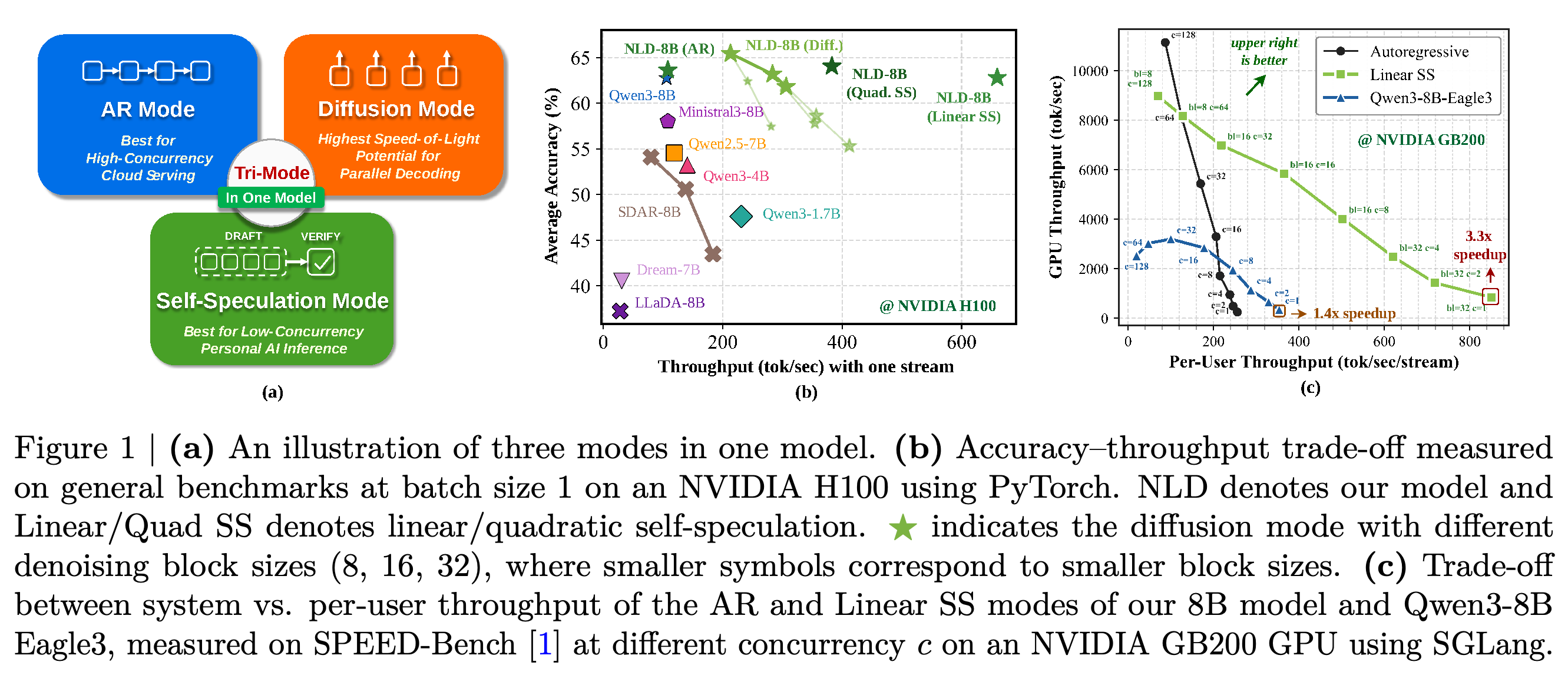
- Nemotron-Labs-Diffusion: A Tri-Mode Language Model Unifying Autoregressive, Diffusion, and Self-Speculation Decoding jointly trains causal next-token prediction and block-wise diffusion denoising in one backbone without separate prediction heads. Its linear self-speculation mode uses a parallel diffusion draft followed by a causal AR verification pass, accepting a contiguous prefix.
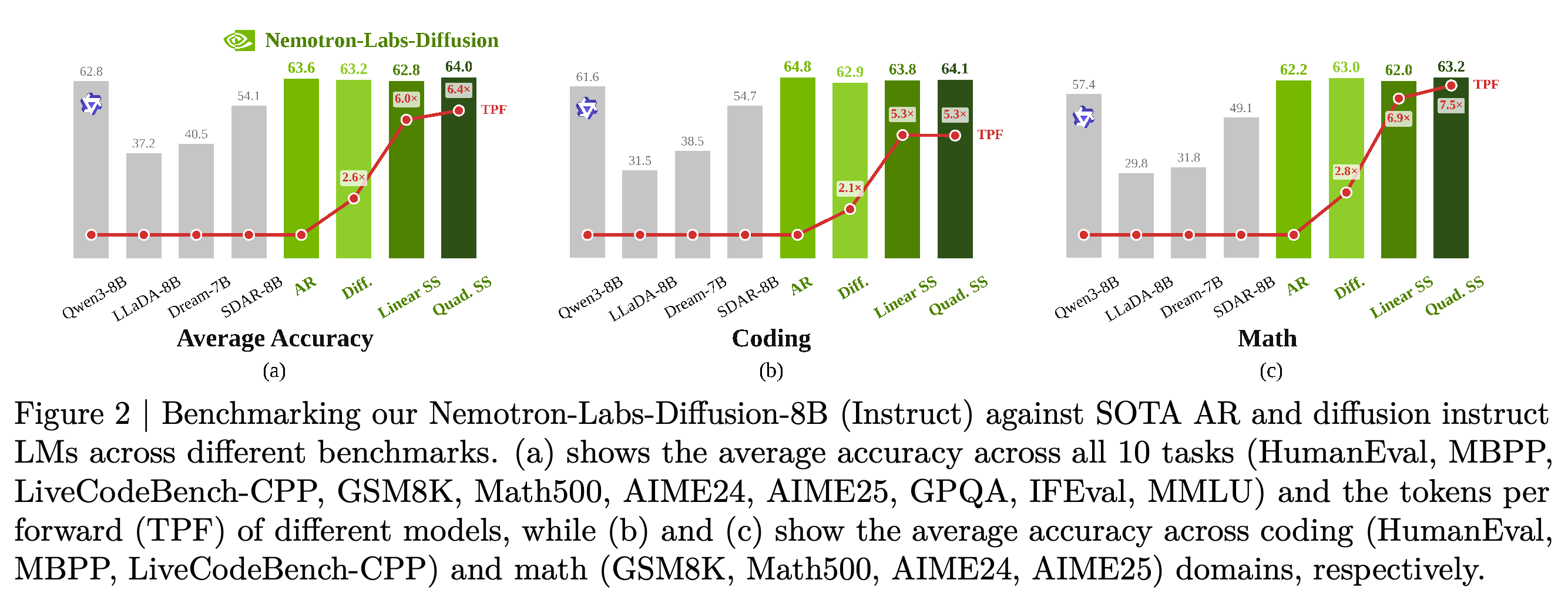
- Across 10 instruct tasks, the 8B model reports mean accuracy of 63.61 in AR mode and 63.18 in diffusion mode. Linear self-speculation enhanced with low-rank adaptation (LoRA), a trainable adapter applied to the diffusion drafter, reaches 62.81 accuracy at 5.99 tokens per forward (TPF), versus Qwen3-8B’s 62.75 at 1.00 TPF. Cross-model comparisons use different evaluation implementations for AR and diffusion baselines.
- In SGLang serving tests at concurrency 1 on GB200, with generation capped at 1024 tokens on SPEED-Bench math, coding, reasoning, and multilingual prompts, linear self-speculation produces 851 tokens/s versus 256 for AR and 354 for Qwen3-8B-Eagle3. An optimized kernel reaches 1015 tokens/s; higher-concurrency curves show a different trade-off between aggregate and per-user throughput.
3. DSpark: Confidence-Scheduled Speculative Decoding with Semi-Autoregressive Generation
- https://arxiv.org/abs/2607.05147
- DSpark: Confidence-Scheduled Speculative Decoding with Semi-Autoregressive Generation | Summary
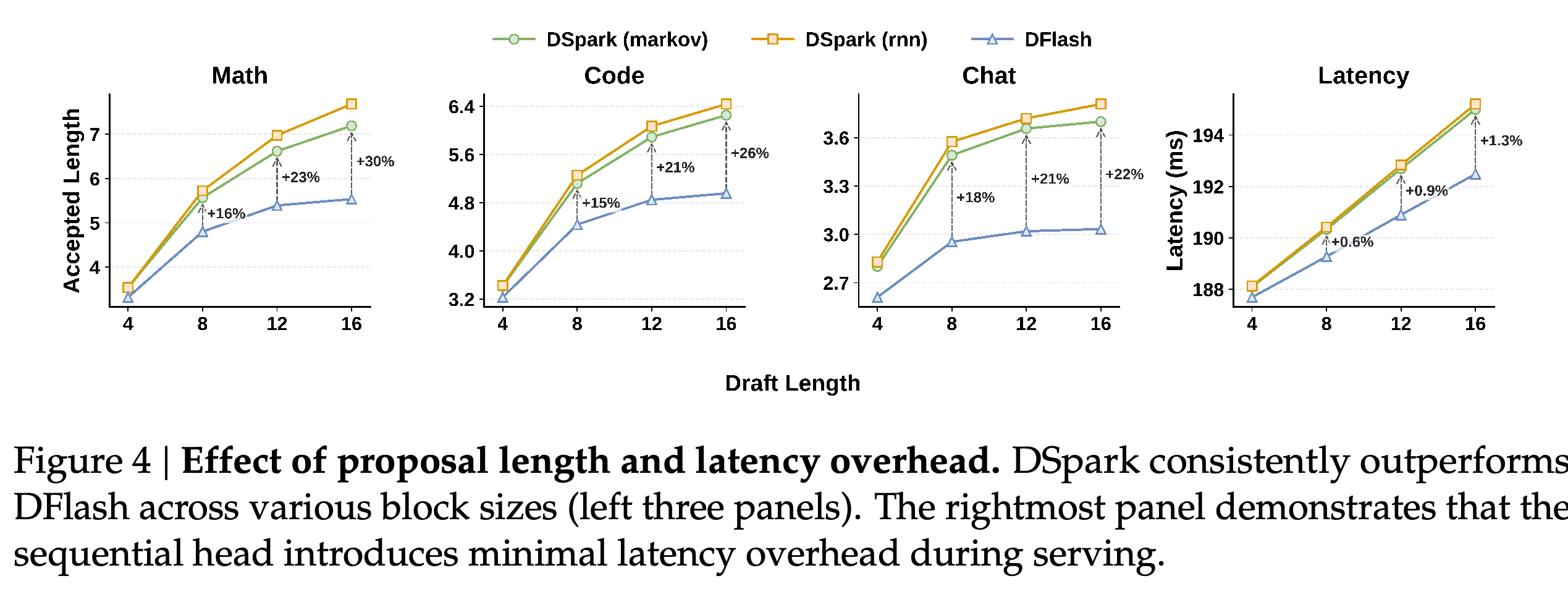
- DSpark: Confidence-Scheduled Speculative Decoding with Semi-Autoregressive Generation combines a parallel draft backbone with a lightweight sequential correction conditioned on preceding sampled tokens. This supplies locally normalized conditional probabilities for standard rejection sampling, the verification procedure that preserves the target model’s output distribution.
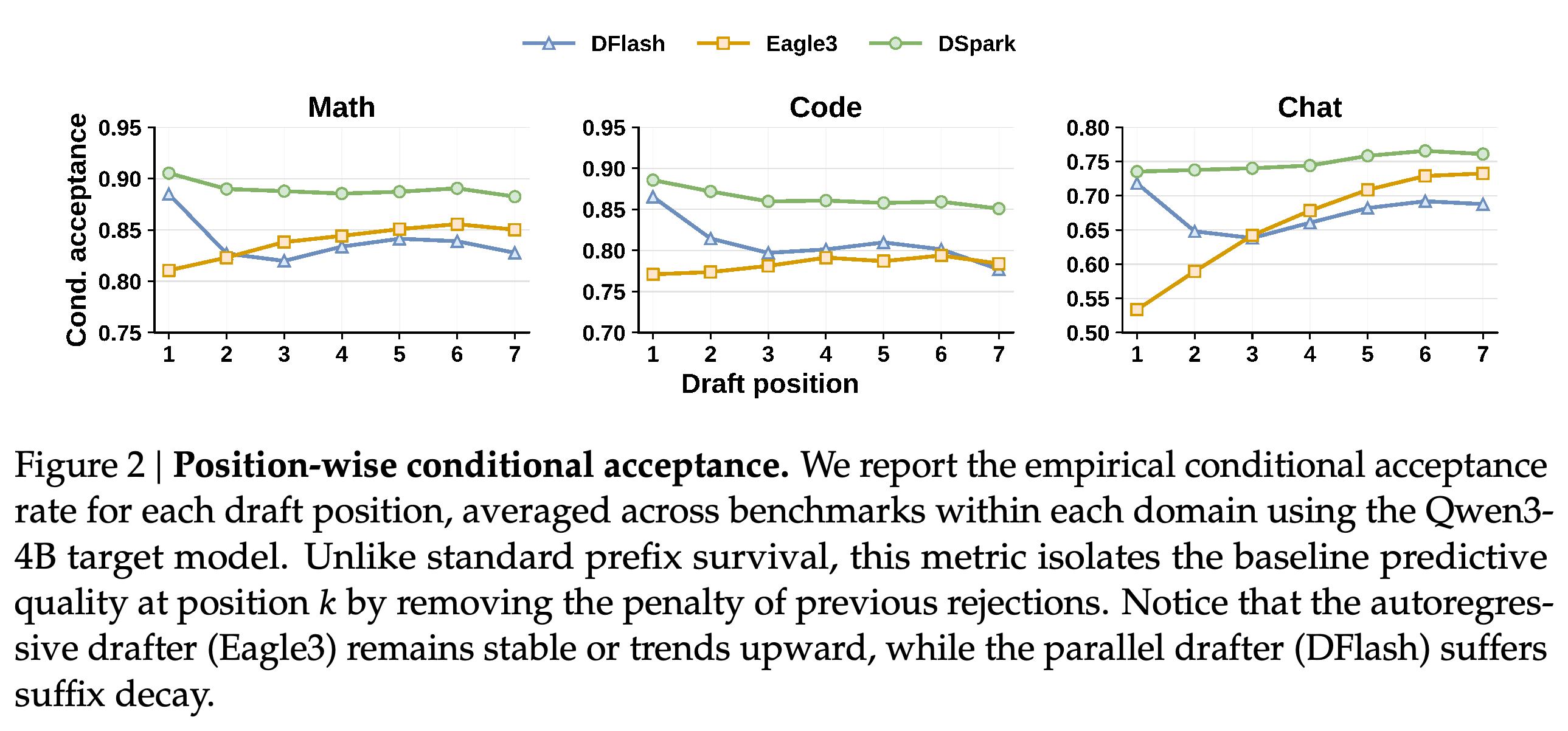
- A confidence head predicts acceptance conditional on earlier draft positions being accepted. Sequential Temperature Scaling calibrates the probability that a whole prefix survives verification, and a hardware-aware scheduler combines these estimates with a profiled engine step-rate curve. Exact target-distribution recovery requires scheduling decisions that avoid retrospective dependence on sampled continuations; the production capacity decision uses historical confidence information.
- With confidence scheduling disabled, DSpark increases macro-average accepted length over Eagle3 by 30.9%, 26.7%, and 30.0% on Qwen3-4B, 8B, and 14B. These non-thinking offline tests use sampling temperature 1.0 and a proposal horizon of 7; accepted length includes the target-generated bonus token. The comparison measures draft quality rather than serving speed.
Sources
[1] Metacognition in LLMs: Foundations, Progress, and Opportunities
[3] DSpark: Confidence-Scheduled Speculative Decoding with Semi-Autoregressive Generation