


Speed, Quality, and the Optimal Timing of Complex Decisions: Field Evidence | Summary
26 Jan 2022 | Paper Review Decision Making Response Times Drift-Diffusion ModelContents
This article explains the key points of Speed, Quality, and the Optimal Timing of Complex Decisions: Field Evidence.
- 2022-01-26 (arXiv)
- Sunde, Uwe, Zegners, Dainis, Strittmatter, Anthony.
- LMU Munich, CEPR, Ifo, IZA, Rotterdam School of Management, Erasmus University, CREST-ENSAE, Paris, CESifo
- Paper
- Reviewed version: arXiv v1, 2022-01-26.
Summary
- The paper asks how decision time relates to decision quality when experts choose how long to deliberate under time pressure. In professional chess, faster moves were more likely than slower moves to match a chess engine’s preferred move, including in regressions controlling for remaining time and measured position difficulty.
- The authors analyze 80,359 moves from 1,592 games, using Stockfish 14 at a search depth of 24 moves to benchmark quality and construct difficulty measures. In the joint specification, an additional minute spent on a move is associated with a 1.64 percentage-point lower probability of matching the engine’s preferred move.
- The association is consistent with a drift-diffusion model, in which noisy evidence accumulates until a decision threshold is reached. The observational design does not establish that making a player decide faster would improve the move.
1 Introduction
Longer deliberation can provide more information, but difficult or uncertain choices may also take longer and produce worse decisions. The paper uses repeated decisions by professional chess players to examine these explanations in a setting with measurable time pressure and position characteristics.
2 Empirical Implementation
The empirical approach first examines factors associated with decision time, then relates decision quality to time and the same factors. Repeated moves allow comparisons within a player’s game while accounting for the position and move number.
2.1 Conceptual Considerations
Remaining time proxies the cost of deliberation: time spent now leaves less for later moves. Position complexity and the evaluation gap between the engine’s best and second-best moves proxy two aspects of difficulty; a smaller gap is treated as greater uncertainty about the best move.
2.2 Data and Measurement
The chess24.com data cover 54 single round-robin tournaments in 2014–2017, with at least two hours of thinking time per player. Both players had an ELO rating, a measure of relative playing strength, of at least 2,500; the first 15 moves per player and games with likely erroneous timing data were excluded.
Stockfish 14 uses Alpha-Beta search, which prunes dominated branches of the game tree, and a neural network to evaluate positions; its recommended move is a benchmark rather than a guaranteed absolute optimum. The main quality measure indicates whether the player chose that move, while complexity is measured by millions of searched nodes and the alternative quality measure uses the evaluation difference in pawn units, where one unit approximates the advantage of an extra pawn.
3 Empirical Results
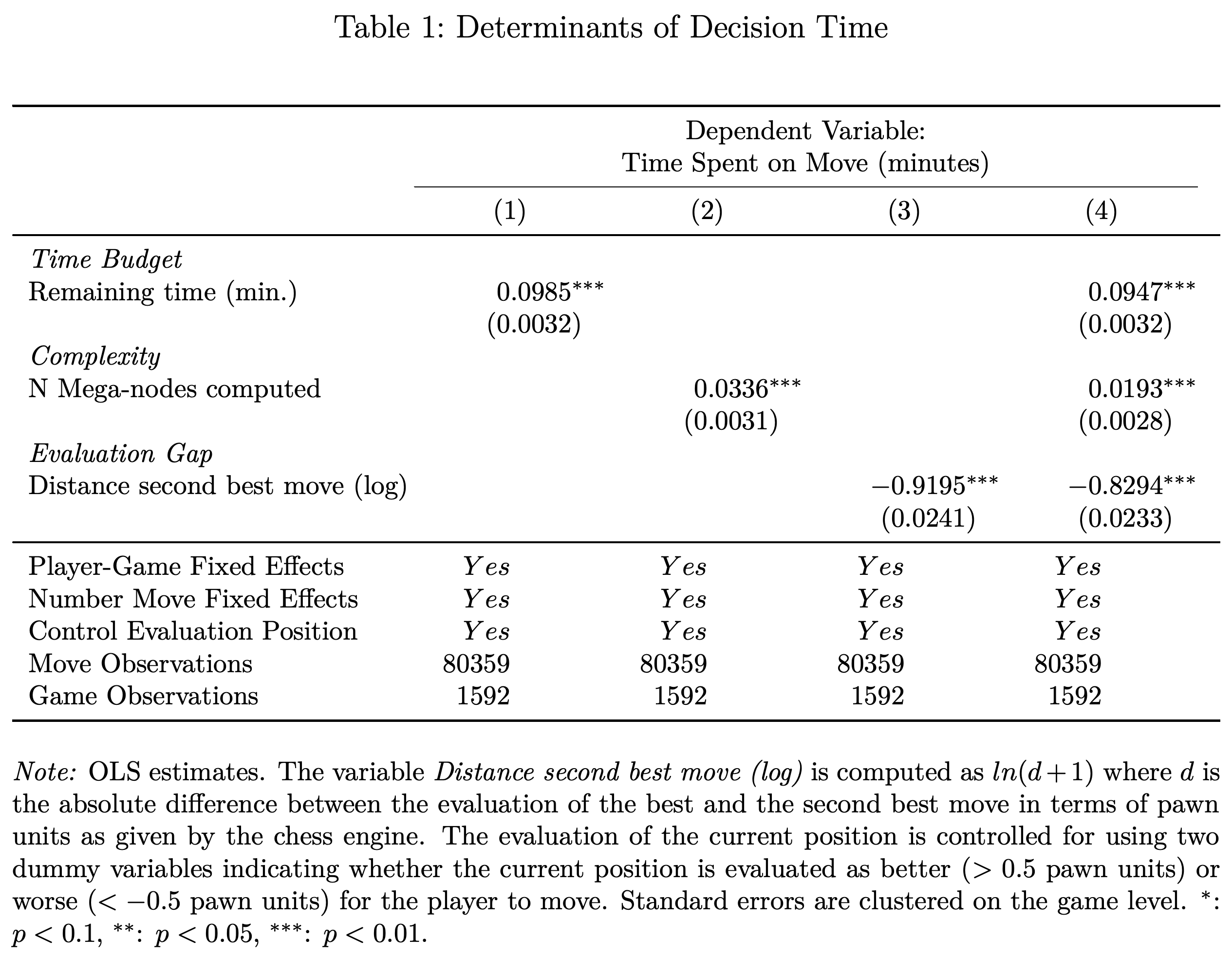
Ordinary least squares (OLS) regressions include player-game and move-number fixed effects, which account for differences across player-game pairs and move numbers, controls for position evaluation, and standard errors clustered by game. In Table 1’s joint specification, each additional minute of remaining time is associated with 0.0947 minutes more spent on the move; each additional mega-node is associated with 0.0193 minutes more, while the coefficient on the log evaluation gap is −0.8294.
The joint regression shows longer move times with more remaining time and more searched nodes, and shorter times when the best and second-best moves have a larger evaluation gap.
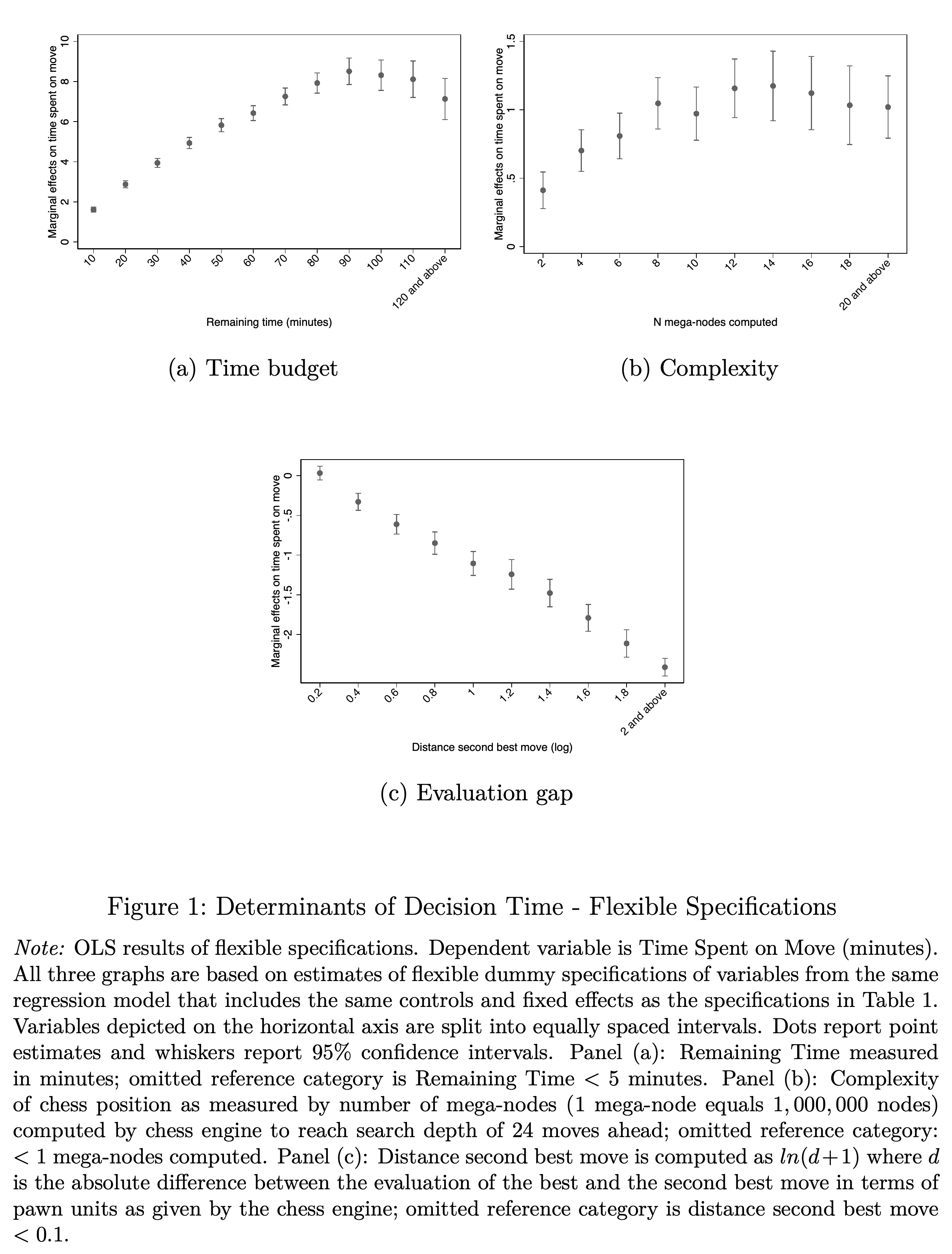
The interval estimates show that move time rises with remaining time and generally rises with search complexity, while it falls as the evaluation gap grows; whiskers show 95% confidence intervals.
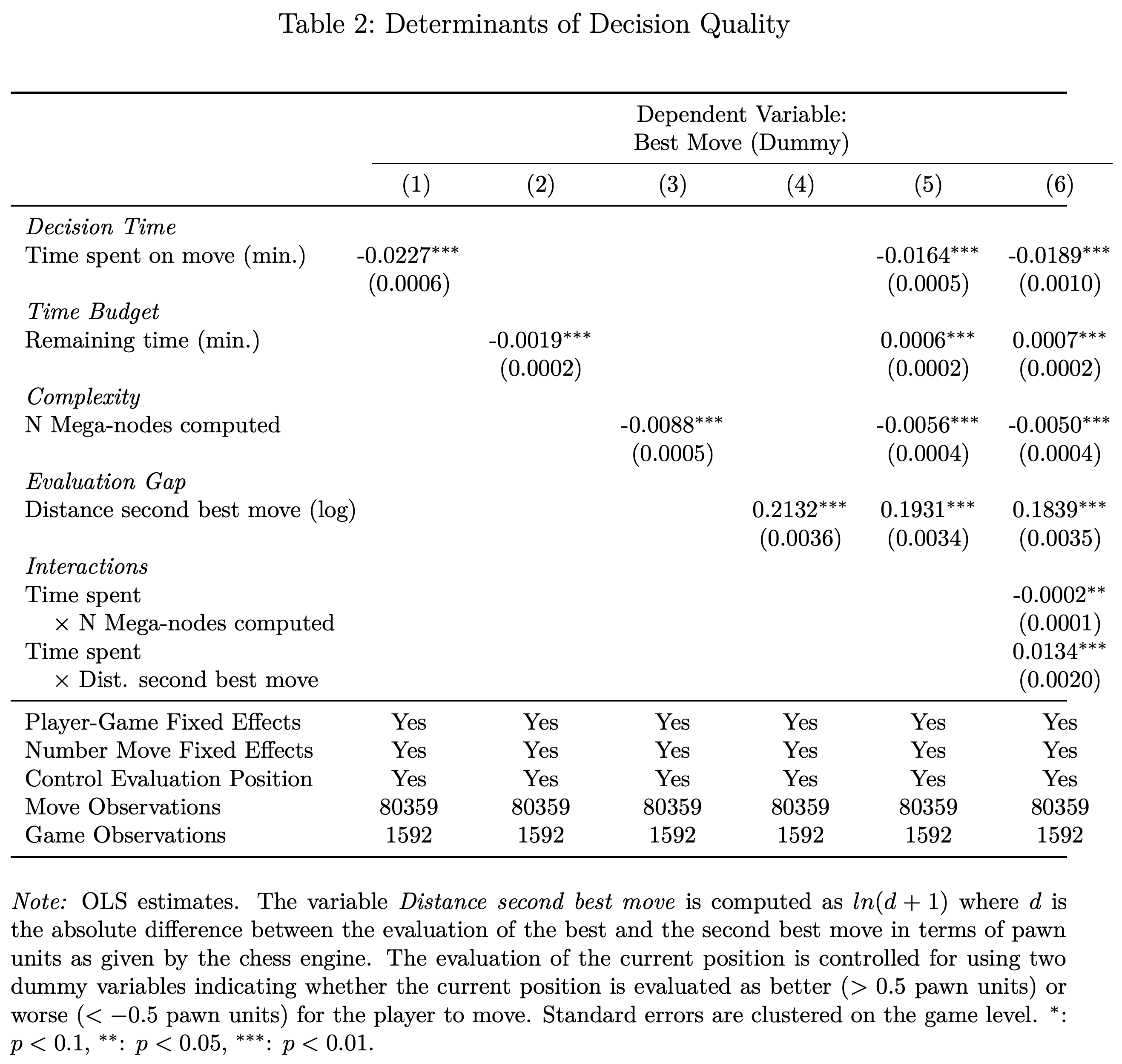
In Table 2, the coefficient on time spent is −0.0227 without the other three proxies and −0.0164 with them, both with p < 0.01. The remaining-time coefficient is −0.0019 in its separate specification and 0.0006 in the joint specification; conditional on decision time, greater complexity and a smaller evaluation gap are associated with a lower probability of choosing the engine’s preferred move.
The negative coefficient on move time remains after the three proxies are added, while the remaining-time coefficient changes sign between its separate and joint specifications. The interaction specification also reports significant interactions with complexity and the evaluation gap.
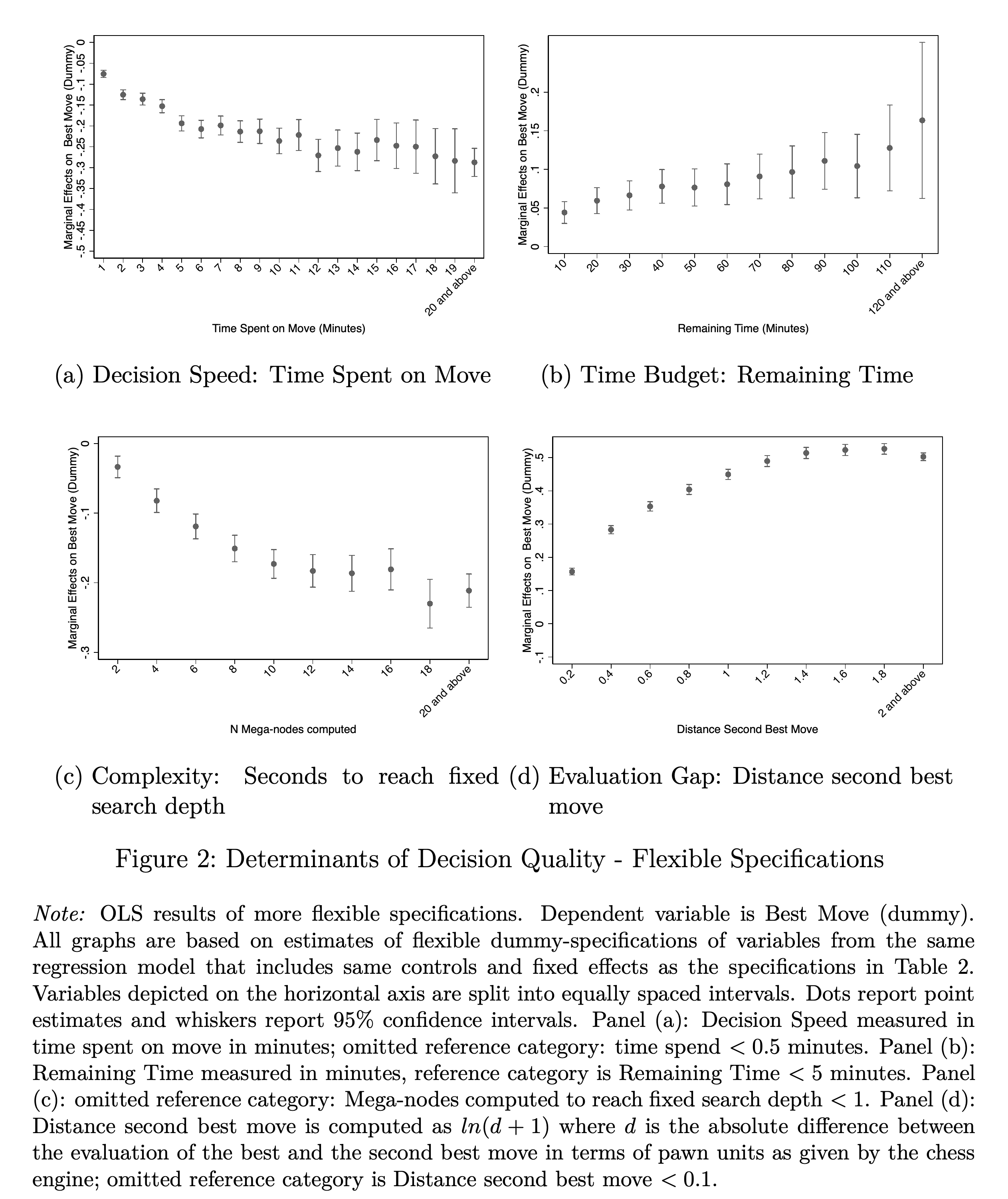
The flexible estimates show a declining probability of matching the engine’s preferred move as move time and complexity rise, and a higher probability as remaining time and the evaluation gap rise, relative to the stated reference categories.
The main time and quality associations persist with alternative proxies, controls for previous moves, and a continuous measure of move quality. However, the interaction coefficients for decision time with complexity and the evaluation gap reverse signs under the continuous quality measure, limiting the robustness of those interaction findings.
4 Discussion
The authors interpret the results through a drift-diffusion account with uncertain evaluations: more deliberation can add information, while strong signals and faster recognition can select better decisions into earlier stopping. The observed associations fit that account but do not uniquely identify its cognitive mechanisms.
Appendix
- Appendix with Supplementary Material For Online Publication and Additional Tables lists tournaments and descriptive statistics, then reports robustness checks using alternative difficulty and time-pressure measures, prior moves, and continuous move quality. The baseline sample’s mean move time is 2.712 minutes and 56.5% of moves match Stockfish’s preferred move.
Brief Thoughts
The engine benchmark and repeated observations make the study’s comparisons concrete, but the sample consists of highly rated chess players under particular tournament conditions. Because decision time is chosen by players and difficulty is measured through proxies, the estimates are associations rather than a causal effect of forcing faster decisions; the paper also leaves individual heterogeneity and strategic interaction for further study.