


Trusted Machine Learning Models Unlock Private Inference for Problems Currently Infeasible with Cryptography | Summary
15 Jan 2025 | Paper Review Private Inference Information Flow Control Trusted Execution EnvironmentsContents
This article explains the key points of Trusted Machine Learning Models Unlock Private Inference for Problems Currently Infeasible with Cryptography.
- 2025-01-15 (arXiv)
- Shumailov, Ilia, Ramage, Daniel, Meiklejohn, Sarah, Kairouz, Peter, Hartmann, Florian, Balle, Borja, Bagdasarian, Eugene.
- Google DeepMind, Google Research, Google
- Paper
Summary
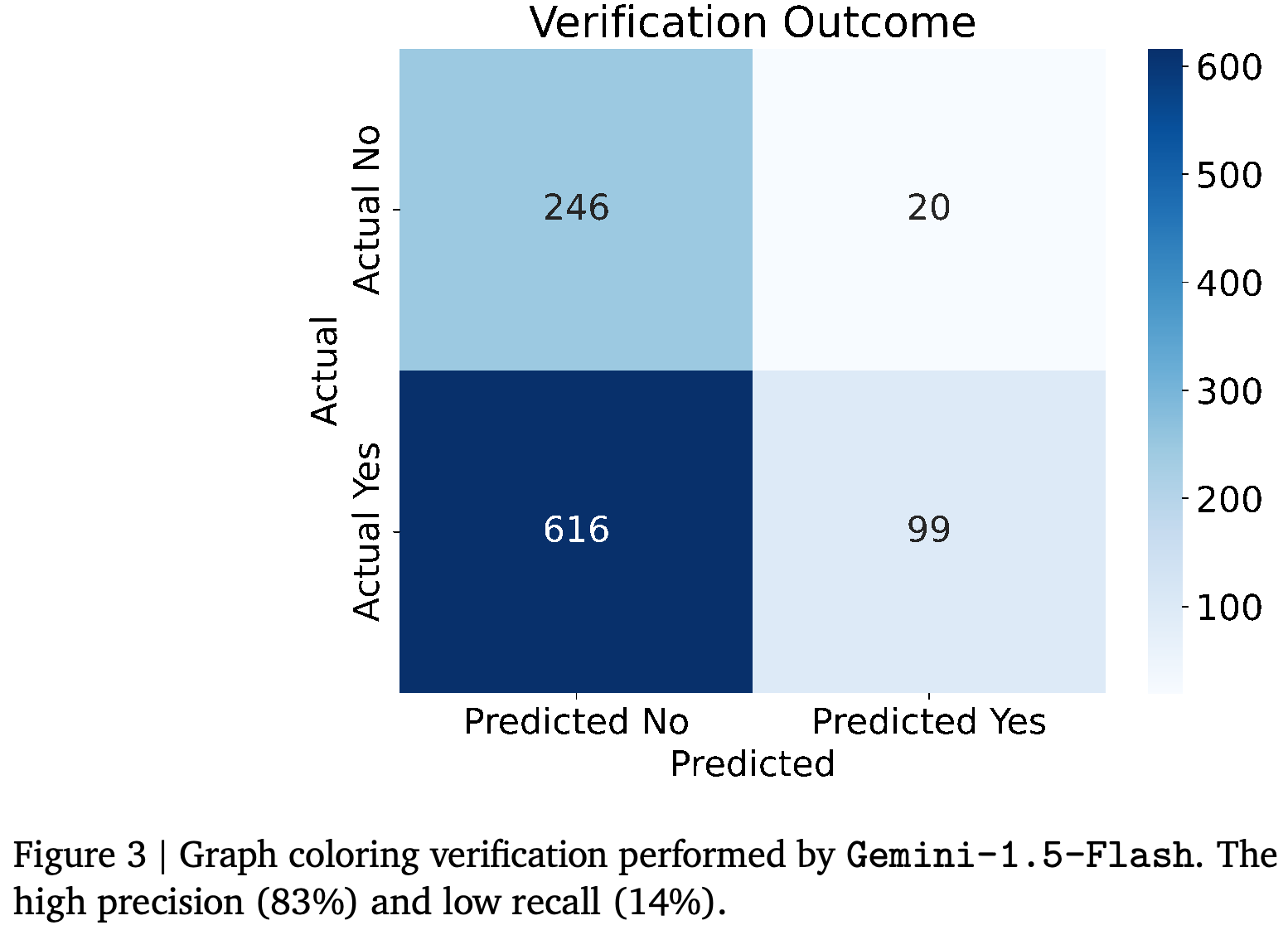
- The paper asks how mutually distrustful parties can compute over private data, including free-form text, while limiting what information is released. Its sole quantitative experiment finds that the language model Gemini-1.5-Flash achieves only 35% accuracy against ground-truth validity labels when directly checking graph colorings, assignments of colors to nodes that must give adjacent nodes different colors.
- The proposed Trusted Capable Model Environment (TCME) makes a capable model a trusted intermediary through statelessness, meaning no private-data-dependent state persists between computations, and information flow control, meaning enforced restrictions on data entering and leaving the environment. Correctness depends on model capability, while privacy depends on isolation and enforced constraints; the paper acknowledges that these requirements are currently only partially achievable.
- The contribution is a proposed architecture, a threat model specifying trusted components and security assumptions, four application scenarios, and one limited capability experiment. The authors argue that model inference could accommodate tasks that are difficult to express as cryptographic computations, but report no end-to-end implementation, measured privacy guarantee, or runtime comparison establishing that advantage.
1. What are TCMEs?
A TCME runs one or more agreed-upon models under fixed prompts and input/output constraints. In the millionaires problem, which asks which of two people has more money without disclosing their amounts, the example accepts 32-bit integers A and B and permits only ‘first’ or ‘second’ as outputs.
- The three required properties are statelessness, explicit and verifiable information flow control, and models whose capability and behavior meet the participants’ expectations.
- Participants must be able to verify the model, prompt, and constraints. The hardware example involving memory erasure, power cycling, radiographic inspection, and a Faraday cage, an enclosure used to block electromagnetic leakage, is hypothetical.
2. Trusted Capable Model Environments
The framework requires both a model that performs the agreed computation adequately and an execution environment that protects private inputs and enforces the agreed information policy. Its security therefore depends on assumptions about both components.
Formulation and threat model
As in secure multi-party computation (MPC), which lets parties jointly compute over their separately held private inputs, n parties hold x₁, …, xₙ and seek y = F(x₁, …, xₙ) for a pre-agreed function F. A TCME instead receives those inputs inside an isolated environment and uses a model M to compute the response with accuracy and efficiency acceptable to the participants.
- The trusted environment must prevent unauthorized access, preserve the model against tampering, protect intermediate computation state, enforce stateless operation, and apply the predefined information flow policy. Under these assumptions, the intended privacy protection also covers the environment’s operator.
- The threat model assumes correct, tamper-proof information flow enforcement, input sanitization that checks and restricts incoming data, output filtering, and secure communication. It also assumes initial model vetting for known vulnerabilities and backdoors, hidden mechanisms that can trigger unintended behavior, with monitoring capable of terminating execution when integrity is violated or an adversary is detected.
- Participants should agree on the model, prompt, information flow policy, and input/output constraints. A footnote permits limited discretion over which queries to run, provided transparency and participant control are maintained.
Why is this different from classical cryptographic approaches?
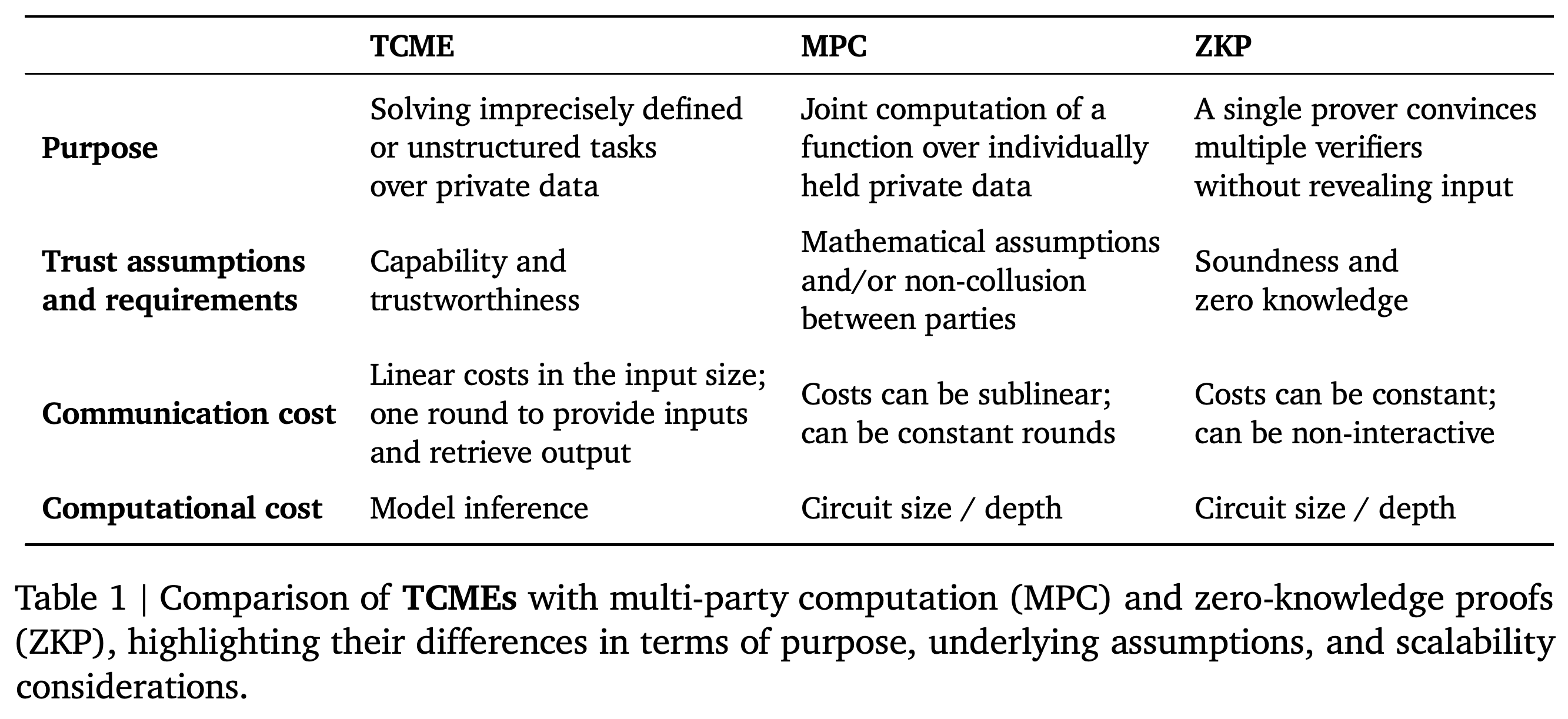
TCME correctness and privacy rely on heuristic assumptions about model behavior and its environment. Cryptographic constructions instead provide proofs under stated security assumptions; zero-knowledge proofs (ZKPs) let a prover establish a claim without revealing the private information used to support it.
- Table 1 compares purposes, trust requirements, communication costs, and computational costs. TCME communication is described as linear in input size with one input/output round, while its computation costs follow model inference.
- For small, structured computations, transmitting inputs and running inference may cost more than cryptographic methods. The proposed advantage for larger, unstructured tasks is argued from the difficulty of representing them as circuits, computations expressed through connected logical gates, without a measured crossover point.
- The authors also propose combining approaches: a TCME could handle unwieldy model inference and produce circuits for portions suitable for cryptographic execution.
The comparison makes the change in trust assumptions explicit: TCME computation depends on model capability and environmental trustworthiness, whereas the cryptographic alternatives have different formal requirements. Its cost entries describe qualitative scaling properties and do not establish a measured efficiency advantage.
Why is this different from Trusted Execution Environments?
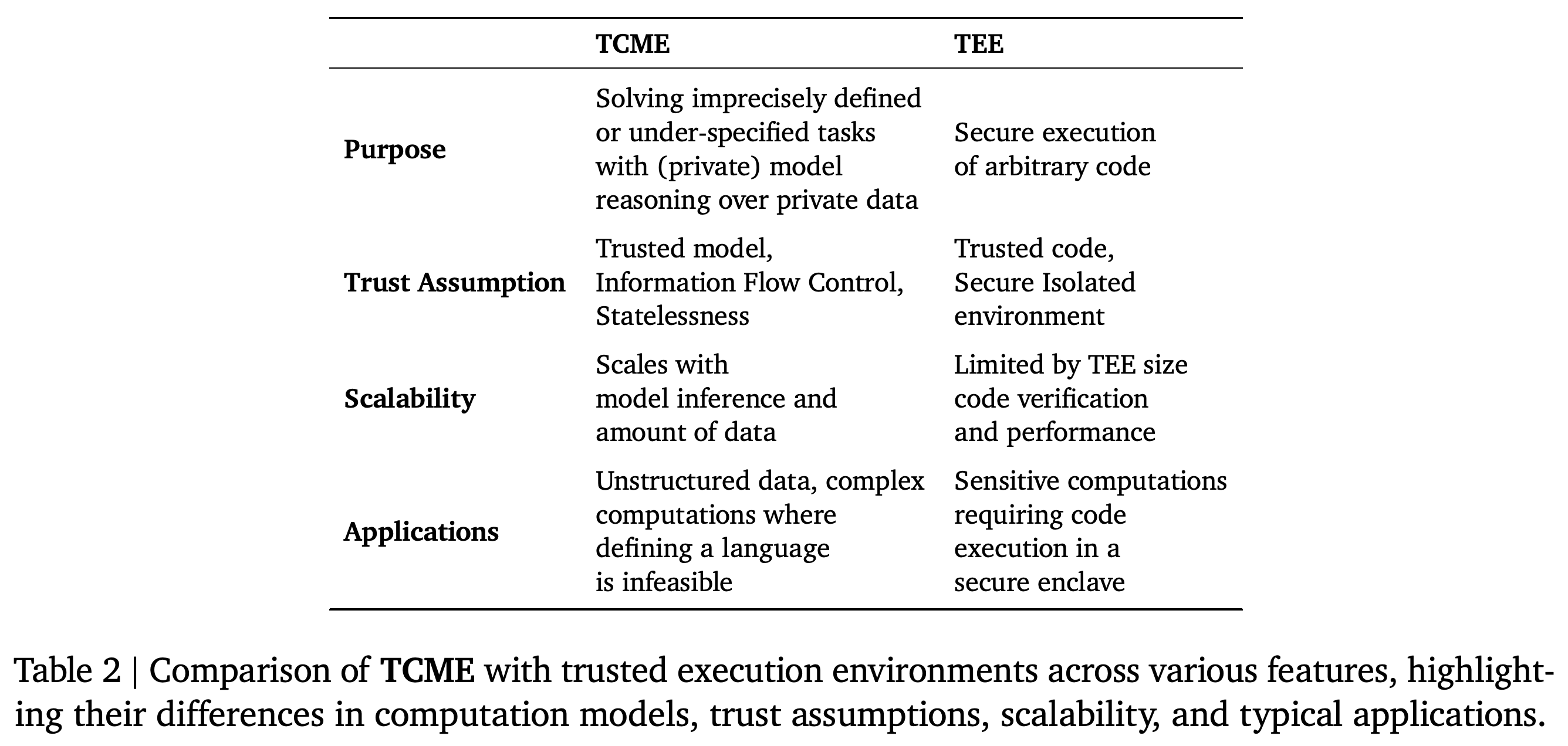
A trusted execution environment (TEE) is an isolated environment for securely executing code; a TCME adds a particular model, task constraints, statelessness, and information flow controls. The paper proposes running a TCME within a TEE, potentially executing generated code in a separate enclave, the TEE’s protected execution area.
- Table 2 distinguishes constrained model-based computation from secure arbitrary code execution. A TCME implemented inside a TEE still inherits that TEE’s trust assumptions.
- The authors argue that fully transparent attestation, verification of the deployed software and environment, requires known model weights and open infrastructure. Their later private-code auditing scenario offers a softer model-based alternative for proprietary components.
The table separates constrained model-based computation from secure execution of arbitrary code. The surrounding discussion allows a TCME to run within a TEE, so the comparison describes different purposes and requirements without establishing independent security guarantees.
3. Instantiating TCMEs
The proposed implementation requirements are an AirGap that explicitly restricts information exchange, immutable model state that prevents learning from private inputs, alignment of model behavior with users’ expectations, fine-grained restrictions on memory access and data processing, and mechanisms to verify hardware state and information flow. The authors suggest simulating these restrictions in modern TEEs or implementing them as dedicated hardware mechanisms, while acknowledging that the envisioned guarantees are not currently available in full.
3.1. Practical implementation
The practical design combines an agreed hosting arrangement, environment attestation, input validation, output filtering, encrypted communication, state reset after each computation, and fault handling. Input and output constraints may be specified using formal regular languages, precisely defined sets of permitted strings, and enforced by procedures in separate TEEs.
- No standard determines who should operate the TCME. The paper proposes a neutral host accepted by participants, supported by agreements on data handling, access control, and conflict resolution, together with monitoring and auditing.
- The authors identify enclave size, deployment complexity, and management overhead as obstacles. They also state that the H100 and H200 graphics processing unit (GPU) TEEs discussed in the paper lack the required in-memory confidentiality and statelessness mechanisms, motivating external isolation and costly practices such as power cycling.
- Fully transparent attestation can require disclosure of deployment code, proprietary libraries, and models. These are implementation limitations described by the paper, rather than measurements from a deployed TCME.
3.2. Limitations
The central limitation is that TCME privacy and correctness guarantees are heuristic and weaker than formal cryptographic guarantees. Imprecise natural-language tasks may not map cleanly to a mathematical function, limiting proofs of completeness and soundness, whether correct results are accepted and incorrect results are rejected.
- Model trustworthiness remains an assumption: bias, unintended behavior, vulnerabilities, and adversarial inputs can undermine the intended computation. Open models permit inspection but also allow attackers to construct adversarial examples, inputs designed to induce errors, offline.
- Scaling to multiple parties and diverse data types requires investigation of communication, computation, and privacy overheads.
- Side channels, information leakage through timing, power consumption, or electromagnetic signals, can bypass intended output restrictions. The paper identifies this risk without evaluating a defense.
4. Examples
The four examples propose constrained inference over sensitive project descriptions, code, databases, and camera recordings. They specify participants, inputs, and permitted outputs, but provide no application-level measurements of accuracy, leakage, or cost.
4.1. Practical Example 1: Multi-agent non-competition
Research groups could submit confidential descriptions of ongoing projects and learn whether their work overlaps through a single Boolean output, a true/false answer. The task requires interpreting unstructured descriptions at different levels of abstraction while withholding the underlying ideas.
- Encrypted knowledge bases would be decrypted inside a shared environment, where models seek a common answer or terminate communication if agreement cannot be reached.
- The proposal uses locally hosted third-party models and a separate TEE to enforce output constraints.
4.2. Practical Example 2: Audit for confidentiality violations
A regulator and business owner could agree on a model and prompt that inspect system code and database access for unsafe handling of personally identifiable information (PII), the private user data discussed in the example. Inputs would prohibit state-changing operations, outputs would be restricted to “YES” and “NO”, and both parties would be notified when a violation is detected.
- The example prompt asks for “YES” only when storage of private user data would endanger customers after a compromise. The intended disclosure is the audit judgment, while the inspected business material remains confidential.
4.3. Practical Example 3: Damage to business property
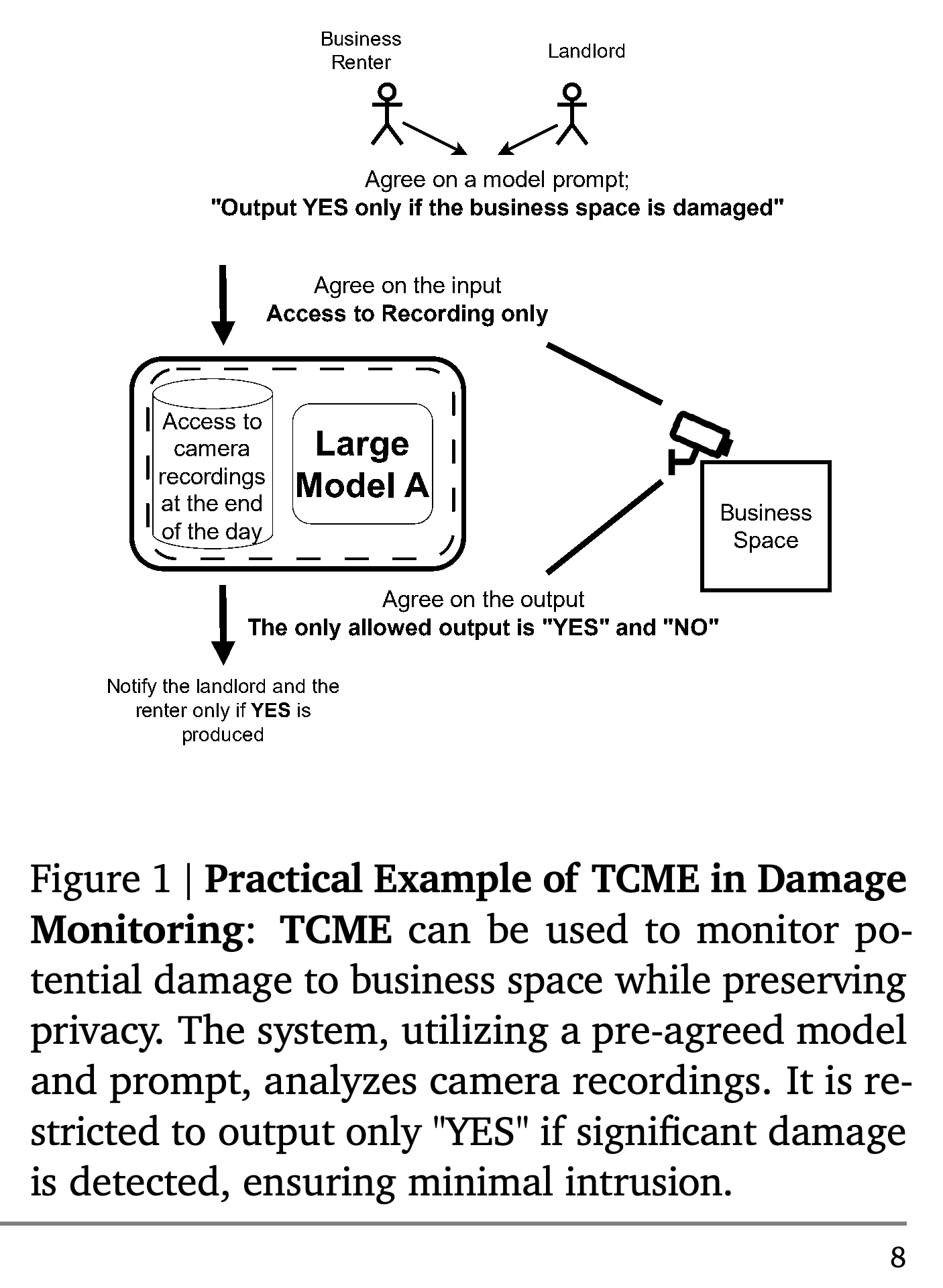
A landlord and business renter could agree on a model that examines camera recordings at the end of the day and reports whether significant property damage occurred. Access is limited to those recordings, outputs are restricted to “YES” and “NO”, and notifications are sent to both parties only when the output is “YES”.
- Figure 1 illustrates the intended separation between sensitive recordings and the released damage judgment. The example does not measure damage-detection accuracy or test leakage prevention.
The arrows show the landlord and renter agreeing on the prompt, recording access, and permitted outputs before inference. The intended released information is a damage judgment and a notification when damage is detected; the diagram does not validate detection reliability or leakage prevention.
4.4. Practical Example 4: Private Code Auditor in TEE Attestation
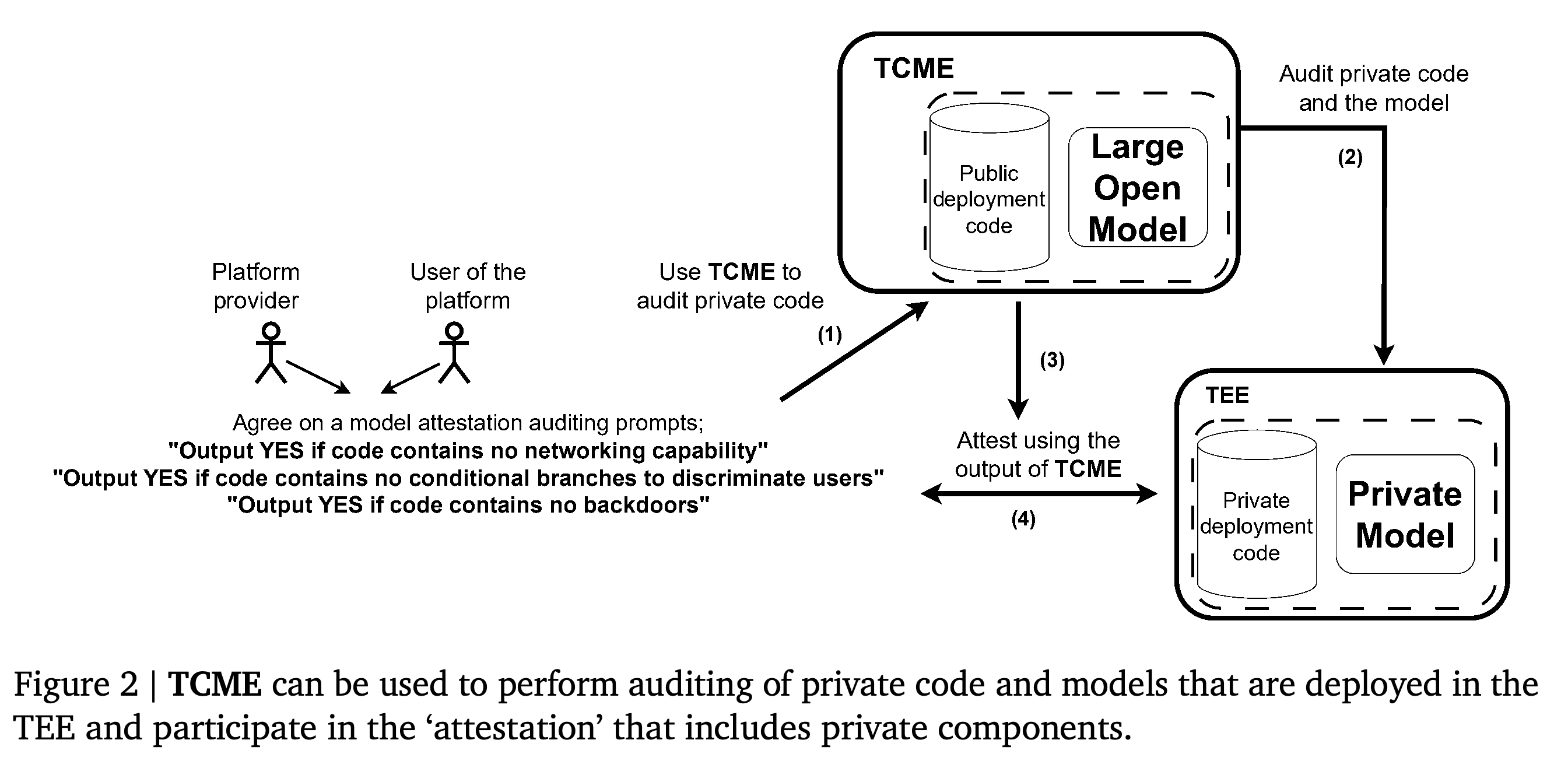
A public model inside a TCME could audit proprietary code and models involved in TEE attestation without releasing those private components. The user and provider would agree on checks, such as the absence of networking capability, discriminatory conditional branches, or backdoors, and use the audit result as part of attestation.
- Figure 2 distinguishes the TCME containing public deployment code and an open model from the target TEE containing private deployment code and a private model.
- The authors describe the resulting assurance as a soft guarantee. Detection reliability for the listed violations is not evaluated.
A public model and public deployment code form the auditing TCME, which examines a separate TEE containing private code and a private model. The audit output contributes to attestation under agreed checks, while the correctness of that audit remains dependent on the model.
5. Understanding the Trade-Off with Cryptography
The trade-off discussion uses customer age-range overlap and graph-coloring verification to examine where conventional cryptography remains suitable. It combines a qualitative cost argument with a model-capability experiment, without benchmarking complete private-computation systems.
5.1. Comparing with MPC
Two companies can represent targeted age ranges as binary vectors and count shared ranges using corresponding AND gates, which identify ranges selected by both companies, followed by summation. With five possible ranges, targeting 18-24 and 25-34 is represented as [1,1,0,0,0].
- The cryptographic example uses garbled circuits, circuits whose gate tables and inputs are encrypted, and oblivious transfer, which supplies input-associated keys without revealing the recipient’s input vector. The second company evaluates the circuit and decrypts the overlap count using an output key supplied by the first.
- The TCME alternative fixes a model and prompt, accepts an integer list of ages, and permits only a float, a floating-point number, representing overlap. The paper reports no accuracy or timing results for this workflow.
- The authors describe garbled-circuit communication and computation as linear in circuit and input size and expect lower costs for small circuits. They argue that finer age discretization or additional attributes could favor the TCME approach, but do not quantify that boundary.
5.2. Comparing with ZKPs
The experiment tests whether Gemini-1.5-Flash can directly verify a graph 3-coloring, an assignment using three colors in which adjacent nodes must have different colors. The authors report sampling 1,000 random graphs with 5–25 nodes and edge probability 0.1, supplying adjacency matrices, tables indicating which nodes are connected, and candidate color assignments, and requiring only “YES” or “NO” without code.
- Figure 3 contains 246 true negatives, 20 false positives, 616 false negatives, and 99 true positives. The paper reports 35% accuracy, 83% precision, the fraction of accepted colorings that are valid, and 14% recall, the fraction of valid colorings accepted.
- The displayed counts total 981 rather than the stated 1,000 sampled graphs; the paper does not explain the discrepancy. The prompt also specifies colors 1 to 3 while its example includes color 0.
- The authors observe that models more often generated correct verification code and suggest combining models with conventional computation and cryptography, but provide no quantitative code-generation comparison. Direct verification here measures capability; it does not implement a zero-knowledge protocol or evaluate privacy.
The confusion matrix shows that the model rejects 616 valid colorings while accepting 99, explaining the reported 14% recall despite 83% precision. Its four cells total 981 evaluations, leaving an unexplained difference from the 1,000 sampled graphs described in the text.
Appendix
- The supplied 12-page paper, “Trusted Machine Learning Models Unlock Private Inference for Problems Currently Infeasible with Cryptography” (arXiv:2501.08970v1, 15 Jan 2025), contains no appendix. References begin on page 11 and continue on page 12.
Brief Thoughts
The paper specifies demanding conditions for private inference: an agreed computation, verifiable isolation, state erasure, controlled outputs, and a model capable of performing the task. Its application scenarios remain proposals, and the sole quantitative experiment reveals substantial verification errors without establishing a secure, scalable implementation. The suggested combination of models and conventional computation is consistent with the weakness in direct verification, but the observation about generated verification code needs quantitative evaluation. The experiment does not establish the broader claim that models handle unstructured private computations better. Assessing that claim would require testing the proposed applications together with their privacy controls and operational costs.