


AlayaWorld: Long-Horizon and Playable Video World Generation | Summary
07 Jul 2026 | Paper Review Interactive World Models Long-Horizon Video Generation Camera ControlContents
- Summary
- 1 Introduction
- 2 Related Work
- 3 AlayaWorld
- 4 Qualitative Results
- 5 Contributions
- Brief Thoughts
This article explains the key points of AlayaWorld: Long-Horizon and Playable Video World Generation.
- 2026-07-07 (arXiv)
- AlayaWorld Team, Zhang, Kaipeng, Li, Chuanhao, Zhan, Yifan, Ge, Yongtao, Yin, Yuanyang, Tan, Jiaming, He, Kang, Fan, Liaoyuan, Liu, Ruicong, et al.
- Alaya Lab
- Paper
- Project Page
Summary
- AlayaWorld addresses four problems in playable video worlds: user control, consistency when a location is revisited, stability over long autoregressive rollouts, and interactive runtime. It describes a framework fine-tuned from LTX-2.3 rather than a world assembled from explicitly authored objects and rules.
- The design combines a rendered 3D cache with AdaLN-style camera conditioning, chunk-boundary prompt switching, compressed frame history, an error bank, and DMD-based few-step distillation. The cache and compressed history provide spatial and temporal evidence, while training with drifted histories and sampled errors targets accumulated rollout artifacts.
- The paper presents qualitative examples of camera control, prompt-driven actions, revisits, one-minute generation, and varied visual styles. It specifies 720p video at 24fps and four denoising steps per roughly one-second chunk, but reports no numerical latency, control-accuracy, or consistency results; it says complete technical details, experimental results, and the full codebase will be released in mid-July.
1 Introduction
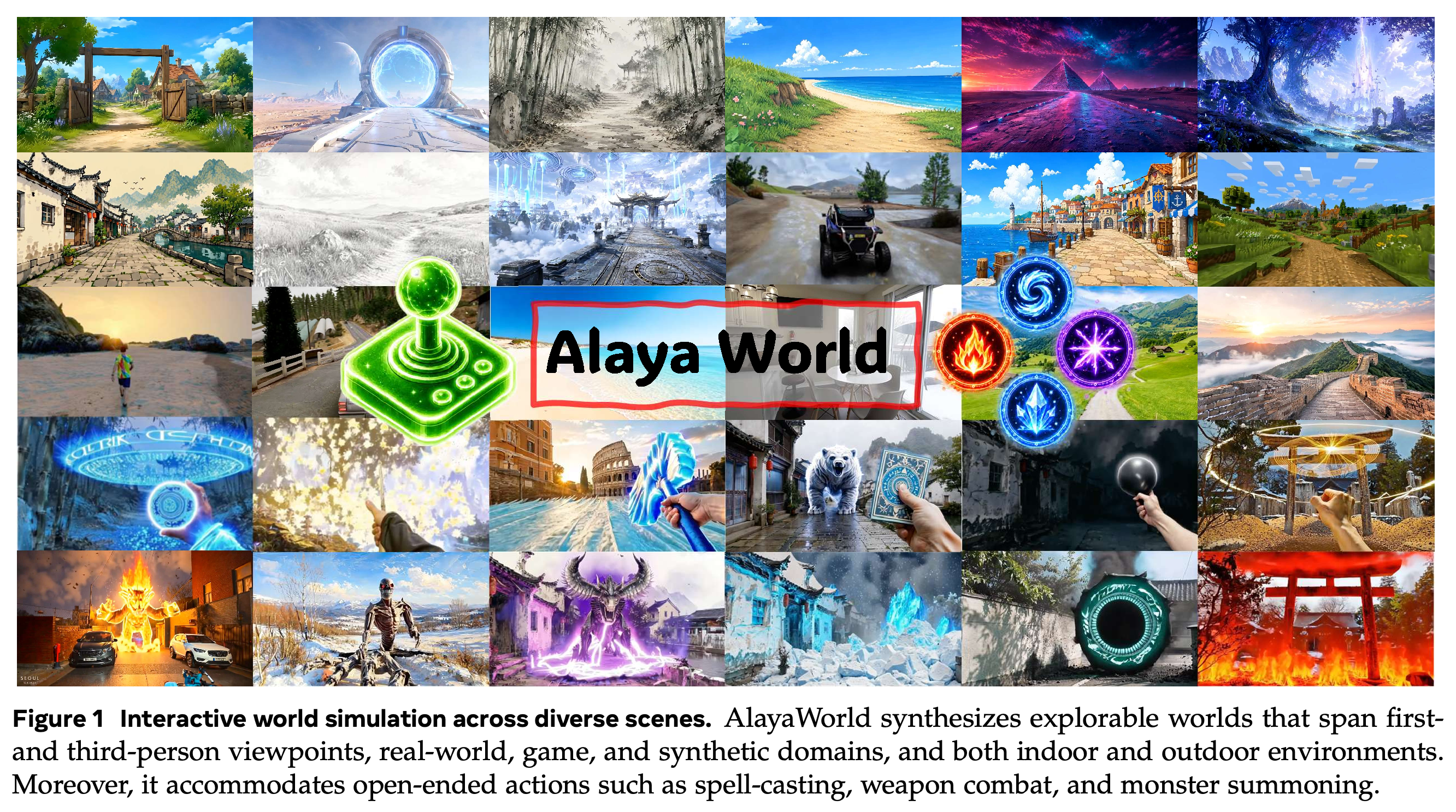
Hand-built virtual worlds require objects, animations, and interaction rules to be specified in advance. AlayaWorld instead autoregressively generates observations conditioned on user interactions, with navigation and actions demonstrated across game-like, real-world, and synthetic scenes. The project page is https://alaya-lab.github.io/AlayaWorld/.
The montage juxtaposes indoor and outdoor scenes, game-like and realistic views, and first-person effects and encounters. It establishes the range of settings and actions illustrated by AlayaWorld rather than measuring their consistency.
2 Related Work
The related-work review separates video generators used as synthesis backbones from interactive world models that respond to actions during continuing rollouts. The subsequent method review organizes the technical requirements around interaction, consistency, stability, and runtime.
2.1 Video Genration Models
Diffusion and latent-diffusion video models with DiT denoisers provide backbones for generating clips along predetermined trajectories. The paper discusses open-source examples including Open-Sora, HunyuanVideo, CogVideoX, Wan, and LTX-Video; their ability to synthesize video does not by itself provide continuing user control.
2.2 Interactive World Models
The review covers action-conditioned Genie, game-specific neural engines such as GameNGen and Oasis, and free-exploration systems such as Yume. It also discusses systems targeting streaming interaction or extended coherence, including Genie 3, Matrix-Game, Hunyuan-GameCraft, and Lingbot-World.
3 AlayaWorld
AlayaWorld is fine-tuned from LTX-2.3 and uses an autoregressive DiT with mechanisms for camera control, prompt updates, spatial and temporal memory, drift robustness, and faster sampling. This version describes their roles but does not provide a complete architecture specification or training recipe.
3.1 Interaction
The framework supports two forms of interaction: navigation changes the viewpoint, while prompt-driven actions change what happens in the generated world. Both are conditioned on a continuing video rollout.
3.1.1 Navigation
The navigation review groups prior techniques into external camera conditioning, geometry-aware transformer mechanisms, and rendered geometric evidence. Pose or action conditioning lets a generator respond to a requested trajectory, whereas rendering a geometric proxy provides image-space guidance but requires geometry estimation and cache maintenance.
Following GEN3C, AlayaWorld maintains a 3D cache and renders it from the player’s target camera, while AdaLN-style modulation injects a compact camera condition into the DiT. The rendered view supplies appearance and geometric evidence for the queried viewpoint; modulation supplies trajectory information without the heavy camera-fusion module the authors seek to avoid.
3.1.2 Prompt-driven Action
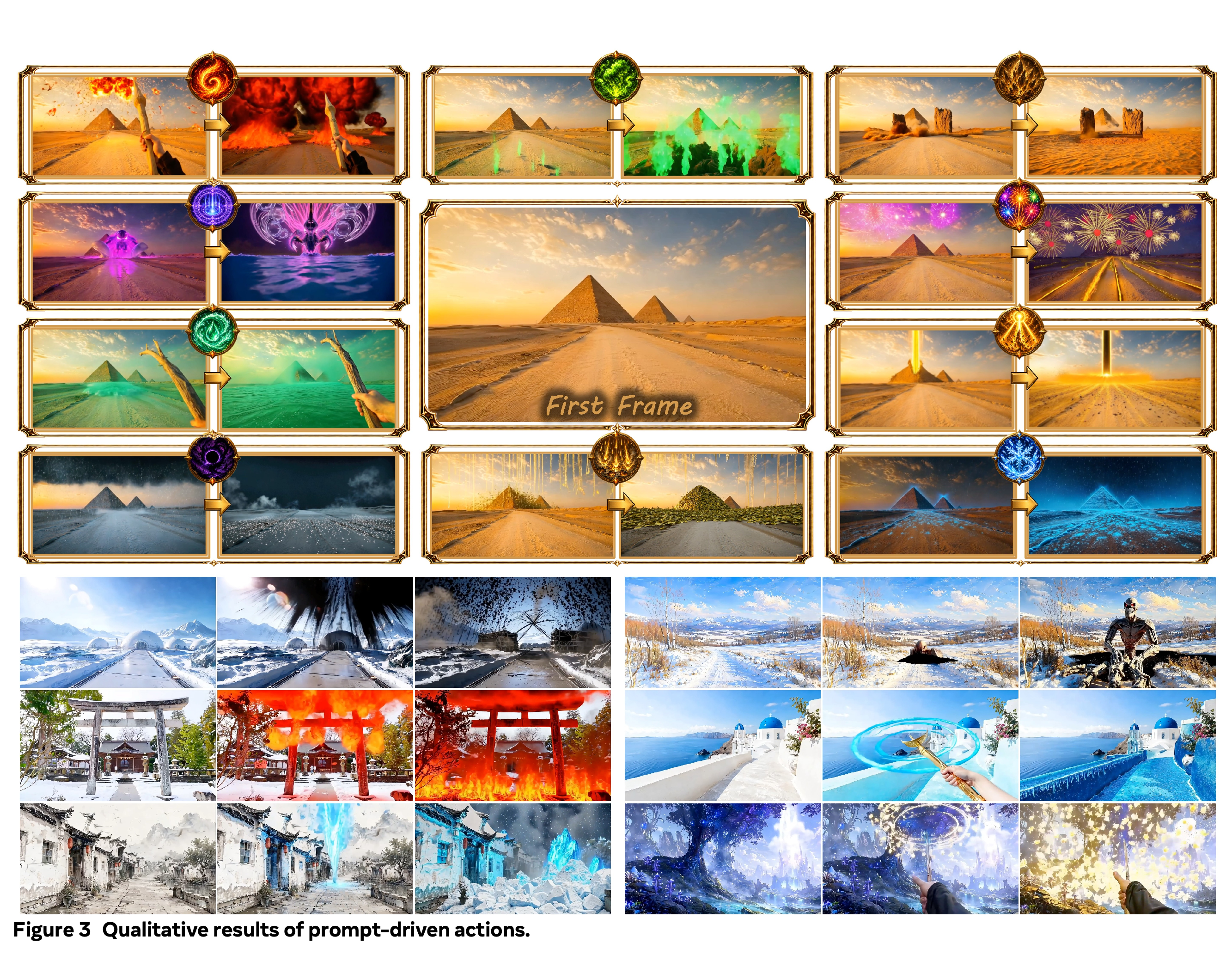
Prompt switching replaces the text condition at a chunk boundary, so an action prompt can affect the next chunk without regenerating earlier video. The paper illustrates spell-casting, weapon combat, and monster summoning, but does not specify an unrestricted action interface beyond text-condition updates.
3.2 Consistency
The paper distinguishes consistency on a leave-and-return trajectory from the absence of visual drift during forward generation: a revisited place can change even if the intervening stream looks stable. Temporally indexed memory retains or compresses observations according to rollout history, while spatially indexed memory retrieves evidence by viewpoint or geometry; the latter depends on the quality of its spatial representation.
AlayaWorld reprojects its explicit 3D cache for previously observed regions and compresses recent frames into a lightweight embedding following Frame Preservation. The cache primarily anchors static scene structure, while the embedding supplies recent motion and other temporal context that a static cache cannot represent alone.
3.3 Stability
Stability concerns degradation as an autoregressive rollout grows, whether or not a location is revisited. The review locates possible interventions in conditioning inputs, training, sampling schedules, and prediction targets, noting that inference repeatedly conditions on generated frames that may contain errors.
Following Helios, AlayaWorld trains with drifted histories and introduces an error bank of residual rollout artifacts. Samples from the bank perturb both the memory condition and the target segment, exposing the model to imperfect history and errors in subsequent generation. The paper provides no ablation isolating the effect of this joint perturbation.
3.4 Runtime
The paper distinguishes visual latency, from a generation decision to a displayed frame, from semantic latency, from a change in user intent to output that reflects it. Few-step distillation targets generation compute; frequent conditioning-update points target responsiveness to changed commands.
AlayaWorld uses DMD-based distillation, short temporal chunks, and text-condition updates at chunk boundaries. A prompt change therefore need not trigger full-sequence regeneration, but the paper reports neither measured wall-clock latency nor a runtime comparison with cache-reuse or KV-recache methods.
4 Qualitative Results
The qualitative results use an LTX-2.3-fine-tuned autoregressive model generating 720p video at 24fps. Each roughly one-second chunk uses four denoising steps; the authors state that baselines use the same input conditioning and resolution whenever their public implementations permit.
4.1 Camera Control
Figure 2 samples sequences under varied camera and action commands, with keyboard-style control icons visible in the panels. The frames illustrate viewpoint changes and translations across several scenes, but the paper reports no numerical camera-trajectory error.
Successive frames show viewpoint or movement changes across several settings, with control icons beneath the samples. The figure makes responses to navigation commands inspectable but does not compare requested and achieved camera poses numerically.

4.2 Open-ended Action
Figure 3 shows different actions and environmental effects following prompt changes during generation. The text condition is updated at a chunk boundary without regenerating earlier video; the examples do not measure the delay before the new action appears.
Action sequences surround a central initial view, and additional three-frame examples show effects emerging in other scenes. The panels illustrate varied generated actions after prompt changes, not a timed prompt-response measurement.
4.3 Consistency
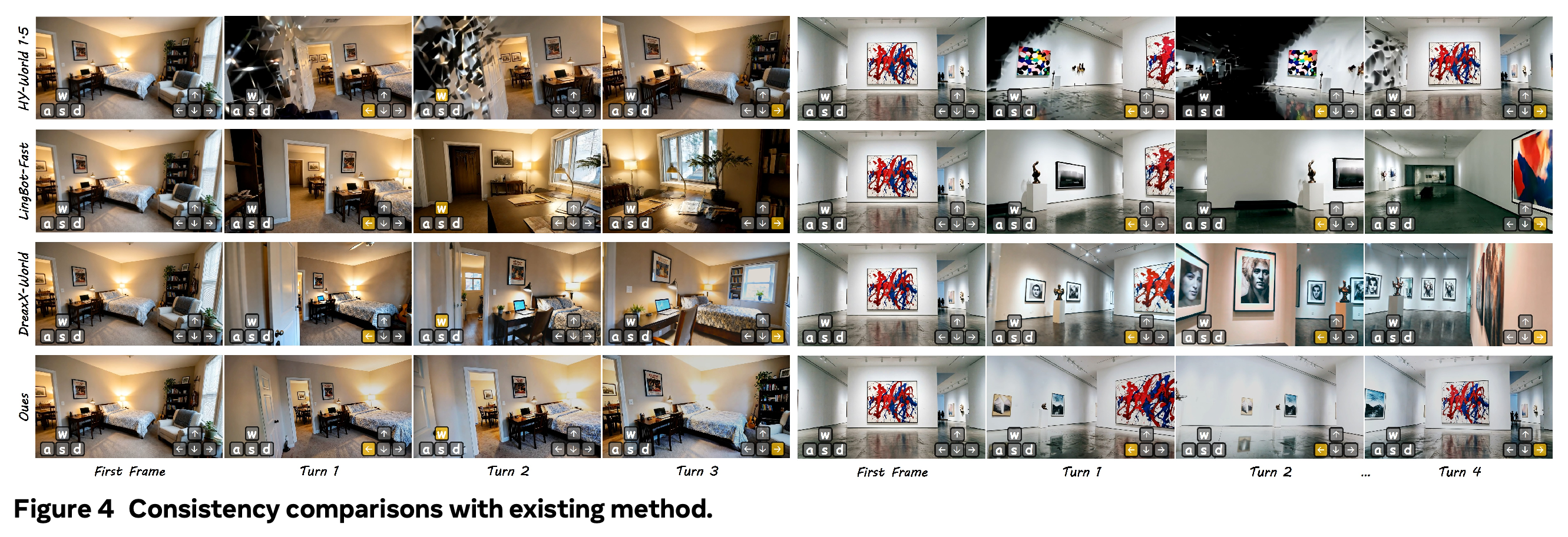
Figure 4 compares sampled leave-and-return trajectories with other interactive world models. The authors identify visual degradation, inaccurate control, and changed scene content in comparison examples, while their examples retain recognizable room and gallery features. The comparison is visual rather than a quantified loop-closure evaluation.
Rows compare initial room and gallery views with frames after successive turns. AlayaWorld's examples retain recognizable features where comparison examples show more conspicuous scene changes, making revisit consistency the focus of the visual comparison.
4.4 Long-Horizon Generation
Figure 5 samples four one-minute rollouts at 0s, 20s, 40s, and 60s. The frames allow inspection of appearance during forward generation, but the PDF supplies no drift score, longer-horizon measurement, or test of which component contributes to stability.
Four illustrated sequences contain frames labeled 0s, 20s, 40s, and 60s. These samples permit visual inspection over one minute but do not establish behavior beyond the displayed horizon.

4.5 Diverse Styles
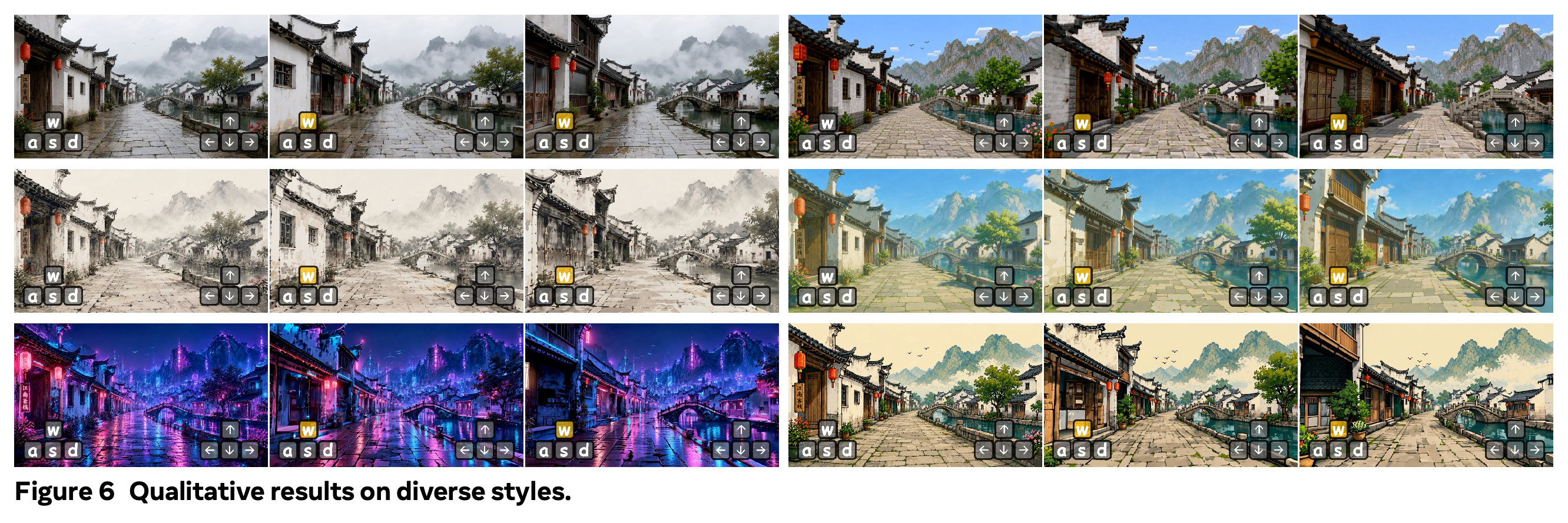
Figure 6 shows the same navigation trajectory in realistic, Minecraft, ink painting, oil painting, cyberpunk, pixel art, and Zelda-inspired styles. The aligned samples qualitatively show similar scene structure and camera movement under different rendering styles.
Aligned three-frame sequences show navigation through a similar street layout in different rendering styles. The repeated route provides a qualitative check of scene structure under changes in appearance.
5 Contributions
The contribution list names Kaipeng Zhang as Core Lead and Chuanhao Li as Lead. It credits Chuanhao Li, Kaipeng Zhang, Yifan Zhan, Yongtao Ge, and Yuanyang Yin as Core Contributors, and Jiaming Tan, Kang He, Liaoyuan Fan, Ruicong Liu, Xiaojie Xu, Xuangeng Chu, Zhen Li, Zhengyuan Lin, Zhixiang Wang, Zian Meng, and Zihui Gao as Contributors. The introduction describes a full-stack open-source project while stating that the full codebase and complete experimental results will be released in mid-July.
Brief Thoughts
The method separates spatial persistence on revisits from stability during forward generation: the 3D cache is intended to address the former, while drifted-history training and the error bank target the latter. Figures 4 and 5 illustrate these settings, but no ablation attributes the displayed behavior to individual components.
The runtime claim remains unmeasured in this version. Four denoising steps per chunk and 24fps output specify a generation configuration, not how quickly frames are computed or displayed; without measured visual or semantic latency, the figures demonstrate interaction modes rather than verify real-time performance.