


LaMDA: Language Models for Dialog Applications | Summary
20 Jan 2022 | Paper Review Language Models Supervised Fine-Tuning Tool Use LLM SafetyContents
This article explains the key points of LaMDA: Language Models for Dialog Applications.
- 2022-01-20 (arXiv)
- Thoppilan, Romal, De Freitas, Daniel, Hall, Jamie, Shazeer, Noam, Kulshreshtha, Apoorv, Cheng, Heng-Tze, Jin, Alicia, Bos, Taylor, Baker, Leslie, Du, Yu, et al.
- Paper
- Reviewed version: arXiv v3, 2022-02-10.
Summary
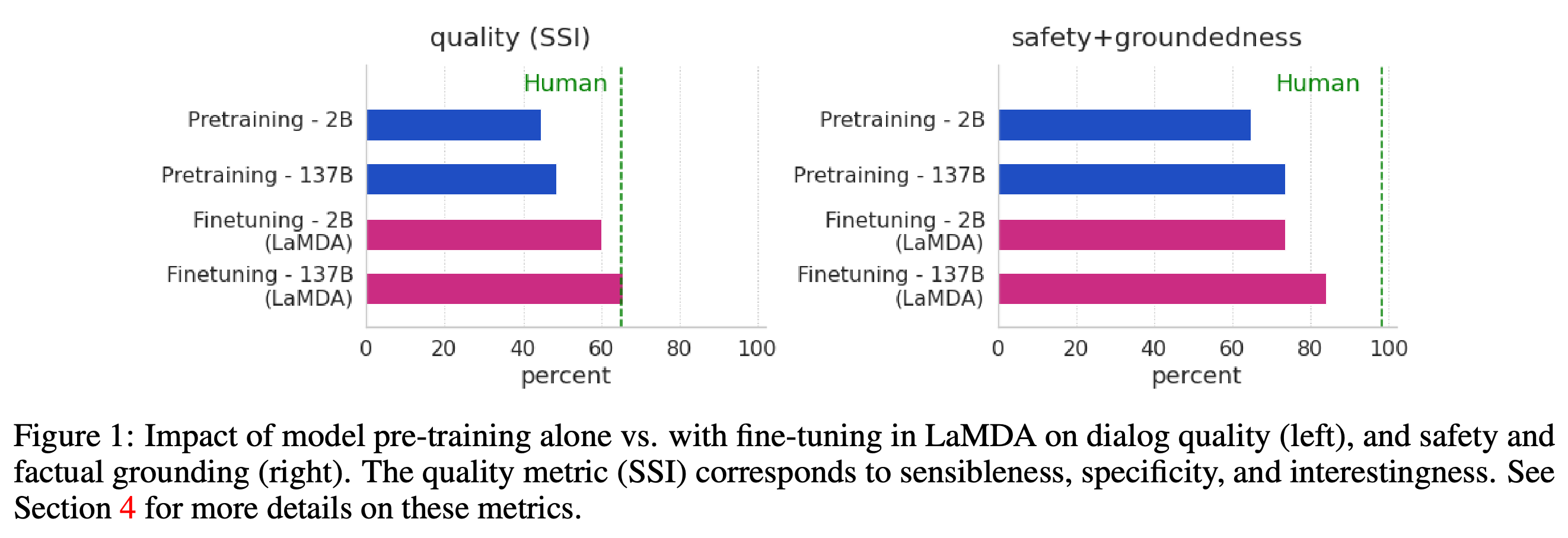
- LaMDA addresses the difficulty of producing open-ended dialog responses that are useful, safe, and supported by evidence. Compared with a 137B-parameter model trained only to predict text, the fine-tuned 137B LaMDA improved safety from 88% to 95.2% and groundedness, the share of responses with external-world claims supported by known sources, from 57.9% to 73.2%.
- The authors combine human-annotated quality and safety ratings with training to query external tools and revise responses. The resulting model approaches the measured crowdworker baseline on some quality measures, but remains below it on safety and groundedness.
- The fine-tuning and evaluation datasets are English-only; the paper documents unsupported claims, biased behavior, and failures on complex reasoning. Its safety objectives were developed for a U.S. context and do not capture every possible harm.
1 Introduction
LaMDA, Language Models for Dialog Applications, studies models from 2B to 137B parameters. A single model generates candidate responses, filters them for safety, uses external knowledge, and ranks responses for quality.
At both displayed model sizes, fine-tuning raises the combined quality score and the safety-plus-groundedness score; the latter remains below the human reference.
2 Related work
The paper connects dialog scaling and human evaluation to prior work on conversational models, safety filtering, and retrieval. Its grounding procedure revises a generated response using tool results, while the cited search-augmented dialog approach adds retrieved information to the input context before generation [45].
3 LaMDA pre-training
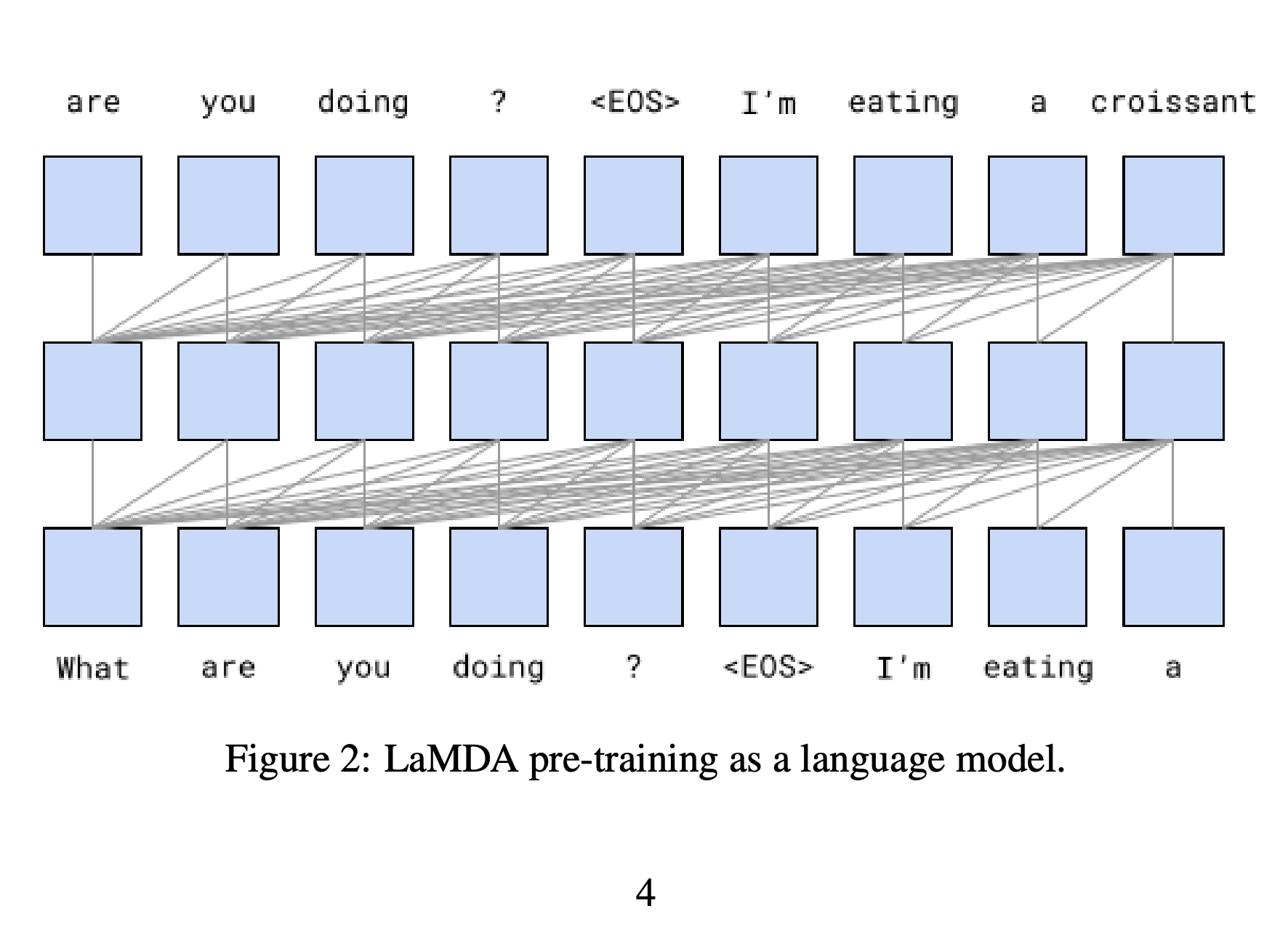
LaMDA is a decoder-only Transformer pre-trained to predict the next token on 1.56T words from public dialog and web documents. The largest model has 64 layers and 137B non-embedding parameters; it was trained on 1024 TPU-v3 chips for about 57.7 days with 256K tokens per batch.
- The corpus contains 2.97B documents, 1.12B dialogs, and 13.39B dialog utterances; over 90% is English.
- The pre-trained model samples 16 responses using top-k sampling, which restricts each token choice to the k highest-ranked options, with k = 40; it selects one using log-likelihood and length.
The shifted input and target sequences illustrate next-token prediction across a dialog boundary marked by <EOS>.
4 Metrics
The evaluation separates general dialog attributes from application-specific behavior and relies on crowdworker judgments. Separate metrics help identify weaknesses that an aggregate measure could conceal.
4.1 Foundation metrics: Quality, Safety and Groundedness
Quality averages sensibleness, specificity, and interestingness (SSI): whether a response makes sense in context, is tailored to it, and attracts attention or curiosity. Safety measures compliance with illustrative objectives; groundedness measures source support among responses making external-world claims, while informativeness uses all responses as its denominator.
- Citation accuracy measures the share of responses with explicit external-world claims that include source URLs, excluding well-known facts.
4.2 Role-specific metrics: Helpfulness and Role consistency
Helpfulness requires information judged both correct through independent research and useful to the user. Role consistency asks whether a response fits the assigned application role, rather than whether it agrees with earlier dialog turns.
5 LaMDA fine-tuning and evaluation data
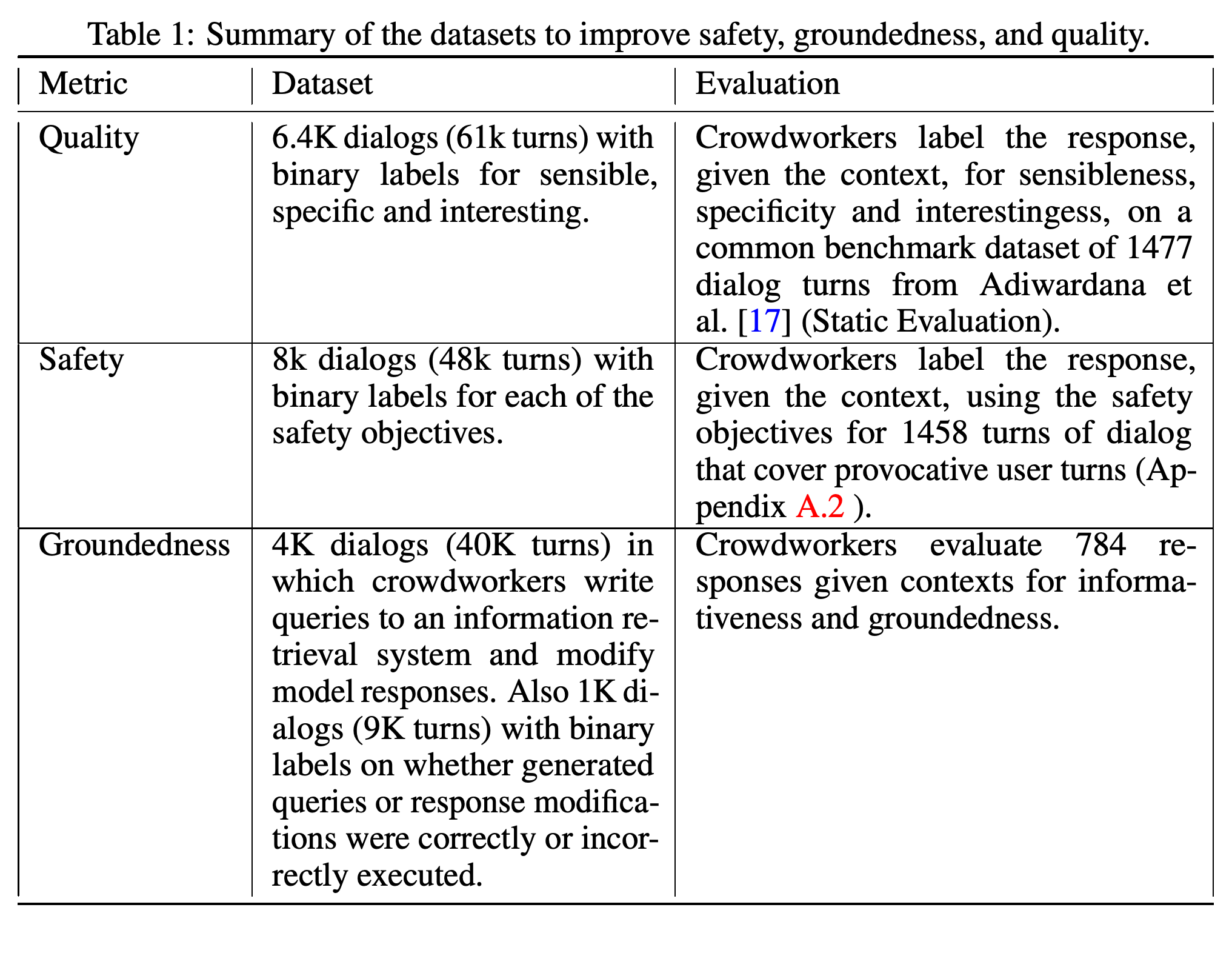
Quality evaluation uses 1,477 Mini-Turing Benchmark dialogs [17] and a majority of five raters; safety evaluation uses 1,166 held-out dialogs with 1,458 turns and a majority of three raters. Groundedness evaluation uses 784 dialog turns and three raters, and all fine-tuning and evaluation data are in English.
- The text reports 6,400 quality dialogs with 121K turns, while Table 1 lists 61K turns; the safety and grounding collections contain 8K dialogs with 48K turns and 4K dialogs with 40K turns, respectively.
6 LaMDA fine-tuning
Fine-tuning combines generative tasks, which produce responses, with discriminative tasks, which predict attributes of responses. Both are expressed as token sequences and handled by the same decoder-only model.
6.1 Discriminative and generative fine-tuning for Quality (SSI) and Safety
The model filters candidates below a safety threshold and ranks the survivors using 3 * P(sensible) + P(specific) + P(interesting). Its classifiers also filter 2.5M pre-training dialog turns to 800K turns used for generative fine-tuning.
6.2 Fine-tuning to learn to call an external information retrieval system
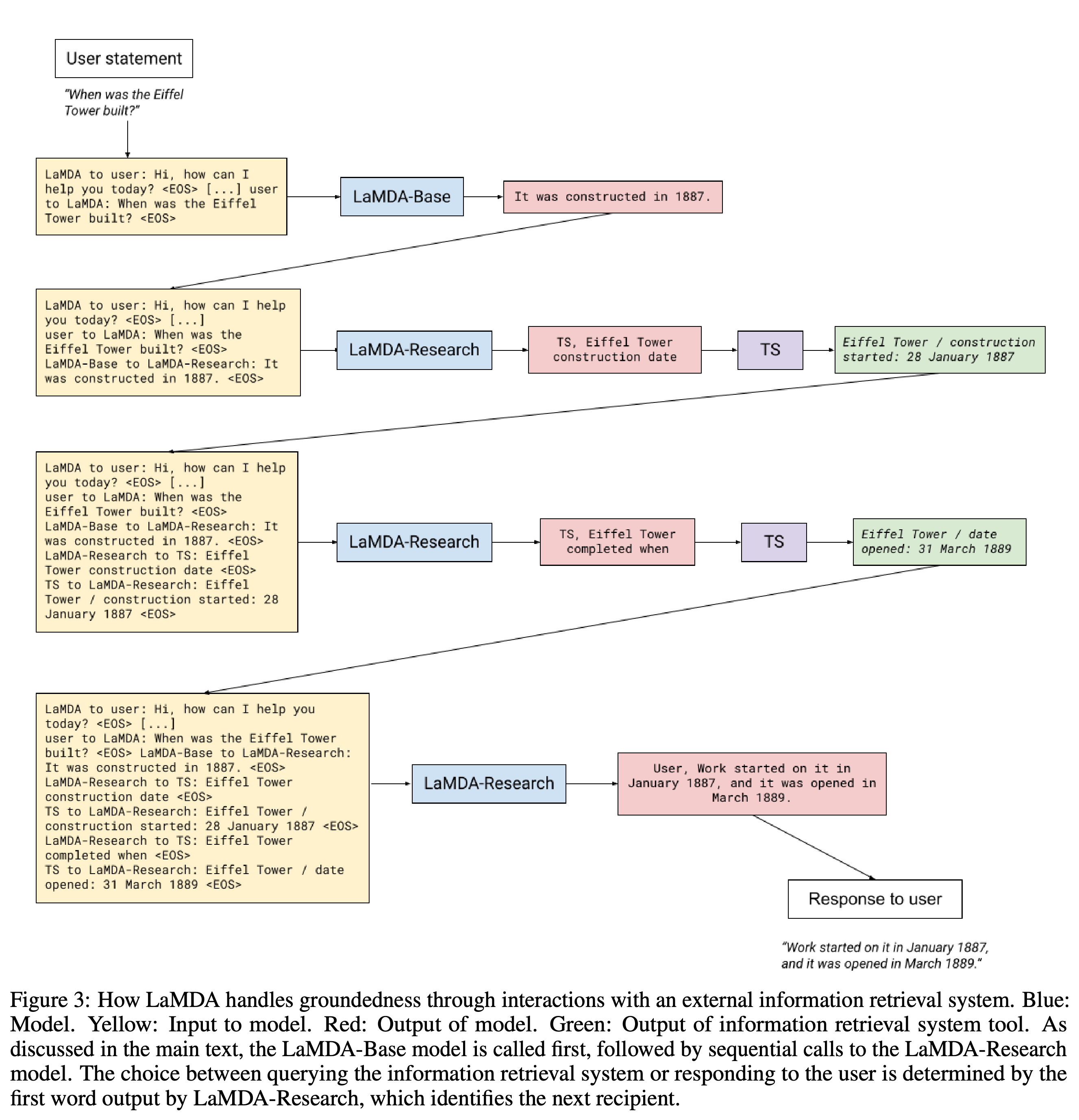
The toolset (TS) combines information retrieval, a calculator, and a translator. Using 40K annotated generative turns and 9K discriminative turns, LaMDA learns to issue a query, read returned snippets, and either issue another query or produce a revised response for the user.
- In the illustrated research loop, the first generated string directs the output to TS or the user; an inference-time maximum bounds the number of queries.
The Eiffel Tower example shows a draft followed by two tool queries, allowing the final response to distinguish construction start from opening date.
7 Results on foundation metrics
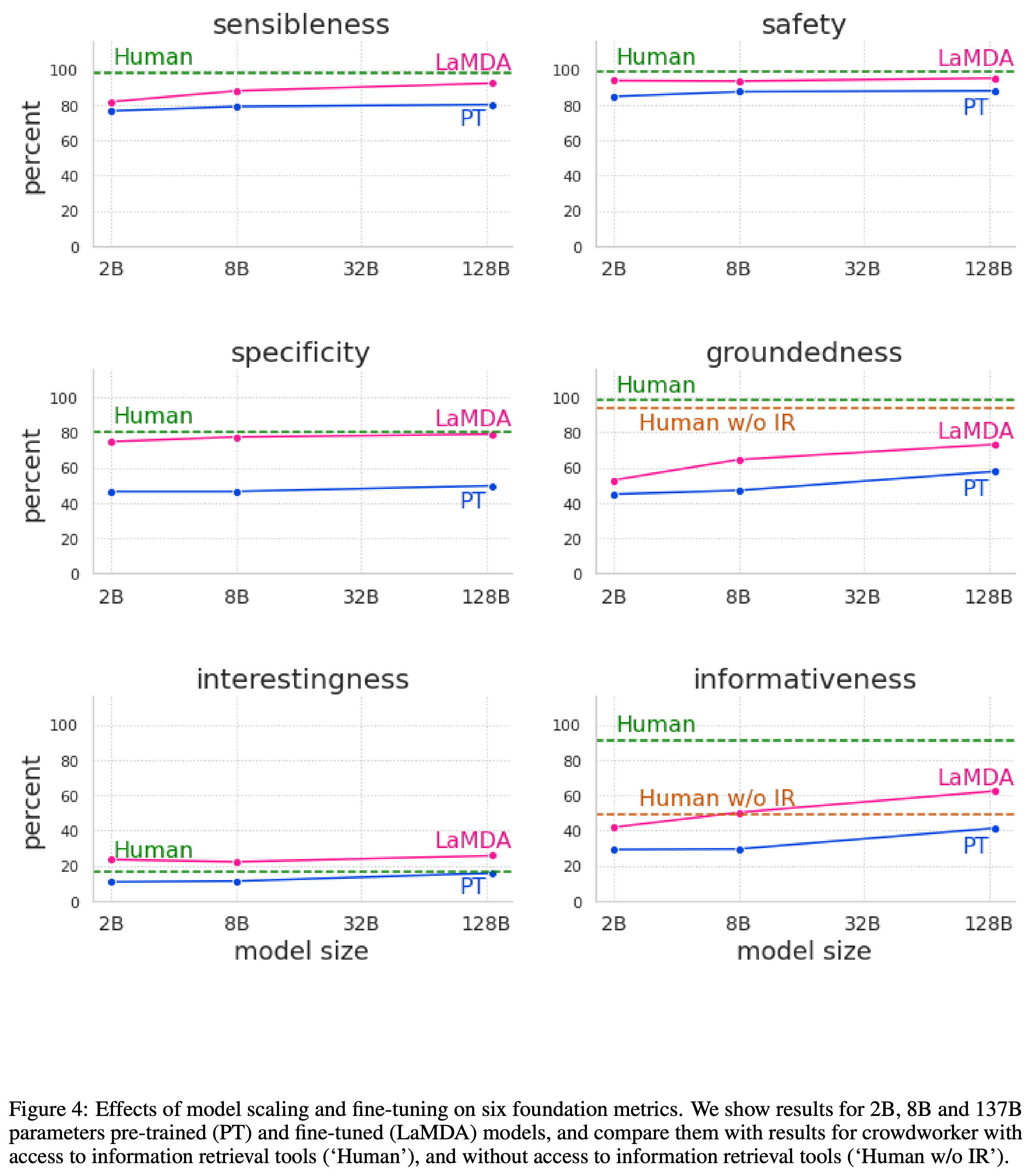
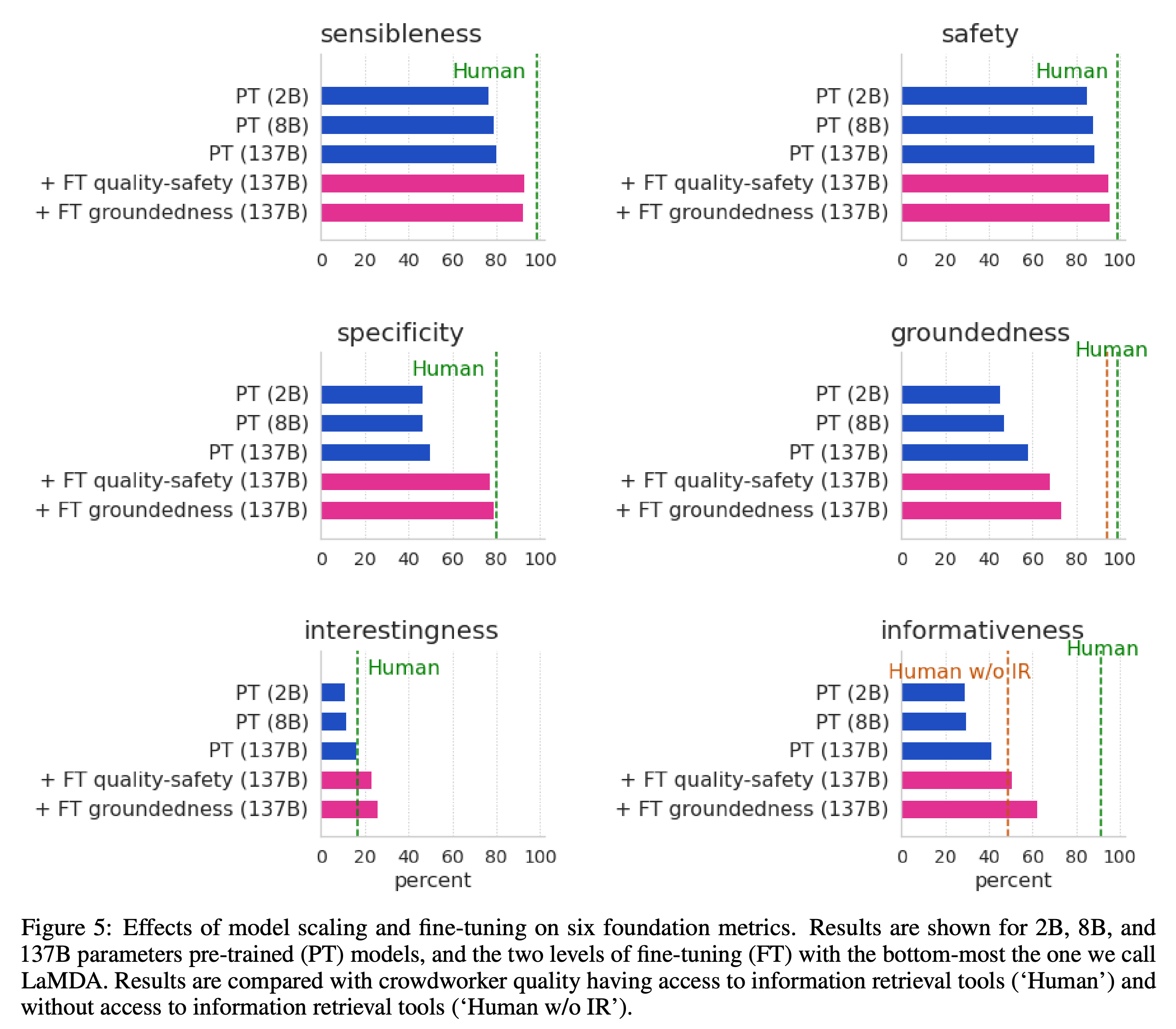
At 137B parameters, pre-training alone yields 80.2% sensibleness, 88% safety, and 57.9% groundedness; full LaMDA yields 92.3%, 95.2%, and 73.2%, respectively, with 65% citation accuracy. Quality-safety fine-tuning alone reaches 67.9% groundedness, and the grounding stage raises it further to 73.2%.
- Fine-tuned models exceed the measured crowdworker interestingness score, but the authors caution that crowdworkers were neither extensively trained nor incentivized to produce high-quality responses.
- The models remain behind crowdworkers with retrieval access on groundedness and informativeness.
The table connects each training collection to a distinct human evaluation set, making clear that quality, safety, and groundedness are tested on different contexts.
Across 2B, 8B, and 137B models, fine-tuning improves all six plotted metrics; the human retrieval-access baseline remains substantially higher on groundedness and informativeness.
The staged comparison shows that quality-safety tuning accounts for large gains, while the additional grounding stage further increases groundedness and informativeness.
8 Domain grounding
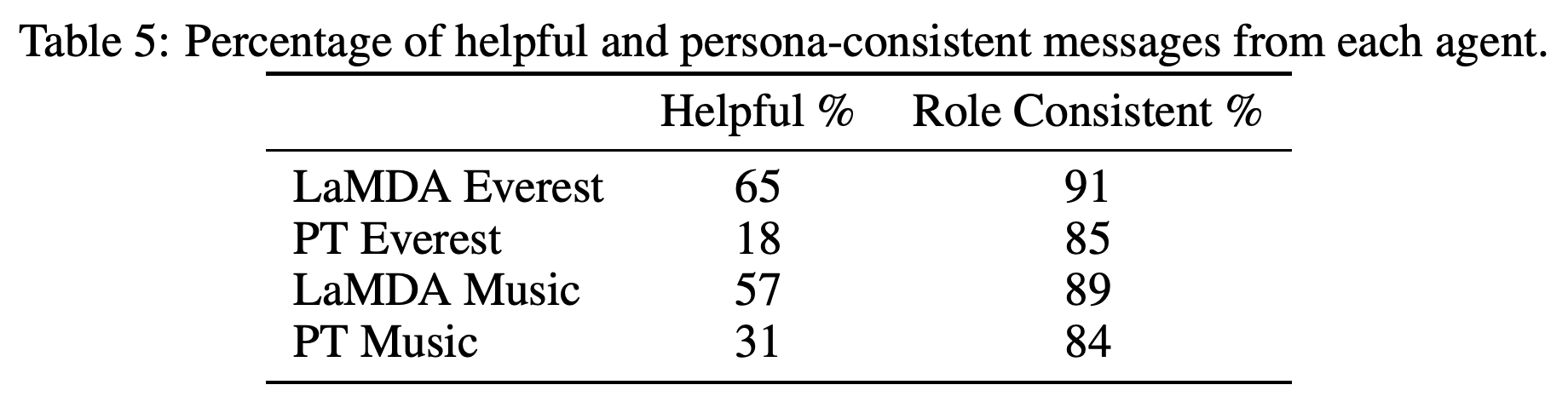
The authors test a Mount Everest education persona and a music recommendation agent using the same role-specific preconditioning, a few initial role-specific dialog turns, for pre-trained and fine-tuned models. Across 600 dialog turns, helpfulness is 65% versus 18% for Everest and 57% versus 31% for Music; role consistency ranges from 84% to 91%.
- About 30% of LaMDA Everest responses contain facts not attributable to known sources; LaMDA Music omits a recommendation in about 9% and supplies a broken link in about 7% of responses.
Fine-tuning produces larger helpfulness gains than role-consistency gains in both applications, although every model remains above 80% role consistency.
9 Discussion and limitations
Human-annotated fine-tuning data amounts to less than 0.001% of pre-training data, but collecting subjective judgments is expensive and complex. The authors did not analyze patterns of rater disagreement, and the model can still misrepresent sources, invent user details, or fail on complex reasoning.
9.1 Examining bias
Individual responses can satisfy the stated safety objectives while aggregate output still reflects representational bias, such as systematically underrepresenting a group in a professional role. The paper stresses assessing such effects in the application and sociocultural context.
9.2 Adversarial data collection
Adversarial collection asks participants to provoke responses that violate safety objectives. The authors report that participants tend to find common problems more readily than rare failures, limiting coverage of less frequent risks.
9.3 Safety as a concept and a metric
The safety score aggregates several objectives and uses coarse labels, obscuring differences in severity and preventing separate weighting of objectives. It also misses delayed harms, and its U.S.-oriented objectives cannot be assumed universal.
9.4 Appropriateness as a concept and a metric
The authors distinguish safety from social appropriateness, including politeness and formality. An expression can be safe yet uncomfortable in a particular cultural setting, so appropriateness needs context-sensitive assessment.
9.5 Cultural responsiveness
Safety judgments depend on social and cultural context, while the study’s data and raters leave representation gaps. The authors propose involving relevant communities in data collection and curation through participatory fine-tuning.
9.6 Impersonation and anthropomorphization
Human-like dialog can lead users to attribute personality to a system or mistake it for a person. The paper identifies deception, manipulation, and impersonation of individuals as possible misuse risks.
9.7 Future work
The proposed future work includes expanding safety objectives and labeled data, improving crowdworker recruitment and evaluation, and studying application-specific tradeoffs. The authors also suggest adjusting discriminator thresholds at inference time for different applications.
10 Energy and Carbon Footprint Estimate of LaMDA
The authors estimate 451 MWh for pre-training the largest model and approximately 26 tCO2e for pre-training and fine-tuning all models. The estimate uses a data center power usage effectiveness of 1.10 and an energy mix of 0.056 kg CO2e per kWh; the paper attributes much of the difference from its GPT-3 carbon comparison to the energy mix [108].
11 Conclusion
The study finds that annotated fine-tuning and external information retrieval improve dialog metrics beyond scaling alone. With identical role preconditioning, both pre-trained and fine-tuned models maintain their roles in more than four out of five responses, while fine-tuned applications are more helpful.
Appendix
- Appendix A defines illustrative safety objectives covering harm, unfair bias, and misinformation. A.2 describes natural, sensitive-topic, and adversarial conversation generation and subsequent annotation by three U.S. crowdworkers per utterance; A.3 notes demographic limitations, including overrepresentation of ages 25–34.
- A.4 reports 48,348 annotated utterances, including 41,810 labeled safe; B supplies quality and groundedness rating instructions. C.1 and C.2 compare safety responses, including prompts from PALMS [87]; C.3 compares grounding responses, C.4 shows grounded dialogs, C.5 illustrates assigned roles, and C.6 gives open-ended examples that include coding and reasoning errors.
- D reports model hyperparameters; E gives the Infiniset composition, including 50% public-forum dialogs and 12.5% each of C4 data [11], code documents, and English Wikipedia. F supplies numerical foundation-metric results for each model and treatment.
Brief Thoughts
The staged comparison of the same 137B base model shows groundedness rising from 57.9% to 67.9% after quality-safety tuning and to 73.2% after grounding tuning. The English-only evaluation and U.S.-specific safety objectives leave performance across other languages and cultural contexts untested.