


Phi-4-Mini-Reasoning: Exploring the Limits of Small Reasoning Language Models in Math | Summary
30 Apr 2025 | Paper Review Mathematical Reasoning Knowledge Distillation Direct Preference Optimization Reinforcement Learning With Verifiable RewardsContents
This article explains the key points of Phi-4-Mini-Reasoning: Exploring the Limits of Small Reasoning Language Models in Math.
- 2025-04-30 (arXiv)
- Xu, Haoran, Peng, Baolin, Awadalla, Hany, Chen, Dongdong, Chen, Yen-Chun, Gao, Mei, Kim, Young Jin, Li, Yunsheng, Ren, Liliang, Shen, Yelong, et al.
- Microsoft
- Paper
Summary
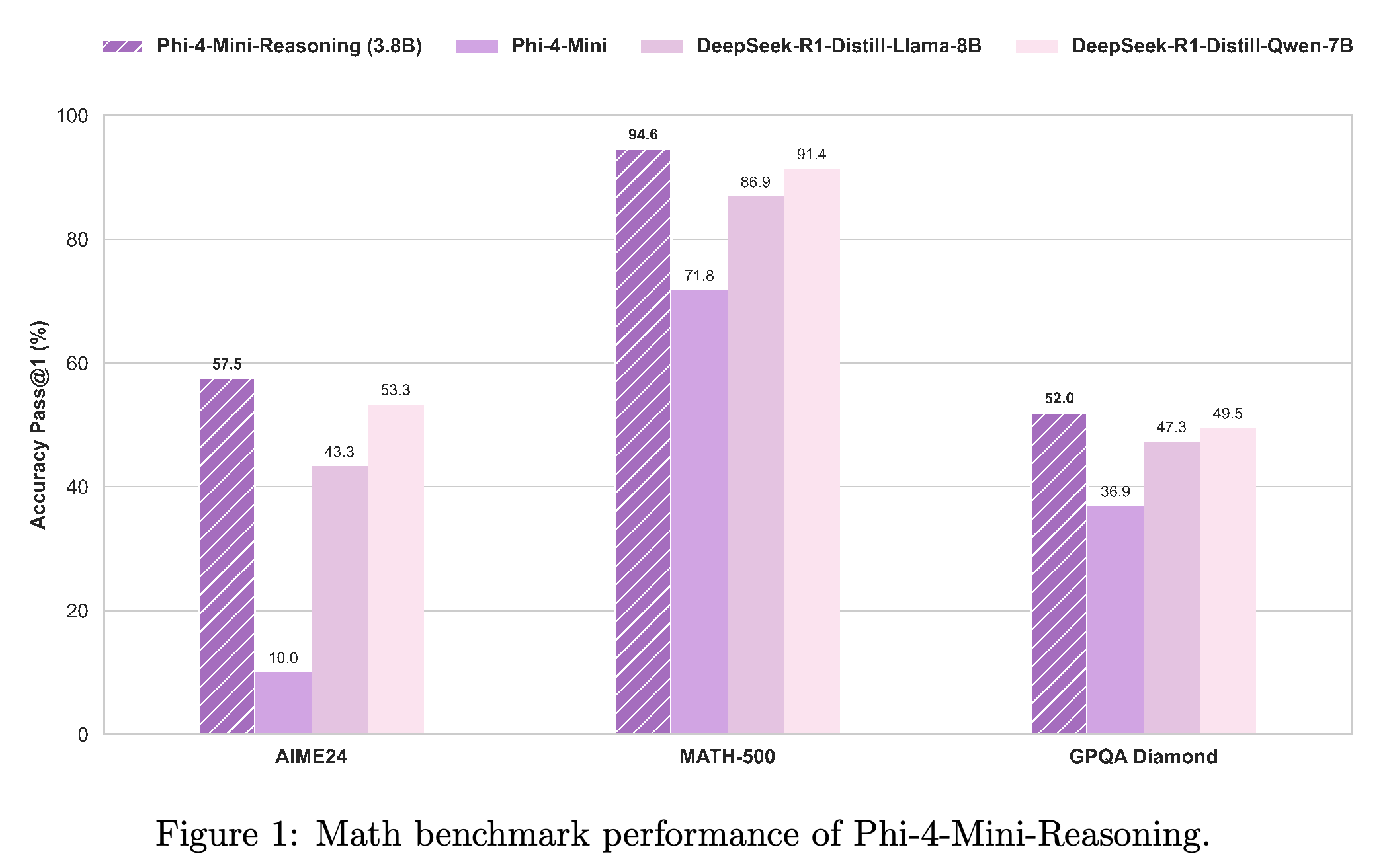
- Small language models have limited capacity to learn the intermediate steps needed for multi-step mathematical reasoning. The paper’s 3.8-billion-parameter Phi-4-Mini-Reasoning achieves 94.6% on MATH-500, a mathematics benchmark, under pass@1 evaluation, which measures single-answer correctness, compared with 91.4% for DeepSeek-R1-Distill-Qwen-7B and 86.9% for DeepSeek-R1-Distill-Llama-8B in the authors’ reproduced comparisons.
- The four-stage recipe begins with distillation, training on a stronger model’s generated answers, through large-scale mid-training and selective supervised fine-tuning. These stages use Chain-of-Thought (CoT), explicit intermediate reasoning steps; Direct Preference Optimization (DPO), learning from preferred and rejected response pairs, then precedes reinforcement learning, which updates the model using rewards based on verified final-answer correctness.
- The final model scores 57.5% on AIME 2024, a mathematics examination benchmark, and 52.0% on GPQA Diamond, a graduate-level question-answering benchmark. Successive training checkpoints improve across all three evaluations, but the experiments concern one base model and do not isolate the contribution of every reinforcement-learning modification.
The final model improves over Phi-4-Mini on all three benchmarks and exceeds both displayed DeepSeek distilled models despite its smaller parameter count. The MATH-500 comparison is 94.6% versus 91.4% and 86.9%, supporting the headline margins of 3.2 and 7.7 percentage points.
1 Introduction
The introduction presents intermediate reasoning and test-time scaling, allocating additional computation during answer generation, as ways to improve difficult multi-step problem solving. It asks how these benefits can be transferred to small language models whose limited capacity makes training sensitive to data and optimization choices.
- The proposed sequence establishes reasoning through two distillation stages, reuses incorrect teacher responses for preference learning, and finally optimizes verified answer correctness through reinforcement learning.
- The contribution is a coordinated training recipe informed by earlier work emphasizing either large-scale reinforcement learning or small, carefully selected reasoning datasets.
2 Background
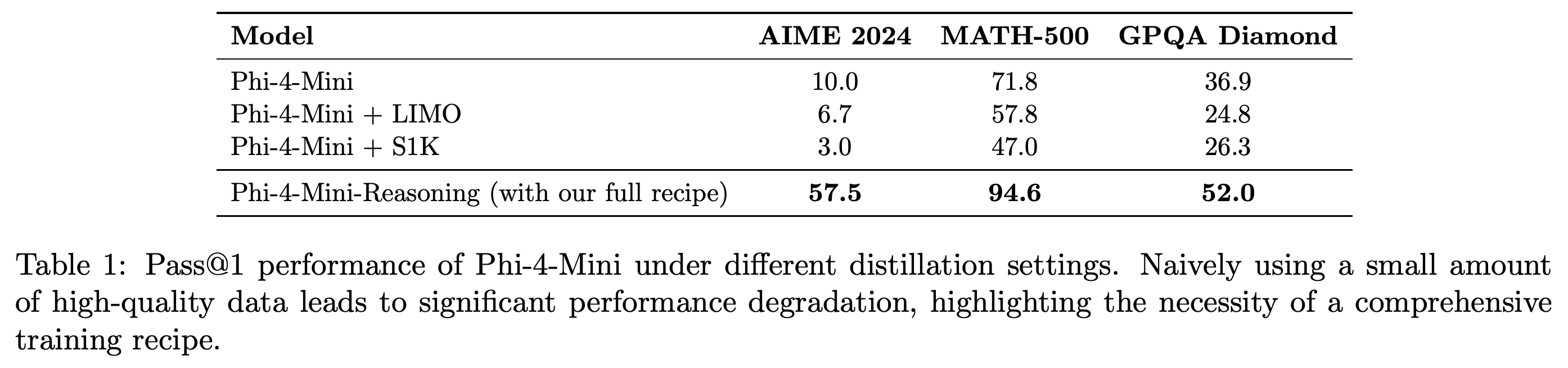
Direct training on LIMO and S1K, two small reasoning datasets, reduces Phi-4-Mini’s accuracy in the reported experiments. Table 1 shows MATH-500 accuracy falling from 71.8% to 57.8% with LIMO and to 47.0% with S1K, while the complete recipe reaches 94.6%.
- AIME 2024 and GPQA Diamond accuracy also declines under both direct-distillation settings.
- These observations motivate extensive initial reasoning training before selective fine-tuning, although they do not establish that every small model requires the same sequence.
Both direct small-dataset distillation settings reduce accuracy across every reported benchmark. This supports the motivation for additional training preparation on Phi-4-Mini, although the comparison does not identify which part of the complete recipe prevents the degradation.
3 Multi-Stage Continual Training for Reasoning
The method starts from pretrained Phi-4-Mini and applies four consecutive stages: distillation as mid-training, distillation as supervised fine-tuning, rollout preference learning, and reinforcement learning with verifiable rewards. A rollout is a sampled model response containing its reasoning and answer.
3.1 Distillation as Mid-Training
Mid-training uses next-token prediction on diverse synthetic reasoning examples across domains and difficulty levels. DeepSeek-R1 generates reasoning answers, and rejection sampling, filtering generated responses by correctness, retains accepted answers.
- Packing places multiple short examples in one input sequence to improve training efficiency.
- The authors recommend repeatedly using extensive CoT data until validation performance saturates, but provide no quantitative data-scaling curve or saturation threshold.
3.2 Distillation as Supervised Fine-tuning
Supervised fine-tuning, training on selected question–response examples, uses a compact, representative, high-quality subset of the mid-training data. The subset spans diverse mathematics domains with difficulty exceeding the ‘college level’, and training uses non-packing mode, keeping examples separate so the model learns where to stop generating.
3.3 Rollout Preference Learning
Rollout preference learning reuses incorrect responses discarded during distillation. Questions classified by GPT-4o-mini as high-school mathematics or above supply pairs in which correct responses are preferred and incorrect responses are rejected.
- The authors identify incorrect responses differing only subtly from correct counterparts as informative preference candidates.
- DPO trains the model to favor correct over incorrect responses relative to a fixed reference model, using a previously collected dataset.
3.4 RL with Verifiable Reward
The final stage performs online reinforcement learning, learning from newly sampled responses, on the distilled, preference-trained model. The paper presents Proximal Policy Optimization (PPO), which clips changes in response probabilities during optimization, and Group-based Relative Policy Optimization (GRPO), which estimates each response’s advantage, its reward relative to a baseline, by comparing responses to the same question.
- PPO uses Generalized Advantage Estimation (GAE), which combines discounted reward-prediction errors from a value function, a predictor of future reward.
- GRPO standardizes rewards within each response group and includes a Kullback–Leibler (KL) penalty, a measure of divergence from a reference model’s response distribution.
- The verifiable reward is +1 when the final answer passes verification against the ground truth and −1 otherwise; this reward does not directly score intermediate reasoning.
Pilot GRPO training encounters variable response lengths, groups with identical rewards and no useful relative reward signal, and a mismatch between training and evaluation sampling temperatures, which control sampling randomness. Correct responses to the same prompt can span approximately 12k to 20k tokens, and difficult questions can require a response batch size of 128 to obtain even one positive sample.
- Prompt Optimization retains candidate prompts whose sampled responses have relatively uniform token lengths.
- Reward Rebalancing through Oversampling and Filtering retains all positive responses and an equal number of randomly sampled negative responses. It also removes overly easy prompts using a group-accuracy threshold, with 50% given as an example.
- Temperature Annealing linearly reduces sampling temperature from 1.0 to 0.6 over the first 50% of training steps, then holds it at 0.6.
4 Synthetic CoT Data Generation
The dataset combines public resources and in-house seed data, totaling around 10 million rollouts across 1.6 million samples. Existing reasoning annotations are reused; otherwise, mathematical questions receive approximately eight sampled responses each from DeepSeek-R1 (671B), a 671-billion-parameter teacher model.
- A mathematics-verification tool checks answers, and GPT-4o-mini rechecks responses initially marked incorrect to reduce false negatives, correct answers mistakenly rejected by the tool.
- Annotations record domain, difficulty, and repetitive patterns. Domains include algebra, geometry, theory, probability, and calculus; difficulty ranges from elementary school through graduate level.
- Mid-training uses the full dataset subject to the correctness filtering described in Section 3.1, while subsequent stages use selected subsets. The paper does not specify the exact sizes of those subsets.
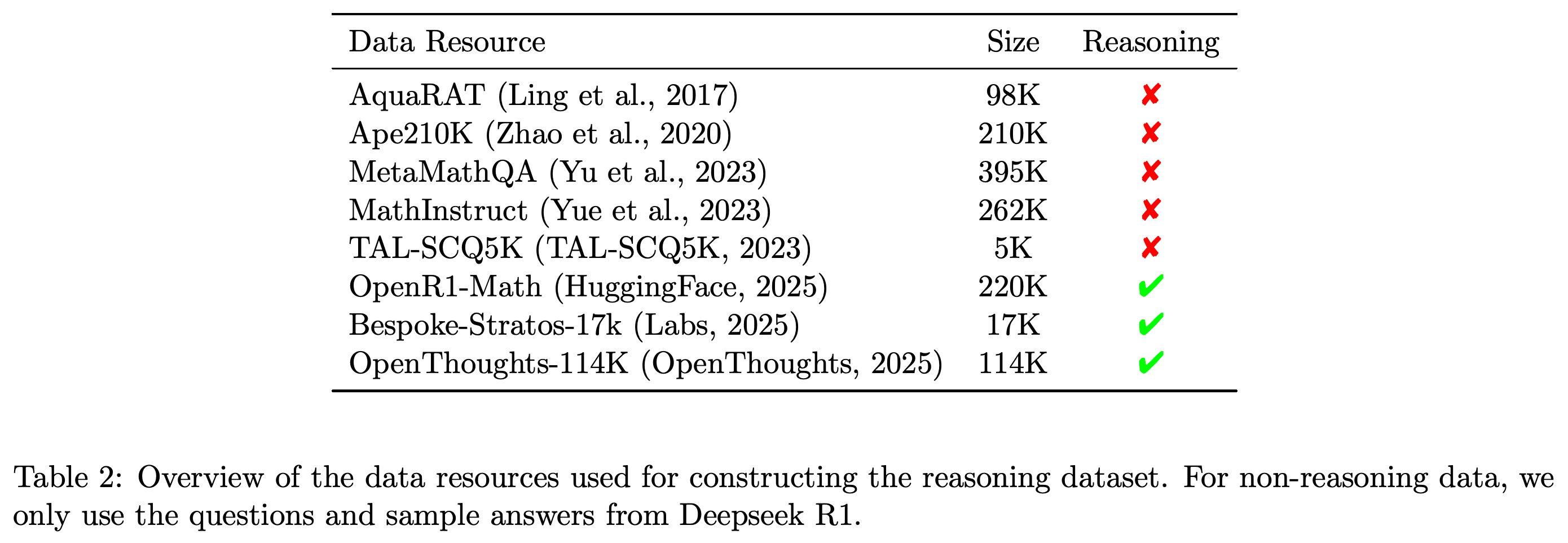
The resource inventory distinguishes question sources requiring newly sampled reasoning from datasets already containing reasoning annotations. It lists AquaRAT 98K, Ape210K 210K, MetaMathQA 395K, MathInstruct 262K, TAL-SCQ5K 5K, OpenR1-Math 220K, Bespoke-Stratos-17k 17K, and OpenThoughts-114K 114K; these public resources are supplemented by in-house seeds.
5 Experiment
The experiments compare final benchmark accuracy, track performance after successive training stages, and examine multi-sample problem-solving coverage and reinforcement-learning stability. The evaluated base model is Phi-4-Mini with 3.8 billion parameters.
5.1 Evaluation
Evaluation covers AIME24, MATH-500, and GPQA Diamond, using temperature 0.6, top_p 0.95, and maximum sequence length 32K. The top_p setting restricts sampling to a set of tokens with cumulative probability 0.95, and reported performance averages 3 runs for each task.
- The paper reports average accuracy without confidence intervals or per-run dispersion.
5.2 Baselines
Baselines include o1-mini, DeepSeek-R1-Distill-Qwen-7B, DeepSeek-R1-Distill-Llama-8B, Bespoke-Stratos-7B, OpenThinker-7B, Llama-3.2-3B-Instruct, and the original Phi-4-Mini.
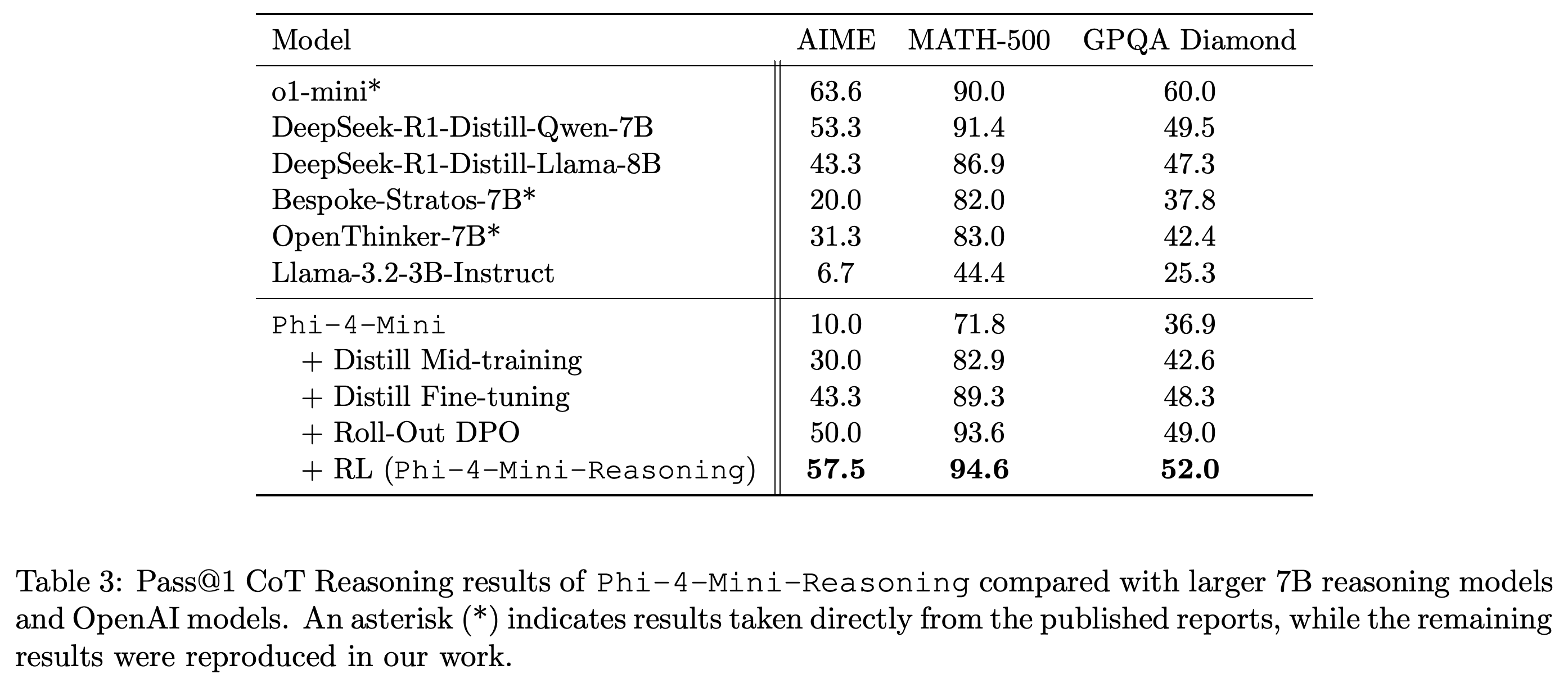
- Table 3 marks o1-mini, Bespoke-Stratos-7B, and OpenThinker-7B results as taken from published reports. The remaining results were reproduced by the authors, so the table combines different sources of evaluation evidence.
5.3 Training Settings
For the first two distillation stages, the paper specifies batch size 128, learning rate 1e-5, a total of 5 training epochs, and warmup ratio 0.1, the fraction of training used to increase the learning rate initially. Sequence length is 16K with packing during mid-training and 20K without packing during supervised fine-tuning.
- Rollout DPO uses learning rate 5e-7, one epoch, and sequence length 16K.
- Reinforcement learning uses learning rate 5e-7 and sequence length 25k.
5.4 Results
Final pass@1 scores are 57.5% on AIME, 94.6% on MATH-500, and 52.0% on GPQA Diamond, exceeding every open-source baseline listed in Table 3. Relative to DeepSeek-R1-Distill-Qwen-7B, the gains are 4.2, 3.2, and 2.5 percentage points, respectively.
- Successive Phi-4-Mini checkpoints score 10.0/71.8/36.9 initially, 30.0/82.9/42.6 after mid-training, 43.3/89.3/48.3 after fine-tuning, 50.0/93.6/49.0 after Roll-Out DPO, and 57.5/94.6/52.0 after reinforcement learning, in AIME/MATH-500/GPQA Diamond order.
- Against the published o1-mini scores, the final model leads on MATH-500, 94.6% versus 90.0%, but trails on AIME, 57.5% versus 63.6%, and GPQA Diamond, 52.0% versus 60.0%.
Every successive training checkpoint improves all three reported scores, with the final reinforcement-learning stage adding 7.5 points on AIME, 1.0 on MATH-500, and 3.0 on GPQA Diamond. The table also limits the broader comparison: o1-mini remains ahead on two benchmarks, and asterisks identify baseline results imported from published reports.
5.5 Ablations
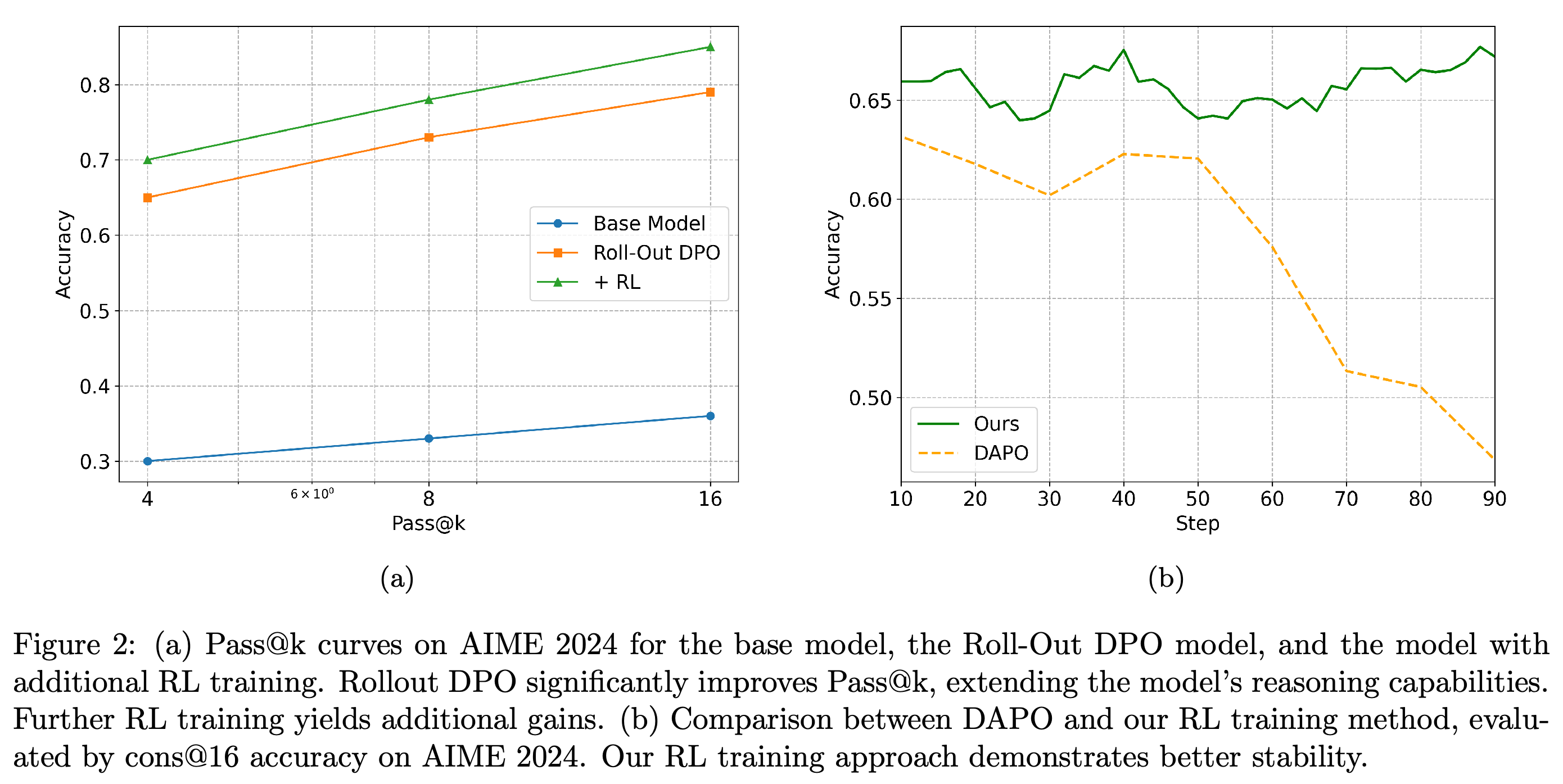
The ablations use pass@k, the fraction of problems with at least one verified correct answer among k sampled responses, to assess problem-solving coverage. Figure 2a shows large gains from the base model to the Roll-Out DPO checkpoint, followed by additional gains from reinforcement learning; the authors describe the latter as approximately 7 points on average.
- Figure 2b compares the proposed reinforcement-learning recipe with DAPO, an existing reinforcement-learning training system, using consensus@16 accuracy on AIME 2024. The paper names this consensus-based evaluation metric but does not define its aggregation procedure; the proposed recipe remains comparatively stable while DAPO deteriorates in this setting.
- The pass@k plot compares accumulated training checkpoints, so it does not isolate DPO from the preceding distillation stages. The reinforcement-learning comparison evaluates the combined recipe without separately removing prompt selection, reward balancing, or temperature annealing.
Panel (a) shows higher AIME 2024 problem-solving coverage at k = 4, 8, and 16 after the accumulated training stages, with an additional increase after reinforcement learning. Panel (b) shows the proposed recipe maintaining consensus@16 accuracy around 0.64–0.68 while DAPO drops to roughly 0.47 by step 90, supporting a stability advantage in this training setting despite short-term fluctuations in both curves.
5.6 Safety Statement
The authors state that development followed Microsoft’s responsible AI principles and that Azure AI Foundry’s Risk and Safety Evaluation framework assessed harmful content, direct jailbreak, meaning attempts to bypass safeguards, and model groundedness, whether responses are supported by evidence. They refer readers to the Phi-4-Mini-Reasoning Model Card for further information, but provide no numerical safety results in this paper.
6 Conclusion
The conclusion attributes the model’s reasoning performance to coordinated large-scale distillation, rollout preference learning, and reinforcement learning with verifiable rewards. The reported comparisons show that this 3.8-billion-parameter model exceeds the listed 7B and 8B open-source baselines on these evaluations.
Appendix
- The supplied 12-page paper contains no appendix. References occupy pages 10–12.
Brief Thoughts
The clearest evidence is the improvement across all three benchmarks at successive training checkpoints, alongside the accuracy declines from direct LIMO and S1K training in Table 1. These results support the recipe for Phi-4-Mini, while the sequential design leaves the optimal stage order and necessity of each component unresolved. Reproducibility is limited by in-house seed data, unspecified subset sizes, and incomplete quantitative criteria for prompt selection and filtering. Small parameter count does not establish low total cost: the recipe uses a 671B teacher, around 10 million rollouts, and long generation sequences, without reporting training compute, inference latency, or a cost-matched comparison. The evaluation supports gains on the reported benchmarks. Additional base models and independent component ablations would be needed to test the recipe’s broader applicability.