


Prospective Learning: Principled Extrapolation to the Future | Summary
19 Jan 2022 | Paper Review Prospective Learning Out-of-Distribution Generalization Online LearningContents
This article explains the key points of Prospective Learning: Principled Extrapolation to the Future.
- 2022-01-19 (arXiv), 2nd Conference on Lifelong Learning Agents (CoLLAs), 2023
- De Silva, Ashwin, Ramesh, Rahul, Ungar, Lyle, Shuler, Marshall Hussain, Cowan, Noah J., Platt, Michael, Li, Chen, Isik, Leyla, Roh, Seung-Eon, Charles, Adam, et al.
- Johns Hopkins University, University of Pennsylvania, Carnegie Mellon University, Morgan State University, Howard Hughes Medical Institute, University of California, San Diego, MindX, Microsoft Research, DeepMind
- Paper, arXiv v2 (2023-07-13)
Summary
- The paper addresses prediction when data distributions change over time in partially predictable ways. In an illustrative sequence of alternating classification tasks, the authors argue that a learner given the switching pattern can select the appropriate classifier without new samples at a switch, while a single fixed classifier cannot achieve arbitrarily small error on both tasks.
- Prospective learning means learning time-indexed decision rules from past data to perform close to a reference sequence on future tasks, averaged over time. The paper proposes a definition and a conjecture, but does not implement or evaluate a prospective learner.
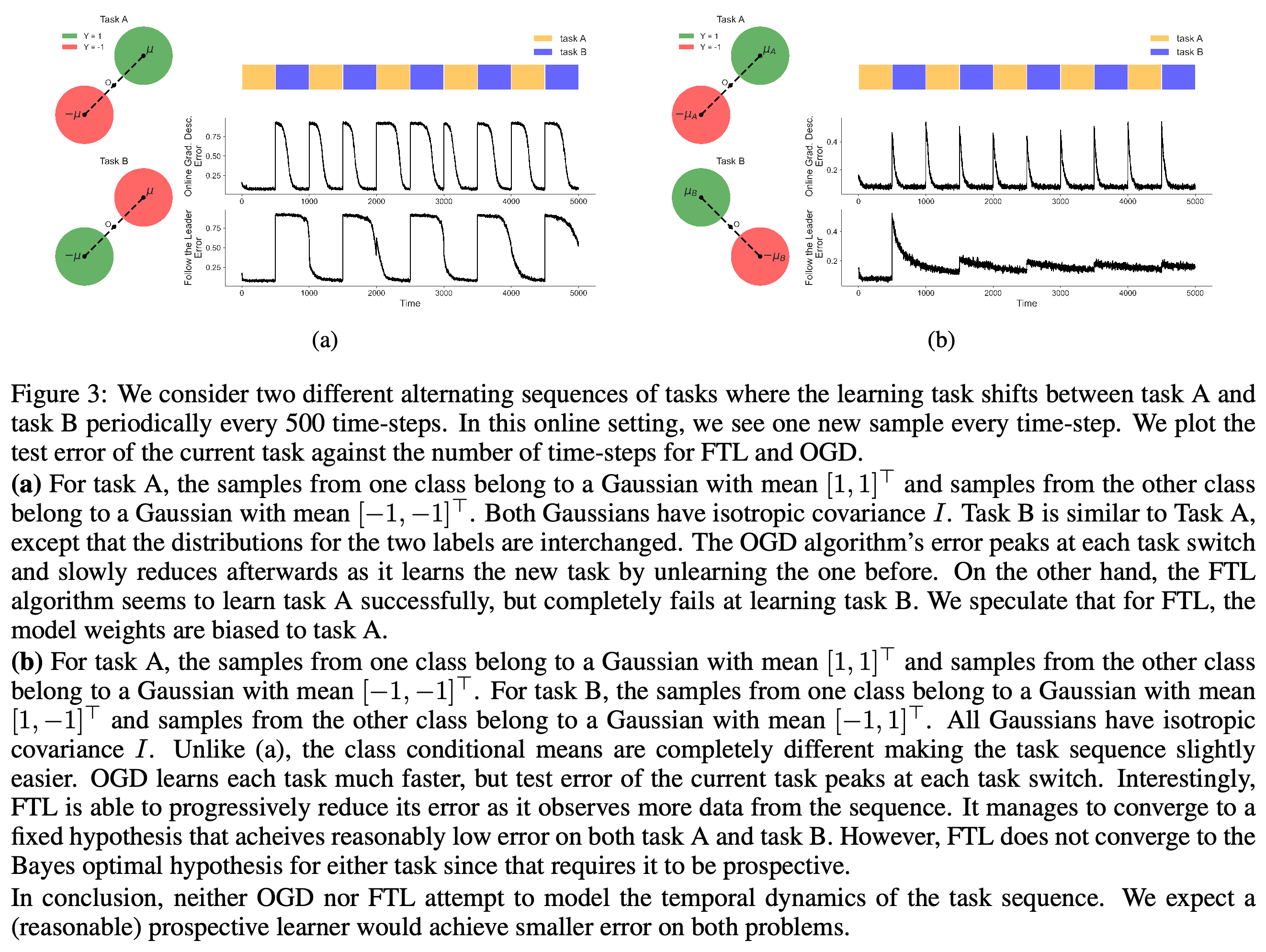
- In two synthetic experiments with a task switch every 500 time-steps and one new sample per step, online gradient descent, which updates a model as samples arrive, shows error peaks at switches. Follow-the-leader, which selects a model based on past performance, fails on one label-flipped task but finds a useful fixed classifier in the second setting.
1 Introduction
The authors call methods that optimize representations for past data retrospective learners. They propose anticipating structured changes in future tasks, relaxing the assumption that past and future distributions are identical and stationary.
2 A Failure Mode of Retrospective Learning
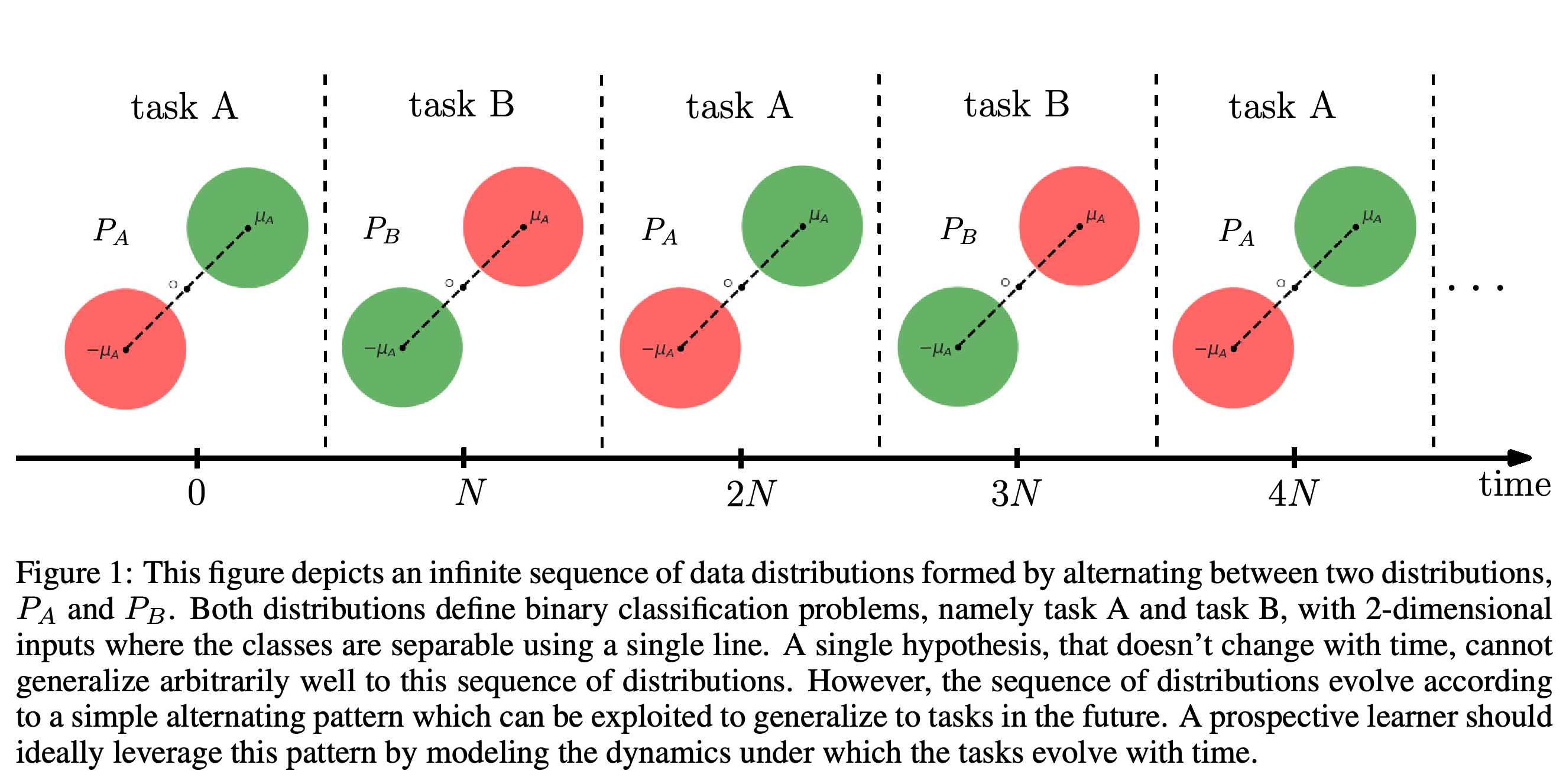
Two binary classification tasks with two-dimensional inputs alternate every N time-steps; each can be separated by a line, but their opposing labels prevent one fixed decision rule from achieving arbitrarily small error on both. If the alternating schedule is known, maintaining and switching between two rules can predict the task without collecting additional samples at each switch.
The class labels reverse between tasks A and B, so the same fixed decision rule cannot be accurate for both even though each task is individually linearly separable. The regular schedule supplies information a time-dependent rule could use.
3 The Theoretical Foundations for Prospective Learning
The theoretical framework represents a task by its data distribution while holding the hypothesis class, the set of candidate decision rules, and the risk function, the expected loss, fixed. It compares learning one fixed hypothesis with learning a sequence of hypotheses indexed by time.
3.1 Retrospective Learning
In probably approximately correct (PAC) learning, a learner receives independent, identically distributed samples from a fixed task and aims to produce a hypothesis whose risk differs from the optimal hypothesis in its class by less than ε with probability at least 1 − δ. The paper calls the learner efficient when its sample complexity is polynomial in ε⁻¹ and δ⁻¹ (Valiant, 1984; Kearns & Vazirani, 1994).
3.2 Prospective Learning
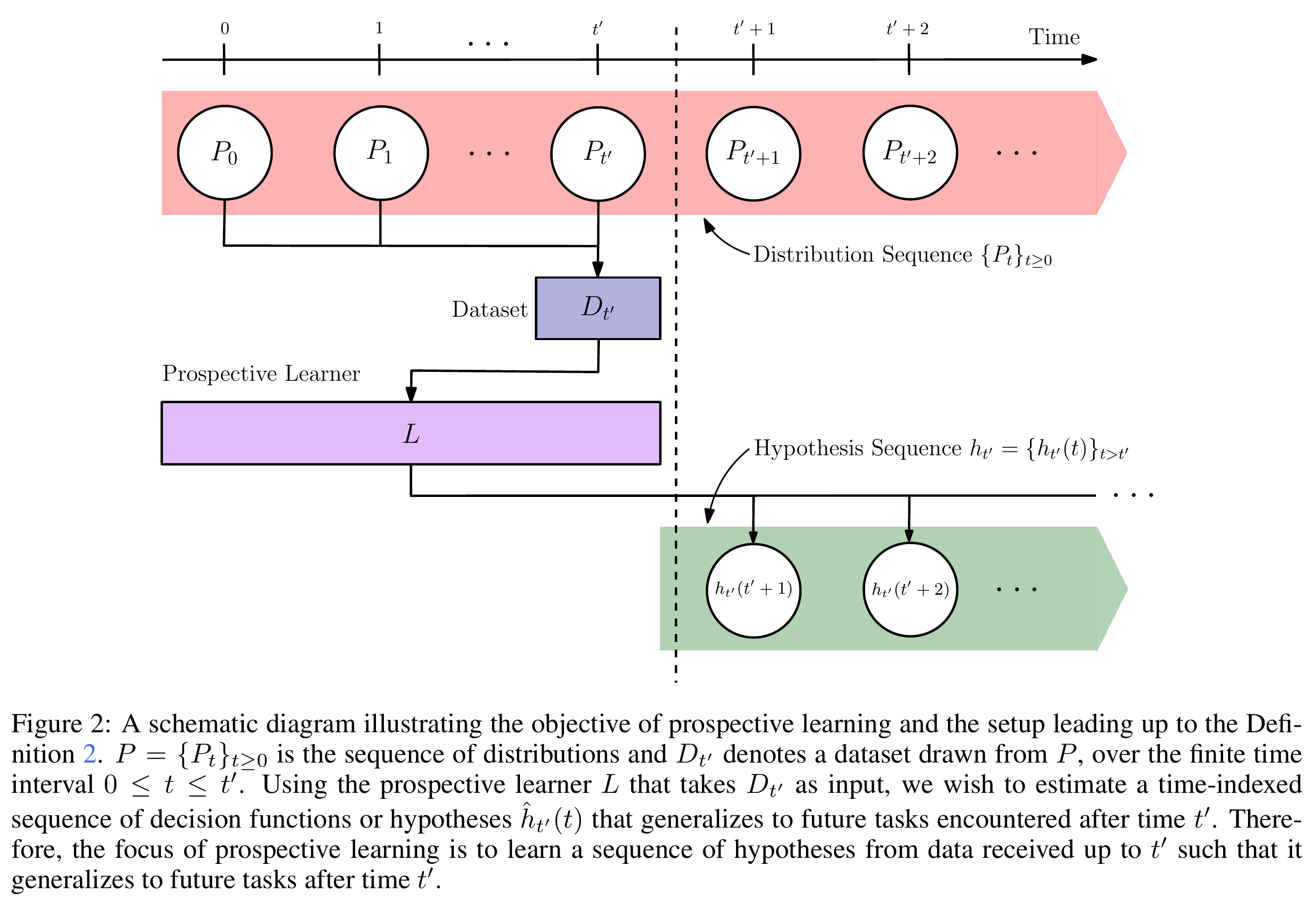
Given data observed through time t′, a prospective learner outputs a sequence of future hypotheses. Definition 2 requires the time average, over an infinite future horizon, of the probability that its risk is within ε of a chosen reference sequence to be at least 1 − δ, for every t′ beyond a finite observation threshold and given enough samples.
The dashed boundary separates observed distributions from future ones: the learner uses the dataset collected up to t′ to produce a sequence of future decision functions.
The reference may be the optimal hypothesis at each time or a random-chance hypothesis, yielding different standards of learnability. The authors conjecture three classes—PAC-learnable, prospectively learnable, and not prospectively learnable—but do not provide a complexity measure or prove the conjecture.
4 Related Work
The paper compares prospective learning with online learning, which updates a learner over a sequence of tasks, and with online meta-learning, continual learning, streaming learning, out-of-distribution generalization, and few-shot learning. Its distinguishing objective is to use temporal structure to anticipate future tasks; the authors note that differing or absent formal definitions limit direct comparisons.
In the synthetic experiments, follow-the-leader (FTL) and online gradient descent (OGD) receive one sample per time-step. With swapped labels, OGD’s error spikes at switches and FTL fails on task B; with different class means, FTL converges to a fixed hypothesis that works reasonably on both tasks, while OGD still spikes at switches.
Both panels show errors around periodic task switches; the label-flipped case exposes persistent FTL failure on task B, while the different-means case admits a useful fixed FTL hypothesis. No prospective learner is plotted.
5 Discussion
The discussion frames prospective learning as a way to study predictably related past and future distributions and proposes experiments on natural and artificial intelligence. The authors explicitly leave the implementation of prospective learning largely unanswered.
Brief Thoughts
The alternating-task example makes anticipation concrete, and the baseline experiments show why reacting after a switch can incur error. The evidence consists of a conceptual framework and synthetic baseline demonstrations; the paper provides no prospective algorithm, real-world evaluation, or proof of the proposed complexity classes.