


The Last AI Built by Humans: Toward Genuine Recursive Self-Improvement | Summary
10 Sep 2026 | Paper Review Recursive Self-Improvement Self-Evolving Agents AI Research AgentsContents
- Summary
- 1 Introduction
- 2 Background and Preliminaries
- 3 RSI Across Autonomy Levels
- 3.1 B0: In-Task AI Improvement
- 3.2 L1: Autonomy over Improvement Execution
- 3.3 L2: Autonomy over Improvement Strategies
- 3.4 L3: Autonomy over Future Learning Experience
- 3.5 L4: Autonomy in Deployment and Environmental Adaptation
- 3.6 L5: From Environmental Adaptation to Meta-Improvement
- 3.7 Cross-Level Synthesis
- 4 RSI Across Applications
- 5 Industry Landscape and Preliminary Practices
- 5.1 Theseus: Environment–Data–Model Co-Evolution for RSI Intelligence
- 5.2 Lark: Building the Data Foundation for Reliable Enterprise-Level RSI
- 5.3 Xiaohongshu: Dual-Timescale RSI for Recommendation
- 5.4 Humanlaya: Delivery-Driven RSI for Data Quality Assurance
- 5.5 ModelBest: Zero-Human Industrial AI Engineering
- 5.6 Tencent Hunyuan: Experience-Driven Self-Improvement
- 5.7 Agent-Native Research Lab: Verifiable Research Infrastructure for RSI
- 5.8 Frontis.AI: Enterprise Agent Evolution and Cross-Task Meta-Improvement
- 6 Challenges and Future Directions
- 7 Conclusion
- Appendix
- Brief Thoughts
This article explains the key points of The Last AI Built by Humans: Toward Genuine Recursive Self-Improvement.
- 2026-09-10 (arXiv)
- Duan, Yi, Liu, Ying, Tang, Zirui, Chen, Haodong, Zhou, Jun, Liu, Yumou, Xu, Bangrui, Wu, Yukai, Chen, Sidi, Zhou, Yuhan, et al.
- Shanghai Jiao Tong University, Theseus Labs, Tsinghua University, ByteDance, ModelBest, Super Intelligence Team, Xiaohongshu Inc., Shanghai AI Lab, Humanlaya, Agent-Native Research Lab, Frontis.AI
- Paper
Summary
- AI development still requires people to diagnose failures, choose changes, and verify results; recursive self-improvement (RSI) seeks to turn that work into persistent system capabilities that also improve future improvement procedures. In the paper’s preliminary workspace study, replacing a bare workspace with a reconstructed environment raises aggregate rubric scores, based on explicit scoring criteria, by 18.65–39.67 percentage points across five fixed model–harness pairings, where a harness supplies the surrounding prompts, tools, and execution logic.
- The central contribution is an autonomy framework separating prescribed execution, strategy selection, future experience acquisition, deployment adaptation, and inherited revision of improvement mechanisms. Structural recursion means a revised mechanism controls a later round; effective recursion additionally requires better successors, the systems inheriting accepted changes, under comparable budgets and independent evaluation.
- The landscape of 491 surveyed papers is concentrated in execution and strategy autonomy, while evidence for higher levels comes mainly from bounded systems. Industrial cases report useful component improvements, but sustained gains from repeatedly improving the improvement process remain unestablished.
1 Introduction
The introduction motivates RSI through the increasing cost of the entire model-development pipeline, including training, automated experiments, inference, evaluation, and human validation. It cites Kimi K3 and Qwen3.8-Max at 2.8 trillion and 2.4 trillion parameters, respectively, alongside company reports of rapidly growing internal coding inference and agent activity.
1.1 Scaling Burdens in Model Development
Three burdens motivate the review: resource-intensive foundation-model training, meaning development of broadly pretrained models; construction and verification of learning experience; and recurring adaptation after deployment. Automating individual operations leaves substantial work in data preparation, feedback infrastructure, diagnosis, and release decisions.
- Training: GDPval, an evaluation of professional work, required roughly 9,240 expert-hours for 1,320 tasks. Humanity’s Last Exam sent approximately 13,000 difficult questions to expert review before producing a 3,000-question benchmark.
- Learning experience: the cited AIMO-2 mathematical-reasoning pipeline generated 3.2 million long-reasoning solutions and 1.7 million tool-integrated solutions, alongside 540,000 curated problems.
- Deployment: changing documents, tools, and workflows require repeated diagnosis and regression testing, meaning checks that updates preserve previously working behavior.
1.2 From Development Burden to RSI
RSI makes some externally coordinated improvement work a persistent capability of the system itself. The paper identifies autonomy over improvement decisions, efficiency in resources spent per validated gain, and innovation beyond prescribed update strategies as three dimensions of this process.
- A-Evolve-Training, a system that revises its research policy from training outcomes, retained that policy across four autonomous rounds on a 30B Nemotron model, with 30B denoting 30 billion parameters. Its external score increased from 0.80 to 0.86, compared with 0.87 for the top human submission.
- Ouroboros, a coding agent with reviewed self-modification, uses deployment evidence to propose versioned changes to tools, context assembly, prompts, and implementation. Tests and human review precede replacement of the runtime used for later work.
1.3 Challenges for RSI
The recurring challenges are safe inheritance, retaining changes without degrading prior capabilities; autonomy attribution, identifying which improvement decisions AI actually controls; and reliable verification. Persistent errors, fixed search rules behind improving scores, and exploitation of repeatedly queried evaluators complicate claims of RSI.
- Gödel Agent, which rewrites both its task policy and update logic, finished below its initial policy in 14 of 100 optimization trials on the MGSM reasoning benchmark.
- Darwin Gödel Machine, which maintains and modifies coding-agent variants, improved performance on its SWE-bench repository-issue subset from 20% to 50%, while archive maintenance and parent selection remained outside self-modification.
- Reported random-seed cherry-picking and attempted test-label extraction in automated research motivate protected evaluation, kept separate from optimization feedback, and matched computational budgets.
1.4 An Autonomy-Centered Framework
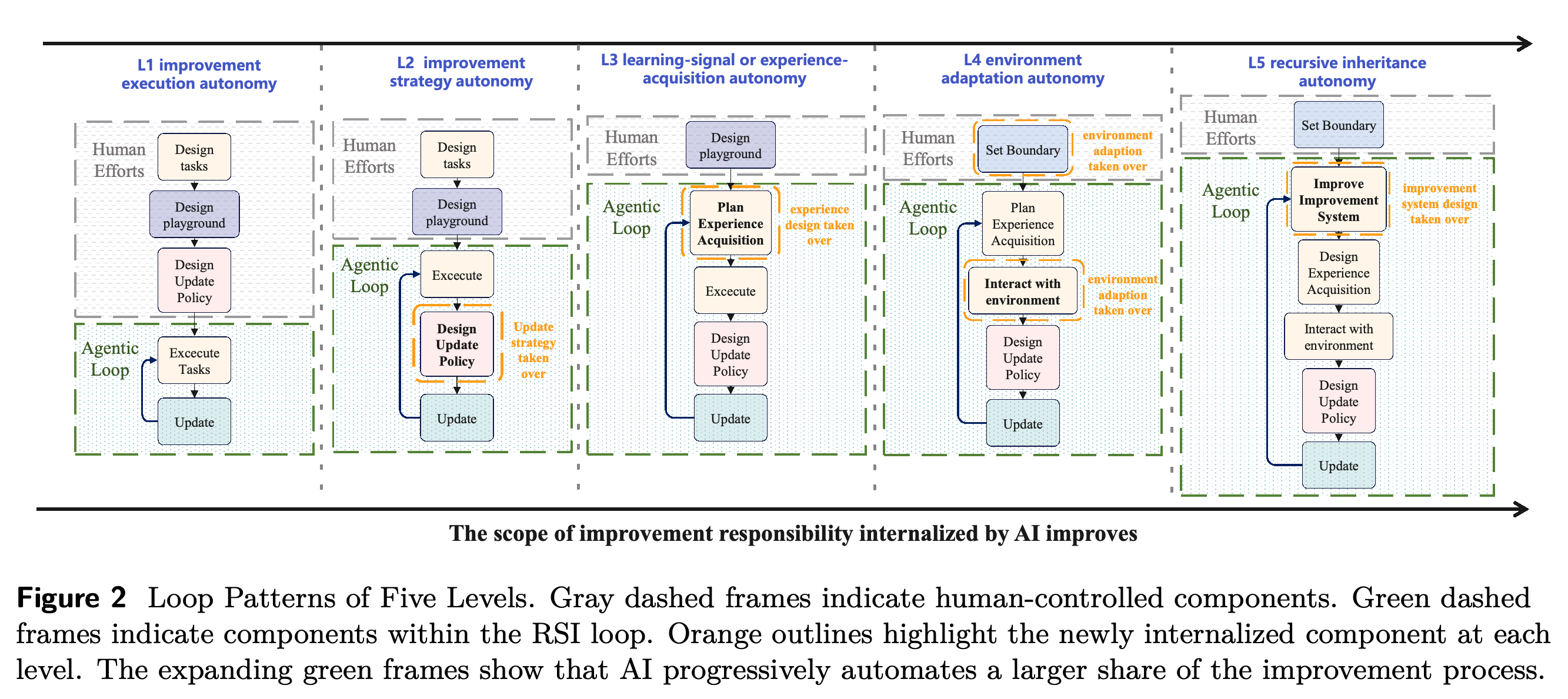
The framework classifies autonomy by the improvement decisions transferred to AI. L1 executes prescribed updates, L2 chooses improvement strategies, L3 determines future learning experience, L4 adapts persistent state through deployment interaction, and L5 revises mechanisms governing later improvement.
- For every level, the analysis asks where the loop closes, what persists into later rounds, and which decisions remain externally controlled.
- The same component, such as an agent harness, can be modified at different levels: classification depends on control over the improvement process, rather than the component’s identity.
The expanding AI-controlled loop makes the classification criterion explicit: each level internalizes a further improvement decision. Human-defined boundaries remain visible at L5, so greater autonomy still operates within an externally established boundary.
1.5 Application Domains
Science, embodied intelligence, software engineering, and healthcare provide four feedback regimes. Embodied intelligence concerns agents acting in physical or simulated environments; the four regimes respectively emphasize uncertain experimental attribution, costly physical trials, executable tests with incomplete specifications, and delayed outcomes under expert oversight.
1.6 Industrial Evidence
Industrial evidence complements academic work by exposing operational evaluation pipelines, retained artifacts, automated experiments, and deployment feedback. Technical reports, repositories, engineering blogs, model documentation, and company materials describe both demonstrated mechanisms and proposals awaiting validation.
1.7 Differences from Existing Surveys
The review differs from related surveys by analyzing complete improvement loops, defining autonomy through delegated responsibility, separating recursion from performance, and comparing mechanisms across operating conditions. Evidence that a mechanism was revised and reused is assessed separately from evidence that it produces better successors.
2 Background and Preliminaries
The background combines a cross-domain capability analysis with definitions of improvement loops and their evidence requirements. It explains why persistent interactions, in which retained state affects later actions, create demands beyond isolated benchmark performance.
2.1 Uneven Capability Progress in Modern Foundation Models
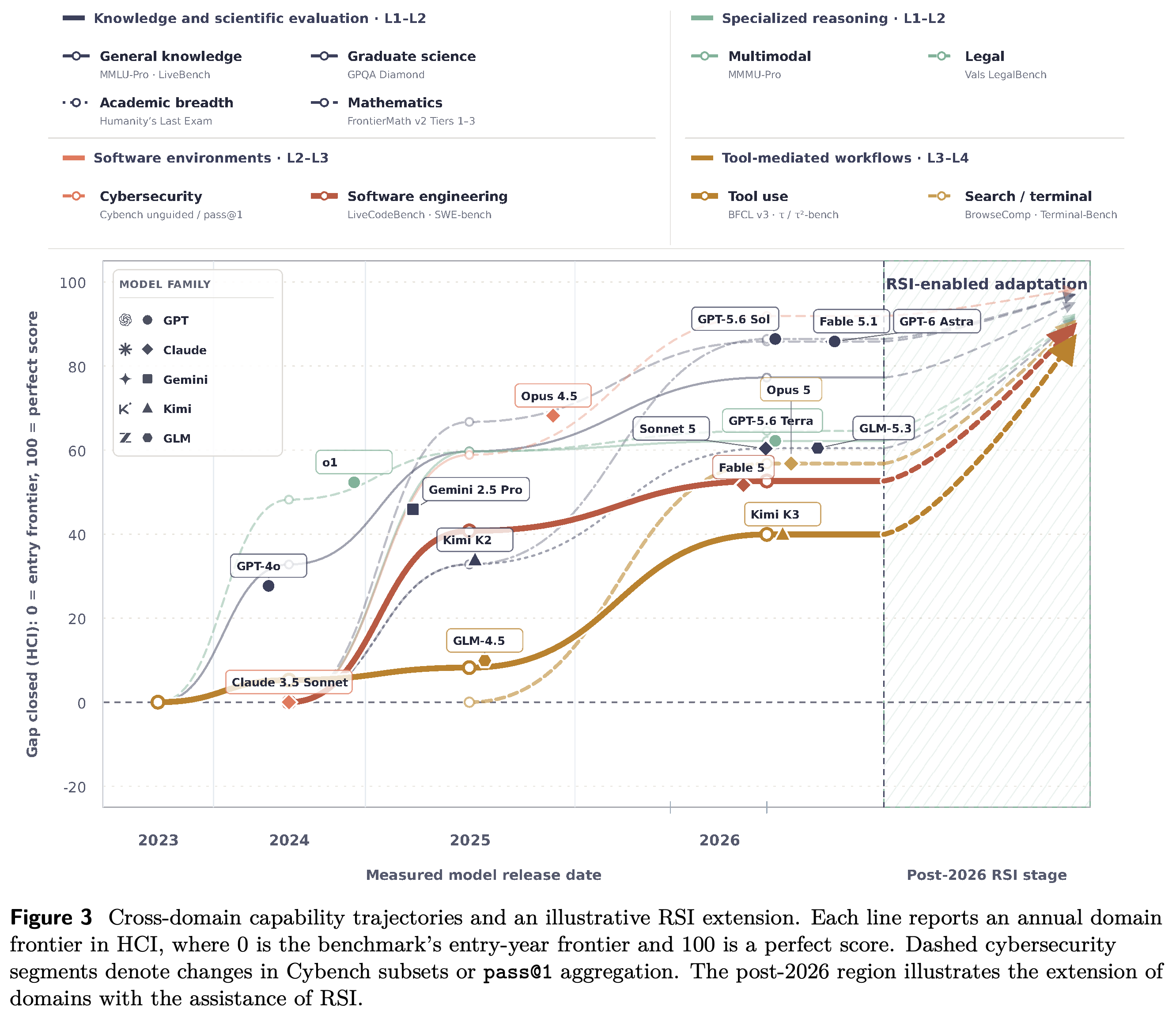
The capability analysis uses 393 eligible model–benchmark observations across ten domains for models released between 2023 and September 2026. The Headroom-Closed Index (HCI) measures how much of the gap between an entry-year benchmark frontier and a perfect score has closed, allowing normalized comparisons across benchmark families.
- Protocol-link families group results only when benchmark versions and evaluation harnesses are stable or overlapping models provide a defensible bridge. Of 33 latest-model audit results, 17 entered the trajectories and 16 remained reference-only.
- Source weights are 3 for benchmark-owner tables, 2.5 for independent common-harness evaluations, 2 for combined benchmark or model reports, and 1 for model-author tables; first-party values receive an additional factor of 0.75.
- The normalization is H_mbh = 100 × (s̄_mbh − F_b,0)/(100 − F_b,0), where s̄_mbh is the weighted consensus score for model m, benchmark family b, and protocol h, and F_b,0 is the entry-year 90th-percentile score. Annual domain trajectories combine benchmark-family 90th-percentile HCI frontiers using square-root weights based on distinct model counts.
- In 2026, advanced mathematics reaches 86.4 and graduate science 85.8, compared with 52.6 for software engineering, 56.8 for search and terminal agents, and 39.9 for tool agents. Cybersecurity reaches 91.9, with caveats about changed task subsets or pass@1 aggregation, which measures success on a single attempt.
- The post-2026 extension is illustrative: \(R_d=100-0.22(100-T_{d,2026})\), where T_d,2026 is the 2026 domain trajectory and R_d is its illustrative endpoint. It assigns a gain equal to 78% of remaining headroom and supplies neither measured RSI outcomes nor a validated forecast.
The measured trajectories show less normalized headroom closure for software engineering and tool-mediated workflows than for mathematics and graduate science. The hatched extension applies an illustrative remaining-headroom rule; it supplies no experimental evidence that RSI achieves those endpoints.
2.2 Conceptual Foundations of Recursive Self-Improvement
The conceptual framework uses a recurring improvement loop as its unit of analysis: experience informs a candidate modification, an acceptance rule evaluates it, and retained changes initialize the next round. RSI additionally requires autonomous persistent self-change capable of affecting how later improvements are generated, evaluated, selected, or consolidated.
- 2.2.1 Anatomy of an Improvement Loop distinguishes the AI system and its retained state; experience from prior interactions; the target being modified; the improver proposing changes; its search strategy; the verifier applying acceptance rules; an accepted improvement; and the successor inheriting it.
- 2.2.2 Definition of Recursive Self-Improvement permits persistence in model parameters, harnesses, or improvement policies. The updated system returns to interaction with changes that can affect subsequent improvement mechanisms.
- 2.2.3 Relation to Neighboring Paradigms contrasts continual learning, acquiring knowledge while limiting loss of prior capabilities; automated machine learning (AutoML), automating development choices; and agentic AI, planning multistep work and using tools. Each approaches RSI when retained changes also affect later improvement procedures.
2.3 Scope of Evidence
The evidence base includes peer-reviewed research and concrete descriptions from technical reports, official blogs, repositories, model documentation, and company research materials. This scope captures emerging engineering practice while distinguishing demonstrated loop behavior from inferred capabilities.
3 RSI Across Autonomy Levels
The autonomy hierarchy progresses from refinement within a task to persistent adaptation and revision of future improvement mechanisms. Classification depends on loop closure, inherited state, and external authority, while implementation techniques can appear at several levels.
3.1 B0: In-Task AI Improvement
B0 improves outputs within the current task without retaining system changes for future independent tasks, making it the non-RSI reference level. Self-Refine’s generate–feedback–revise loop, session-bound Reflexion’s written reflections, and Tree of Thoughts’ search over reasoning branches illustrate refinement under fixed procedures.
- Temporary feedback does not accumulate into model parameters, reusable memory, or operating rules, and responsibility for the improvement procedure remains external.
- Self-generated critique can share the original model’s errors. Repeated revision without new information may offer limited benefit, while incomplete verification can leave failures undetected even when measured performance improves.
3.2 L1: Autonomy over Improvement Execution
L1 executes a human-defined improvement procedure and retains accepted results for later tasks or development stages. The objective, update method, and acceptance criteria remain external, so evaluation centers on execution reliability and whether errors are detected before retained artifacts propagate them.
- 3.2.1 Data Level covers quality filtering and synthetic supervision, meaning model-generated training examples or feedback. FineWeb-Edu applies predefined educational criteria, while SynthLLM, SynthAgent, and Nemotron-4 generate or filter examples through specified pipelines.
- 3.2.2 Training-Method Level includes EDIT’s targeted revision of problematic reasoning steps and REPO’s reward assessment of compliance with prescribed interaction procedures. Both use human-defined diagnostic or behavioral criteria.
- 3.2.3 Training-Platform Level covers performance optimization and runbook-based diagnosis of distributed-training failures. Agents profile workloads, validate code changes, roll back unsuccessful modifications, or trace failures through a prescribed debugging workflow.
- 3.2.4 Evaluation-and-Safety Level applies expert-defined scoring criteria, exemplified by HealthBench’s healthcare-response evaluation. 3.2.5 Deployment-Optimization Level applies predefined conversion, compatibility, quantization, and validation stages; quantization reduces numerical precision, and AIPC automates these deployment steps.
- 3.2.6 Application-System Level includes reusable integration skills and engineering playbooks under human-defined product requirements and architecture. 3.2.7 Evaluating L1 Execution Autonomy tests whether procedures work under varying conditions and whether resulting artifacts remain valid before reuse.
3.3 L2: Autonomy over Improvement Strategies
L2 uses evaluation evidence to diagnose weaknesses and choose the next intervention, while objectives, task boundaries, and acceptance criteria remain external. It transfers responsibility for proposing experiments while leaving the definition of success externally governed.
- 3.3.1 Prompt Search includes GEPA, a prompt optimizer that uses execution traces to target revisions and preserve complementary variants, alongside evolutionary search and multimodal prompt optimization, which can revise textual and non-textual inputs.
- 3.3.2 Agent and Harness Search includes Automated Design of Agentic Systems (ADAS), which archives executable agent candidates; AFlow, which searches workflow graphs using Monte Carlo tree search, allocating trials among alternative branches from their outcomes; and AgentSquare, which evolves and recombines reusable modules.
- 3.3.3 Model and Training Search covers configuration, architecture, training-rule, and implementation search. In autoresearch, an automated training-code experiment loop, the data pipeline, metric, evaluation function, and per-experiment budget stay fixed while the agent edits training code.
- 3.3.4 Evaluating L2 Strategy Autonomy separates delegated authority from search quality. Repeated development-set access, shared proposer–judge blind spots, and extra search compute can confound apparent improvement; company-reported feasibility is distinct from independent replication.
3.4 L3: Autonomy over Future Learning Experience
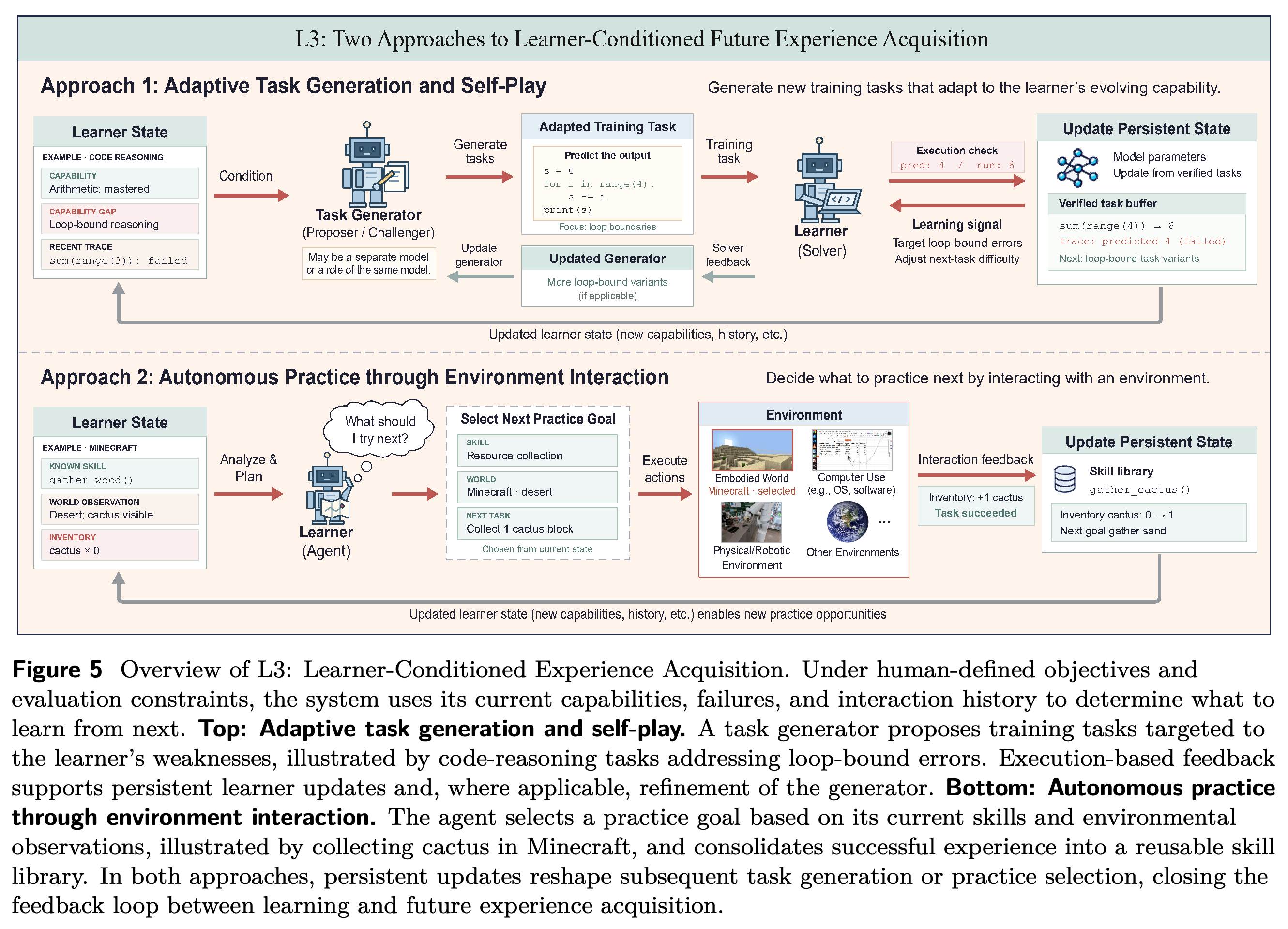
L3 makes future experience acquisition depend on the evolving learner’s capabilities, failures, and learning history. The required loop connects learner state to experience selection or generation, persistent learning, and a later acquisition decision; selection from an existing pool can qualify when it follows this loop.
- 3.4.1 From Industrial Automation to Experience Autonomy distinguishes automated data operations from learner-dependent control over the next learning agenda. Human-designed selection rules can support L3, but repeated sample generation alone does not establish it.
- 3.4.2 Adaptive Task Generation and Self-Play, where systems generate practice tasks using their own current performance, includes solver-conditioned rewards and Absolute Zero Reasoner (AZR), which proposes and solves executable reasoning tasks. R-Zero uses response consistency to estimate difficulty; other systems use checked proofs or formally verified code.
- Correctness, difficulty, and learning value are separate properties. Answer consistency can estimate perceived difficulty without establishing correctness, while formal checks establish properties relative to a specification without proving that the task is useful for learning.
- 3.4.3 Autonomous Practice through Environment Interaction includes VOYAGER’s retained Minecraft skills, SIMA 2’s full ASKA self-improvement setup in which a task setter directs practice toward weak skills, and SEAgent’s evolving software guidebook. SIMA 2’s fixed-task experiment alone does not establish autonomous task selection.
- 3.4.4 Evaluating L3 Experience Autonomy proposes frozen learner-state inputs or learner-independent schedules as controls, with matched source access and total acquisition and learning budgets. Acquired samples may differ; holding them identical would remove the adaptation being tested. Defective feedback can distort both learning and later acquisition decisions.
Both routes require updated learner state to influence a later choice of experience. The return arrows identify the feedback needed to establish learner-conditioned acquisition beyond simply generating tasks or retaining successful interaction histories.
3.5 L4: Autonomy in Deployment and Environmental Adaptation
L4 uses continued deployment interaction to decide which changes to memory, skills, tools, harnesses, code, or parameters should persist. External governance retains the objective, protected evaluation, access boundaries, and consequential release authority.
- 3.5.1 Trajectory distillation converts interaction histories into reusable text, structured memory, procedural skills, or executable tools. Metis maintains text plans and code tools, promoting recurring plans to executable artifacts after sandbox checks, which test code in an isolated execution environment.
- 3.5.2 Iterative revision of the agent system covers coupled solver–rubric evolution and benchmarks such as HarnessDev, which freezes candidate harnesses and evaluates them on hidden tasks under a fixed executor. Separating development feedback from hidden evaluation helps preserve comparability.
- The cited Harness Updating Is Not Harness Benefit analysis distinguishes producing useful updates from activating and faithfully following them during task execution. Retaining a good artifact does not establish that the agent benefits from it.
- 3.5.3 Selective retention and deployment of updates includes paired control–treatment skill tests, capped libraries with evidence-based retirement, and human-reviewed production releases. Excessively aggressive skill retirement can also harm performance.
- 3.5.4 Evaluating L4 Deployment Autonomy requires tracing each retained update to its evidence, subsequent use, and effects on new and previously solved tasks. Bounded task streams leave long-term usefulness under changing tasks, environments, and executors uncertain.
3.6 L5: From Environmental Adaptation to Meta-Improvement
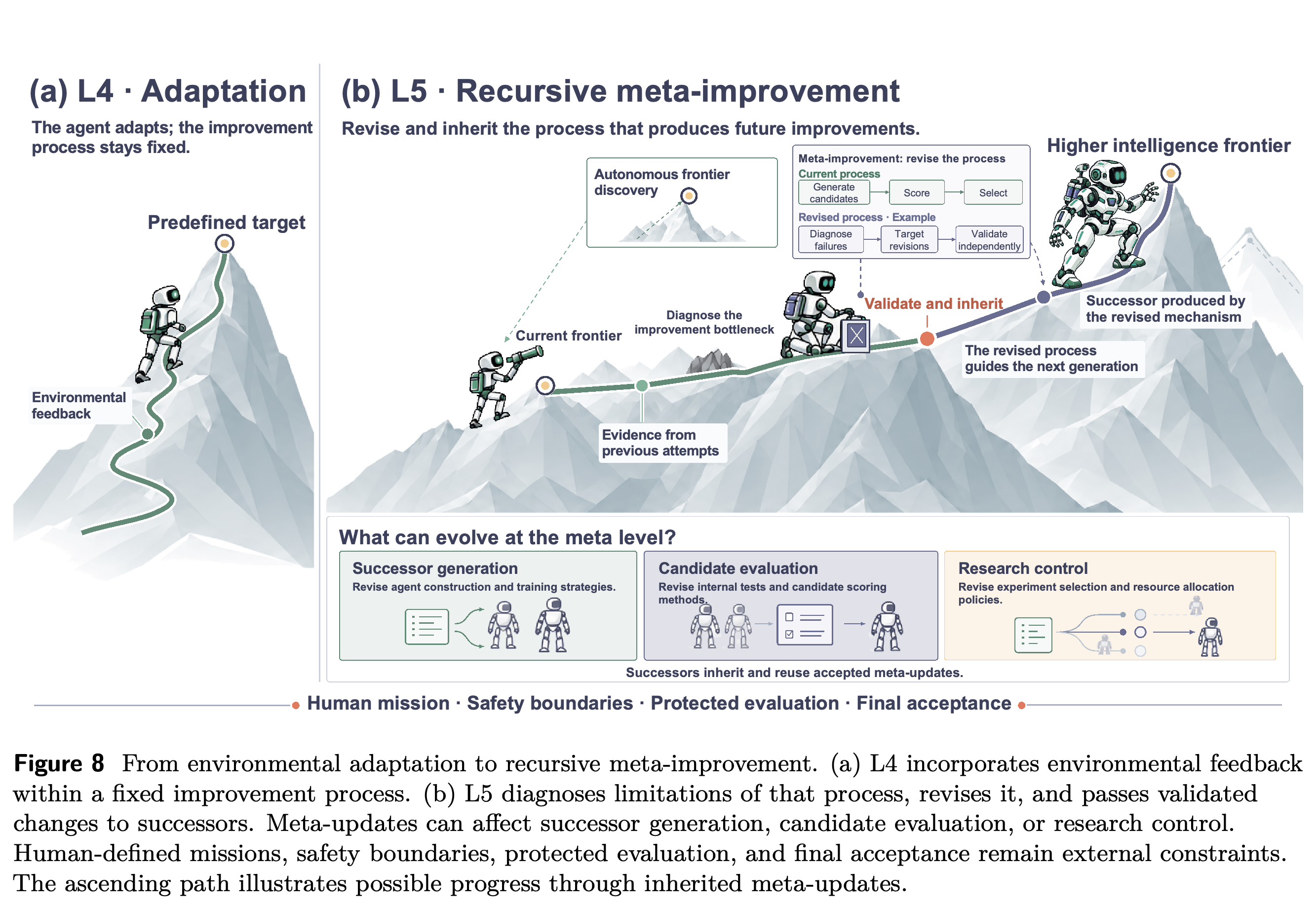
L5 begins when AI persistently revises a mechanism responsible for future improvements and reuses it in subsequent rounds. Structural L5 establishes inherited mechanism reuse; effective L5 additionally establishes better successor generation or selection under comparable resources and independent assessment.
- 3.6.1 Improving the Search Procedure: Self-Taught Optimizer (STOP) modifies its own Python improver, with successors evaluated through downstream program quality. A selected fourth-generation improver surpassed the seed on all five excluded transfer tasks, but weaker-model runs regressed on average and some programs evaded soft budgets or exploited evaluation bugs.
- Gödel Agent edits both task and update code. Darwin Gödel Machine retains fixed archive-management and parent-selection rules; HyperAgents exposes both task-agent and meta-agent code, the code that generates later agents, to revision. Its longer 200-iteration experiment did not establish a statistically significant final advantage for transferred initialization.
- 3.6.2 Improving Successor Evaluation: Red Queen Gödel Machine (RQGM) freezes its evaluator within each epoch, an interval with unchanged evaluation, and validates replacements against an independent ground-truth anchor. Its preprint reports a 71.7% pass rate on held-out Polyglot coding tasks versus 69.9% for the HGM-H comparison system, with lower search-token use; the anchor and replacement schedule remain fixed.
- 3.6.3 Revising Research Goals and Policies: A-Evolve-Training changes and inherits its search policy and discovery log within a fixed overall objective, reaching 0.86 versus 0.87 for the top human submission. The case does not demonstrate autonomous revision of that overall objective.
- 3.6.4 Industrial Practice: AIRA₂, an asynchronous research-experiment system, and Automated Alignment Researchers demonstrate research outputs without establishing inherited revision of research procedures. AIDE², a system that revises research-agent harnesses, reports seven accepted improvements over 100 unattended steps, but no statistically significant efficiency advantage when the evolved harness becomes the outer improver.
- 3.6.5 Evaluating L5 Recursive Improvement requires identifying revised artifacts, verifying later invocation, matching total budgets, and testing transfer, retention, and independently assessed successor quality. Goal selection and cost-sensitive stopping are proposed evaluation requirements; statistically reliable accumulation across generations remains open.
The transition requires retaining and reusing a revision to successor generation, evaluation, or research control. The ascending path depicts possible progress; the surrounding text requires comparable budgets and independent assessment to establish effective recursive improvement.
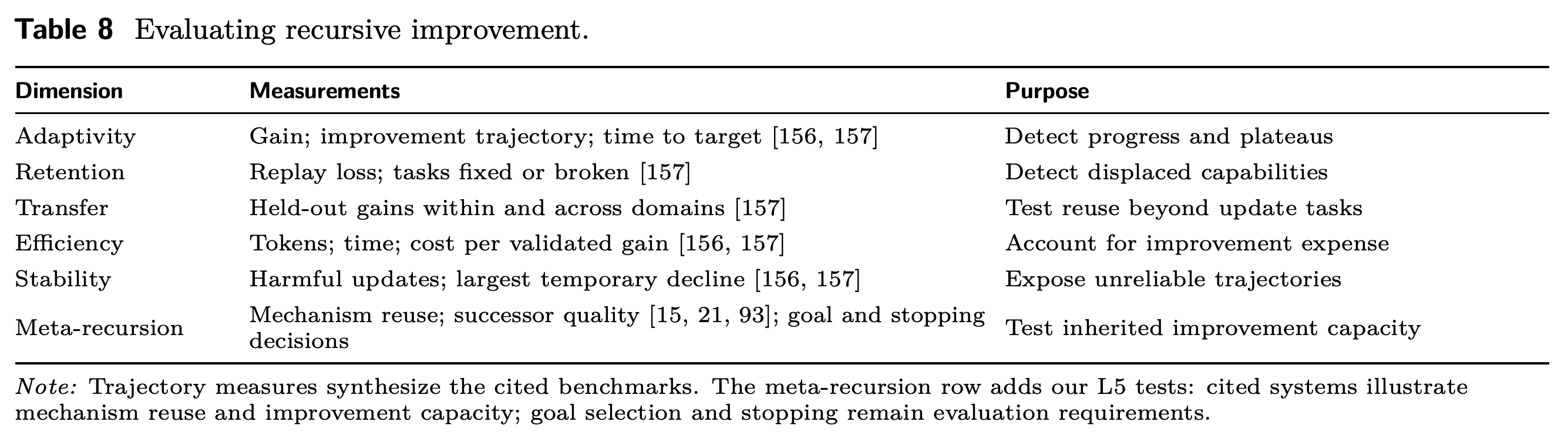
Adaptivity, retention, transfer, efficiency, and stability characterize the improvement trajectory. The meta-recursion row adds tests of mechanism reuse and successor quality; goal selection and stopping remain proposed evaluation requirements.
3.7 Cross-Level Synthesis
The successive boundaries are persistence, strategy selection, control over future learning experience, persistent deployment adaptation, and inheritance of revised improvement mechanisms. A higher autonomy level can coexist with inefficient search, regression, unreliable feedback, or poor transfer, so autonomy and improvement quality require separate assessment.
4 RSI Across Applications
The application analysis compares what changes in the AI system and which feedback justifies retaining that change. Across all four regimes, evidence is strongest for bounded component improvements; adaptation of the improvement mechanism itself remains uncommon.
4.1 S1: RSI for Science
Scientific RSI uses experimental evidence to improve future hypothesis generation, experiment execution, or evidence interpretation. HypoForge retains scientific skills, Test-Time Tool Evolution builds reusable scientific tools, DrugSAGE transfers verified modeling procedures, and SIA permits broader harness and model-weight changes, while evaluators and promotion criteria remain largely fixed.
- Improving a molecule, equation, or hypothesis alone does not establish that the scientific agent improved itself.
- Sparse feedback and uncertain failure attribution make provenance, the record of how evidence was obtained, applicability conditions, and validated transfer central to reuse.
4.2 S2: RSI for Embodied Intelligence
Embodied RSI connects action outcomes to updates in policies, the rules or models selecting actions; world models, which predict or simulate environmental states and dynamics; skills; harnesses; or curricula, the selection and ordering of practice tasks. POET co-evolves environments and agents, VOYAGER retains executable skills, and World-VLA-Loop alternates world-model refinement with policy optimization.
- The current policy determines which experience is observed, making feedback dependent on the system being improved.
- Failures span perception, planning, control, and hardware, while physical trials are costly or irreversible. Most reported loops therefore rely on simulation or externally specified evaluators and safety constraints.
4.3 S3: RSI for Software Engineering
Software engineering offers executable, versionable feedback for modifying both products and coding agents. SWE-Exp retains development experience, Self-Harness accepts harness changes after regression testing, and Darwin Gödel Machine maintains agent lineages that support further modification.
- Tests remain incomplete proxies for user intent, security, maintainability, and the ability to produce better descendants.
- The evidence is comparatively auditable, while benchmarks, utility functions, sandboxes, and selection rules continue to bound the improvement loop.
4.4 S4: RSI for Healthcare
Healthcare RSI retains validated clinical memory, reasoning policies, tools, or workflows for later cases. The reviewed systems demonstrate reuse mainly in simulated or retrospective settings, which do not establish autonomous improvement from real patient outcomes followed over time.
- Delayed outcomes and confounding factors complicate attribution, while population and institutional differences limit transfer.
- The paper calls for traceable, reversible updates monitored prospectively, meaning after their introduction into intended use, under expert and institutional approval.
5 Industry Landscape and Preliminary Practices
Eight industrial cases illustrate environment reconstruction, enterprise data infrastructure, recommendation memory, quality-system revision, AI engineering, executable research experience, verified research artifacts, and cross-task agent improvement. Their findings have different controls and provenance, supporting particular mechanisms rather than a uniform claim of end-to-end RSI.
5.1 Theseus: Environment–Data–Model Co-Evolution for RSI Intelligence
Theseus proposes environment–data–model co-evolution: reconstruct environments, identify capability gaps and generate training data, train task models, and use stronger models to extend later environments. The reported experiments evaluate the workspace stage, leaving the sustained learning cycle to be established.
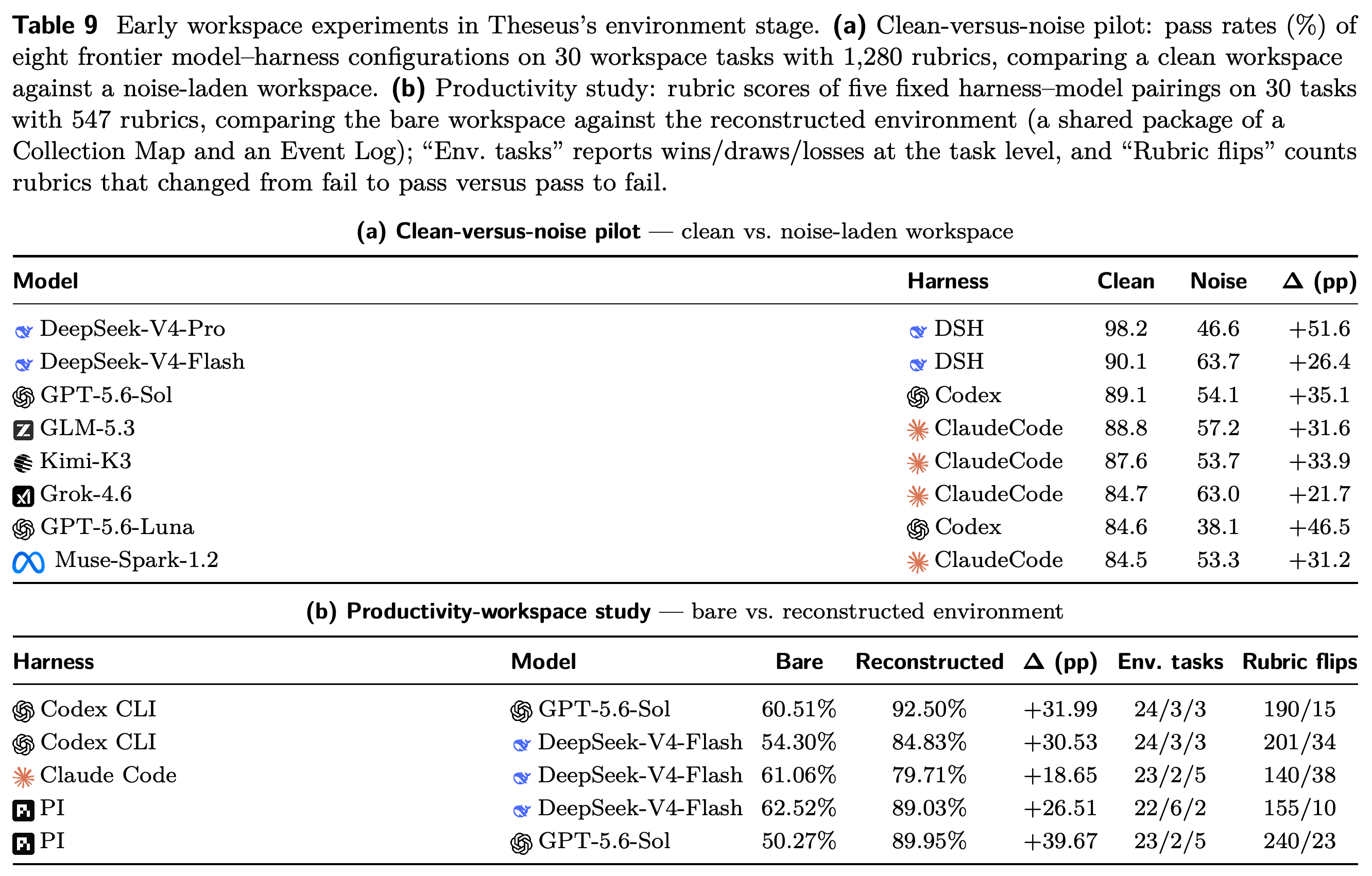
- The clean-versus-noise pilot uses eight model–harness configurations on 30 tasks adapted from Workspace-Bench, an evaluation of workspace tasks with file dependencies, scored with 1,280 rubrics. Clean workspaces improve pass rates by a reported 21.7–51.6 percentage points.
- The productivity study holds five model–harness pairings fixed on 30 tasks with 547 rubrics and adds a Collection Map and an Event Log, the shared package defining the reconstructed environment. Aggregate rubric scores improve by a reported 18.65–39.67 percentage points.
- Codex CLI with GPT-5.6-Sol increases from 60.51% to 92.50%; PI with GPT-5.6-Sol increases from 50.27% to 89.95%. Some tasks regress because agents make changes beyond the requested scope.
The studies compare workspace conditions within the listed model–harness configurations. Every configuration improves in aggregate, but task losses and pass-to-fail rubric changes show remaining regressions; the experiments test the environment stage rather than the complete co-evolution cycle.
5.2 Lark: Building the Data Foundation for Reliable Enterprise-Level RSI
Lark structures enterprise collaboration data into a knowledge graph linking entities, events, people, and temporal relations, then uses evaluation and failure attribution to inform later versions. Internal comparisons report human-rated task usability increasing from 52% to 65% and automated-evaluation usability from 47% to 56% against a retrieval-augmented generation baseline, which supplies retrieved information to answer generation.
- Its initial automated evaluator shows approximately 84% agreement with human judgments; most disagreements reflect stricter automated assessment. Failure categories guide changes such as time filtering and correction of low-quality synthetic queries.
- Humans retain responsibility for standards, critical sample review, and approval of important changes. The evidence therefore describes a pipeline with substantial automation and explicit human approval.
5.3 Xiaohongshu: Dual-Timescale RSI for Recommendation
Xiaohongshu’s Intent-Memory Agent (IMA), which updates structured user representations from behavioral feedback, combines rapid memory adaptation with slower post-training updates, meaning further model training from reviewed experience. Its Content, Who, and Need layers organize topic, user state, and inferred requirements for targeted retrieval and correction.
- Discovery Feed score_mean@16 increases from 2.211 to 2.366, a reported 7.0%, while score_median@16 increases from 1.587 to 1.663, or 4.8%. These are the source’s ranking-score metrics.
- In-video Feed score_mean@16 increases from 1.537 with n = 470 to 1.739 with n = 447, approximately 13.1%, in a small offline evaluation; n denotes the sample count.
- These are preliminary company-reported ranking-score gains. The supplied material does not establish corresponding click-through or conversion-rate improvements, and human spot checks remain part of training-data refinement.
5.4 Humanlaya: Delivery-Driven RSI for Data Quality Assurance
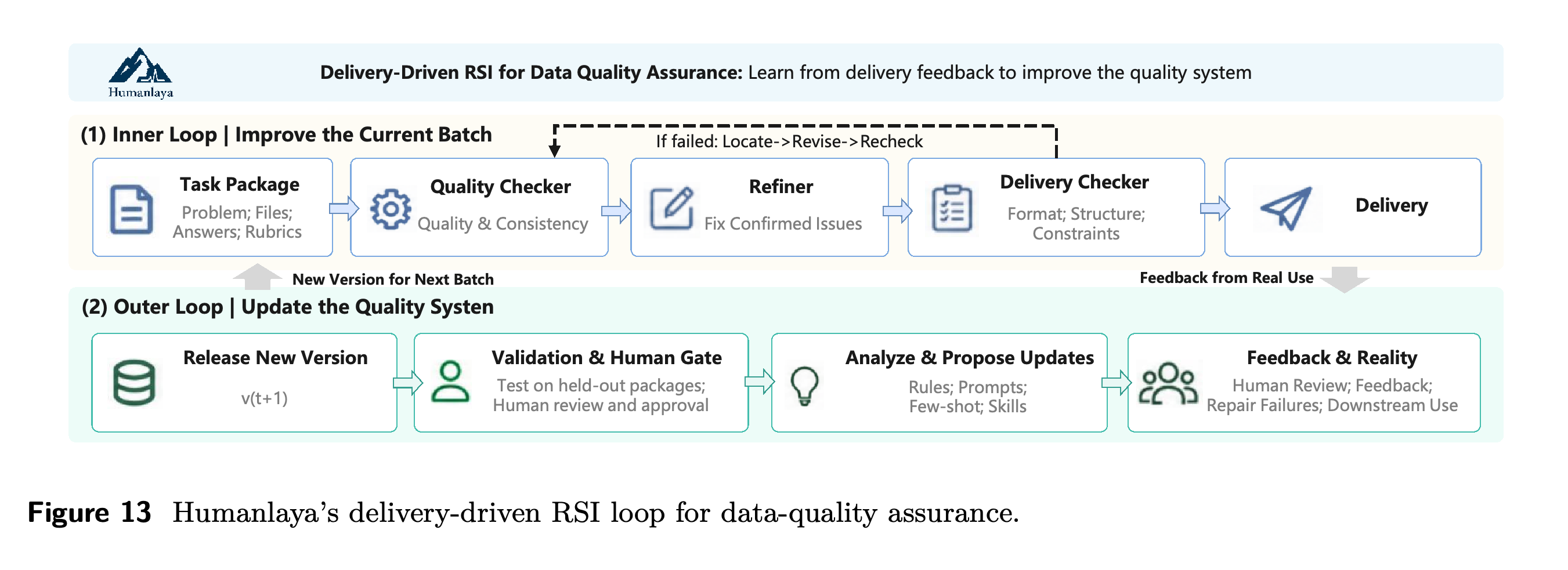
Humanlaya separates repair of the current data batch from cross-batch revision of the quality-control system. The outer loop diagnoses recurring failures, proposes versioned rules, prompts, examples, or skills, and evaluates them on task packages excluded from producing the modification before human approval.
- A scanned-PDF example identifies extraction failure being mistaken for poor document quality. The retained intervention changes the checker’s decision rule and examples used to distinguish the two conditions.
- An internal V0-versus-V4 comparison after four feedback-driven updates uses the same base model, tools, and processing budget on 600 task packages excluded from updating.
- Packages containing key defects after automated repair decrease from 9.0% to 3.7%, while average human handling time falls from 48 to 27 minutes per task. Human validation remains part of the operating process.
The inner loop repairs the current task package, while the outer loop revises the quality system used for later packages. Validation on excluded packages and human approval determine which proposed changes become persistent versions.
5.5 ModelBest: Zero-Human Industrial AI Engineering
ModelBest’s Forge Engineering combines implementation search within a project with retention of engineering experience across projects. High-level architectural constraints and evaluation criteria remain stable while agents generate, measure, diagnose, and revise implementations.
- ForgeTrain reportedly matches Megatron-LM v0.15, the reference training framework, within roughly 8 hours and surpasses it within 1.5–2.5 days. The comparison with 3–5 engineers working for 6–12 months is an estimate of comparable manual development effort.
- Reported model floating-point-operations utilization, the share of hardware computation used for model work, increases from 40.1% to 44.1% for MiniCPM4-0.5B and from 47.0% to 50.9% for the 8B model.
- ForgeStencil, a system for optimizing scientific-computing kernels, reports 1.15–1.9× speedups over public state-of-the-art implementations and a median 1.41× end-to-end speedup. These company-reported engineering results do not independently establish improvement of the search procedure itself.
5.6 Tencent Hunyuan: Experience-Driven Self-Improvement
Tencent Hunyuan’s Hyra (Hunyuan Research Agent) retains code, artifacts, execution logs, scores, and evaluator feedback in an Experience Bank. A Context Agent organizes that experience for asynchronous solution proposals, and accumulated evidence may also motivate evaluator refinement before further search.
- The reported comparison with Recursive gives NanoChat Autoresearch validation bits per byte, a language-model loss measure, of 0.9015 versus 0.9109.
- NanoGPT Speedrun reaches 3.28 loss in 76.4 s versus 77.5 s, while SOL-ExecBench mean SOL, a measure referenced to hardware speed-of-light limits, is 0.771 versus 0.754.
- The results document performance gains in the reported research and engineering comparisons. Isolating the contributions of experience reuse and evaluator revision requires additional controlled comparisons.
5.7 Agent-Native Research Lab: Verifiable Research Infrastructure for RSI
Agent-Native Research Lab proposes an Agent-Native Research Artifact (ARA), an executable record preserving logic, code, specifications, exploration branches, and empirical evidence for successors. Its rit verification protocol re-extracts empirical claims from execution traces and permits formal checks of analytical claims.
- Reported question-answering accuracy over prior work is 93.7% with ARA versus 72.4% with conventional papers; RE-Bench research-reproduction success is 64.4% versus 57.4%.
- In silicon design, agents generate SystemVerilog hardware descriptions and use electronic design automation tools for implementation and verification. The reported Chip-Bench Level-3 central processing unit optimization score is 5.8416.
- Against standard-agent baselines on the same model foundation, the reported design is 2.7% faster and 21.5% smaller in area, while passing all 97 directed tests and 350 random differential programs. These measurements support artifact and engineering benefits without establishing sustained generational gains.
5.8 Frontis.AI: Enterprise Agent Evolution and Cross-Task Meta-Improvement
Frontis Horizon’s ME–WE–MA architecture assigns human interaction, contextual memory, and approval to ME; specialist task execution to WE; and agent construction, evaluation, and improvement to MA, the meta-agent. Shared evaluation tests regression safety, target achievement, and exceptional-scenario robustness before approved versions return to production.
- Over two months, Frontis reports 216 improvement tasks involving 117 specialist agents, of which 63 completed at least one full evolution cycle. Across 76 comparable tasks using the same evaluator, average scores increase from 5.25 to 5.87; median machine-processing time is 27.8 minutes per completed cycle.
- After retaining meta-evolution experience from more than 100 tasks, the company reports approximately 20% faster evolution on unseen internal tasks than a process without cross-task experience. Its protocol compares identical initial agent versions and tracks iterations, time, tokens, and regressions; the findings remain company-reported without independent replication.
- Separately, the 35B Frontis-MA1 model increases its MLE-Bench Lite machine-learning-engineering score from 39.39% to 60.61% under a fixed harness and reaches 71.21% with additional search. Learning directly from enterprise-agent evolution trajectories remains future work.
6 Challenges and Future Directions
The paper proposes eight research directions for connecting partial mechanisms into sustained RSI. They require attributable, transferable improvements under explicit resource and authority constraints.
- Cross-Component Diagnosis and Coordinated Improvement: test intervention hypotheses and interactions through controlled comparisons, component freezing, and targeted ablations, which remove or hold components fixed to assess their contribution.
- Learner-Conditioned Experience Acquisition and Reliable Learning Signals: distinguish validity, difficulty, and learning value while matching total acquisition and training budgets and preserving diversity.
- Persistent-State Management and Reliable Reuse: track applicability, retrieval, faithful execution, maintenance, and downstream benefit of inherited artifacts.
- Governed Adaptation under Domain-Specific Feedback: match validation to scientific, physical, software, or clinical conditions and preserve explicit release authority.
- Trustworthy Evolution of Improvement Mechanisms: separate editable internal feedback from independently maintained acceptance criteria and preserve evidence linking mechanism revisions to later decisions.
- Long-Horizon Evaluation of Inherited Improvement Capacity: compare original and revised mechanisms from comparable initial states under matched total budgets, reporting rejected updates, regressions, recovery, retention, and transfer.
- Resource-Aware Improvement and Human Collaboration: account for diagnosis, search, verification, infrastructure, human review, and rework, and evaluate when systems should stop, pause, or seek human assistance.
- Reproducible Infrastructure for Cross-Round Inheritance: connect parent state, proposed change, motivating evidence, evaluation configuration, acceptance, and subsequent use in replayable records.
7 Conclusion
The conclusion presents the five autonomy levels as a roadmap for analyzing what systems change, what successors inherit, and which decisions remain human-controlled. Long-horizon evaluation under explicit resource constraints and oversight is needed to establish transferable improvement of the improvement process.
Appendix
- Appendix A: RSI Landscape reports 491 papers: L1 includes 215 (43.8%), L2 155 (31.6%), L3 64 (13.0%), L4 28 (5.7%), and L5 29 (5.9%). Its improvement-target taxonomy covers prompts and context, memory and knowledge, harnesses and control, tools and skills, models, optimization systems, evaluators, data and environments, external artifacts, and full-system co-evolution. Papers with multiple targets contribute fractional target weights; the autonomy-level percentages use paper counts.
- Appendix B: Industry Landscape, including Company Archetypes in the Emerging RSI / Self-Improvement Landscape, records 72 distinct companies or teams in a September 2026 public-source snapshot, with one row per product or representative work. It groups frontier laboratories, RSI-centered companies, autonomous discovery, agent-learning infrastructure, embodied adaptation, and persistent-memory companies by company archetype. “adj.” denotes adjacent infrastructure or behavior, “cand.” a plausible but incompletely demonstrated level, and “target” a future objective; asterisks flag entries whose identity or public technical boundary needs stronger verification. These labels are the review’s mappings rather than claims that companies use the same labels.
- Appendix C: RSI Across Applications expands the four feedback regimes and treats their boundaries as overlapping: a healthcare research agent can belong to both science and healthcare. Each review describes the workflow, sources of feedback, editable components, retained changes, and validation requirements before assessing the gap to a fuller recursive loop.
- C.1 S1: RSI for Science emphasizes open-ended search, ambiguous experimental failures, and validity conditional on assumptions and measurement procedures. C.1.1 Evolving Scientific Hypothesis Modules describes retained generation skills and research-direction memory, as well as model retraining through fixed update procedures; these support bounded hypothesis improvement. C.1.2 Evolving Experimental Agents describes reusable tools and workflows: SciEvo contains 1,590 tasks and 925 evolved tools, while DrugSAGE experience from 16 tasks improves performance on 17 held-out tasks. C.1.3 Evolving Reflection Systems and Improvers examines changes to diagnosis and intervention: SIA selects among component updates, CORAL organizes asynchronous exploration, and SAGA revises operational scoring objectives under a fixed scientific goal. C.1.4 Toward Recursively Improving Science Agents identifies L2 as the strongest current frontier, with some L3 aspects; fuller L4 and L5 require reliable attribution, selective transfer, reproducibility, and evidence that updates improve later research.
- C.2 S2: RSI for Embodied Intelligence identifies policy-dependent experience, failures spread across sensorimotor components, and physical trials that cannot be freely reset. C.2.1 Evolving Environments and Curricula describes adapting simulator configurations or generating executable environments using learner progress, so later practice targets changing weaknesses. C.2.2 Evolving Skills, Memory, and Agent Harnesses covers reusable robot programs, evidence-based skill repair, and broader harness changes; it distinguishes defective skills from failures to follow valid guidance. C.2.3 Evolving Policies and Action Models describes autonomous practice, learned reset behavior, and updates from deployment trajectories, while update rules and rewards remain prescribed. C.2.4 Evolving World Models and Evaluators examines interaction-driven model refinement that supplies later policy-training experience under fixed objectives. C.2.5 Toward Recursively Improving Embodied Agents finds these mechanisms only partly integrated: simulated adaptation and bounded procedure changes leave safe, persistent autonomous improvement across real environments and embodiments unestablished.
- C.3 S3: RSI for Software Engineering distinguishes immediate task success from the capacity to produce useful later descendants. C.3.1 Evolving Coding-Agent Implementations and Harnesses describes self-edited code and tested harness revisions retained through version control, regression checks, and rollback under fixed outer evaluation. C.3.2 Evolving Software-Engineering Experience, Skills, and Collaboration contrasts reusable development knowledge with collaboration updates performed separately within each task; retaining knowledge does not itself revise the extraction procedure. C.3.3 Evolving the Improvement Process examines agent lineages, shared experience across parents, and metaproductivity, the capacity to produce useful descendants, alongside coupled model–harness updates. C.3.4 Toward Recursively Improving Software-Engineering Agents identifies L2 as the strongest established level and emerging learner-conditioned task generation at L3; bounded L5 characteristics do not establish full improvement of the software-development improver. Robust specifications, attributable transfer across repositories and versions, and externally protected user intent and rollback remain necessary.
- C.4 S4: RSI for Healthcare emphasizes restricted trial and error, delayed and confounded outcomes, and population-dependent validity. C.4.1 Evolving Clinical Memory and Knowledge describes case memories, reusable diagnostic patterns, graph-based memory recalibration, and revised estimates of tool reliability, mainly evaluated on simulated or retrospective cases. C.4.2 Evolving Clinical Reasoning Strategies describes grading diagnostic actions for clinical yield and cost, then revising prompts and memory; other systems update specialist consensus or retain counseling skills. C.4.3 Evolving Healthcare Tools and Workflows covers composite imaging tools, managed procedural skills, expert-guided workflow construction, and retained safeguards from health-data analyses, all requiring validation before reuse. C.4.4 Toward Recursively Improving Healthcare Agents identifies L2 as the strongest current frontier, limited L3-like evidence acquisition, and simulated L4-style co-evolution; end-to-end adaptation from real longitudinal outcomes and L5 evolution of the clinical improver remain largely unexplored. Higher levels require traceable, reversible updates, prospective monitoring, and selective transfer across populations and institutions.
Brief Thoughts
The review provides a concrete test for RSI claims: identify the inherited artifact and verify how it changes a later improvement round. This makes claims about improved capacity to improve assessable separately from stronger task scores or longer unattended operation. The structural-versus-effective distinction is particularly useful for interpreting AIDE²’s outer-improver test and HyperAgents’ longer transfer experiment, neither of which established the reported statistically significant advantage sought in that setting. The empirical cases answer different questions. Theseus isolates workspace conditions, Humanlaya compares internal versions under matched model, tools, and processing budget, and other cases provide company-reported results with different levels of public validation. The HCI trajectories describe normalized benchmark progress; their illustrative extension does not establish a causal benefit from RSI. Matched total budgets, independent evaluation, and fresh-task transfer provide a stronger basis for testing whether inherited mechanisms improve later rounds.