


VibeVoice Technical Report | Summary
26 Aug 2025 | Paper Review Speech Generation Text-to-Speech Next-Token DiffusionContents
This article explains the key points of VibeVoice Technical Report.
- 2025-08-26 (arXiv)
- Peng, Zhiliang, Yu, Jianwei, Wang, Wenhui, Chang, Yaoyao, Sun, Yutao, Dong, Li, Zhu, Yi, Xu, Weijiang, Bao, Hangbo, Wang, Zehua, et al.
- Microsoft Research
- Paper
- Github
- Project Page
Summary
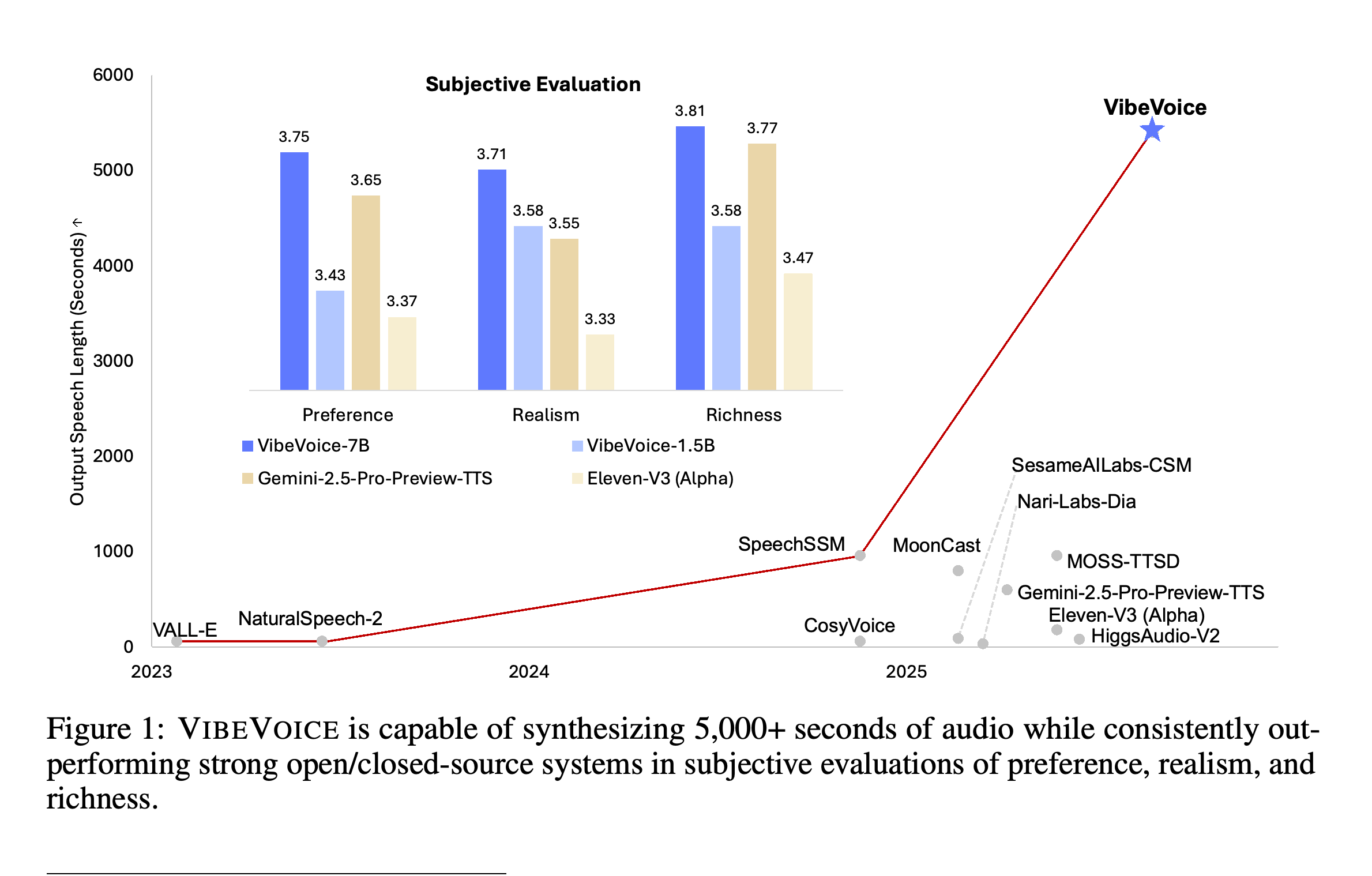
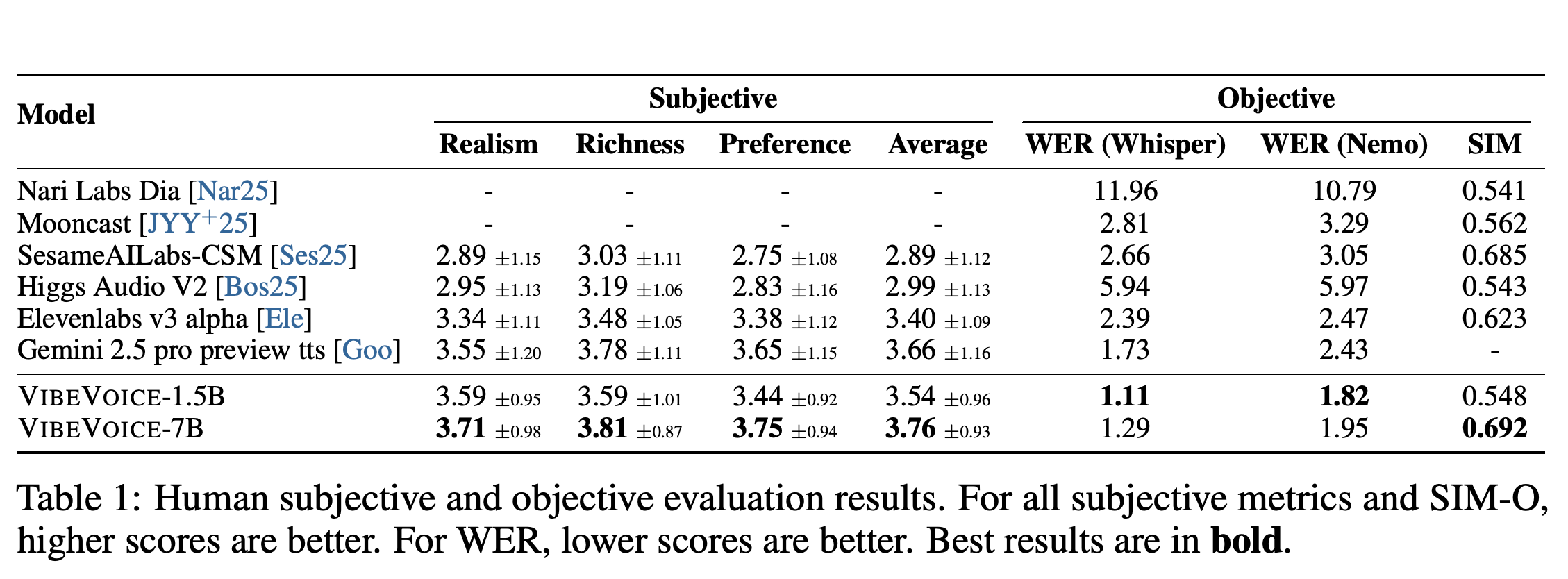
- VibeVoice addresses text-to-speech (TTS), the synthesis of speech from written scripts, for long conversations that require consistent speaker voices, natural turns, and expressive delivery. On eight conversational transcripts totaling about 1 hour, VIBEVOICE-7B achieved the highest reported average human rating among the evaluated systems, scoring 3.76 versus 3.66 for Gemini 2.5 Pro Preview TTS; Gemini used default voices because it did not support the speech-prompt control used for the other systems.
- The method combines continuous speech tokenizers, which encode audio into compact feature vectors, with next-token diffusion, which generates successive vectors by iterative removal of noise. Its acoustic tokenizer produces 7.5 frames per second from 24 kHz audio, and the report states generation capacity of up to 90 minutes with up to 4 speakers in a 64K-token context window.
- VIBEVOICE-7B leads the reported podcast human ratings, while its acoustic tokenizer leads two reconstruction-quality metrics at a lower token rate than the listed alternatives. Short-utterance results are mixed, and the report provides no controlled component ablation, an experiment that removes or changes a component to test its contribution, or measured runtime comparison.
The plot places VIBEVOICE above 5,000 seconds of generation and combines this capacity claim with selected human-rating scores. The inset favors the 7B model, but several inset values differ slightly from Table 1; the detailed evaluation therefore uses Table 1. The generation-length comparison and listener ratings are separate evidence, and the figure does not establish quality throughout a controlled 90-minute test.
1 Introduction
Recent TTS systems produce natural short single-speaker utterances, but long conversations also require consistent voices, natural turn-taking, and delivery that follows the content. Concatenating independently synthesized utterances does not directly address these requirements; the introduction identifies generation length, stability, and unavailable source code as limitations of existing systems.
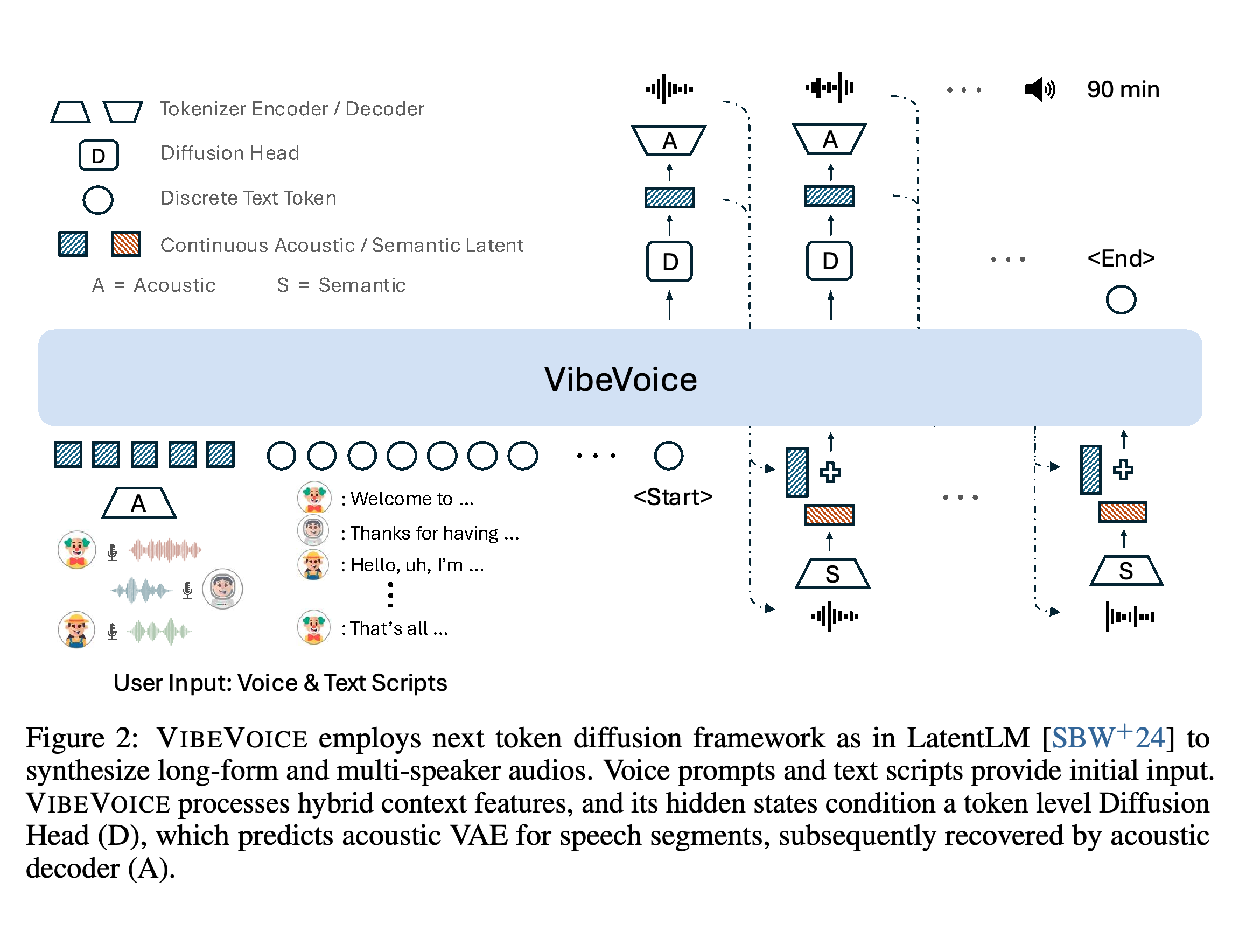
VIBEVOICE shortens speech sequences through a causal tokenizer, which processes audio without using future samples, with 3200× waveform downsampling and a 7.5 Hz frame rate. The authors report an approximate 2:1 speech-to-text token ratio, where two speech tokens correspond roughly to one BPE text token, a subword unit produced by byte-pair encoding.
Voice prompts and speaker-labeled text initialize the sequence model. Its hidden states condition acoustic-feature generation through the diffusion head, the acoustic decoder converts features into speech, and acoustic and semantic encodings of generated speech return to the context for subsequent predictions.
2 Method
The method separates acoustic representation, which captures audio characteristics, from semantic representation, which captures transcript-related content. A pretrained Large Language Model (LLM), a language model used here as the core sequence predictor, processes voice prompts and speaker-labeled scripts, then conditions a diffusion head, a module that generates acoustic features by denoising, for decoding into audio.
2.1 Speech Tokenizers
The acoustic tokenizer uses a σ-VAE, a Variational Autoencoder variant that encodes audio into a latent distribution with predefined rather than learned noise variability. Following LatentLM, a prior next-token diffusion model, this design aims to mitigate variance collapse, the loss of latent variability during autoregressive modeling, where each prediction depends on preceding context. The encoder predicts the mean μ, and the report specifies sampling as z = μ + σ ⊙ ϵ, where ⊙ denotes element-wise multiplication, \(\epsilon \sim \mathcal{N}(0,1)\), and \(\sigma \sim \mathcal{N}(0,C_{\sigma})\), with N denoting a Gaussian distribution.
The acoustic encoder and decoder have a mirror-symmetric architecture. Seven stages of modified Transformer blocks, sequence-processing blocks, replace self-attention, which relates positions within a sequence, with one-dimensional depth-wise causal convolutions, which filter channels separately using current and past inputs; six downsampling layers reduce 24 kHz audio to 7.5 frames per second. Each encoder/decoder component has approximately 340M parameters, and training follows DAC, a neural audio-compression method, including its discriminator, a network used to distinguish reconstructed from real audio, and loss designs.
The semantic tokenizer mirrors the acoustic encoder but omits the VAE components and extracts deterministic content features. It is pretrained using Automatic Speech Recognition (ASR), the prediction of a transcript from speech, through Transformer decoder layers that are discarded after pretraining. The authors state that separating the tokenizers helps long-form generation but provide no numerical ablation of this design.
2.2 VibeVoice
Input Representation concatenates speaker-labeled acoustic voice features with speaker-labeled text scripts: X = [Speaker₁: z₁, Speaker₂: z₂, …, Speakerₙ: zₙ] + [Speaker₁: T₁, Speaker₂: T₂, …, Speakerₙ: Tₙ]. Here z denotes an acoustic latent representation, a compact encoded audio feature, and T denotes a speaker’s script; generated speech segments are encoded by both tokenizers to form the hybrid representation used in subsequent predictions.
Token-Level Diffusion conditions the diffusion head on the LLM hidden state, its internal contextual representation, at each token. Training predicts noise added to clean acoustic features, while inference denoises a sampled Gaussian vector. Classifier-Free Guidance (CFG), which combines conditional and unconditional predictions, controls this process, and a sampler such as DPM-Solver++, a solver for guided diffusion sampling, accelerates the iterative generation.
The core models use the 1.5B and 7B parameter versions of Qwen2.5, a pretrained language-model family, with a 4-layer diffusion head. Both pretrained tokenizers remain frozen, meaning their parameters are not updated, while the LLM and diffusion head are trained; curriculum learning progressively increases input length from 4,096 to 65,536 tokens. Inference uses guidance scale 1.3 and 10 denoising steps.
3 Results
The evaluation measures conversational speech quality, performance on short English and Chinese utterances, and acoustic-tokenizer reconstruction quality. The experiments address different aspects of the system: podcast rankings do not establish superiority on short speech or every reconstruction metric.
3.1 VIBEVOICE Podcast
The podcast test contains eight long conversational transcripts totaling about 1 hour, with speech prompts used to align voice characteristics across systems except Gemini 2.5 Pro Preview TTS, which uses its default male and female voices. Word Error Rate (WER), transcription errors relative to the script, is measured with Whisper-large-v3 and Nemo ASR, two speech-recognition systems. Speaker similarity (SIM), an embedding-based measure of voice resemblance, uses WavLM-large to extract numerical speaker representations.
Twenty-four annotators provide Mean Opinion Scores (MOS), averaged human ratings, for Realism, covering naturalness and speaker turns; Richness, covering expressive tone and contextual variation; and Preference, covering listener enjoyment. The subjective evaluation includes six models and all eight samples, with approximately six hours of audio heard by each annotator. Table 1 leaves subjective scores unavailable for Nari Labs Dia and Mooncast.
VIBEVOICE-7B scores 3.71 ± 0.98 for Realism, 3.81 ± 0.87 for Richness, and 3.75 ± 0.94 for Preference, compared with Gemini’s 3.55 ± 1.20, 3.78 ± 1.11, and 3.65 ± 1.15. VIBEVOICE-1.5B has the lowest WER under both recognizers, at 1.11 and 1.82, whereas VIBEVOICE-7B records 1.29 and 1.95 and the highest reported SIM, 0.692. The larger model therefore has higher subjective ratings and speaker similarity, but slightly higher transcription error.
The 7B model leads all three subjective dimensions and reported speaker similarity, while the 1.5B model leads both transcription-error measures. These values support higher perceptual ratings for the larger model, but contradict the surrounding prose’s claim that it improves every objective metric. The report does not define the reported ± quantities or provide significance tests.
3.2 VIBEVOICE Short Utterance
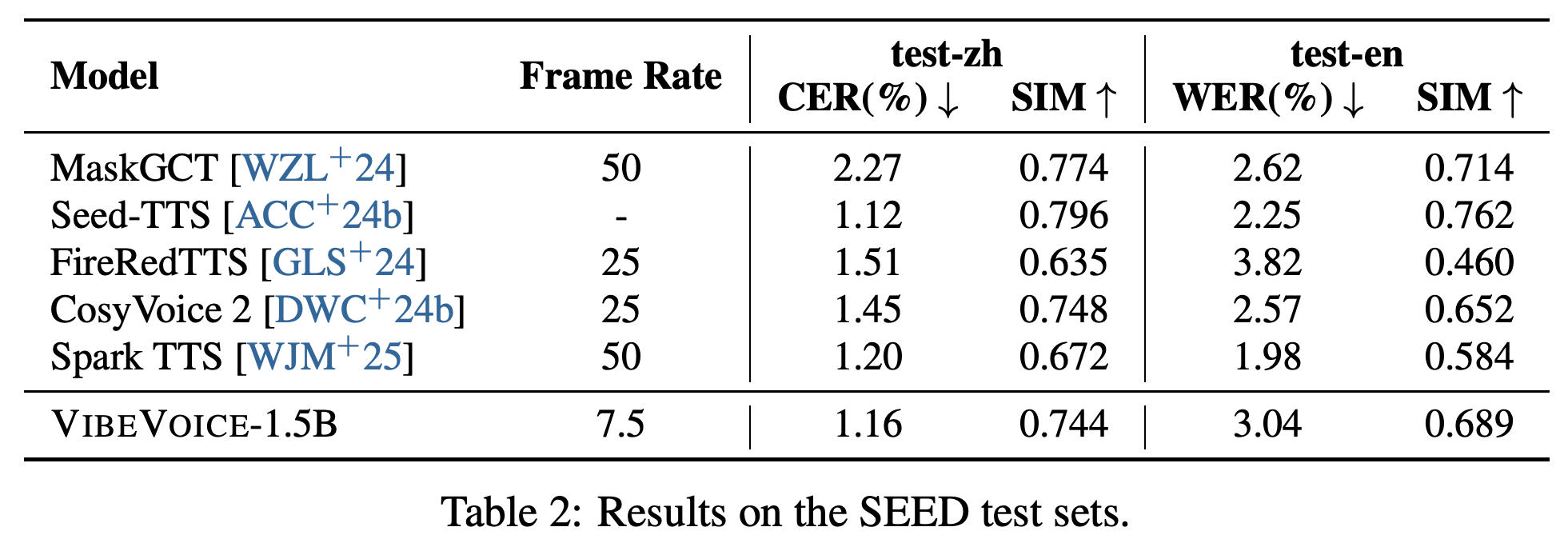
The SEED short-utterance benchmark draws approximately 1,000 English and 2,000 Chinese samples from CommonVoice, a speech dataset, named test-en and test-zh. Whisper-large-v3 evaluates English transcription, Paraformer, a speech-recognition model, evaluates Chinese transcription, and WavLM-large measures speaker similarity. Table 2 reports Chinese Character Error Rate (CER), transcription errors at the character level, although the surrounding prose refers generally to WER.
At 7.5 frames per second, VIBEVOICE-1.5B achieves Chinese CER 1.16% and SIM 0.744, and English WER 3.04% and SIM 0.689. Seed-TTS reports Chinese CER 1.12% and English WER 2.25%, with higher similarity in both languages. VIBEVOICE’s lower frame rate reduces the number of generated speech frames, but the table does not establish leading short-utterance accuracy or measured runtime savings.
VIBEVOICE-1.5B uses the lowest reported frame rate, 7.5, and achieves Chinese CER close to Seed-TTS. English WER is higher than several baselines, and speaker similarity is below Seed-TTS in both languages. The compact representation therefore accompanies mixed short-utterance results.
3.3 Tokenizer Reconstruction
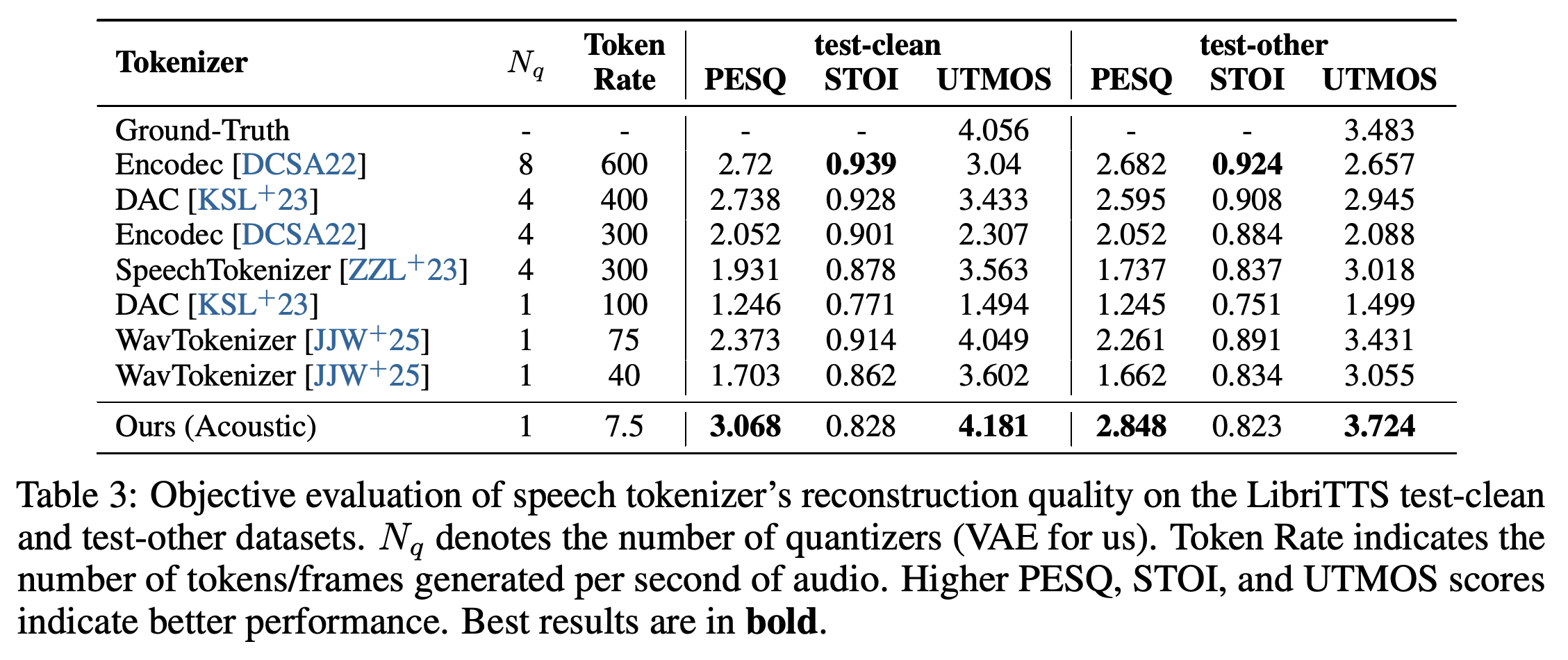
Tokenizer reconstruction is evaluated on the LibriTTS speech dataset’s test-clean and test-other subsets using PESQ, a perceptual speech-quality measure; STOI, an objective intelligibility measure; and UTMOS, an automated prediction of speech-quality ratings. The acoustic tokenizer achieves PESQ 3.068 and UTMOS 4.181 on test-clean, and PESQ 2.848 and UTMOS 3.724 on test-other, leading the listed reconstruction systems on these two metrics.
The 7.5-token-per-second representation uses 80 times fewer tokens than the 600-token-per-second Encodec audio-compression configuration in Table 3. Its STOI values, 0.828 and 0.823, are below Encodec’s 0.939 and 0.924, so the reconstruction advantage does not extend to every metric. The token-rate ratio does not by itself establish an equivalent reduction in storage bits for continuous features and discrete tokens.
At 7.5 tokens per second, the acoustic tokenizer leads the listed reconstruction systems on PESQ and UTMOS for both subsets while trailing several alternatives on STOI. Its UTMOS scores also exceed the ground-truth row, so that automated score alone cannot establish greater fidelity to the original waveform.
4 Conclusion, Limitations, and Risks
The report concludes that compact acoustic and semantic representations support long-form speech generation of up to 90 minutes with up to 4 speakers. Its stated limitations are support for English and Chinese only, no handling of background noise, music, or sound effects, and no explicit modeling or generation of overlapping speech, where speakers talk simultaneously.
The authors identify impersonation, fraud, and disinformation as potential misuses of realistic synthetic speech and call for reliable transcripts, content checks, and avoidance of misleading uses. They state that the model is intended for research and development and advise further testing and development before commercial or real-world use.
Appendix
- The supplied eight-page report contains no source appendix; pages 6–8 contain the end of the risk discussion and References. The paper identifier is arXiv:2508.19205v1, dated 26 Aug 2025, and the source provides the project page https://microsoft.github.io/VibeVoice, code https://github.com/microsoft/VibeVoice, model collection https://huggingface.co/collections/microsoft/vibevoice-68a2ef24a875c44be47b034f, and demo https://aka.ms/VibeVoice-Demo.
Brief Thoughts
The engineering contribution is a shorter speech representation that retains high reconstruction scores on two metrics and supports competitive conversational generation. Table 3 supports the token-rate reduction, and Table 1 shows higher perceptual ratings with the larger sequence model; neither experiment isolates the contribution of semantic features or the diffusion head.
The conversational evaluation covers eight transcripts and 24 annotators, with a voice-control mismatch for Gemini. The report provides no statistical significance tests, systematic 90-minute stability evaluation, training-data quantities, or runtime and memory measurements. These omissions limit assessment of the reported differences, reproducibility, and deployment cost.