


AURORA-LM: Autoencoding Unified Representation for Continuous-Latent Diffusion Language Modeling | Summary
03 Aug 2026 | Paper Review Continuous Diffusion Language Models Flow Matching Autoencoders Block-Causal ModelingContents
- Summary
- 3.2 Continuous Text Latent Construction
- 3.3 Block-Causal Modeling of Continuous Text Latents
- 3.4 Learning the Full-Width Latent Distribution
- 3.5 Latent Generation and Text Decoding
- 4.1 Further analysis
- 4.2 System-Level Comparison
- 4.3 Scaling Evaluation
- Appendix
- Brief Thoughts
This article explains the key points of AURORA-LM: Autoencoding Unified Representation for Continuous-Latent Diffusion Language Modeling.
- 2026-08-03 (arXiv)
- Liang, Jiajun, Liao, Yucheng, Cao, Yukang, Wei, Jiazhe, Li, Ken, Tan, Wende, Zhang, Jiankun, Cui, ZY, Yang, Jingkang, Guo, Liucheng, et al.
- PRLab, Nanjing University, S-Lab, Nanyang Technological University, Imperial College London
- Paper
- Github
- Project Page
Summary
- AURORA-LM addresses the conflict between retaining a text latent rich enough for token decoding and making that latent tractable for continuous generation. It trains a Query-based Encoder-Decoder to form a high-capacity, prefix-aligned latent sequence, freezes this autoencoder, and learns the latent distribution with a block-causal flow-matching Transformer. The paper reports the strongest results among its evaluated systems on OpenWebText free generation and XSum summarization, and a higher nine-task macro average at 1B denoiser parameters than the released 1.8B-parameter Cola-DLM checkpoint under the stated shared benchmark protocol.
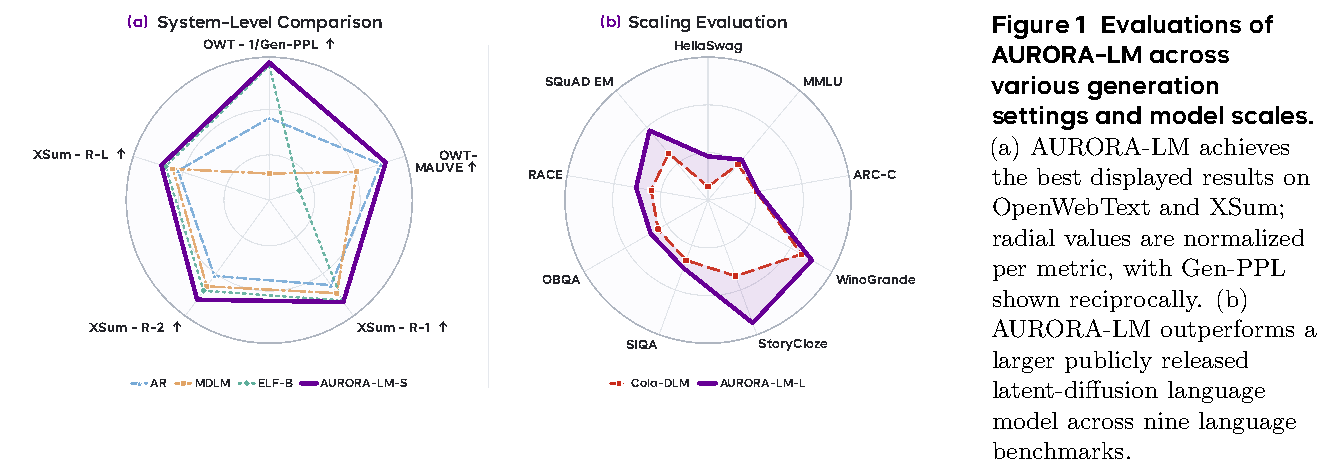
The left radar chart normalizes OpenWebText and XSum metrics and depicts AURORA-LM-S as the outermost displayed system on the reported axes. The right chart compares the 1B AURORA-LM-L with Cola-DLM across nine benchmarks and reflects AURORA-LM-L's higher displayed scores on each task.
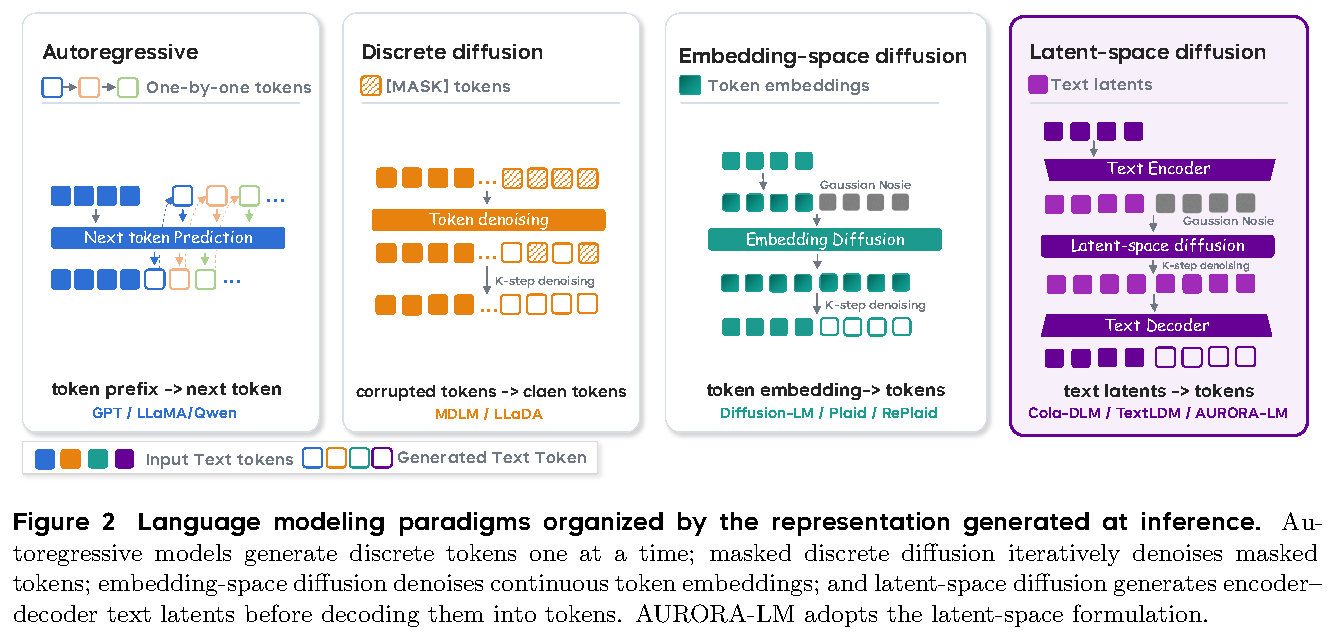
The diagram separates language-modeling paradigms by their inference representation: sequential discrete tokens, masked tokens, token embeddings, and encoder-decoder text latents. It places AURORA-LM in the latent-space category, where continuous latents are denoised before token decoding.
3.2 Continuous Text Latent Construction
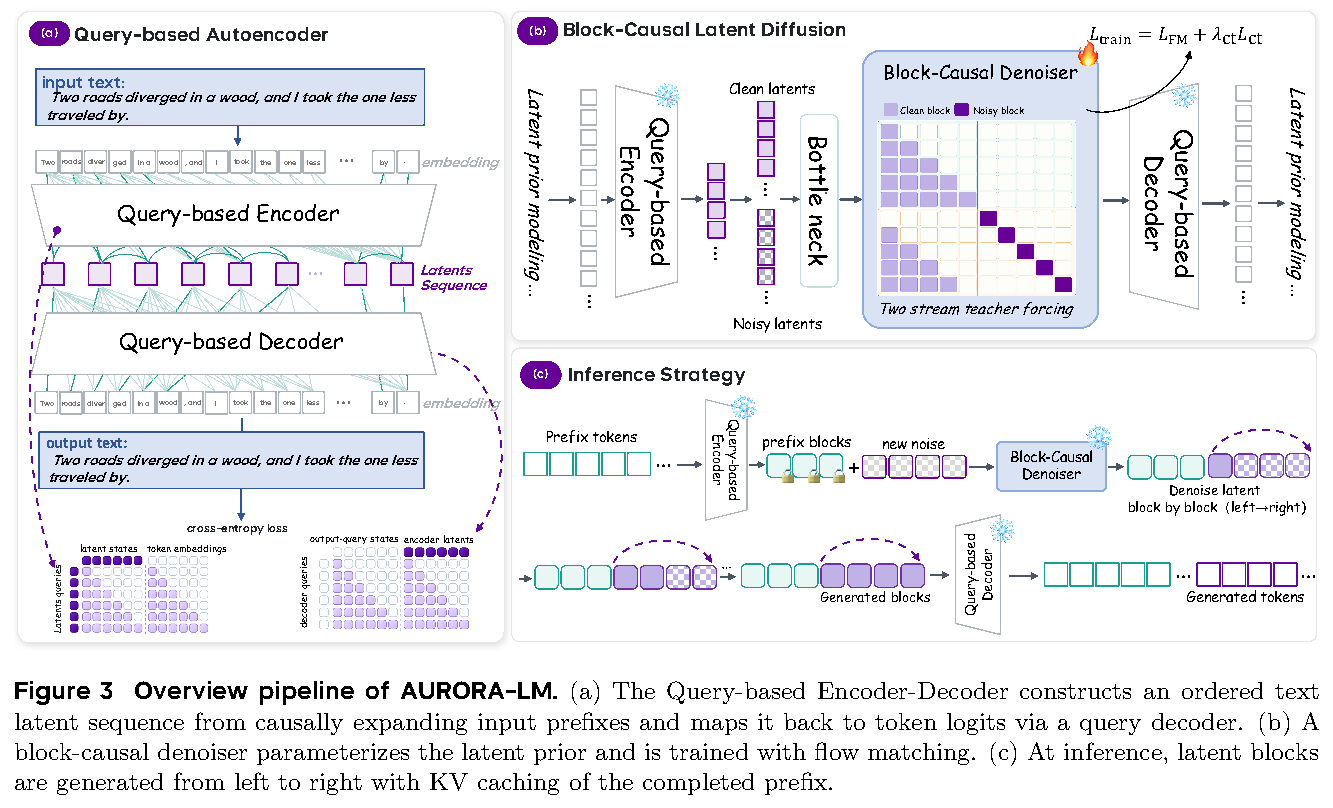
Given tokens w1:L, the encoder produces zenc ∈ R^(N×D), where N = round(cL); D controls channel capacity per latent position and c controls the retained sequence length. Causally expanding encoder queries read token prefixes, while decoder queries reconstruct each token from only the corresponding latent prefix, yielding an ordered representation suitable for left-to-right latent generation. The autoencoder is trained with token-level cross-entropy plus token-embedding and latent dropout, then frozen before denoiser training.
3.3 Block-Causal Modeling of Continuous Text Latents
The standardized latent sequence is divided into contiguous blocks of Q positions and factorized left to right: a block is generated conditional on completed earlier blocks, while its positions are denoised jointly. Linear-interpolant flow matching corrupts each clean block with Gaussian noise and trains the model to predict its clean endpoint from the noisy block, noise level, and clean prefix. A two-stream attention mask permits parallel training of all block conditionals without revealing future clean blocks or noisy states from other target blocks.
3.4 Learning the Full-Width Latent Distribution
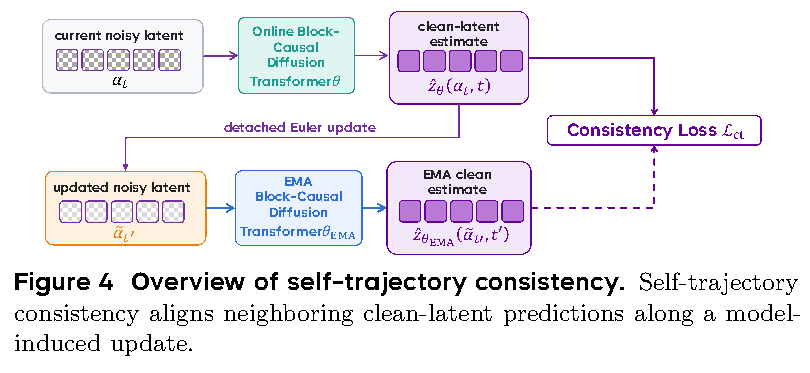
AURORA-LM retains the D-dimensional clean target required by the frozen decoder but applies a low-rank projection only to the noisy-latent input route. Its objective combines clean-latent flow-matching loss with self-trajectory consistency: an EMA teacher predicts after a detached Euler update to a neighboring lower-noise state, and the online model is penalized when the estimates disagree. The model also uses self-conditioning and calibrates the training noise distribution to latent width; the reported sweeps favor greater high-noise allocation for wider targets.
The consistency branch uses an online denoiser prediction in a detached Euler update, then aligns that prediction with an EMA denoiser estimate at the next lower-noise state. Gradients flow only through the online prediction, so the branch is an auxiliary regularizer rather than a separately trained consistency model.
3.5 Latent Generation and Text Decoding
For unconditional generation, each latent block starts as Gaussian noise and is denoised from t = 1 to t = 0 conditional on previously generated blocks. Prompt-conditioned generation encodes the prompt into a clean standardized latent prefix and generates only continuation blocks; generated latents are unstandardized before frozen query decoding into vocabulary logits. SC-CFG combines self-conditioned and non-self-conditioned estimates for unconditional sampling, whereas classifier-free guidance combines conditional and unconditional estimates for prompted generation.
The figure links the method's three stages: prefix-constrained query autoencoding, two-stream block-causal latent-prior training, and left-to-right block generation with KV caching. It shows that the bottleneck is applied to the noisy-latent path while the query decoder remains a fixed latent-to-token interface.
4.1 Further analysis
Controlled ablations use OpenWebText sequences of at most 128 tokens, vary one design choice at a time, generate 1,000 samples per configuration with a 32-step ODE sampler unless otherwise specified, and evaluate MAUVE against held-out OpenWebText. AURORA-LM-S uses a 130M-parameter denoiser for system comparisons, whereas AURORA-LM-L uses a 1.01B-parameter denoiser for scaling; these counts exclude the autoencoder. All reported experiments use Ascend NPUs.
4.1.1 Latent Capacity
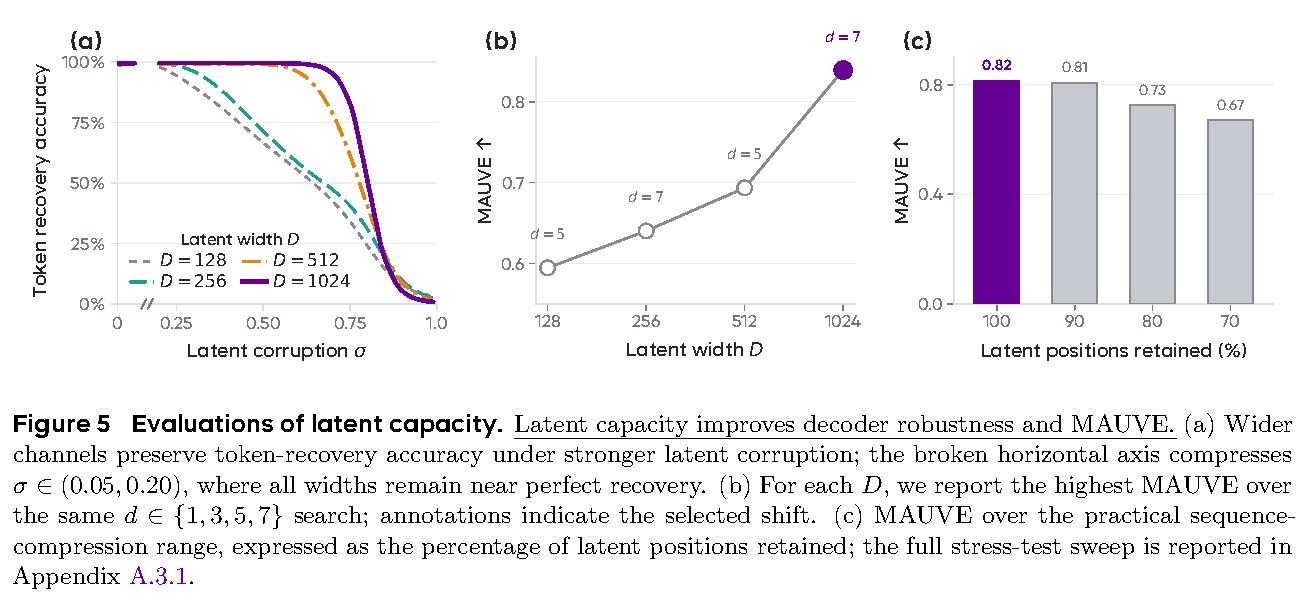
Increasing latent width from D = 128 to 1024 improves robustness of token reconstruction under latent corruption and raises the best calibrated MAUVE from 0.594 to 0.839. At D = 1024, retaining 90% of latent positions yields MAUVE 0.807 versus 0.815 with no compression, while 80% and 70% retention yield 0.726 and 0.671. The controlled reference configuration consequently uses D = 1024 and c = 1, with c = 0.9 presented as an efficiency-oriented alternative.
Panel (a) shows wider latents preserving token-recovery accuracy under stronger corruption; panel (b) shows the best calibrated MAUVE increasing with latent width; and panel (c) quantifies quality loss under sequence compression. Together, these results motivate D = 1024 and full latent retention for the controlled reference configuration.
4.1.2 Modeling the Full-Width Latent Distribution
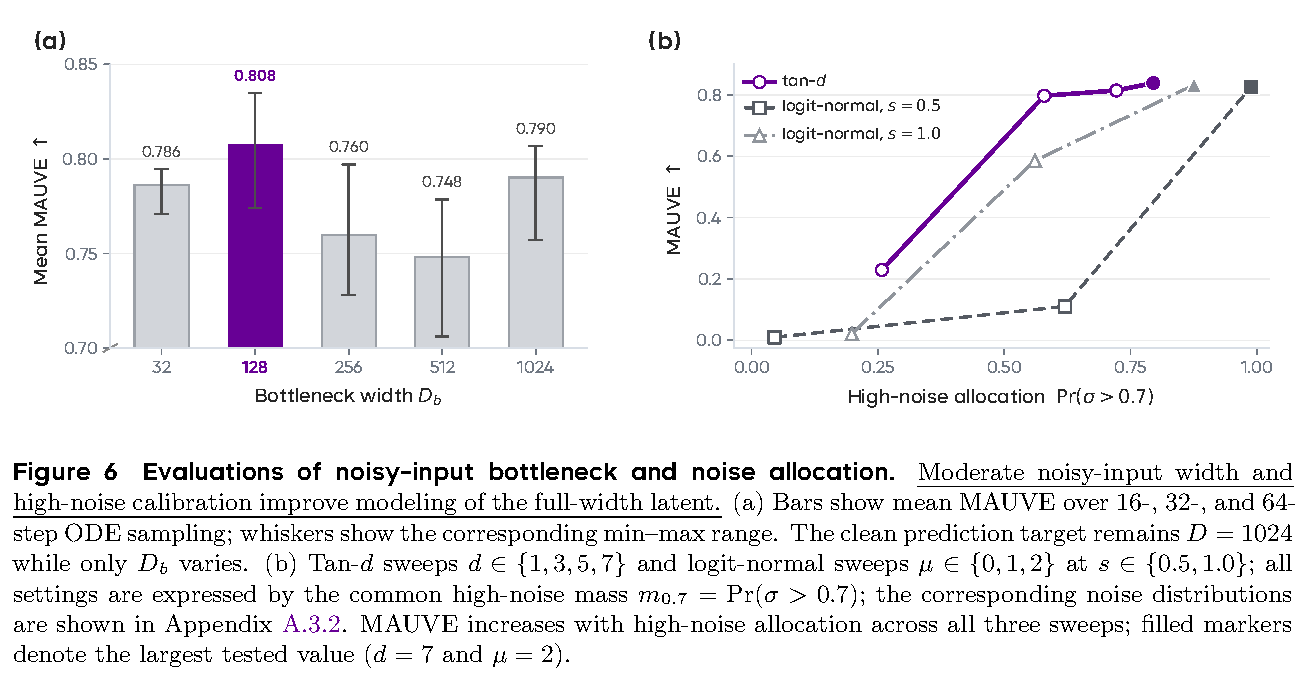
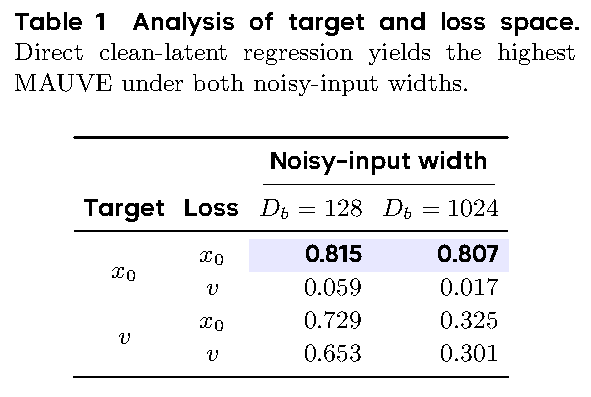
For the D = 1024 clean target, a noisy-input bottleneck of Db = 128 gives the best mean MAUVE across 16-, 32-, and 64-step ODE sampling at 0.808, compared with 0.786 for Db = 32 and 0.790 for Db = 1024. Across tan-d and logit-normal schedule sweeps, MAUVE rises as more training mass is assigned to high-noise states; tan-d with d = 7 reaches 0.839. Direct x0 prediction with an x0-space loss is best at both input widths, while scoring x0 predictions in velocity space introduces a 1/σ² weighting toward low-noise states.
The bottleneck sweep peaks at Db = 128 rather than at a very narrow or full-width noisy input. The schedule sweep groups parameterizations by Pr(σ > 0.7) and shows higher MAUVE with greater high-noise allocation across the tested families.
The table distinguishes the prediction target from the loss space at Db = 128 and Db = 1024. Clean-latent x0 prediction optimized in x0 space is best in both columns, whereas x0 prediction evaluated in velocity space is particularly poor.
4.1.3 Efficient Blockwise Generation
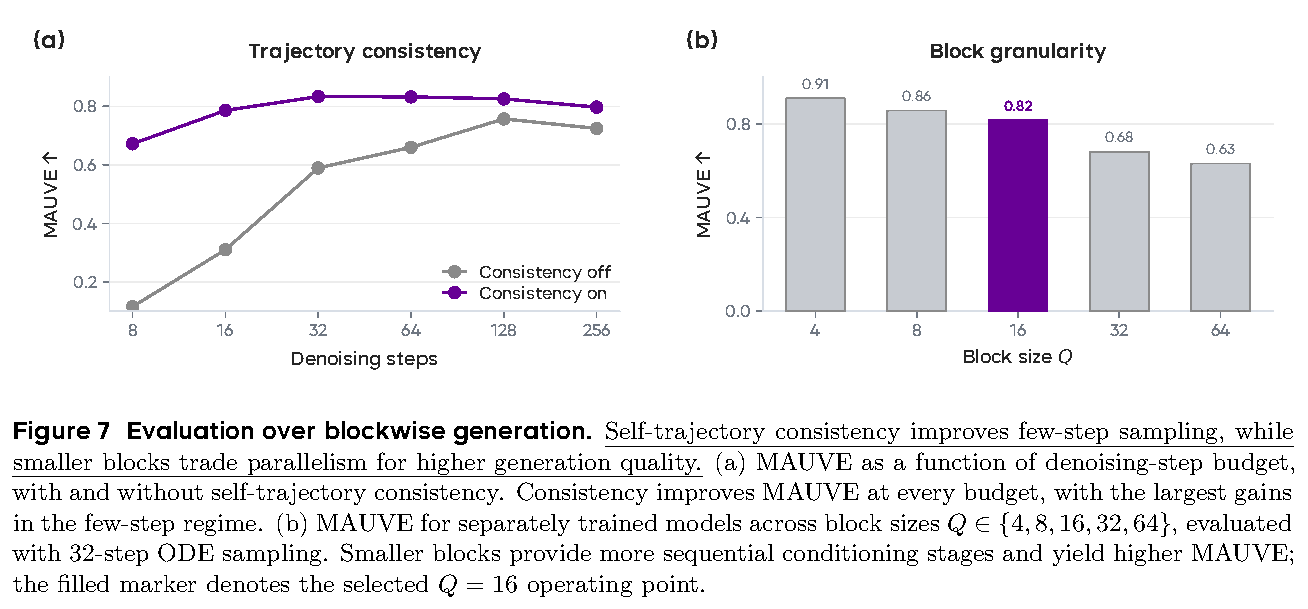
Self-trajectory consistency improves MAUVE at every tested sampling budget, notably from 0.116 to 0.672 at 8 steps and from 0.310 to 0.786 at 16 steps. Smaller latent blocks improve quality but increase sequential stages: Q = 4 reaches 0.909 MAUVE, whereas Q = 64 reaches 0.631. The selected Q = 16 attains 0.815 MAUVE while reducing block-generation stages from 32 to 8 relative to Q = 4.
Trajectory consistency improves MAUVE at every denoising-step budget, with especially large separations at 8 and 16 steps. The block-size sweep visualizes the quality-parallelism trade-off and identifies Q = 16 as the selected compromise.
4.2 System-Level Comparison
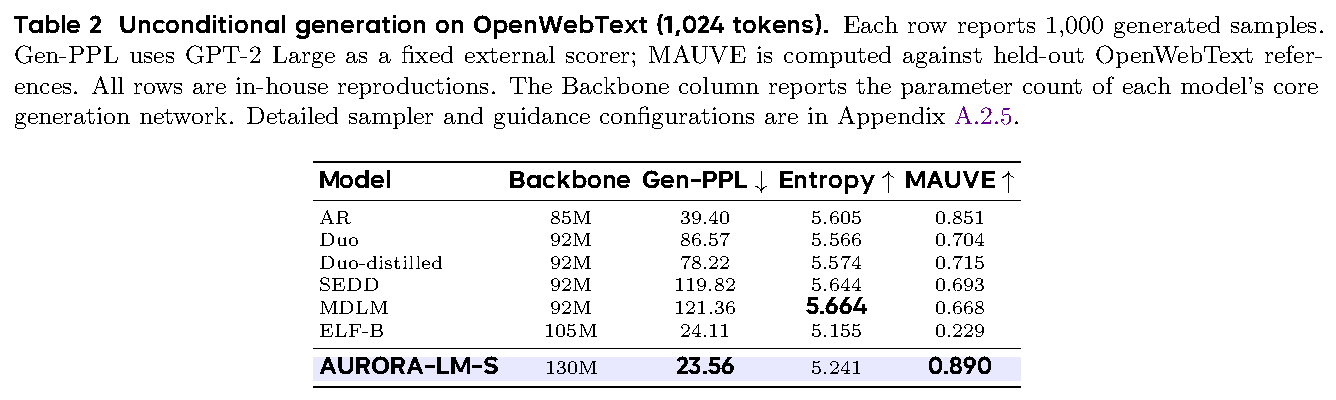
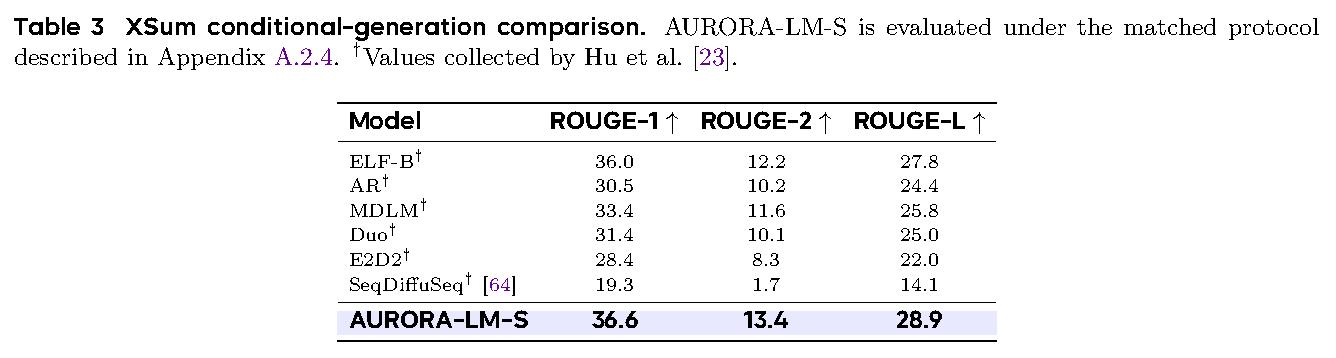
On 1,024-token OpenWebText free generation, AURORA-LM-S uses 64-step SDE-DPM++ sampling and SC-CFG scale 4, obtaining Gen-PPL 23.56, entropy 5.241, and MAUVE 0.890 over 1,000 samples. It has the lowest Gen-PPL and highest MAUVE in the paper’s reproduced comparison with AR, Duo, Duo-distilled, SEDD, MDLM, and ELF-B. On XSum, 32-step ODE sampling with classifier-free guidance scale 2.0 yields ROUGE-1/ROUGE-2/ROUGE-L of 36.6/13.4/28.9; the baseline values in that table are collected from Hu et al. rather than reproduced end to end here.
Under the paper's OpenWebText evaluation harness, AURORA-LM-S has the lowest external-scorer Gen-PPL and highest MAUVE among the listed systems. Its entropy is below most discrete baselines but above ELF-B, so the reported quality lead is not simply associated with maximum unigram diversity.
AURORA-LM-S has the highest listed ROUGE-1, ROUGE-2, and ROUGE-L values on XSum, with its largest absolute margin over ELF-B on ROUGE-2. The table marks all non-AURORA values as collected by Hu et al., limiting direct protocol equivalence.
4.3 Scaling Evaluation
AURORA-LM-L is trained on a 294.7B-token English mixture for 590,000 denoiser updates, with approximately 1,406 EFLOPs of denoiser training compute and approximately 1,500 EFLOPs total compute. Under a shared two-shot benchmark protocol, 16 denoising steps, and up to 32 generated tokens, its 1B denoiser obtains a 32.6 macro average across MMLU, ARC-C, OBQA, HellaSwag, WinoGrande, StoryCloze, SIQA, RACE, and SQuAD EM, compared with 25.1 for the released 1.8B-parameter Cola-DLM checkpoint. The systems use the same task instances, prompting, truncation, and scoring pipeline, but retain model-specific inference defaults and were not trained under matched conditions.
The 1B AURORA-LM-L exceeds the released 1.8B Cola-DLM checkpoint on the macro average and every individual benchmark listed in the table. The largest displayed gaps occur on WinoGrande, SIQA, and SQuAD EM, although several absolute task scores remain modest.

Appendix
- The appendix specifies autoencoder masking rates px = 0.3 and pz = 0.6, derives the 1/σ² weighting induced by evaluating x0 prediction in velocity space, and gives high-noise-mass formulas for the schedule families. It documents architectures, optimization settings, inference sweeps, baseline protocols, answer extraction, and full controlled-study results. Qualitative OpenWebText samples have favorable external GPT-2 Large perplexities but contain incoherent prose and unsupported entities or claims, while the two shown XSum outputs are concise and closely track their references.
Brief Thoughts
The paper isolates a coherent design principle: preserve a decoder-capable text latent and move tractability interventions to the diffusion side through causal blocking, an input-only bottleneck, and noise calibration. Its controlled ablations directly support these choices, particularly the large few-step gains from trajectory consistency. Comparative claims nevertheless depend on differing parameter accounting, samplers, guidance settings, and baseline provenance, while the appendix’s free-generation examples show that low external-scorer perplexity does not ensure factuality or coherence.