


Emu3.5: Native Multimodal Models are World Learners | Summary
30 Oct 2025 | Paper Review Unified Multimodal Models World Models Diffusion Acceleration Reinforcement LearningContents
This article explains the key points of Emu3.5: Native Multimodal Models are World Learners.
- 2025-10-30 (arXiv)
- Cui, Yufeng, Chen, Honghao, Deng, Haoge, Huang, Xu, Li, Xinghang, Liu, Jirong, Liu, Yang, Luo, Zhuoyan, Wang, Jinsheng, Wang, Wenxuan, et al.
- BAAI
- Paper
- Github
- Project Page
Summary
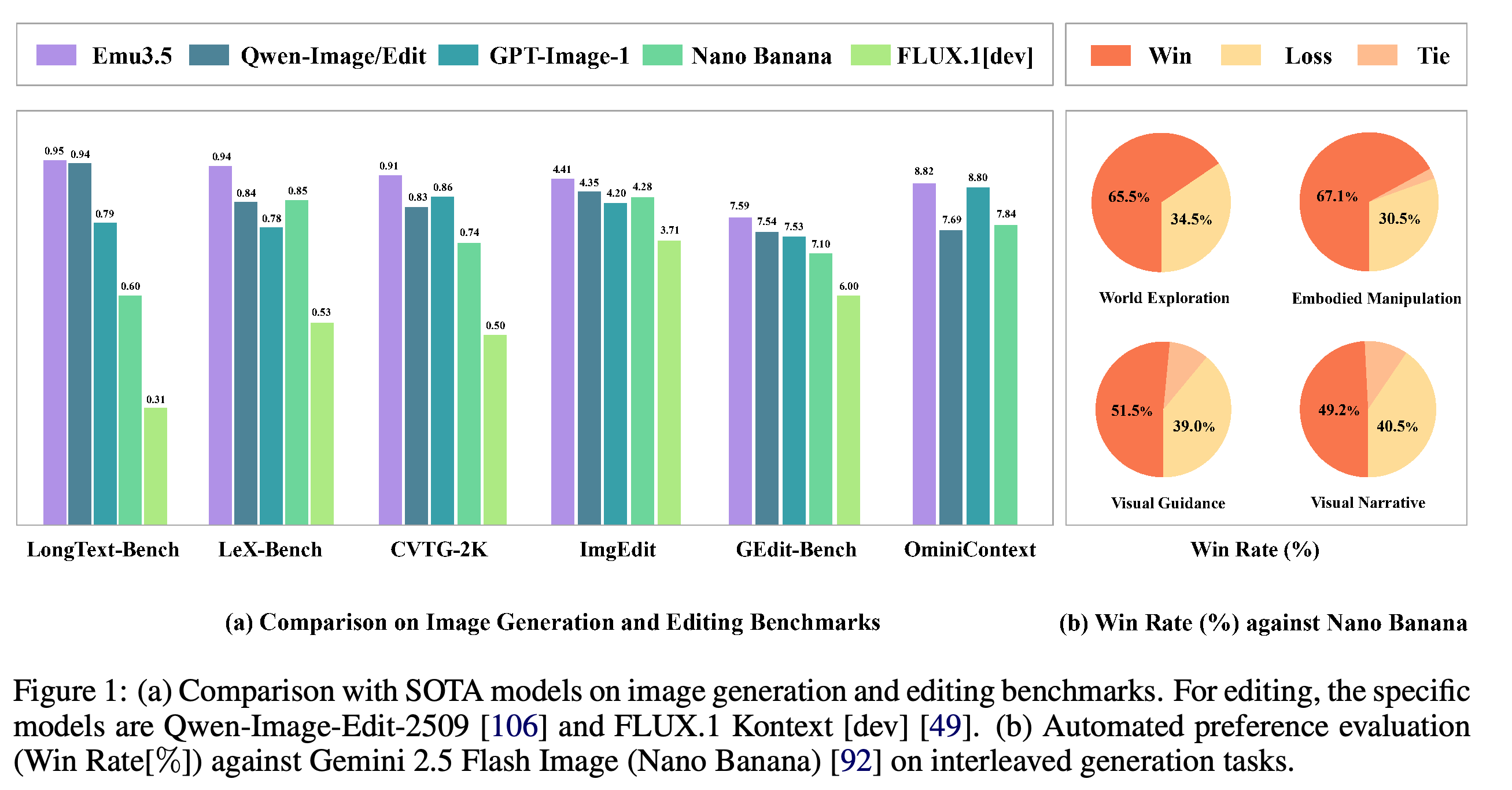
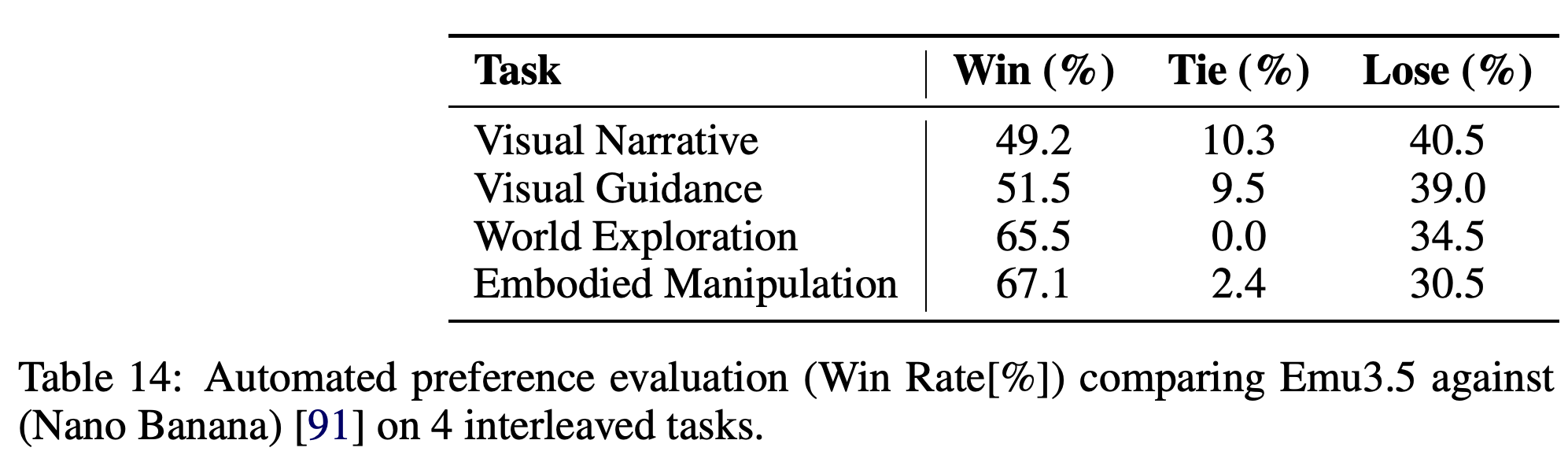
- Emu3.5 addresses how one model can generate coherent sequences of images and text that depict changes in scenes and object interactions. In the paper’s automated ChatGPT preference evaluation against Gemini 2.5 Flash Image, it wins 65.5% of world exploration comparisons, which assess successive generated environment views, and 67.1% of embodied manipulation comparisons, which assess generated subtask instructions and robot-interaction images.
- The model uses approximately 13 trillion multimodal tokens, discrete text or image elements, for next-token prediction: learning to predict the next element in a sequence. Supervised fine-tuning, training on task-specific examples, and reinforcement learning, optimization using generation rewards, establish a shared interface for image editing, illustrated stories, procedural guidance, and scene prediction.
- Discrete Diffusion Adaptation (DiDA), an adaptation that iteratively refines image tokens in parallel, reduces 1024×1024 image generation from 120 s to 10 s with FlagScale, the paper’s training and inference framework, while preserving the GenEval image-text alignment score at 0.86. Other reported quality scores decrease slightly; long-horizon evaluation relies on automated preferences, and generated manipulation sequences do not establish physical robot execution success.
The benchmark bars summarize text-rendering and editing scores, while the preference charts show larger win percentages for exploration and manipulation than for narrative and guidance. The benchmark axes use different scales, and the preference results compare generated outputs against Gemini 2.5 Flash Image.
1 Introduction
The introduction identifies three linked challenges: learning extended image-text sequences, supporting general multimodal interaction, and efficiently decoding thousands of visual tokens. Internet videos supply temporally ordered frames and transcripts for interleaved generation, in which images and text occur within the same sequence; Emu3.5 combines this training source with unified post-training and parallel image inference.
2 Emu3.5
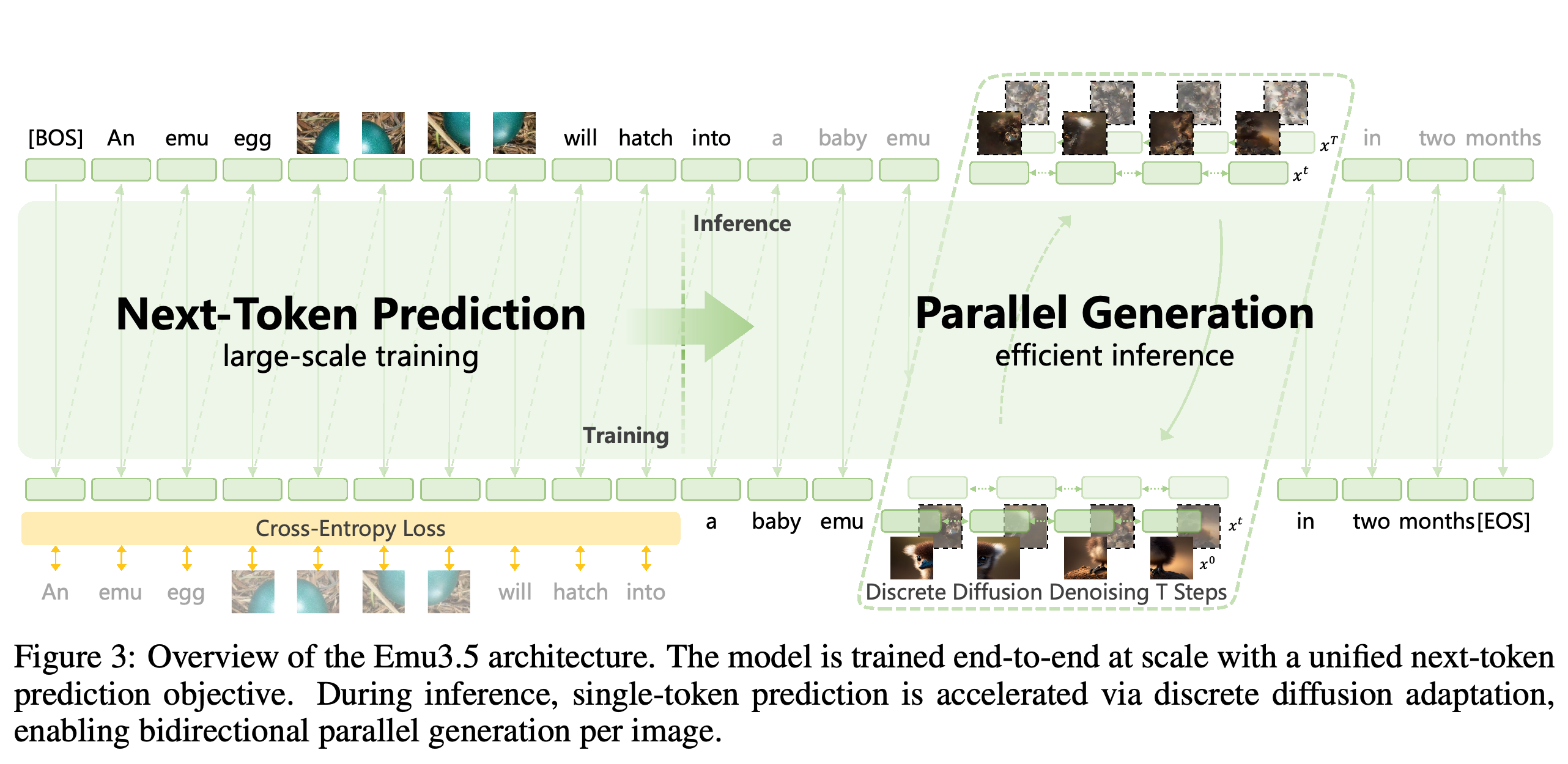
Emu3.5 represents text and vision in one discrete sequence processed by a decoder-only transformer, a model that predicts outputs from preceding sequence elements. Its interface accepts and produces interleaved images and text, with separate visual decoders converting image codes into images or continuous video.
The diagram separates the shared next-token training objective from the adapted inference procedure. Parallel refinement applies within an image, while surrounding text remains part of the ordered multimodal sequence.
2.1 Overall
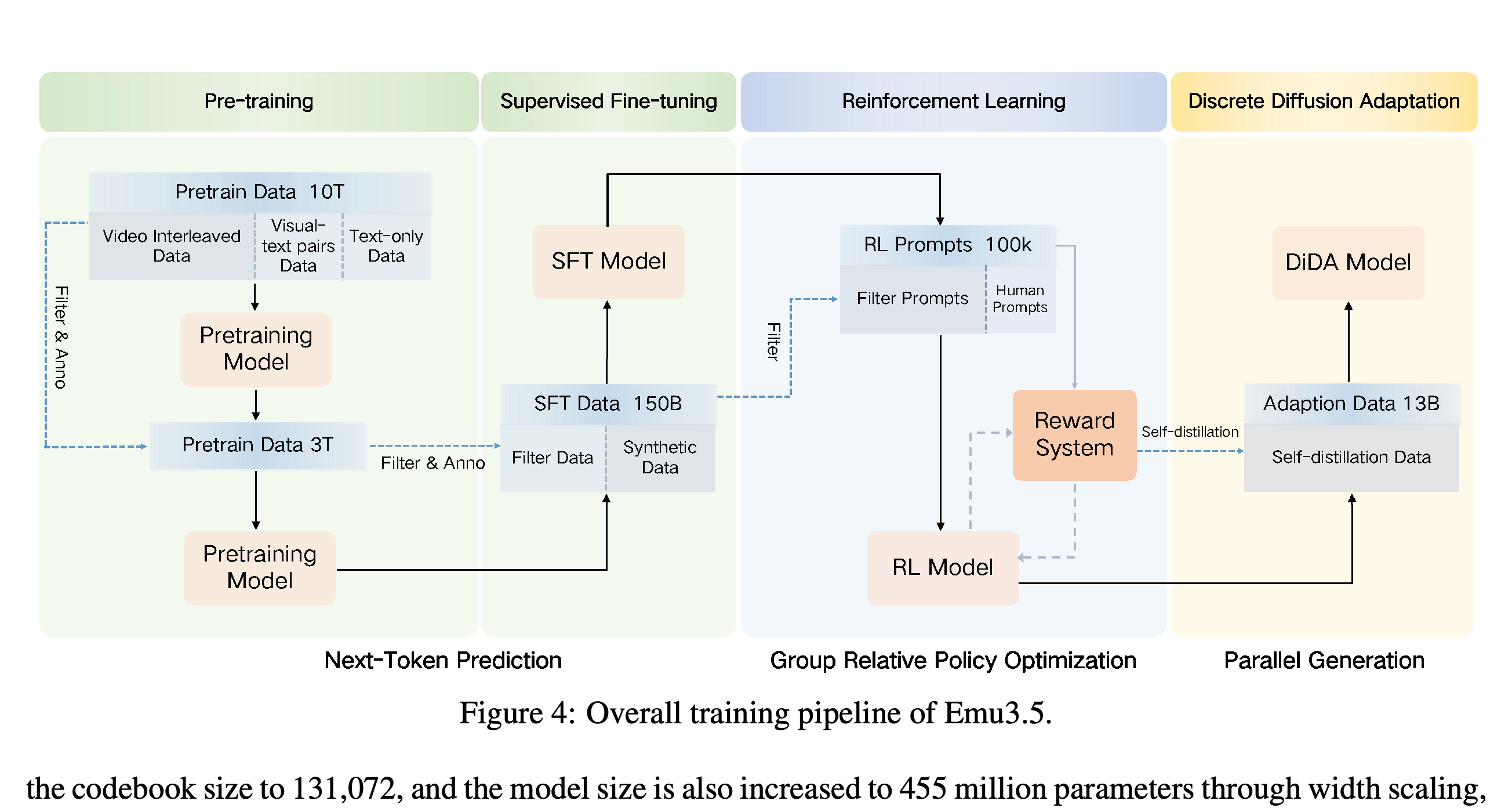
The pipeline comprises two-stage pre-training, supervised fine-tuning (SFT), multi-task reinforcement learning (RL), and DiDA. Text remains sequential during inference, while DiDA generates each image through parallel refinement.
- Figure 4 labels pre-training stages as 10T and 3T, SFT data as 150B, and adaptation data as 13B. Section 2.1 calls the SFT quantity “150 billion samples,” whereas Table 3 reports task quantities in billions of tokens; these units are inconsistent in the source.
DiDA follows pre-training, SFT, and reward-based optimization. The diagram labels adaptation data as 13B and shows self-distillation feeding this final stage.
2.2 Unified Architecture
The detailed configuration specifies 34.1 billion parameters: 31.2 billion in transformer layers and 2.9 billion in embeddings. It has 64 layers, hidden size 5,120, intermediate size 25,600, 64 query heads, 8 key-value heads, a 282,926-token vocabulary, and a maximum context of 32,768 tokens.
- Grouped Query Attention (GQA), attention with multiple query heads sharing key-value heads, improves efficiency. RMSNorm, root mean square normalization, and QK-Norm, normalization of query and key projections, support training stability; SwiGLU, a gated activation function, and rotary positional embeddings (RoPE), position-encoding transformations, complete the stated design.
- The vocabulary contains 151,854 text tokens and 131,072 vision tokens. Text tokenization reuses https://huggingface.co/Qwen/Qwen-7B/blob/main/tokenization_qwen.py, and dropout, random suppression of activations during training, is 0.1.
2.3 Tokenizer
The visual tokenizer, which converts images into discrete codes, uses index backpropagation quantization (IBQ) with downsampling factor 16, code dimension 256, a 131,072-entry codebook, and 455 million parameters. SigLIP, the cited language-image pre-training model, supplies feature distillation that trains intermediate decoder features to match its representations.
- The vanilla decoder uses one-fourth of Emu3’s tokens for the same image. An optional diffusion image decoder reconstructs at twice the resolution and uses LoRA-based distillation, training with low-rank weight updates, to reduce denoising from 50 steps to 4.
- A diffusion transformer (DiT), a transformer used for iterative visual generation, decodes continuous video from generated keyframe tokens, codes representing selected frames. Optional inter-frame text supplies semantic guidance, and a 4-channel mask marks frames whose tokens are provided.
3 Pre-training
Pre-training unifies interleaved video-language sequences, vision-text pairs, any-to-image examples, and text-only documents under one prediction objective. Any-to-image (X2I) generates an image from arbitrary interleaved image-text instructions; the second pre-training stage increases visual resolution and adds filtering and annotations.
3.1 Training Data
The training corpus combines temporally extended video-language data with paired and text-only sources. Video interleaved data retains a sampling ratio of 0.55 in both pre-training stages.
- 3.1.1 Video Interleaved Data: Approximately 63 million videos average 6.5 minutes, totaling roughly 790 years of footage. Scene-aware extraction yields an average of 0.27 keyframes per second; automatic speech recognition (ASR), transcription of audio into text, uses Whisper-large-v2 with Faster-Whisper, followed by spaCy transcript segmentation and timestamp-based interleaving.
- Basic filtering removes short or low-resolution videos and talking heads, and balances languages and silence. Advanced filtering evaluates frame quality, removes visually redundant frames, and scores transcript quality; second-stage annotations add semantic segments, visual captions, and multimodal summaries.
- 3.1.2 Vision-Text Paired Data: Approximately 500 million image-text pairs and 30 million video-text pairs receive enriched annotations from Qwen2.5-VL-7B, an image-and-text model. Additional synthetic image-text examples supplement these sources; video-text frames are sampled at 1 frame per second and clips from the same video are packed in temporal order.
- 3.1.3 Any-to-Image Data: Approximately 27.35 million examples combine public datasets and in-house data curated from videos and images.
- 3.1.4 Text-only Data: Approximately 3 trillion tokens of filtered English and Chinese text supplement multimodal training.
3.2 Training Details
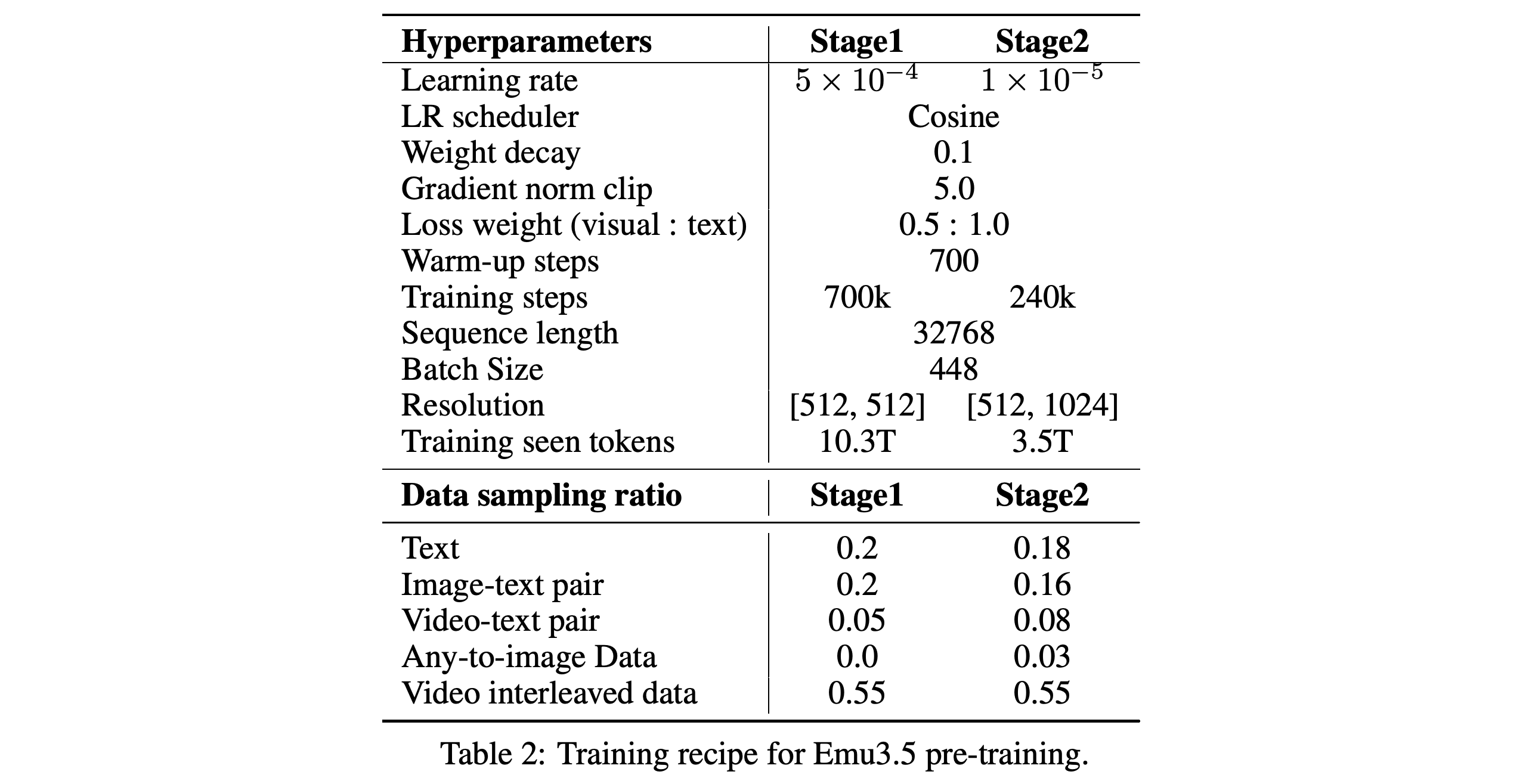
Pre-training uses cross-entropy loss, the prediction loss for the target discrete token, with visual-token weight 0.5 and text-token weight 1.0, initialized from Qwen3. Table 2 reports 10.3T seen tokens over 700k steps in Stage1 and 3.5T over 240k steps in Stage2, providing more precise quantities than the rounded 10T and 3T descriptions.
- Both stages use sequence length 32,768, batch size 448, cosine learning-rate scheduling, weight decay 0.1, gradient clipping 5.0, and 700 warm-up steps. Learning rates are 5×10⁻⁴ and 1×10⁻⁵; the AdamW optimizer uses β1 = 0.9, β2 = 0.95, and ε = 1.0×10⁻⁸.
- Stage1 caps each image at 1,024 visual tokens and pixel area 512×512; Stage2 uses 1,024–4,096 visual tokens and resolutions up to 1024×1024 while preserving aspect ratio. Tensor parallelism, splitting model computations across devices, is 8; context parallelism, splitting sequence computations, is 2.
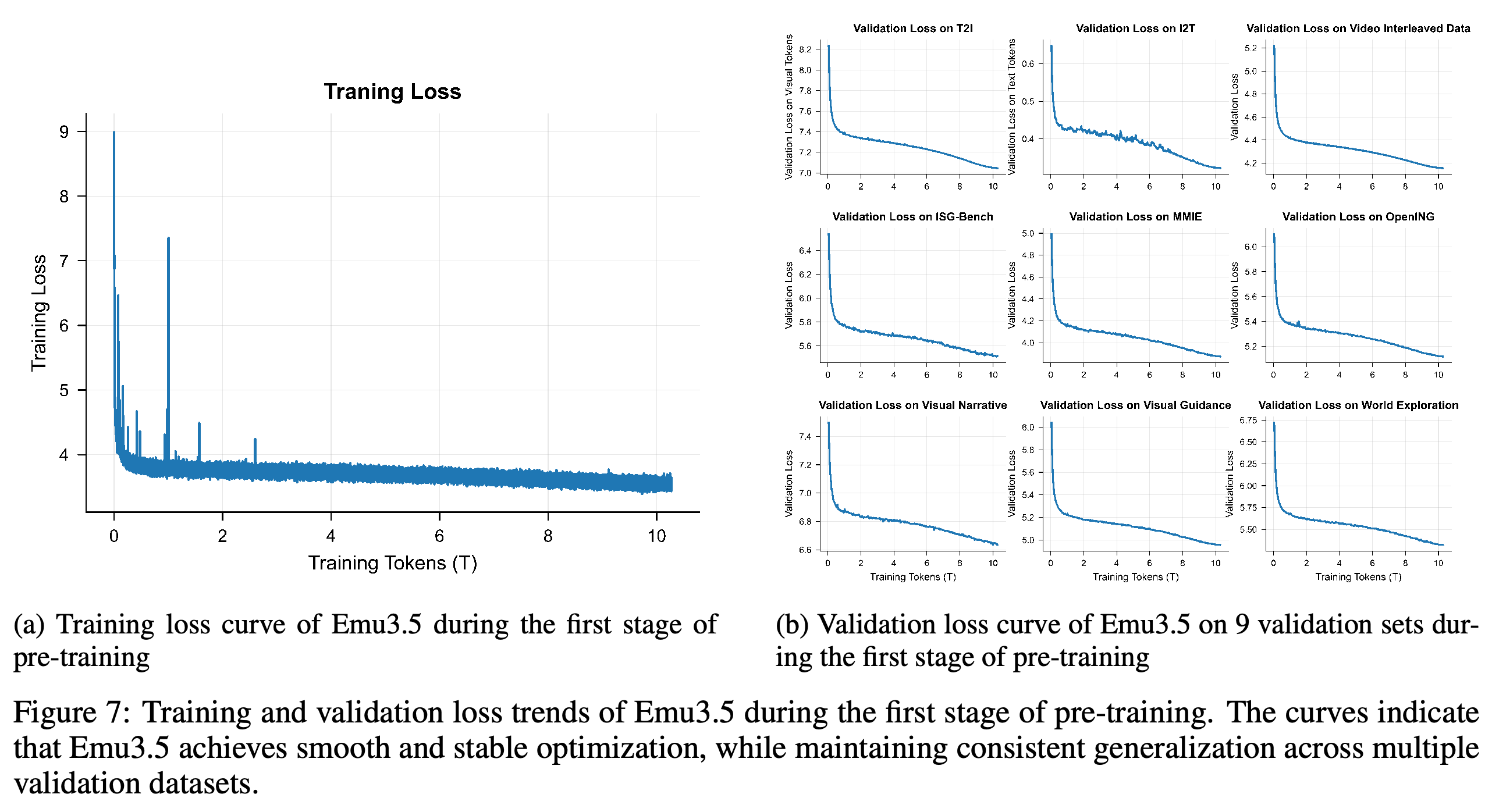
- Training loss and losses on nine validation sets decrease throughout Stage1. These include in-domain modalities; ISG-Bench, OpenING, and MMIE, benchmarks for interleaved multimodal evaluation; and three downstream task sets without pre-training overlap. Prediction loss improves on these sets, but it does not directly measure task completion.
The table gives seen-token counts of 10.3T and 3.5T and holds video-interleaved sampling at 0.55 across stages. Stage2 introduces X2I at ratio 0.03, raises resolution, and lowers the learning rate.
Training loss declines after early spikes, and all nine validation losses trend downward as seen tokens increase. The curves measure improvement in token prediction on the selected sets, without directly measuring interactive task completion.
4 Post-training
Post-training first teaches a unified task interface through SFT, then optimizes generations with shared and task-specific rewards. DiDA subsequently adapts visual decoding for efficient inference.
4.1 Supervised Fine-tuning
SFT covers general language and vision-language tasks, X2I, Visual Narrative, Visual Guidance, World Exploration, and Embodied Manipulation. Visual Narrative generates illustrated story sequences; Visual Guidance generates aligned images and instructions for successive procedural steps.
- 4.1.1 Task Formulation: World Exploration supports User-Interactive Mode, one visual update per instruction, and Free-Exploration Mode, autonomous continuation with synchronized narration. Embodied Manipulation decomposes a task into language-described subtasks and keyframes representing their completion.
- 4.1.2 Training Data: Table 3 reports 29.7B tokens for General Tasks, 56.2B for Any-to-Image, 10.1B for Visual Narrative, 22.5B for Visual Guidance, 17.5B for World Exploration, and 14.1B for Embodied Manipulation.
- General-task sources include approximately 5 million text-to-image examples, 8.9 million instruction-response pairs, and 3.7 million vision-language examples. X2I combines fully real, partially synthetic, and fully synthetic examples with zero, one, or multiple input images and one output image.
- Interleaved datasets contain 430k narrative examples, 960K guidance examples restricted to 2–10 procedural steps, 200K exploration examples, and 973K manipulation examples. The latter comprise 920K from OpenX Embodiment, 40K from Agi-world Alpha, and 13K from Songling Aloha; global and image-level chain-of-thought (CoT), explicit reasoning annotations, enrich narrative and guidance data. Exploration data receive camera-trajectory annotations, while manipulation sequences can begin at intermediate subtasks.
- 4.1.3 Training Details: Stage1 uses 768px for X2I, 512px for narrative, guidance, and manipulation, and 720px for exploration, with context 16,384 and visual loss weight 1.0. Stage2 raises X2I to 1024px and other interleaved tasks to 720px, with context 32,768 and visual loss weight 0.5; both stages use batch size 1024, learning rate 6e−6, and 3000 iterations. Tensor parallelism remains 8, while context parallelism increases from 1 to 2.
4.2 Reinforcement Learning
RL combines general image-text alignment and aesthetic rewards with task-specific measures of text fidelity, identity preservation, and sequence consistency. Each reward is normalized to [1, 10] before aggregation.
- 4.2.1 Reward System: CLIP, an image-text representation model used here for similarity scoring, supplies alignment rewards. Vision-language models (VLMs), models processing both images and text, assess alignment and consistency, while optical character recognition (OCR), extraction of written text from images, supports text-fidelity rewards. The multiple components diversify supervision; the reward curve alone does not establish the absence of reward hacking, exploitation of the scoring system.
- 4.2.2 Training Data: Approximately 10K prompts are filtered for each downstream task, with an additional 1K human-feedback samples. An image-focused stage adds 58K X2I instructions and 50K text-to-image samples.
- 4.2.3 Training Details: Group Relative Policy Optimization (GRPO), policy optimization using groups of generated samples, uses batch size 640, learning rate 1×10⁻⁶, and 8 rollouts, sampled model outputs per prompt. A vLLM sampling engine operates within VeRL, the RL training framework; mixed-task RL makes one full pass over prompts, followed by a separate X2I and text-to-image stage.
- 4.2.4 Scaling Behavior: Average training reward rises from approximately 4.5 to over 7.1. Quantitative results use the resulting RL model unless otherwise specified.
4.3 Discrete Diffusion Adaptation
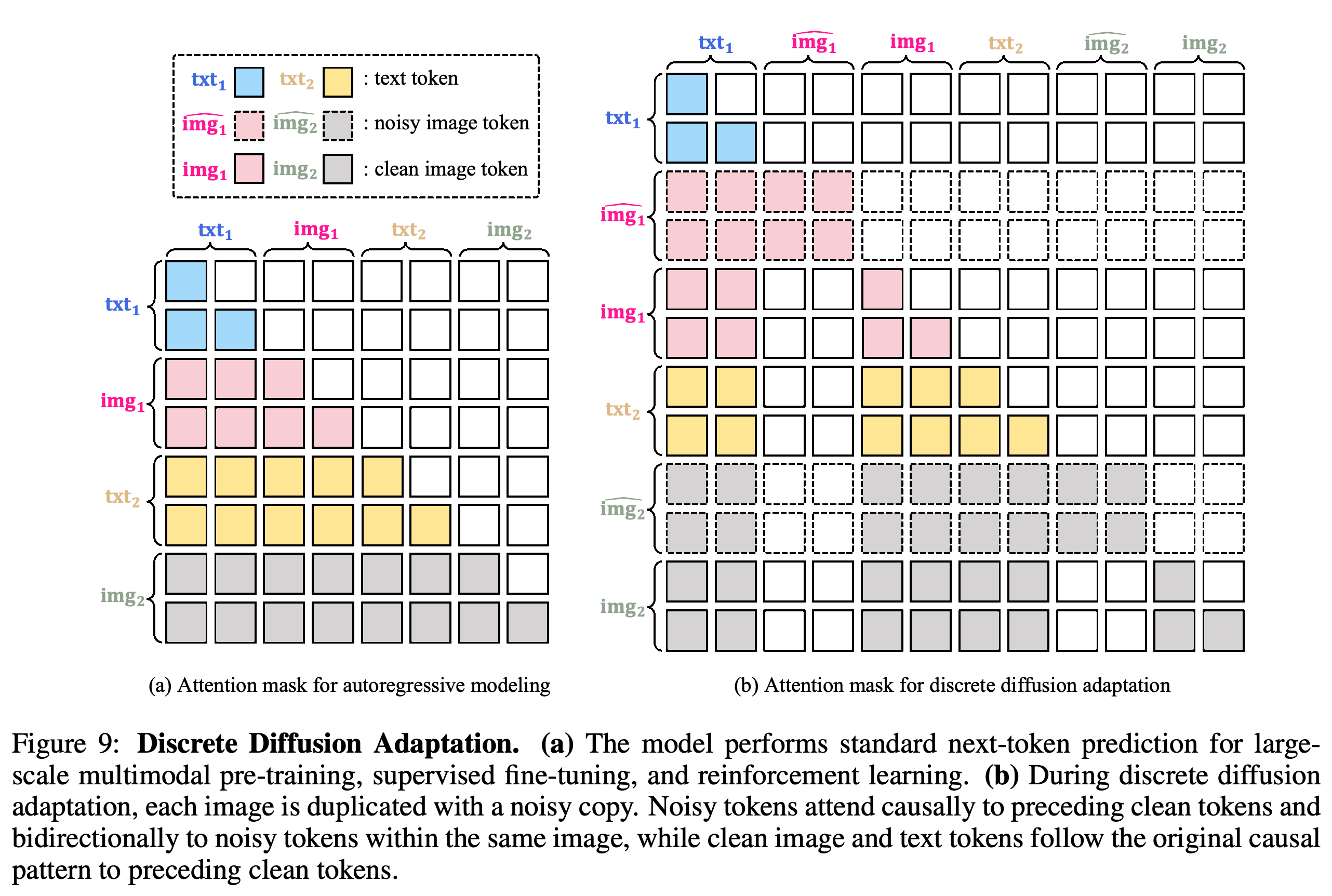
DiDA adapts the autoregressive model, which ordinarily generates one token at a time, to initialize and progressively denoise an entire image-token sequence in parallel. Self-distillation, adaptation using the model’s own generated examples, supplies image-text pairs and interleaved sequences.
- 4.3.1 Training Approach: Each image is paired with a noisy copy. Noisy image tokens attend to preceding clean tokens and bidirectionally within their own noisy image; clean image and text tokens preserve causal attention, access restricted to preceding clean tokens.
- 4.3.2 Infrastructure: FlagScale integrates PyTorch FlexAttention, an attention implementation supporting configurable masks, with per-row block masks. Training combines tensor parallelism, pipeline parallelism that distributes layers, sequence parallelism that distributes sequence operations, and ZeRO-1 data parallelism that partitions optimizer state; activation recomputation reduces stored intermediate activations.
- A Finite-State Machine (FSM), a scheduler with explicit text and image states, manages modality transitions. Asynchronous requests, runtime-state reuse, and FP8 quantization, computation using an 8-bit floating-point format, contribute to a reported speedup of at least 50% on a 4-device setup.
The additional noisy-image blocks enable bidirectional attention among tokens of the image being denoised. Clean images and text retain causal dependencies on preceding clean tokens, allowing parallel image refinement within an ordered image-text sequence.
5 Tokenizer Training
Tokenizer training separately develops discrete visual representations and their image and video decoders. The objectives and data emphasize general reconstruction alongside text and facial detail.
5.1 Data
The image corpus combines general datasets, aesthetic images, and text-rich and face-rich collections. Images below 512×512 pixels or quality score 0.4 are excluded, with additional aesthetic and watermark filtering.
- General sources include ImageNet, OpenImage, CC3M, CC12M, and in-house imagery. TextAtlas5M, PosterCraft, and LAION contribute text-rich content; Midjourney, COYO-700M, DataComp, and JourneyDB supply imagery from which facial data are extracted.
- Video-decoder data include Koala, Sekai, Agibot, in-house stock videos, and high-quality images. Scene segmentation, optical flow, estimated motion between frames, and Video Training Suitability Score (VTSS), a score for selecting suitable Koala training clips, filter the corpus.
5.2 Training Details
The tokenizer combines reconstruction, quantization, perceptual, adversarial, entropy, and semantic-distillation losses. Its perceptual loss uses Learned Perceptual Image Patch Similarity (LPIPS), a learned visual-distance metric, and its adversarial loss uses PatchGAN, a discriminator scoring image patches; Adam uses β1 = 0.5 and β2 = 0.9, learning rate 1e−4, 15K warm-up steps, 500K iterations, and batch size 256.
- The optional image decoder uses Flow-matching, the cited generative training objective, initialized from Stable-Diffusion 3.5 medium. Training includes 200k steps at 512px with batch size 512 and learning rate 5e−5, followed by 50K iterations across 512px–1024px resolutions using balanced resolution buckets.
- LoRA-based decoder distillation runs for 6K steps with batch size 128 and learning rate 1e−5, reducing denoising from 50 steps to 4 and supporting outputs up to 2K resolution.
- The video decoder starts from Wan2.2 5B. It trains for approximately 80K steps on 1-second 720px/480px clips with batch size 1,024, image-video ratio 4:1, and learning rate 5e−5, then another 80K steps on 2–5-second clips with ratio 1:1 and learning rate 3e−5, followed by 1080px fine-tuning.
6 Experiment
Experiments evaluate image generation, image editing and conditioning, four interleaved tasks, tokenizer reconstruction, and DiDA latency and quality. Established image benchmarks provide quantitative comparisons, while the interleaved tasks use ChatGPT preference judgments and selected qualitative examples.
6.1 Text-to-Image
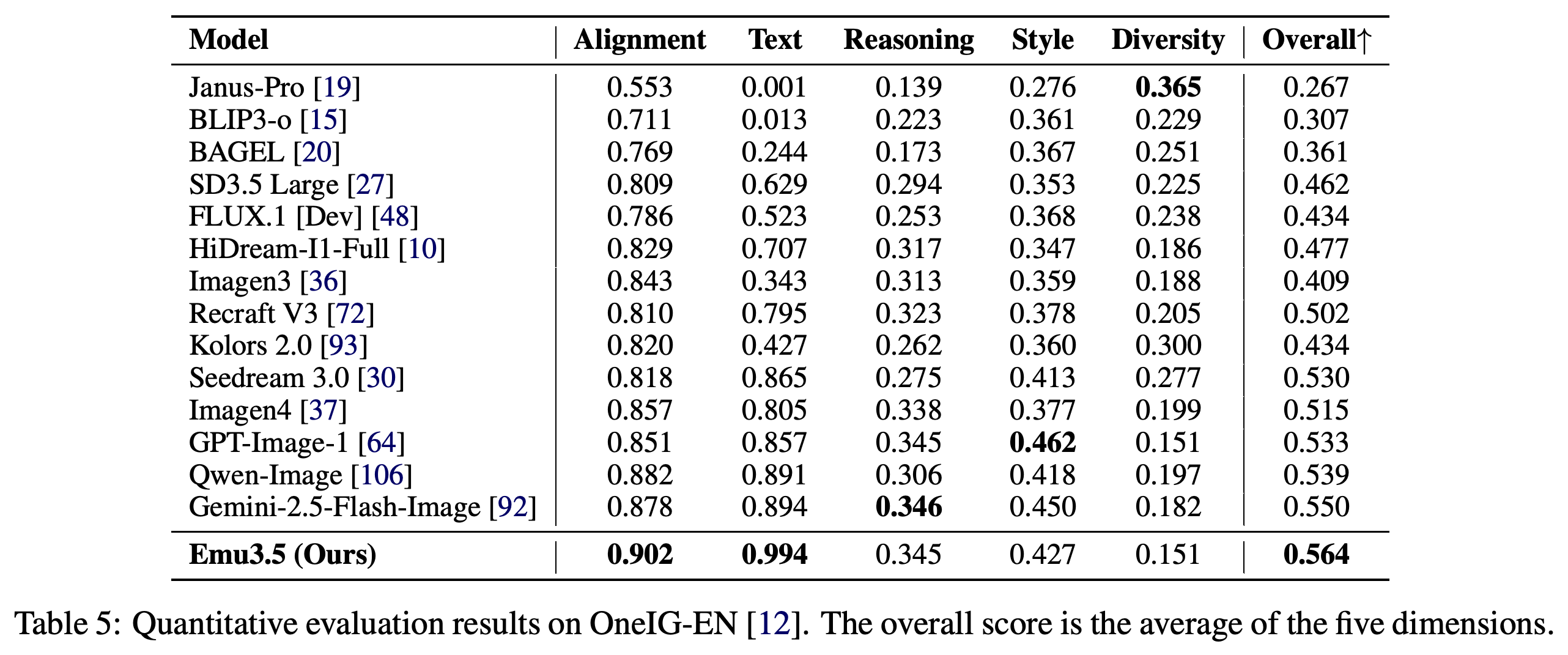
Text-to-image evaluation covers general instruction following and English and Chinese text rendering. On OneIG-Bench, which evaluates alignment, text, reasoning, style, and diversity, Emu3.5 leads the reported English overall score at 0.564 versus Gemini 2.5 Flash Image at 0.550; its Chinese score is 0.529 versus Qwen-Image at 0.548.
- TIIF Bench testmini, a benchmark for following complex image-generation instructions, reports overall short/long scores of 89.48/88.18 for Emu3.5 and 89.15/88.29 for GPT Image 1. The two prompt conditions have different leaders.
- LeX-Bench evaluates English text rendering with 1,310 prompts. Emu3.5 achieves recall 0.98, 0.96, and 0.87 on easy, medium, and hard conditions, with corresponding pned text-error scores of 0.43, 1.16, and 4.39, where lower is preferred. The PDF does not expand pned; Seedream 3.0 has the better easy score at 0.34.
- LongText-Bench evaluates long-text rendering. Scores are 0.976 for English, 0.928 for Chinese, and 0.952 on average; Qwen-Image scores 0.943, 0.946, and 0.944, so Emu3.5 leads English and the average but trails Chinese.
- CVTG-2K contains 2,000 prompts requiring 2–5 English text regions. Emu3.5 reaches average word accuracy 0.9123 and Normalized Edit Distance (NED), the benchmark’s normalized text-comparison score reported with higher values preferred, 0.9656; GPT-Image-1 scores 0.8569 and 0.9478.
- Figure 12 illustrates photographic and stylized outputs, dense English and Chinese text, and mathematical notation. These selected examples illustrate output formats without measuring their failure frequency.
Emu3.5's leading OneIG-EN average of 0.564 combines the highest listed alignment and text scores with lower diversity than several alternatives. It does not lead every evaluation dimension.
6.2 Any-to-Image
X2I evaluation uses approximately 1024×1024 resolution across editing, subject-conditioned generation, and 31 creation and editing tasks. Emu3.5 has the highest reported overall scores on ImgEdit, GEdit-Bench, OmniContext, and ICE-Bench, although several margins are small and individual subtasks remain weaker.
- ImgEdit evaluates single-turn image editing with 737 samples and GPT-4.1 scoring: Emu3.5 scores 4.41 versus Qwen-Image-Edit-2509 at 4.35 and Gemini 2.5 Flash Image at 4.28.
- GEdit-Bench evaluates single-turn editing with 606 samples and GPT-4o scoring. Emu3.5 scores 8.11 for semantic consistency, 7.70 for perceptual quality, and 7.59 overall; Qwen-Image-Edit scores 7.56 overall. Overall is the mean of sample-level overall scores, not the mean of the two component metrics.
- OmniContext evaluates subject-driven generation with 400 samples and GPT-4.1-based scoring of prompt following and subject consistency. Emu3.5 averages 8.82 versus GPT-4o at 8.80, with stronger object results than character results.
- ICE-Bench evaluates image creation and editing with 6538 samples and task-specific automated quality, consistency, and controllability metrics. Emu3.5 scores 0.637 overall versus Gemini 2.5 Flash Image at 0.631, but is weaker on face reference, style reference, and face swap; Qwen-Image-Edit-2509 receives a blank 1024×1024 input image for its no-reference creation evaluation.
- Figures 13–15 illustrate viewpoint changes, local and composite edits, and single-image or multi-image subject conditioning.
Emu3.5's 0.637 aggregate leads the listed competitors, while face reference, style reference, and face swap remain weaker than Gemini 2.5 Flash Image. The breakdown qualifies the aggregate result.

6.3 Visual Narrative
Visual Narrative is evaluated through ChatGPT comparisons covering visual, textual, and cross-modal quality against Gemini 2.5 Flash Image. Emu3.5 wins 49.2%, ties 10.3%, and loses 40.5%, consistent with the paper’s characterization of comparable narrative performance.
- Figure 16 shows text-only and image-conditioned narratives spanning cartoon stories, historical explanation, imagined scenarios, and nature descriptions. The evaluation assesses generated narrative quality and does not independently verify the factual accuracy of educational content.
6.4 Visual Guidance
Visual Guidance evaluation considers step relevance and completeness, instructional clarity, text-image alignment, procedural coherence, visual informativeness, task completion, and image quality. Automated preference against Gemini 2.5 Flash Image yields 51.5% wins, 9.5% ties, and 39.0% losses.
- Figure 17 illustrates sketch development, planting, cooking, expression changes, object handling, cable organization, and sculpting. These are generated procedural depictions; the evaluation does not report users completing the depicted procedures.
6.5 World Exploration
World Exploration evaluation includes in-domain and additional out-of-domain scenarios, both text-only and multimodal prompts, and both User-Interactive and Free-Exploration modes. ChatGPT assesses eight criteria: path plausibility, spatial consistency, global coherence, environmental richness, visual-text alignment, image quality, text quality, and task completion; Emu3.5 wins 65.5% and loses 34.5%.
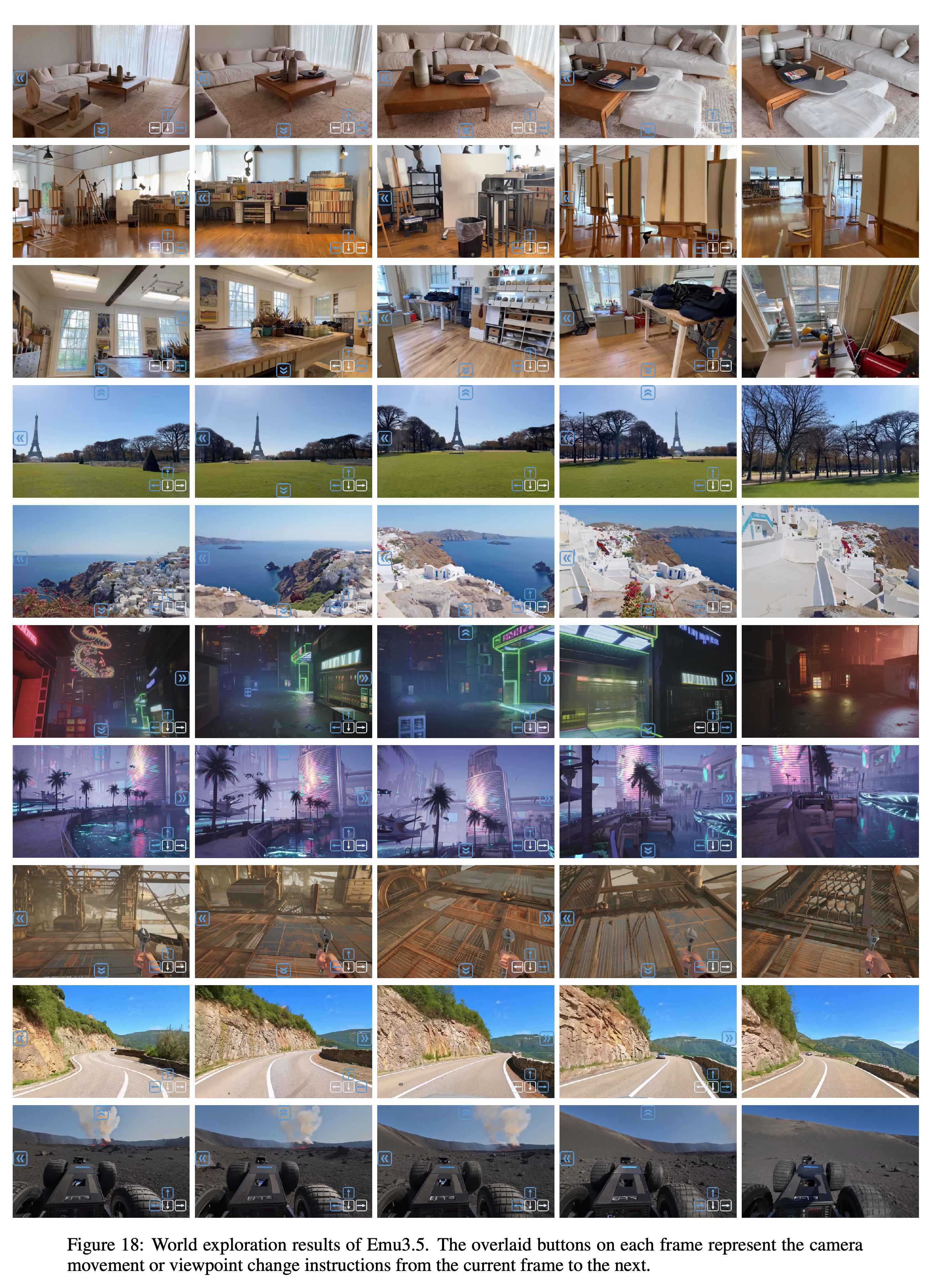
- Figure 18 emphasizes text-only initialization in User-Interactive Mode and shows successive views of indoor, outdoor, driving, and game-like scenes. Table 14 aggregates preferences without separate quantitative scores for each input mode or domain.
Successive generated views illustrate instruction-conditioned camera motion in rooms, landscapes, roads, and game environments. The selected trajectories show the interaction format without quantifying geometric consistency over arbitrary paths.
6.6 Embodied Manipulation
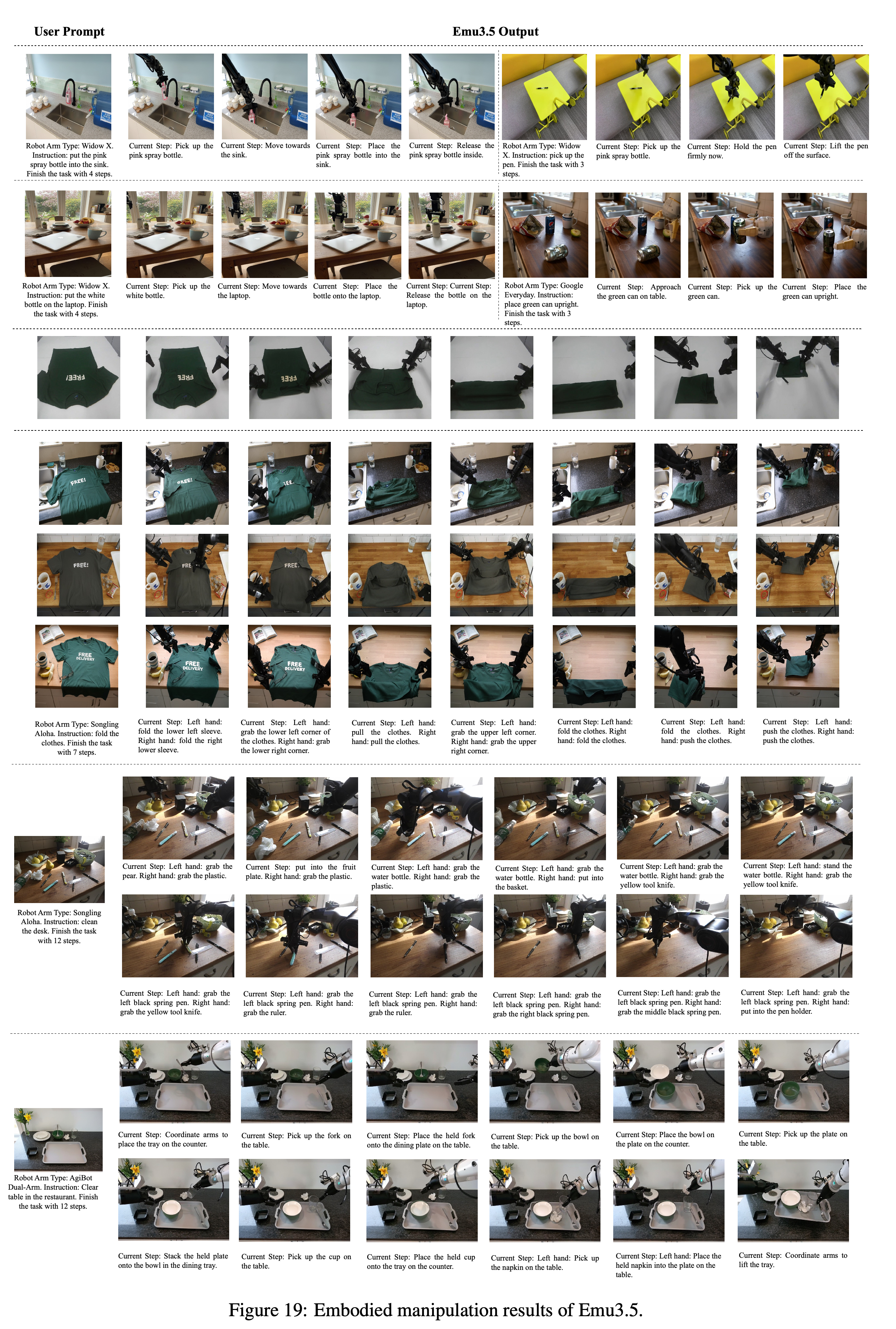
Embodied Manipulation evaluation covers 5 robotic embodiments, robot configurations, and over 50 tasks lasting 3–13 steps. Its 331 samples comprise 10 real captured images, 109 sampled examples, and 192 synthesized examples with perturbed arm positions and environmental conditions.
- ChatGPT evaluates subtask skill clarity, text-image alignment, task execution progress, image quality, background consistency, and physical-law consistency. Emu3.5 wins 67.1%, ties 2.4%, and loses 30.5% against Gemini 2.5 Flash Image.
- Figure 19 shows generated subtask-keyframe sequences for object placement, cloth folding, and clearing surfaces. All initial frames except the first cloth-folding row are generated by Gemini 2.5 Flash Image; the reported outcomes assess generated plans and images rather than executed robot trajectories.
The win, tie, and loss columns distinguish the smaller preference margins for narrative and guidance from the larger margins for exploration and manipulation. These percentages measure automated preferences against one comparator, rather than physical task success.
The examples pair language subtasks with generated keyframes for several robot types and multi-step activities. They visualize predicted interaction states, with no corresponding physical execution success measurement.
6.7 Tokenizer Reconstruction
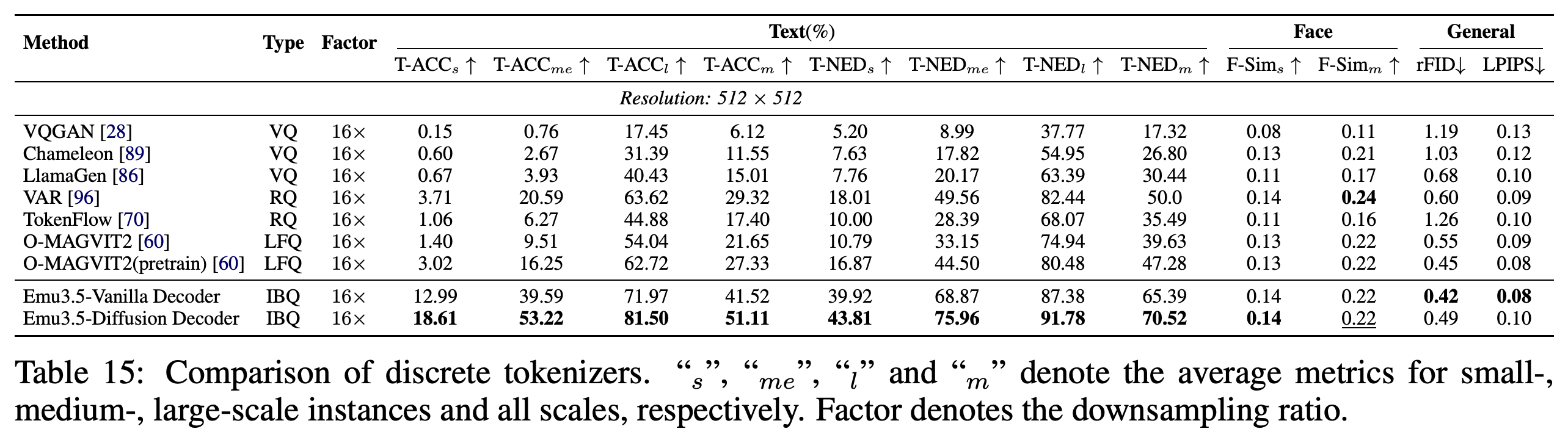
Tokenizer evaluation uses Tokbench, a visual-tokenizer benchmark for text and facial reconstruction, and a curated 60k-image set for general reconstruction. The diffusion decoder raises all-scale text accuracy from 41.52 to 51.11 and the reported normalized text score from 65.39 to 70.52 relative to the vanilla decoder.
- Table 15 also exposes a tradeoff: reconstruction Fréchet Inception Distance (rFID), a distribution-based reconstruction metric, worsens from 0.42 to 0.49, and LPIPS worsens from 0.08 to 0.10; lower is preferred for both.
- Both decoders report all-scale facial similarity 0.22. Figure 11 compares originals with reconstructions of text, portraits, animals, and landscapes; the optional diffusion decoder reconstructs at twice the vanilla decoder’s resolution.
The diffusion decoder improves text reconstruction relative to the vanilla decoder while worsening rFID and LPIPS. Facial similarity is unchanged between the two Emu3.5 decoders, making the benefit metric-dependent.
6.8 Discrete Diffusion Adaptation
At 1024×1024 resolution and 4,096 generated tokens, DiDA reduces naive inference time from 512 s to 22 s and FlagScale inference time from 120 s to 10 s. These entries imply approximately 23.3× and 12× speedups, respectively, while the paper’s prose summarizes acceleration as up to 20×.
- GenEval remains 0.86; DPG-Bench, another image-generation alignment benchmark, decreases from 88.26 to 87.46, and GEdit-Bench-EN overall decreases from 7.59 to 7.56. The results support comparable measured quality with small score reductions.
- Emu3’s comparison uses 8B parameters, 720×720 resolution, and 8,100 tokens, scoring 0.66 on GenEval and 80.60 on DPG-Bench. Differences in resolution, parameter count, and tokenization prevent this comparison from isolating any one change.
The matched Emu3.5 rows compare decoding methods at 1024×1024 and 4,096 tokens. FlagScale latency falls from 120 s to 10 s, with unchanged GenEval and small reductions on DPG-Bench and GEdit-Bench-EN; the table reports latency for text-to-image generation.

7 Conclusion, Limitations and Future Work
The conclusion attributes Emu3.5’s capabilities to large-scale unified prediction and multimodal post-training, and presents the model and development pipeline as an open release. Explicit limitations include the 1,024 tokens still needed for a 512×512 image, remaining inference latency, and insufficient systematic evaluation of long-horizon tasks.
- Future work proposes better tokenizer compression and reconstruction, additional acceleration, quantitative and human benchmarks, richer multimodal prompting, and embodied agents that interact with the physical world. These directions extend beyond the demonstrated generation experiments.
8 Authors and Contributions
The paper credits the Emu3.5 Team at BAAI and lists contributors by workstream, with asterisks marking core contributors ordered by Chinese surname stroke count. Zhongyuan Wang and Tiejun Huang are Senior Leads, and Xinlong Wang is Project Lead.
- Tokenizer: Fan Zhang*, Zhuoyan Luo*, Xu Huang*.
- Data: Yueze Wang*, Wenxuan Wang*, Yufeng Cui*, Chengyuan Wang, Xinghang Li, Honghao Chen, Fan Zhang, Yang Liu, Zhuoyan Luo, Jinsheng Wang.
- Pre-training: Yufeng Cui*, Wenxuan Wang, Yueze Wang, Zhuoyan Luo, Yingli Zhao, Fan Zhang, Zecheng Hao, Wenxuan Ma.
- Downstream Post-training: Yueze Wang*, Wenxuan Wang*, Chengyuan Wang*, Jirong Liu*, Yang Liu*, Honghao Chen*, Xinghang Li*, Fan Zhang*, Zhuoyan Luo*, Yufeng Cui*.
- Unified Post-training: Jinsheng Wang*, Yang Liu*, Jirong Liu*, Yufeng Cui, Chengyuan Wang, Wenxuan Wang, Honghao Chen.
- Discrete Diffusion Adaptation: Haoge Deng*, Fan Zhang*, Ting Pan, Yingli Zhao, Xianduo Li.
- Infrastructure: Yingli Zhao*, Xianduo Li, Zhuo Chen, Yulong Ao.
Appendix
- The PDF contains no explicitly titled Appendix. Pages 29–36 provide additional qualitative figures discussed in the experimental sections, and pages 37–45 contain References; the project URLs are https://emu.world and https://github.com/baaivision/Emu3.5.
Brief Thoughts
The clearest engineering comparison is DiDA: the matched Emu3.5 rows use the same reported model size, resolution, and token count and show substantially lower latency with nearly unchanged benchmark scores. Automated preferences favor its generated exploration and manipulation sequences, but the experiments do not establish physical execution success or isolate the contributions of video pre-training and joint RL; the authors also identify human evaluation as future work.