


Zetta $\zeta$: An Efficient Closed-Loop Embodied Harness for Self-Evolving Physical Intelligence | Summary
17 Aug 2026 | Paper Review Embodied Agents Self-Evolving Agents Vision-Language-Action Models Rollout InfrastructureContents
- Summary
- 1. Introduction
- 2. Enabling Deployment-Time Evolution of Embodied Agents
- 2.1. Problem Formulation: Dual-Agent Governance and Evolutionary Architecture
- 2.3. Phase I: Empirical Failure Profiling and Baseline Establishment (Loop 1)
- 2.4. Phase II Stage 1: Failure Clustering and Causal Diagnosis
- 2.5. Phase II Stage 2: Critic-Guided Harness Repair and Validation
- 2.6. Phase III: Harness Consolidation, Packaging and Generalization
- 3. Z-Infra: Embodied Agent Rollout Infrastructure
- 4. Experiments
- Appendix
- Brief Thoughts
This article explains the key points of Zetta $\zeta$: An Efficient Closed-Loop Embodied Harness for Self-Evolving Physical Intelligence.
- 2026-08-17 (arXiv)
- Ding, Xin, Mi, Liang, Huang, Mingzhe, Wang, Zixuan, Zhang, Chao, Hao, Zixu, Chen, Fu, Li, Xiangyu, Zheng, Yikai, Guo, Yaoyu, et al.
- Institute for AI Industry Research (AIR), Tsinghua University, Z-Trans AI
- Paper
- Github
- Project Page
Summary
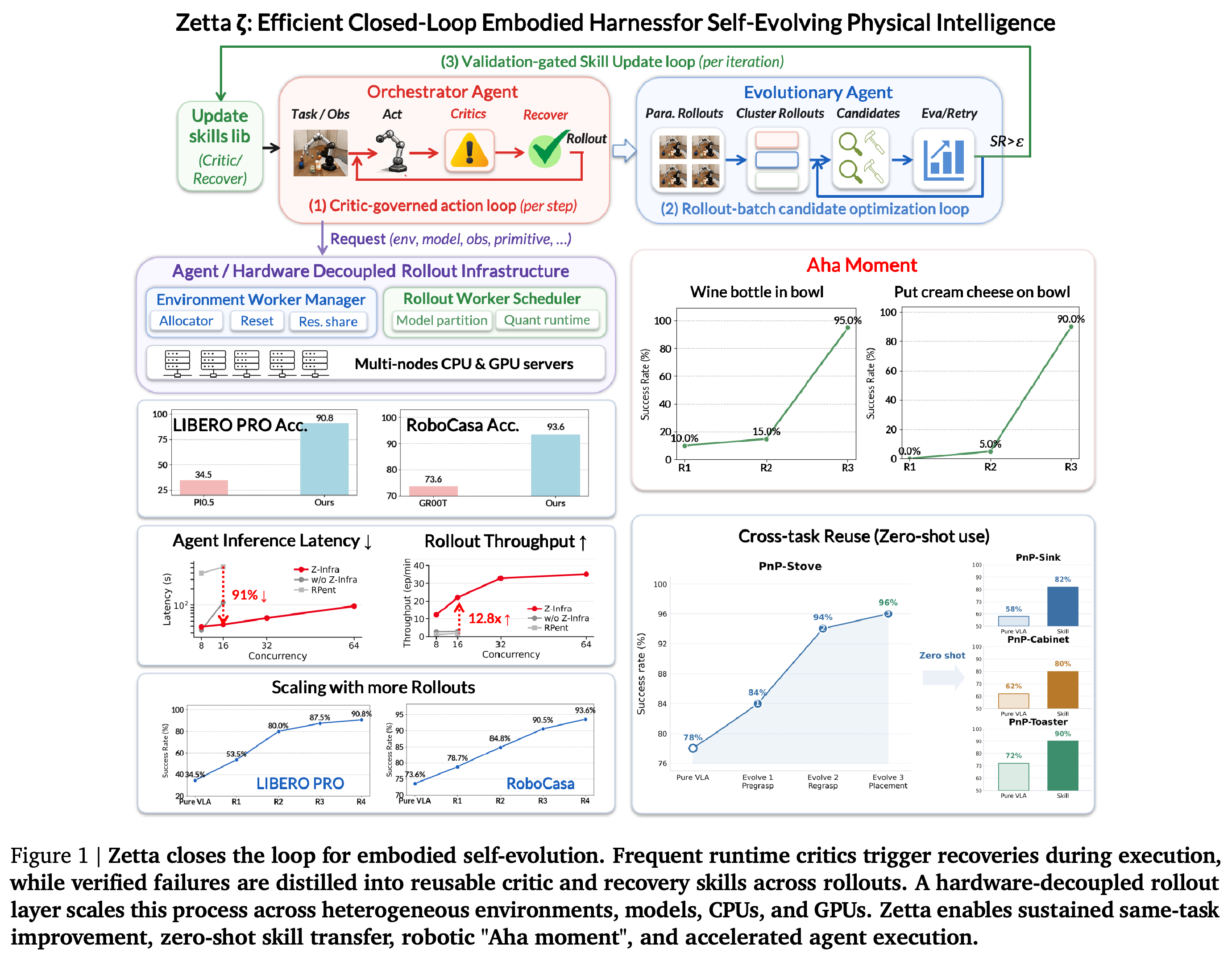
- Zetta is a closed-loop embodied harness that keeps a base VLA or world-action policy frozen while evolving code-based runtime critics, recovery playbooks, and tools. It is paired with Z-Infra, a hardware-decoupled rollout system; the paper reports 93.56% RoboCasa macro-average success, LIBERO-Pro Goal averages of 92.5% for T and 89.0% for S, and up to 35.1 episodes/min on the Z-Infra systems evaluation.
The overview joins three timescales: action-frequency critic and recovery execution, rollout-batch candidate optimization, and validation-gated skill updates. It also presents the paper’s claimed same-task scaling, transfer, “Aha” moments, latency, and throughput outcomes.
1. Introduction
The paper argues that episode-end reflection cannot govern rapidly changing physical states, whereas invoking large agentic models at action frequency is impractical. It therefore proposes learning reusable runtime mechanisms from self-exploration while treating rollout throughput as a limiting factor for improvement.
2. Enabling Deployment-Time Evolution of Embodied Agents
Deployment-time evolution is framed as high-frequency state governance plus automated repair and generalization. The design uses lightweight critics to detect deviations, hierarchical diagnosis from evaluation logic to low-level parameters, and held-out validation rather than expert debugging alone.
2.1. Problem Formulation: Dual-Agent Governance and Evolutionary Architecture
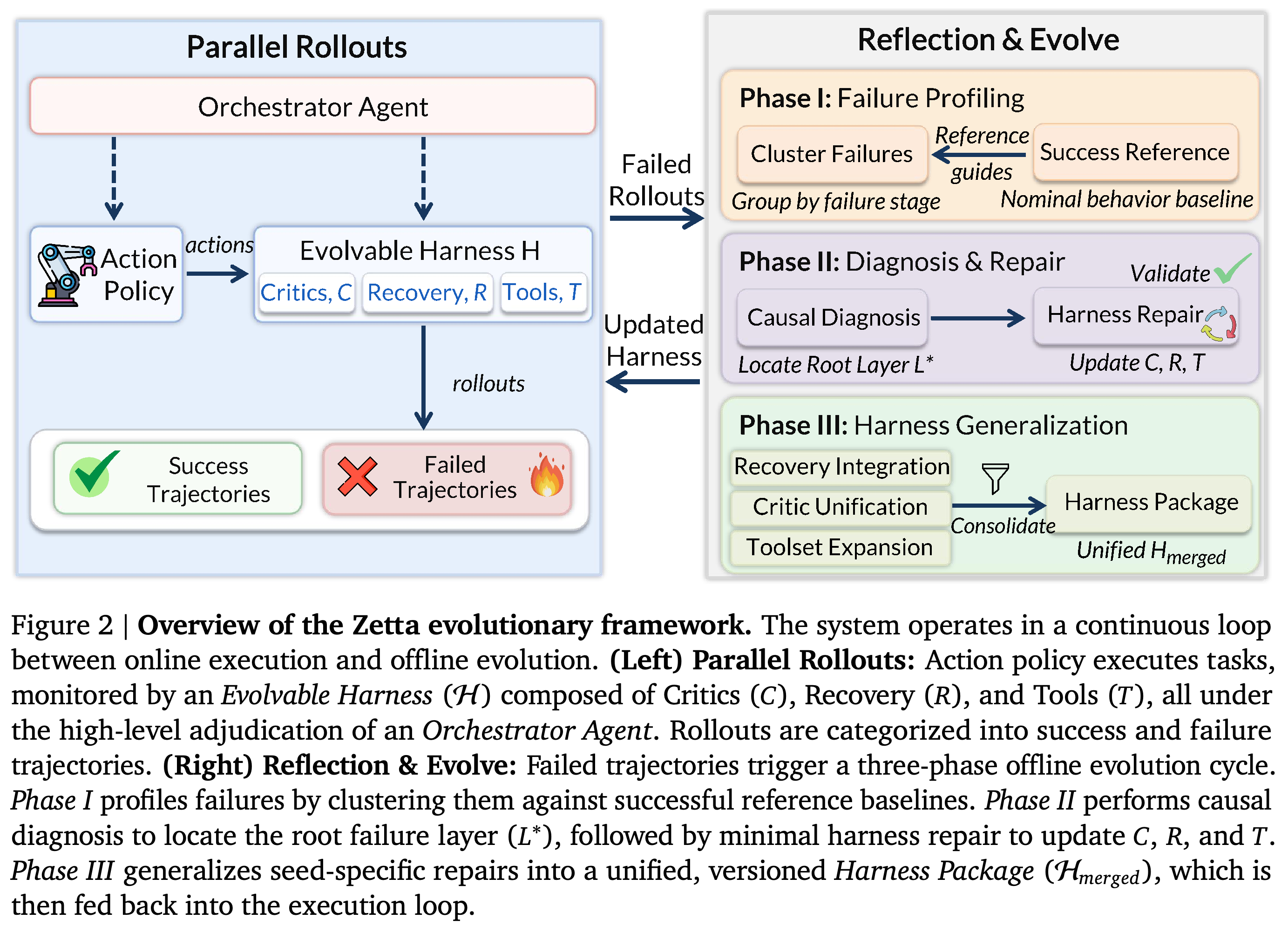
The fixed runtime components are an action policy π and an Orchestrator Agent, while the evolvable harness is H = {C, R, T}: runtime critics, recovery playbooks, and a heterogeneous toolset. Critics submit evidence and a mode proposal, the Orchestrator adjudicates interventions, and offline Evolutionary Agents update H while leaving π and the Orchestrator fixed.
The diagram separates online parallel rollouts from offline profiling, diagnosis, repair, and consolidation. Failed trajectories produce updates to the harness, while the action policy and Orchestrator remain fixed.
2.3. Phase I: Empirical Failure Profiling and Baseline Establishment (Loop 1)
Loop 1 establishes a pure-policy baseline on development seeds under deterministic routing and reruns infrastructure-invalid attempts. It records multimodal trajectories, indexes successful states by milestones, and assigns failures a First Missing Milestone to identify the stage for diagnosis.
2.4. Phase II Stage 1: Failure Clustering and Causal Diagnosis
For failed seeds, the diagnosis agent identifies the Earliest Observable Divergence from successful reference states, clusters failures by signature, and selects a medoid seed for detailed analysis. It uses a primary visual view and, when necessary, simulator state and physical signals, then checks evaluation, critic, state, planning/control, recovery, and parameter layers in order.
2.5. Phase II Stage 2: Critic-Guided Harness Repair and Validation
The Repair Agent creates a minimal critic, recovery, and tool patch for the diagnosed root layer. Its VLA Re-entry Contract returns control only after failure evidence is cleared and contact stability exceeds a threshold; validation requires divergence detection and a new successful closed-loop rollout with Orchestrator-adjudicated interventions.
2.6. Phase III: Harness Consolidation, Packaging and Generalization
Validated seed-level patches are consolidated into generalized critics, recoveries, tools, and versioned package files including SKILL.md, tools/, plans/, and params/. Promotion requires success across the originating cluster and improvement over the frozen policy on held-out seeds; held-out failures used for repair are moved to development and replaced before final validation.
3. Z-Infra: Embodied Agent Rollout Infrastructure
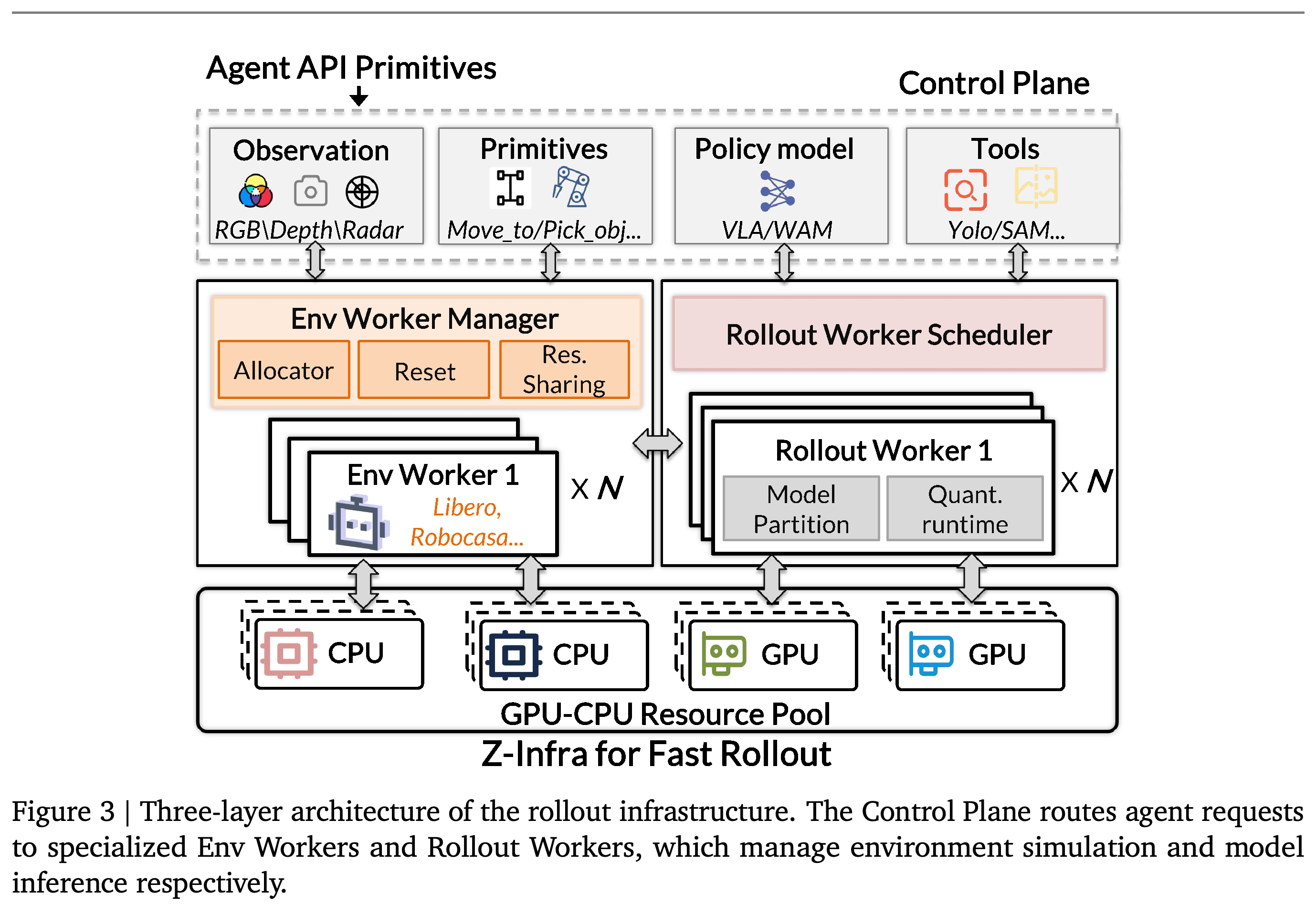
Z-Infra is the execution backbone for concurrent agent-environment rollouts and hides heterogeneous simulator and hardware details behind a session interface. It separates workloads including CPU simulation, GPU rendering, policy inference, perception, and low-latency primitive operations rather than placing them in one homogeneous resource pool.
3.3. System Architecture
The three-layer system comprises a Control Plane, Environment Workers, and GPU-resident Rollout Workers connected through bounded asynchronous channels. The Control Plane manages sessions, routing, and worker health; environment workers isolate session state and share immutable MuJoCo resources; rollout workers batch compatible requests and return results asynchronously by routing token.
The architecture assigns session and resource coordination to the Control Plane, simulation to Environment Workers, and model serving to Rollout Workers. This separation supports hardware-decoupled scheduling of CPU and GPU resources.
3.4. Programming Support
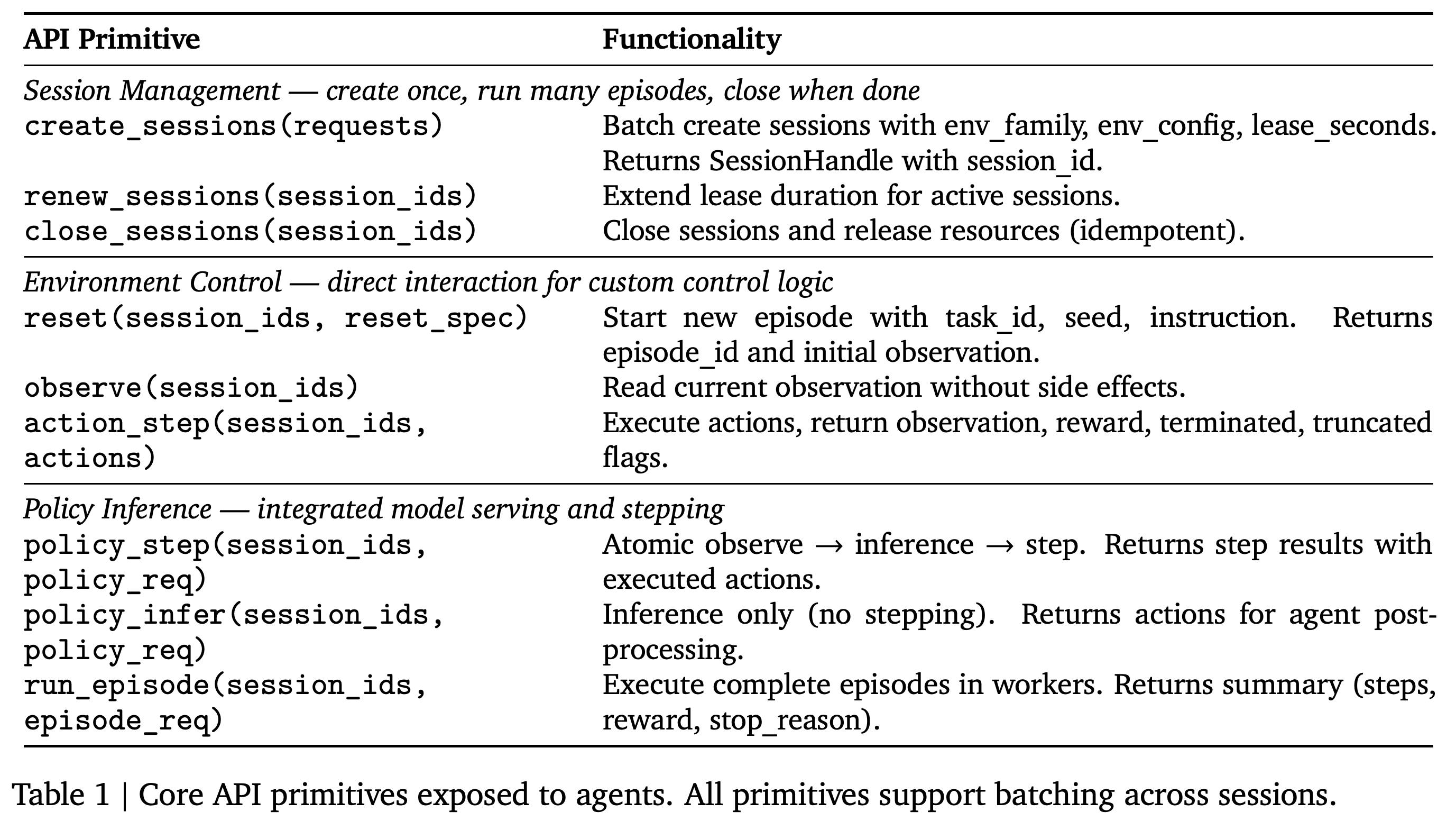
The programming model exposes managed sessions, episodes, and steps, with APIs for environment control, policy inference, perception, and planning. For π0.5, separating the Vision-Language Model and Action Expert through CUDA IPC reduces average inference latency by 53% and improves goodput under a 200 ms SLO by 2.4×; W8A8 prefix-MLP quantization yields 1.18×–1.32× speedup on RTX 4090 without reported LIBERO success degradation.
The table defines the agent-facing API boundary for session management, direct environment control, integrated policy inference, and complete episode execution. All listed primitives support batched operation across sessions.
4. Experiments
Experiments use frozen π0.5 on LIBERO-Pro and frozen GR00T N1.5 on RoboCasa. RoboCasa uses 50 development and 50 disjoint held-out random seeds per task; LIBERO-Pro evolves on 50 parent development seeds and evaluates only on isolated seeds 1–20.
4.2. Physical Intelligence “Aha” Moments
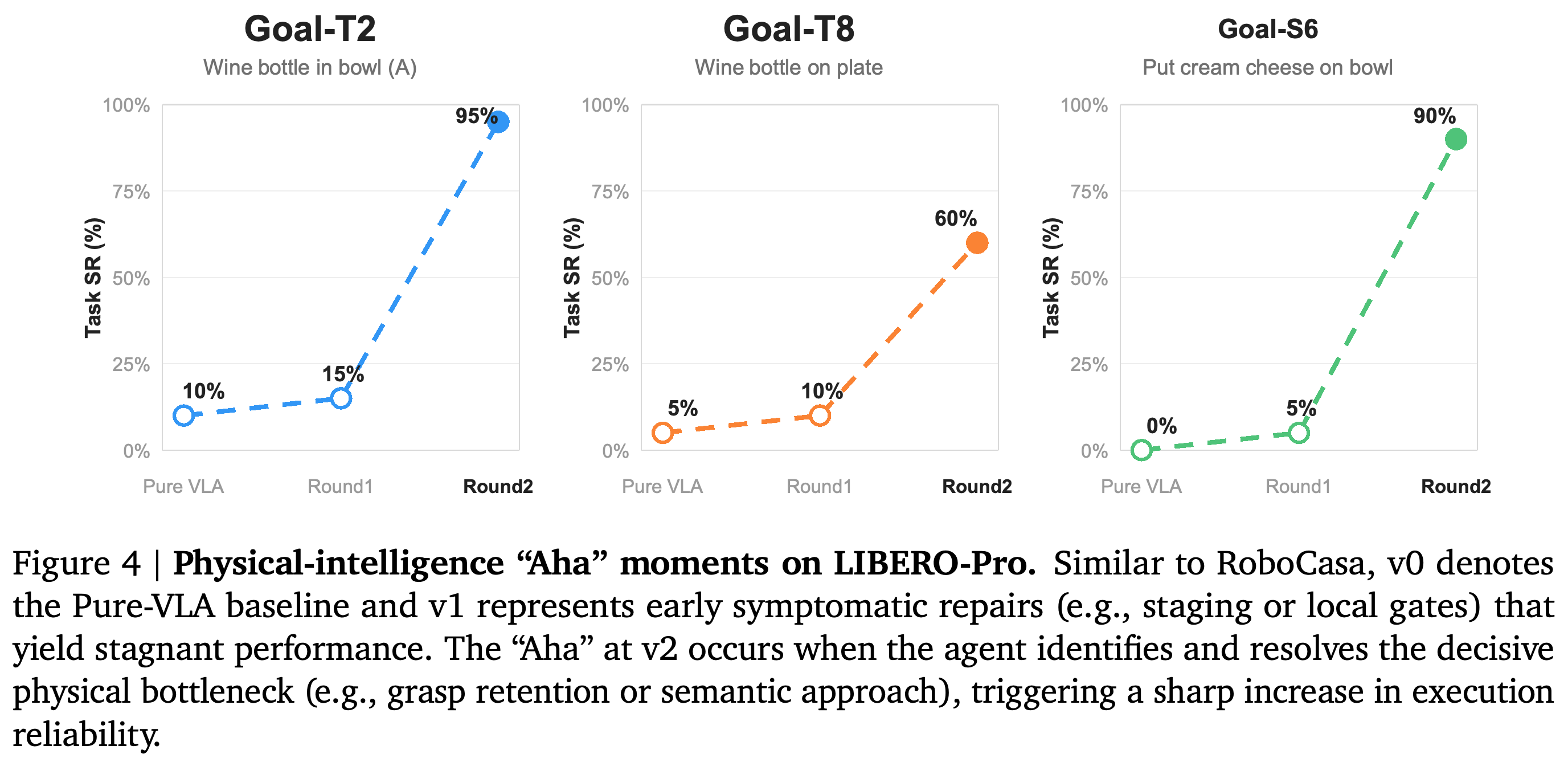
The authors define an “Aha” moment as a sharp success increase after a critic-recovery revision identifies a physical bottleneck rather than a local symptom. On LIBERO-Pro, Goal-T2 rises from 15% after an early repair to 95%, Goal-T8 rises to 60%, and Goal-S6 rises to 90% after their respective later repairs.
The three LIBERO-Pro traces show low improvement after early revisions and sharp gains after later root-cause repairs. The reported sequences are 10%→15%→95% for Goal-T2, 5%→10%→60% for Goal-T8, and 0%→5%→90% for Goal-S6.
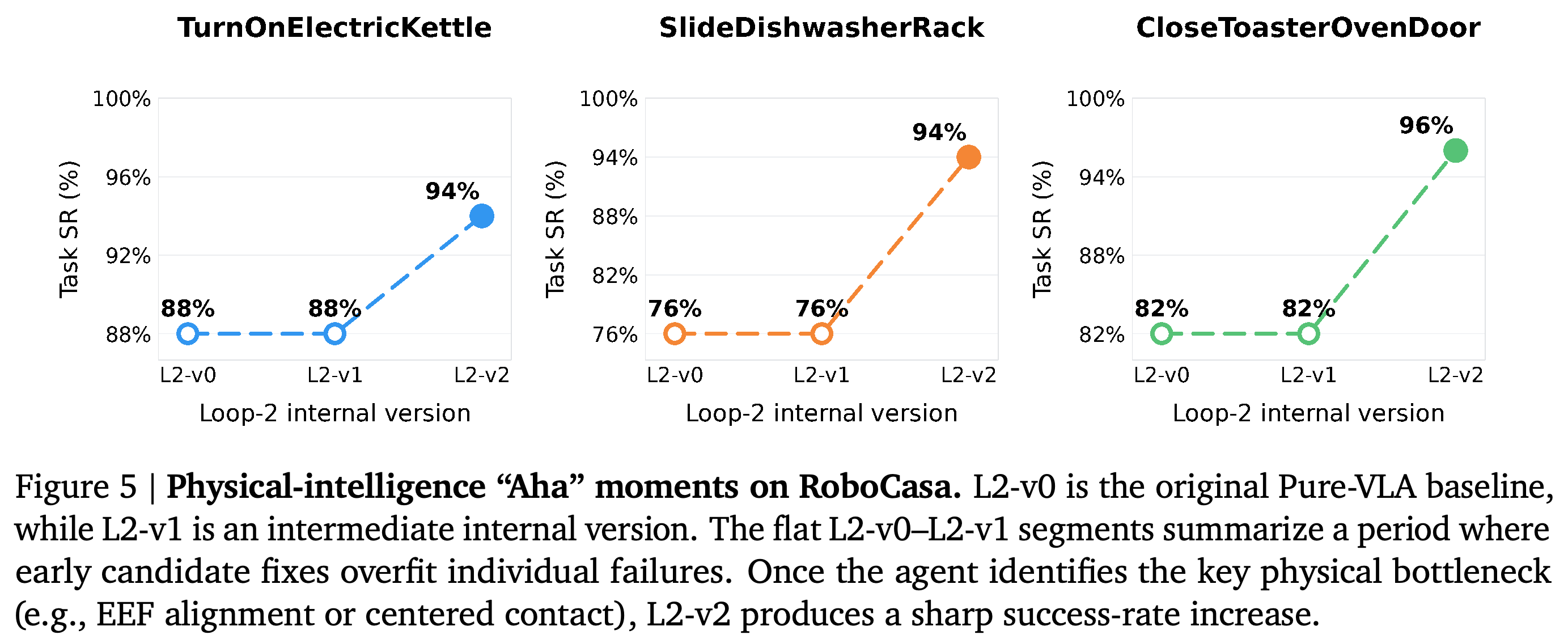
The RoboCasa examples are flat from L2-v0 to L2-v1, then improve at L2-v2. The final changes are 88%→94% for TurnOnElectricKettle, 76%→94% for SlideDishwasherRack, and 82%→96% for CloseToasterOvenDoor.
4.3. Physical Intelligence Scaling and Zero-shot Capability
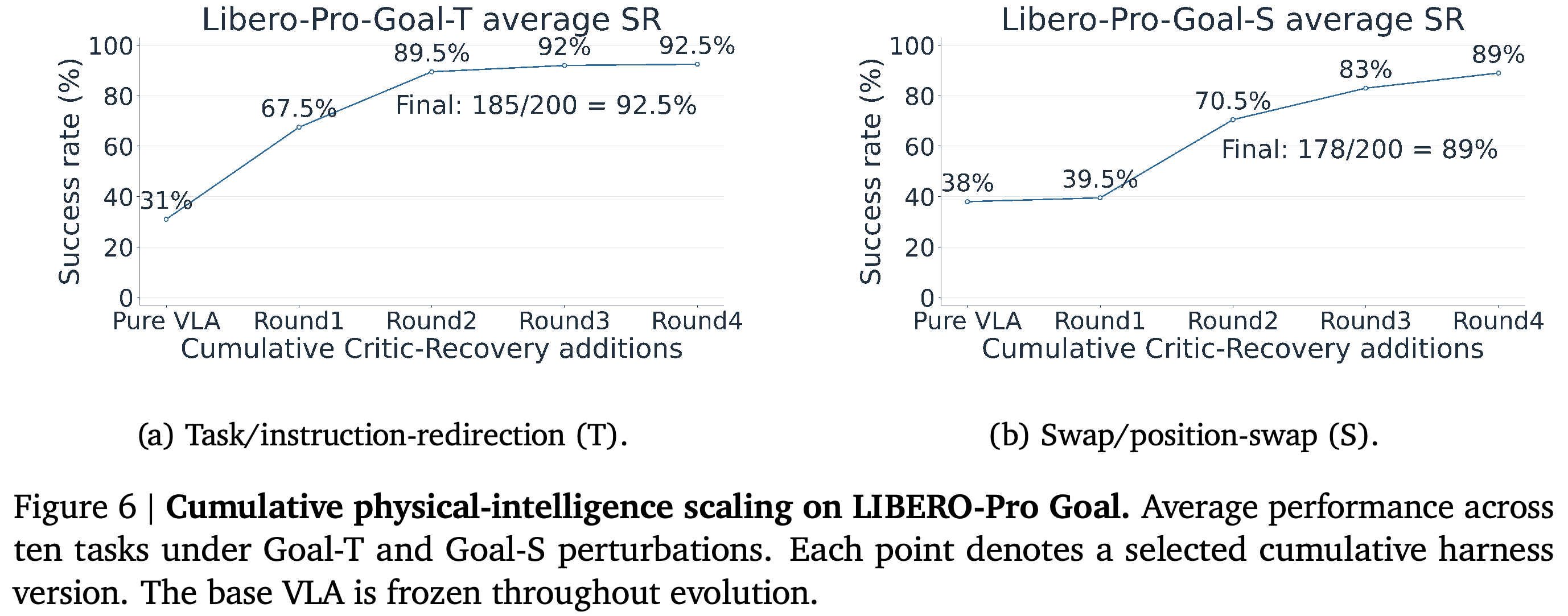
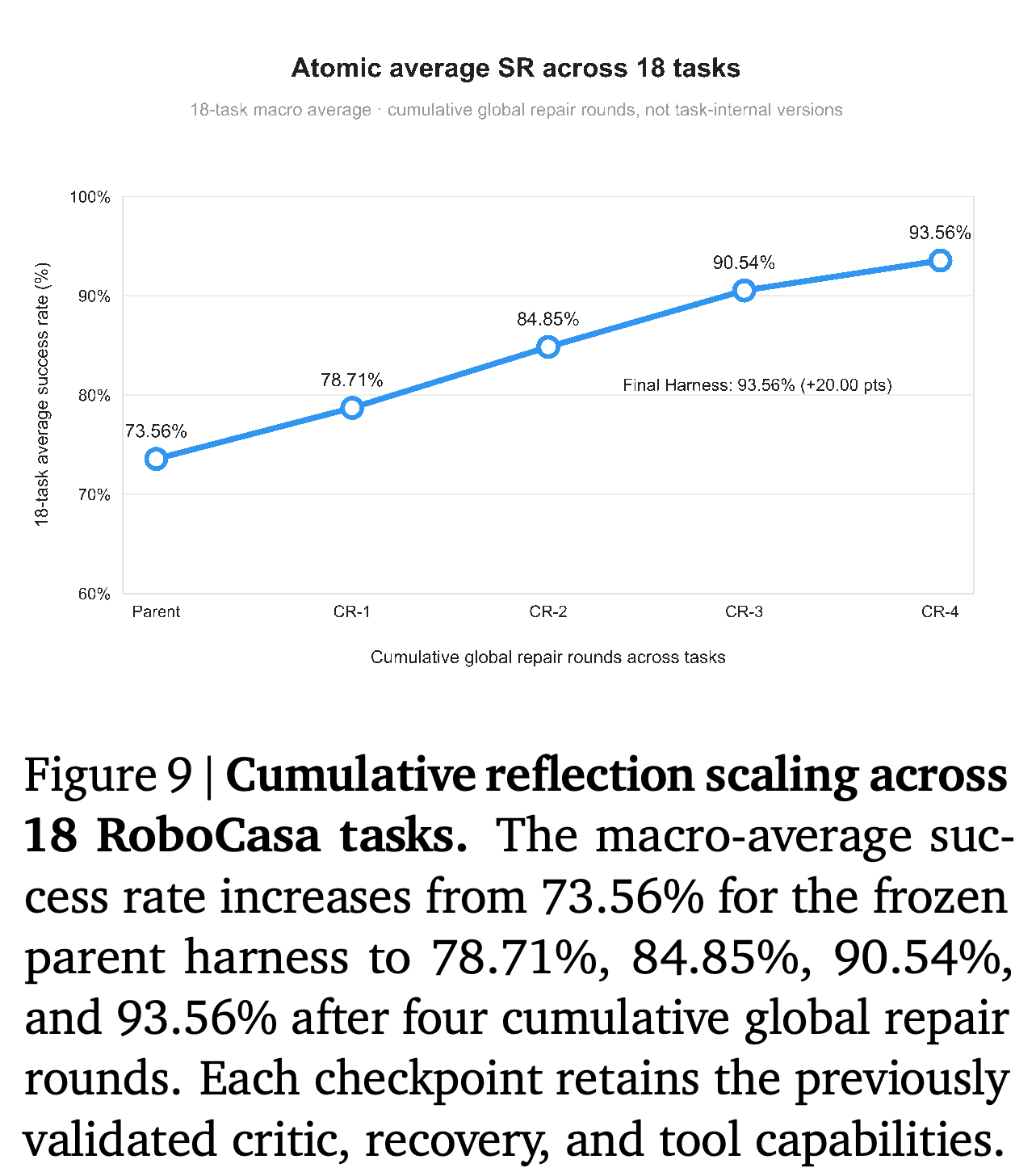
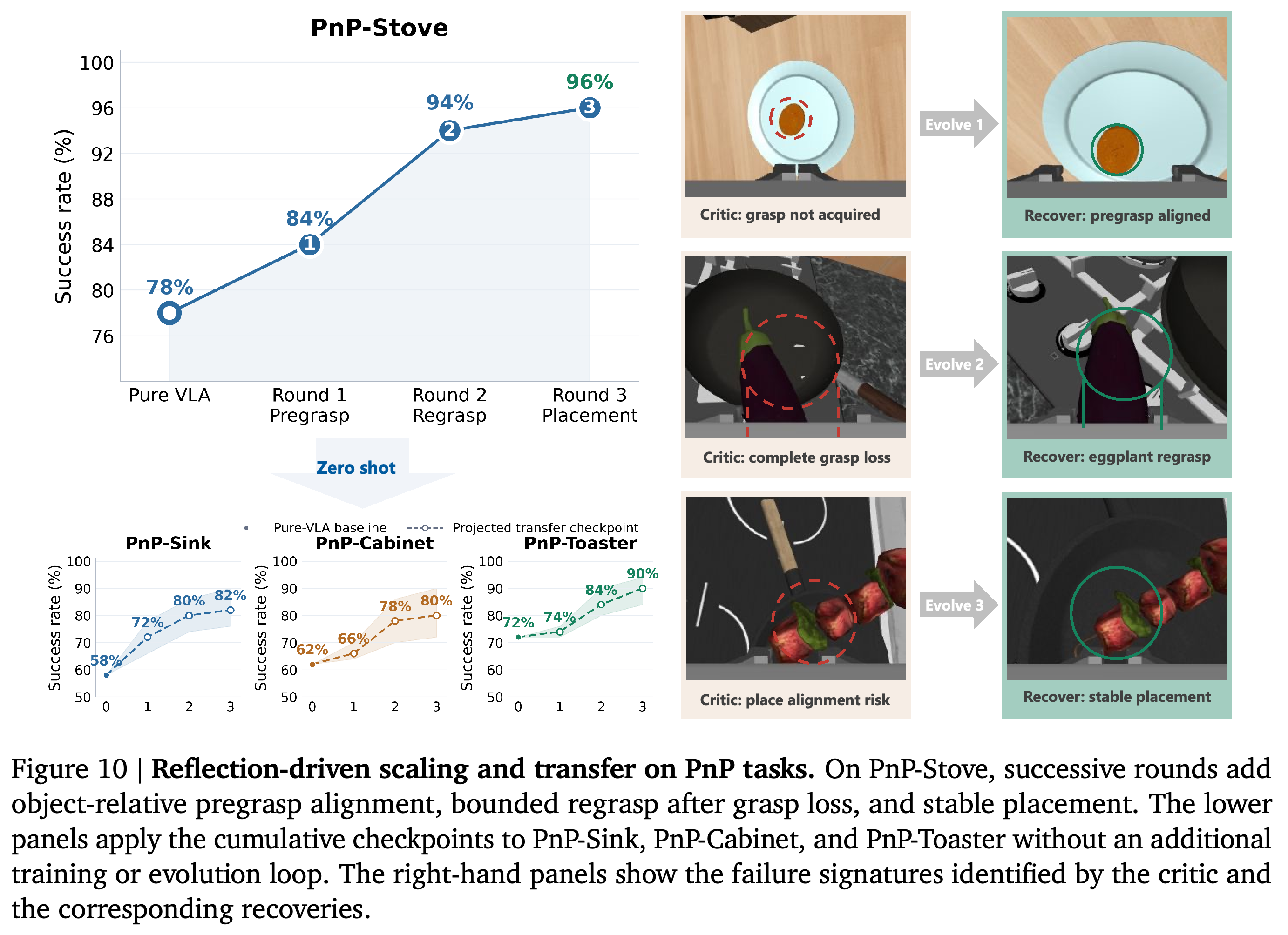
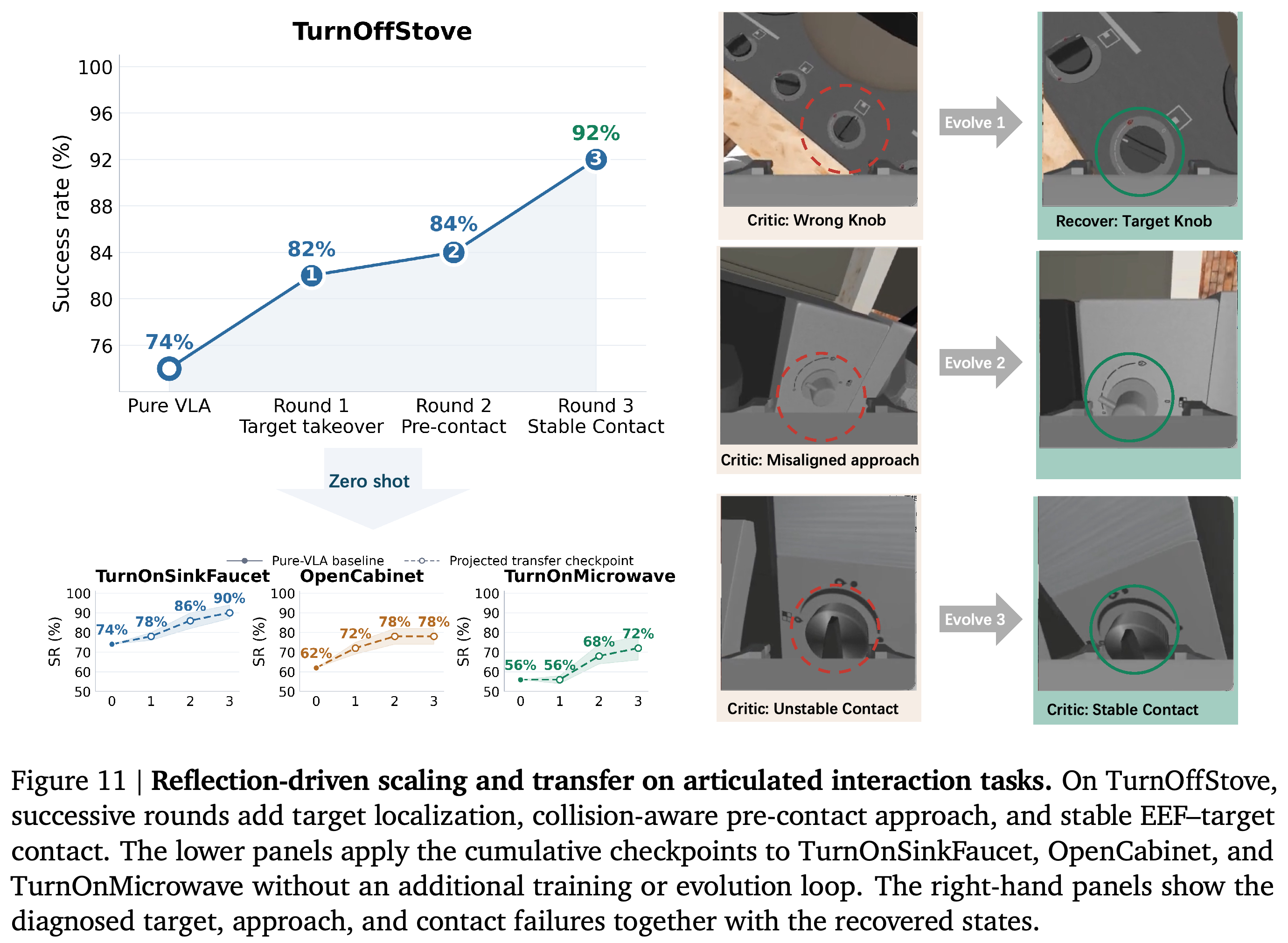
Cumulative mechanisms raise LIBERO-Pro Goal-T from 31.0% to 92.5% and Goal-S from 38.0% to 89.0%; four global repair rounds raise the 18-task RoboCasa macro-average from 73.56% to 93.56%. In the reported zero-shot studies, pick-and-place transfer rises from 64% to 84%, while articulated-interaction transfer rises from 64% to 80%.
The figure reports cumulative harness versions across ten Goal-T and ten Goal-S tasks with the base VLA frozen. Goal-T reaches 92.5% (185/200) and Goal-S reaches 89.0% (178/200) after four rounds.
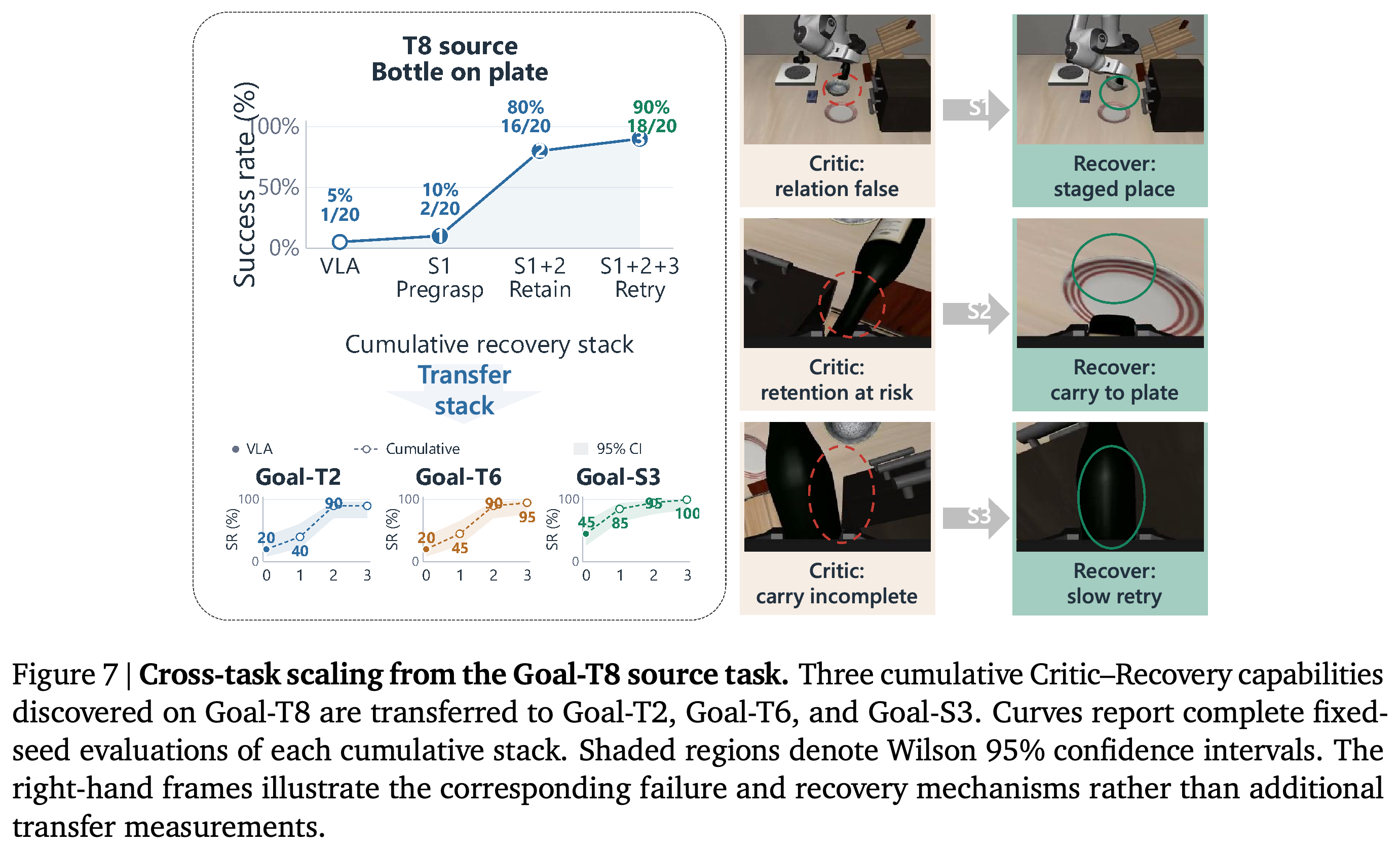
Three mechanisms learned on Goal-T8—pre-grasp staging, grasp-retention monitoring, and failure-gated retry—are tested cumulatively on three other tasks using fixed seeds. The reported transfer includes Goal-S3 increasing from 9/20 to 20/20.
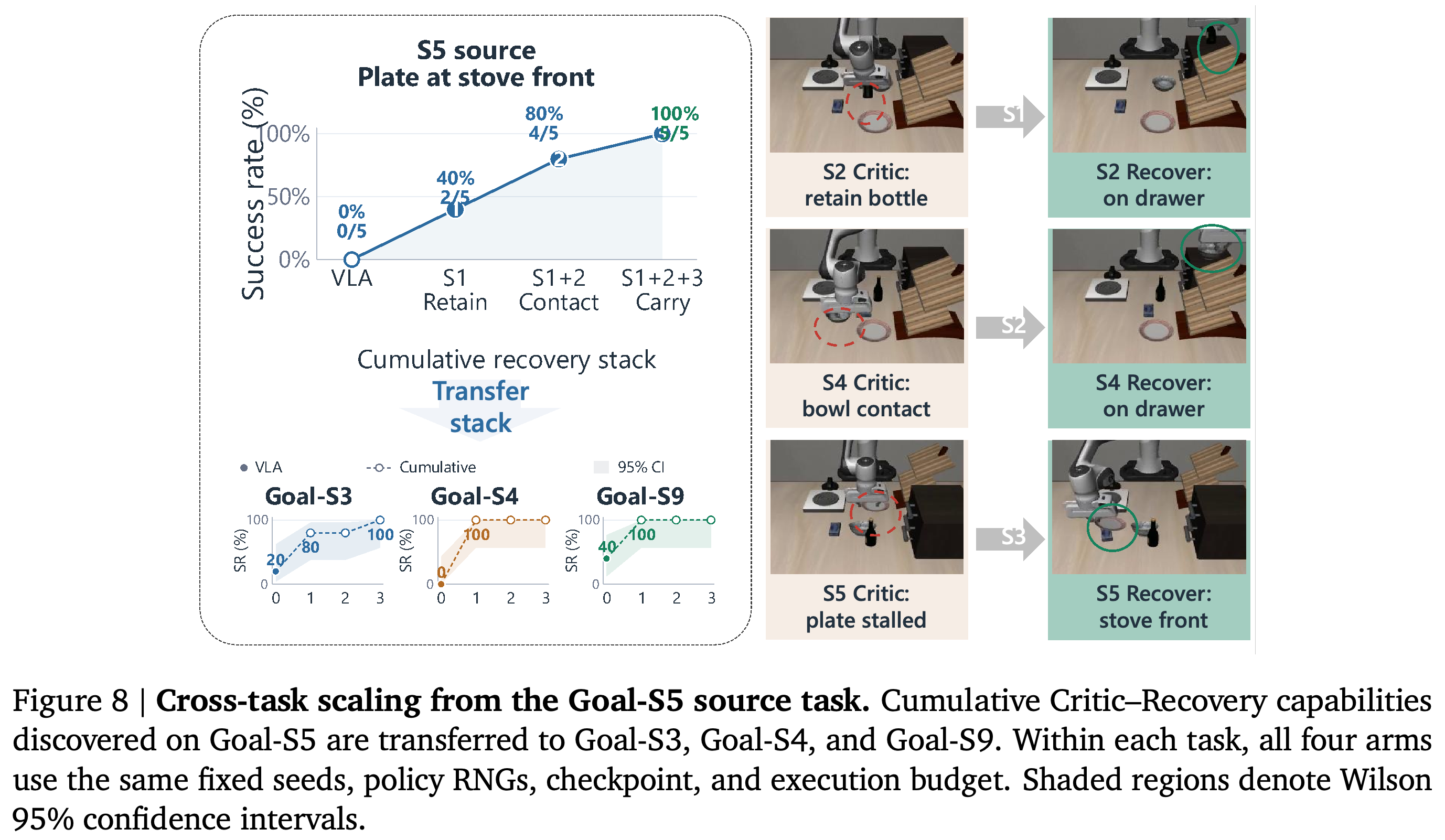
This complementary transfer experiment uses Goal-S5 as a source and applies its cumulative mechanism stack to Goal-S3, Goal-S4, and Goal-S9. Within each target task, seeds, policy RNGs, checkpoint, and execution budget are held fixed across arms.
The chart aggregates global repair rounds over 18 RoboCasa tasks. Macro-average success increases from 73.56% to 78.71%, 84.85%, 90.54%, and 93.56%.
On PnP-Stove, pre-grasp alignment, re-grasp, and placement mechanisms increase source-task success from 78% to 96%. Applying cumulative checkpoints to PnP-Sink, PnP-Cabinet, and PnP-Toaster produces the reported transfer macro-average increase from 64% to 84%.
The source TurnOffStove task rises from 74% to 92% after target localization, collision-aware approach, and stable-contact additions. The source stack is applied without target-task evolution to faucet, cabinet, and microwave tasks, for a reported transfer macro-average increase from 64% to 80%.
4.4. Results on Simulation benchmark
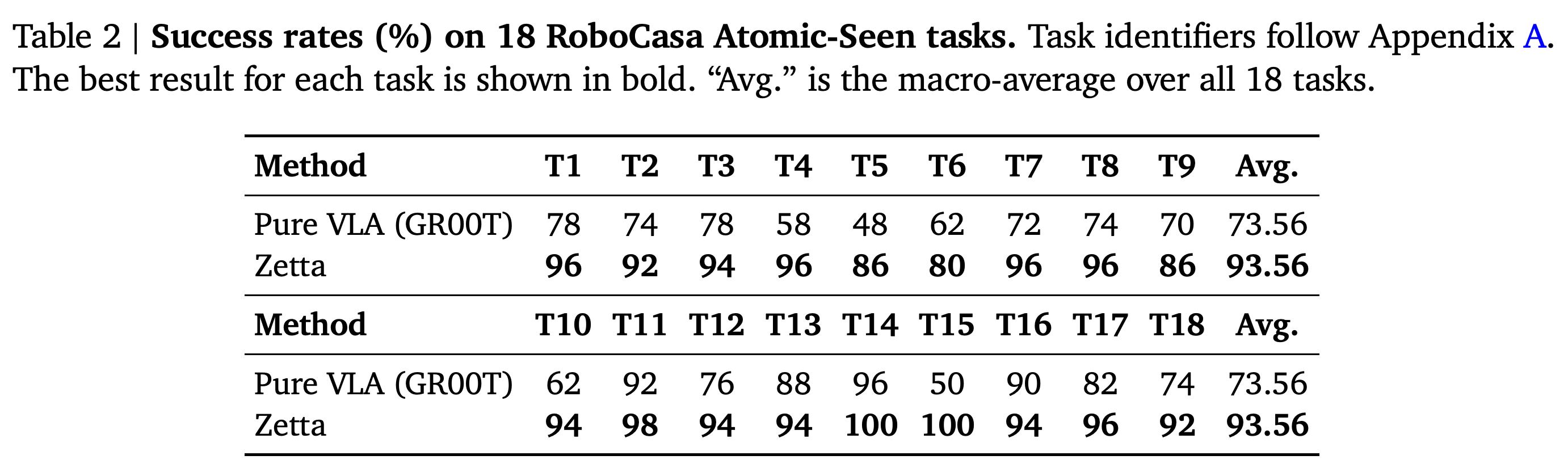
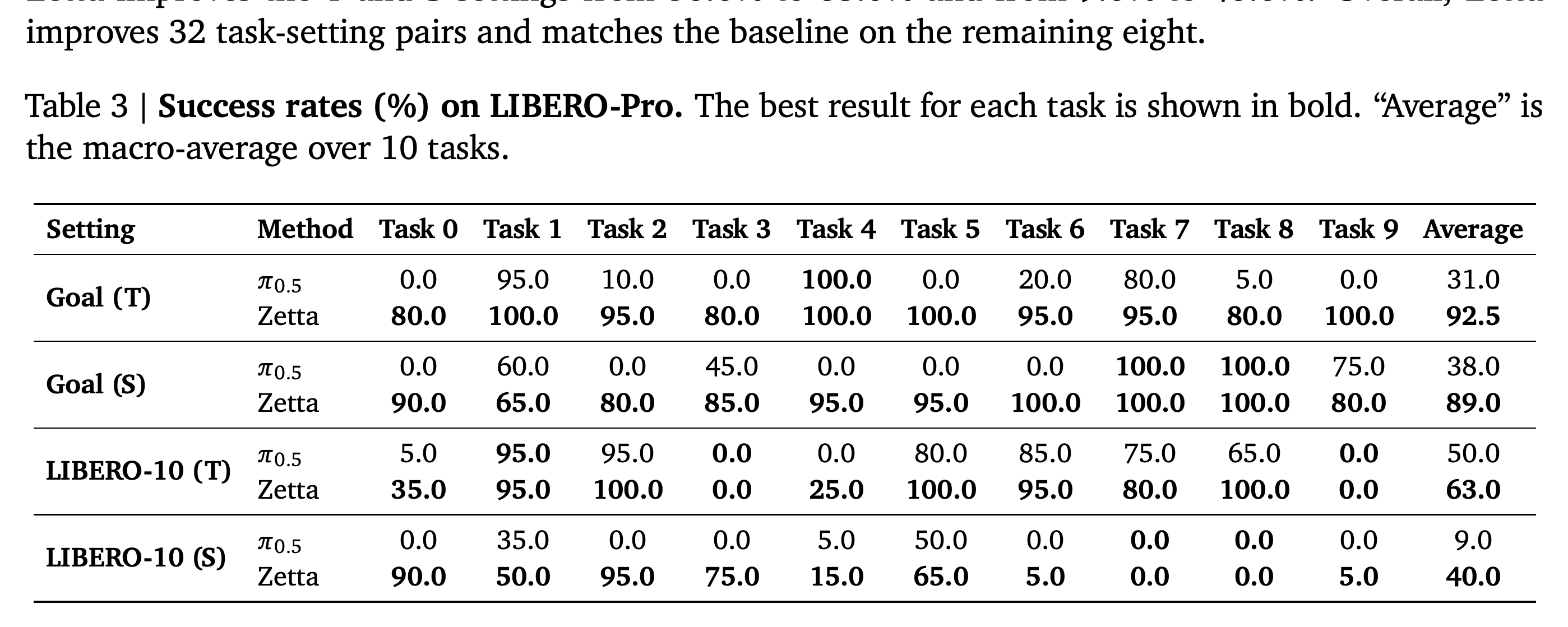
On 18 RoboCasa Atomic-Seen tasks, Zetta raises the GR00T macro-average from 73.56% to 93.56%. On 40 LIBERO-Pro task-setting pairs, it raises the π0.5 overall macro-average from 32.00% to 71.13%; Goal-T and Goal-S improve from 31.0% to 92.5% and from 38.0% to 89.0%, respectively.
The table provides per-task RoboCasa Atomic-Seen success rates and shows gains on all 18 identifiers. The macro-average rises by 20.00 percentage points, from 73.56% for Pure VLA (GR00T) to 93.56% for Zetta.
The results distribute gains across Goal and LIBERO-10 task-setting pairs rather than reporting only an aggregate. Zetta improves 32 pairs and matches the baseline on eight, while the lower LIBERO-10 (S) average remains visible.
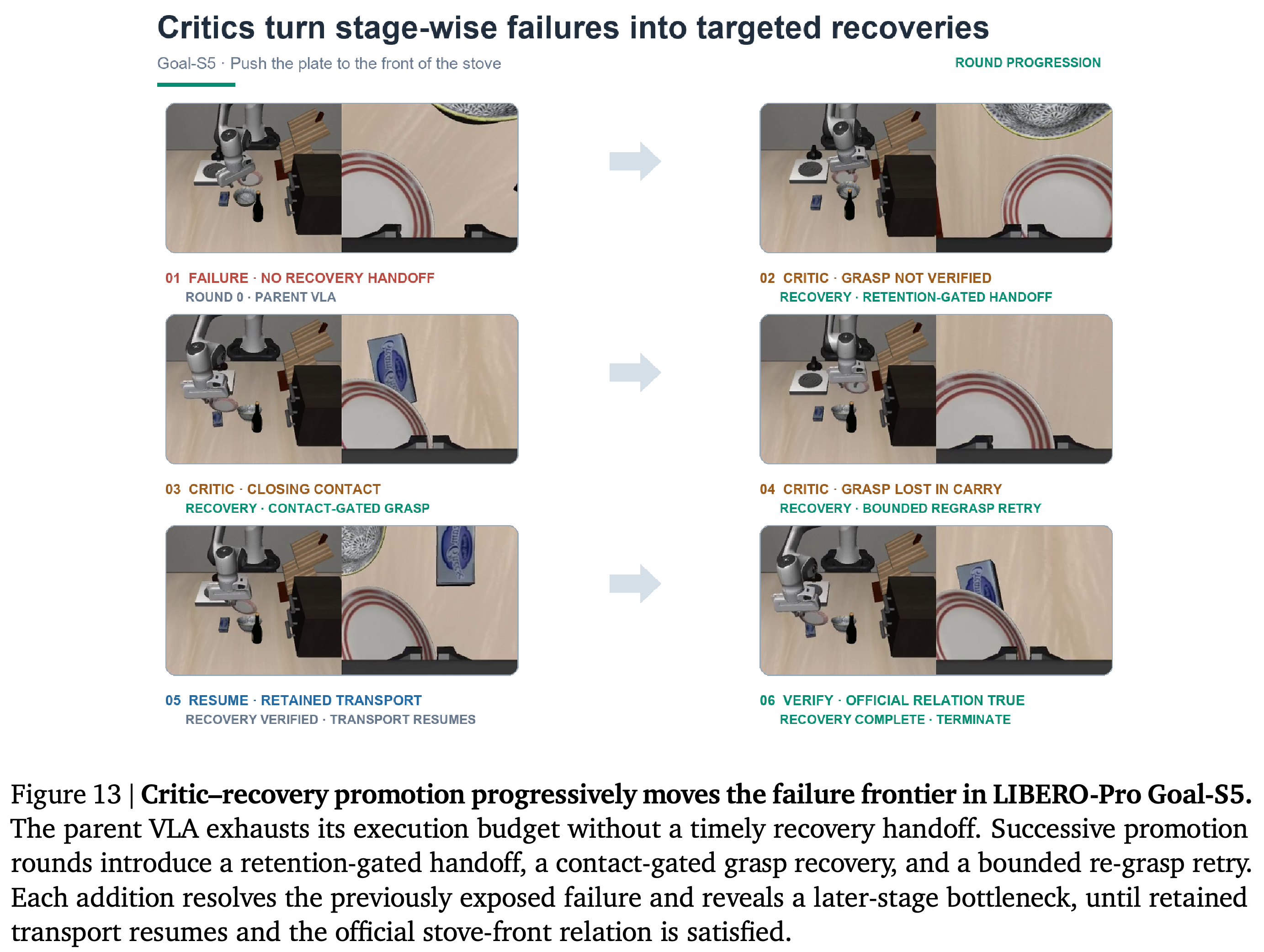
4.6. Z-Infra Performance Evaluation
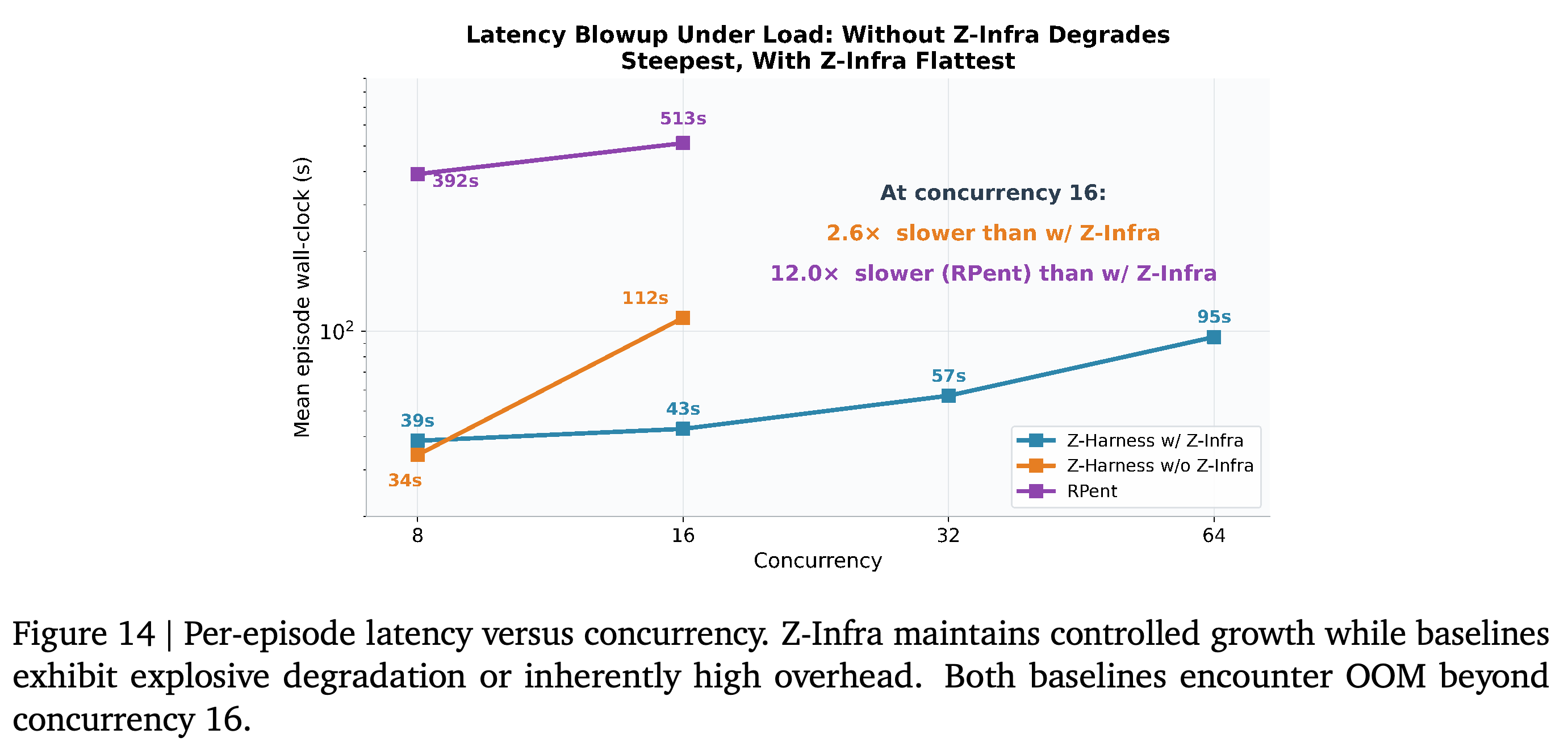
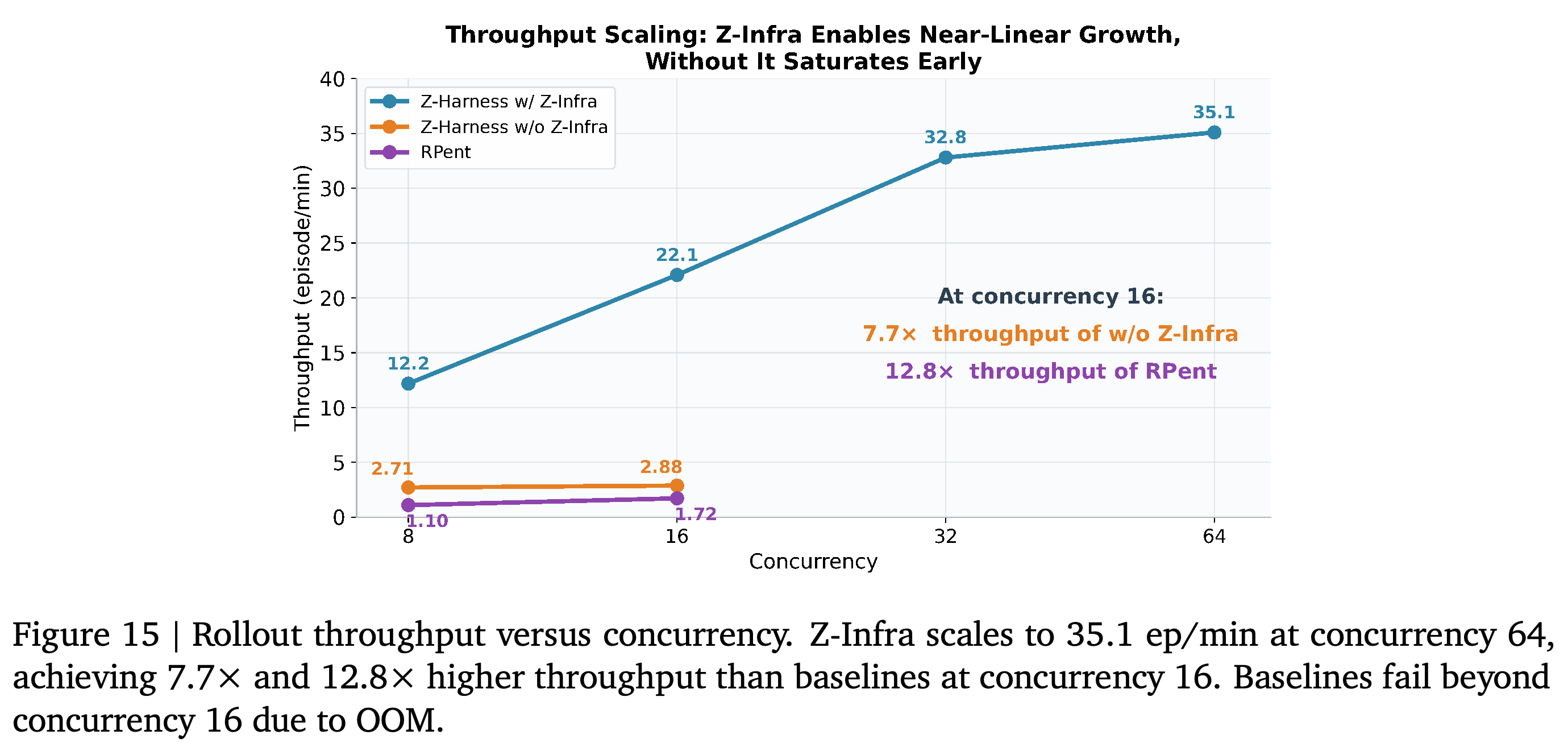
A RoboCasa pick-and-place case study shows online interventions for grasp loss, an infeasible re-grasp pose, and near-goal placement risk before verified return to the nominal VLA. On 8×A100 GPUs, Z-Infra reaches 35.1 episodes/min at concurrency 64; at concurrency 16 it reports 22.09 episodes/min, 7.7× the no-Z-Infra variant and 12.8× RPent, while both baselines run out of memory beyond concurrency 16.
Successive promotion rounds address later stages of the Goal-S5 failure sequence: absent recovery handoff, unverified grasp, and lost grasp during transport. The final bounded re-grasp retry restores retained transport before termination.
At concurrency 8, 32, and 64, Z-Infra has mean episode wall-clock times of 39 s, 57 s, and 95 s. The no-Z-Infra variant rises from 34 s at 8 to 112 s at 16, RPent is 392 s and 513 s at 8 and 16, and both baselines are unavailable beyond 16 because of OOM.
Z-Infra throughput rises from 12.2 episodes/min at concurrency 8 to 35.1 episodes/min at 64, with a plateau after 32. At concurrency 16, its 22.1 episodes/min is compared with 2.88 without Z-Infra and 1.72 for RPent.
Appendix
- The appendix maps the 18 RoboCasa Atomic-Seen identifiers and LIBERO-Pro task indices to official task names and instructions. It also provides bounded critic-guided recovery pseudocode for PnP-Stove and Goal-T2, where critics make proposals, the Orchestrator approves interventions, and failed grasp attempts are recorded for retries.
Brief Thoughts
The reported gains are obtained on simulation benchmarks under held-out-seed protocols, with policy weights separated from harness updates. The system depends on task milestones, physical signals, runtime critics, and available recovery tools; extending Zetta and Z-Infra to real robots is stated as future work.