


DeepSeek-V3.2: Pushing the Frontier of Open Large Language Models | Summary
02 Dec 2025 | Paper Review Sparse Attention Reinforcement Learning Agent Training DataContents
This article explains the key points of DeepSeek-V3.2: Pushing the Frontier of Open Large Language Models.
- 2025-12-02 (arXiv)
- DeepSeek-AI, Liu, Aixin, Mei, Aoxue, Lin, Bangcai, Xue, Bing, Wang, Bingxuan, Xu, Bingzheng, Wu, Bochao, Zhang, Bowei, Lin, Chaofan, et al.
- DeepSeek-AI
- Paper
Summary
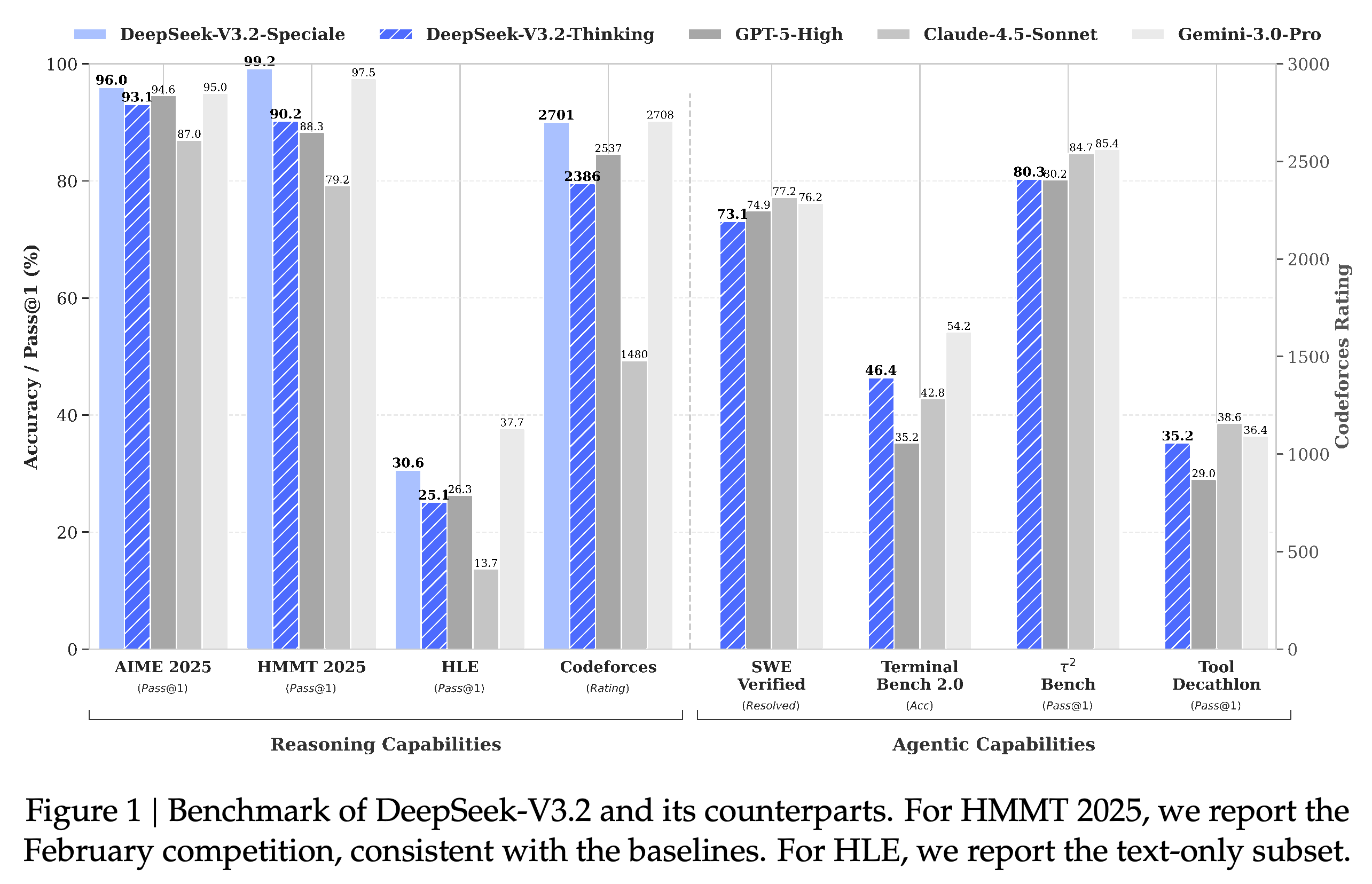
- DeepSeek-V3.2 addresses expensive long-input processing and weaker reasoning and tool use, where a model calls external functions to complete tasks, in open language models compared with proprietary systems. Under the paper’s benchmark settings, DeepSeek-V3.2 performs comparably to GPT-5-High on several reasoning tasks, while the higher-compute DeepSeek-V3.2-Speciale exceeds Gemini-3.0-Pro on several mathematics benchmarks using more output tokens.
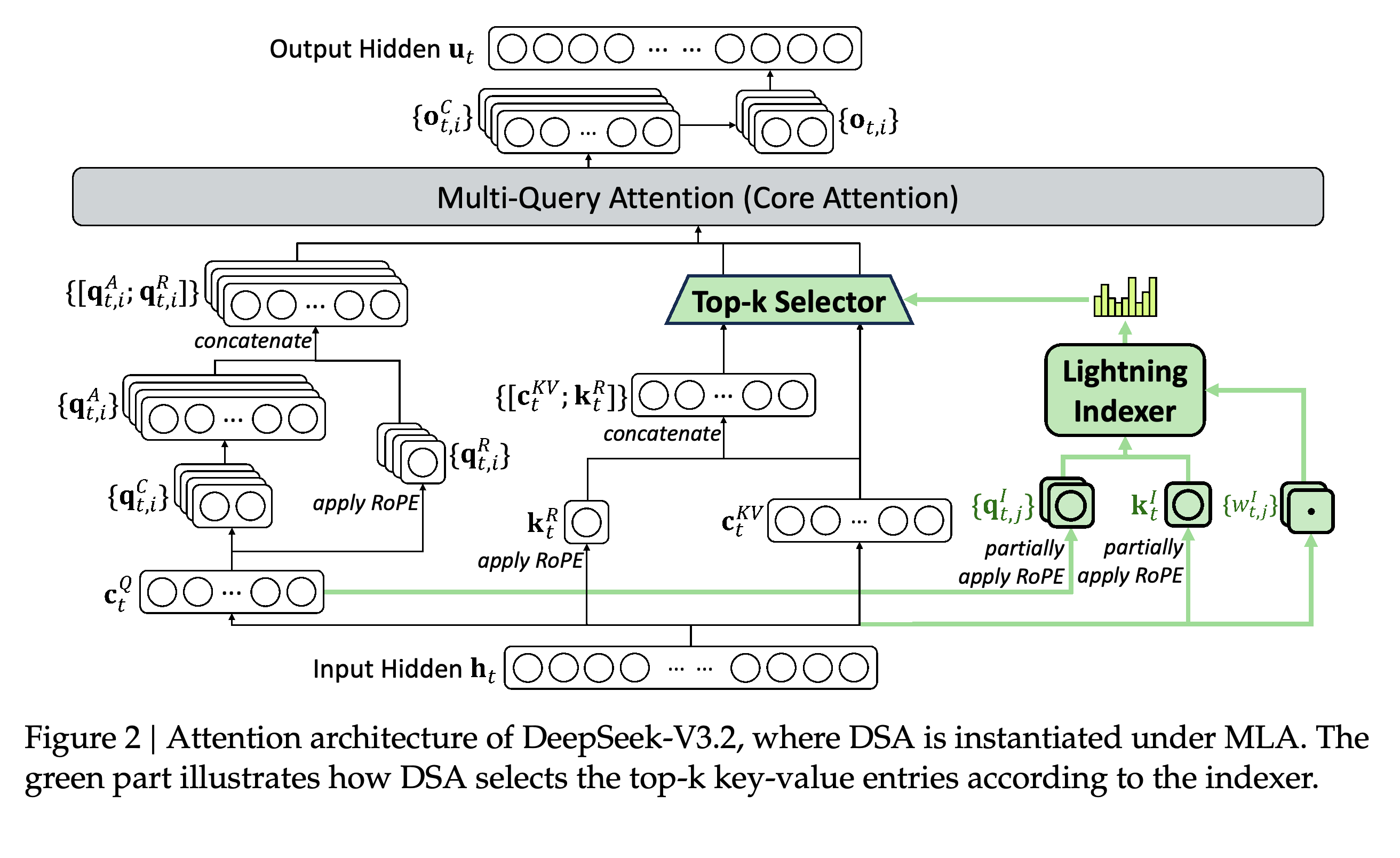
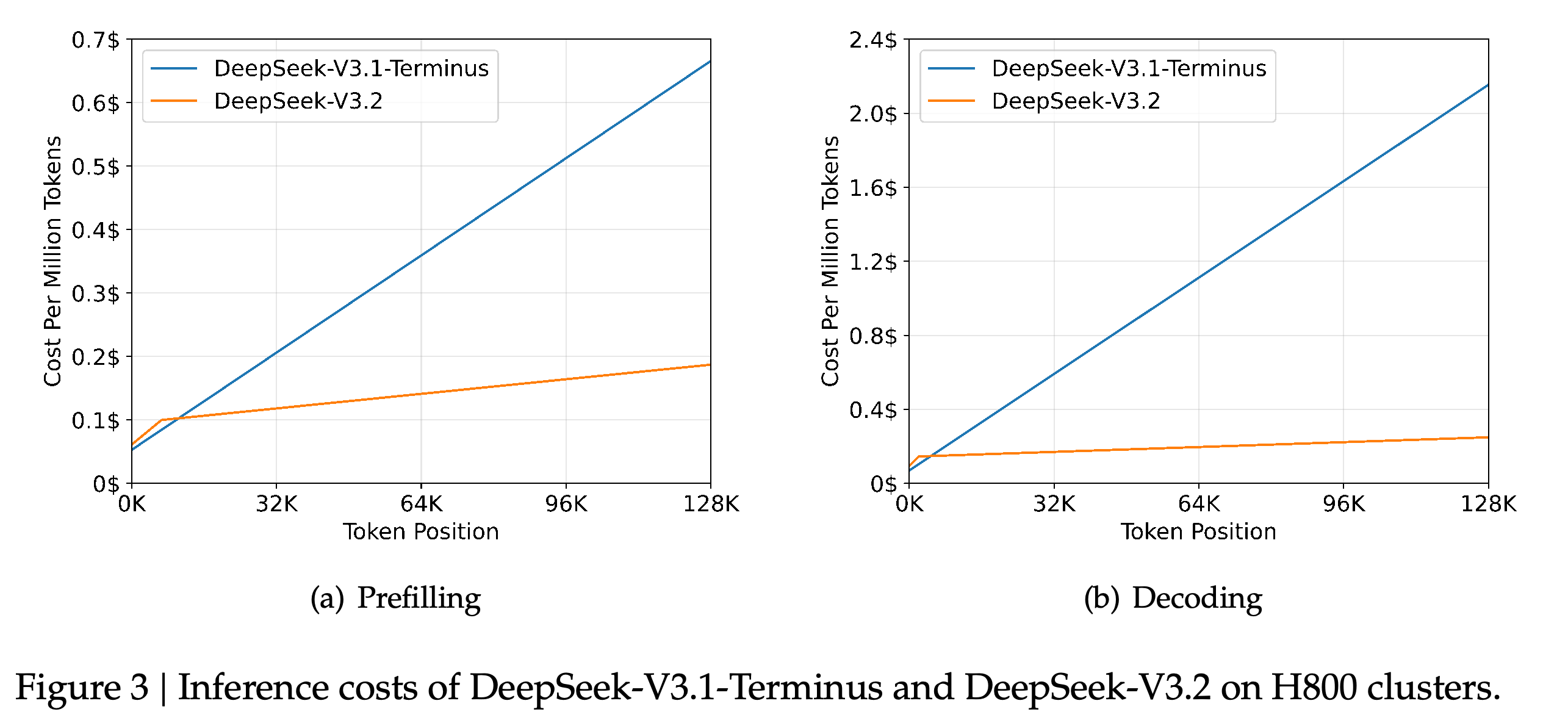
- DeepSeek Sparse Attention (DSA), an attention mechanism that selects preceding tokens for each query token, uses a lightweight indexer to choose 2048 key-value entries, the stored representations used by attention. The experimental model preserves reported short- and long-context performance relative to DeepSeek-V3.1-Terminus, while service benchmarks show lower inference costs at long token positions.
- Reinforcement learning (RL), training that optimizes responses using rewards, receives a computational budget exceeding 10% of the pre-training cost. The recipe corrects estimates of differences between response distributions, excludes selected negative responses generated by a sufficiently different model policy, and preserves both expert routing, the selection of active model modules, and token-sampling masks, the restrictions on candidate output tokens, between generation and training.
- The agent training pipeline, which constructs tasks requiring interaction with tools and environments, combines real tools with extracted or synthesized prompts and produces 1,827 synthetic environments containing 4,417 general agent tasks. A controlled experiment using only synthetic general agent data in non-thinking mode, which generates responses without an extended reasoning trace, improves tool-use benchmark performance beyond the supervised checkpoint and a comparison model trained with RL in search and code environments.
- DeepSeek-V3.2-Speciale reaches reported gold-medal thresholds in four 2025 mathematics and programming competitions using multiple candidate solutions or iterative refinement. The 128K-token context window, the amount of conversation available to the model at once, can truncate agent workflows; scores also depend on the execution framework, and Speciale’s accuracy gains require longer generations than Gemini-3.0-Pro in Table 3.
The overview separates reasoning benchmarks from agent benchmarks and shows Speciale’s gains on the displayed reasoning tasks. The standard model does not lead every proprietary baseline on agent tasks. Its plotted HMMT value of 90.2 conflicts with the caption’s February designation; Tables 2–3 distinguish February’s 92.5 from November’s 90.2.
1. Introduction
The introduction identifies three constraints on open large language models: expensive attention over long sequences, insufficient post-training compute, and weaker generalization and instruction following in interactive tool environments. The proposed response combines DSA, a scalable RL recipe, and agent task synthesis; the introduction reports over 1,800 environments and 85,000 complex prompts.
2. DeepSeek-V3.2 Architecture
DeepSeek-V3.2 uses the same architecture as DeepSeek-V3.2-Exp. Relative to DeepSeek-V3.1-Terminus, its only architectural modification is the introduction of DSA through continued training.
2.1. DeepSeek Sparse Attention
The lightning indexer, a small scoring module, ranks preceding tokens using weighted query-key similarities passed through ReLU, a rectified linear activation chosen for throughput. Attention then operates on entries with the top-k, or k highest, index scores; the indexer has few heads and supports FP8, eight-bit floating-point computation.
- DSA is instantiated under MLA, the inherited attention design that represents key-value entries as latent vectors, using MQA, multi-query attention that shares each latent entry across query heads.
- The index score is \(I_{t,s}=\sum_{j=1}^{H^I}w^I_{t,j}\operatorname{ReLU}\left(\mathbf{q}^I_{t,j}\cdot\mathbf{k}^I_s\right)\), where H^I is the number of indexer heads.
- The referenced implementation is https://huggingface.co/deepseek-ai/DeepSeek-V3.2-Exp/tree/main/inference.
2.1.1. Continued Pre-Training starts from DeepSeek-V3.1-Terminus with a 128K context window and uses the same long-context data distribution. A dense warm-up trains only the indexer, followed by sparse training of both the indexer and main model.
- Dense warm-up freezes the other parameters and aligns indexer scores with the attention distribution summed across heads and L1-normalized to sum to one, using KL divergence, a measure of difference between probability distributions. It uses a learning rate of 10^-3 for 1000 steps, with 16 sequences of 128K tokens per step, totaling 2.1B tokens.
- Sparse training selects 2048 key-value tokens per query and uses a learning rate of 7.3 × 10^-6 for 15000 steps, with 480 sequences of 128K tokens per step, totaling 943.7B tokens.
- The indexer input is detached from the computational graph, preventing its loss from updating the main model. Its distribution-matching loss trains the indexer, while the language modeling loss trains the main model; distribution matching in the sparse stage considers only selected tokens.
The green branch scores and selects tokens before the core attention operation. The selector filters shared latent key-value entries, allowing core attention to process the selected set through the inherited attention pathway.
2.2. Parity Evaluation
The parity evaluation compares DeepSeek-V3.2-Exp with DeepSeek-V3.1-Terminus and reports no substantial degradation on short- or long-context benchmarks. With identical post-training strategies, their ChatbotArena Elo ratings, comparative ratings used to approximate user preferences, were closely matched on 10 November 2025.
- On AA-LCR, the cited long-context reasoning benchmark, DeepSeek-V3.2-Exp scores four points higher in reasoning mode.
- The paper also reports better results across multiple Fiction.liveBench long-context evaluation metrics on previously unseen tests. This section does not provide the complete benchmark scores or uncertainty estimates for the preference ratings.
2.3. Inference Costs
DSA reduces main-model core attention complexity from \(O(L^2)\) to \(O(Lk)\), where L is sequence length and k is the number of selected tokens, with k much smaller than L. The lightning indexer remains quadratic in sequence length, so the complexity reduction applies to core attention rather than the entire attention pipeline.
- Figure 3 estimates cost per million tokens from the deployed service on H800 GPUs, graphics processors used for inference, assuming a rental price of 2 USD per GPU hour. The cost advantage grows with token position, especially during decoding, the stage that generates new tokens.
- For short-sequence prefilling, the stage that processes an input prompt, the implementation uses masked MHA, multi-head attention, to simulate DSA efficiently.
Both panels show a growing cost gap as token position increases. DeepSeek-V3.2’s decoding cost rises much more slowly than DeepSeek-V3.1-Terminus’s, supporting the long-context efficiency claim for the benchmarked H800 service under the stated rental-price assumption.
3. Post-Training
Post-training retains sparse attention and combines specialist distillation, training a shared model on responses produced by domain-specific models, with mixed RL. Specialists cover mathematics, programming, logical reasoning, general agent tasks, agentic coding, and agentic search, alongside writing and general question answering.
- Each specialist supports thinking mode, which produces an extended reasoning trace, and non-thinking mode, which generates a direct response. The authors report that subsequent RL closes the remaining performance gap between the distilled model and specialists, without presenting a numerical comparison here.
- Mixed training combines reasoning, agent tasks, and human alignment, training responses to meet human preferences, in one RL stage. Reasoning and agent rewards include rule-based outcomes, length penalties, and language consistency; general tasks use a generative reward model that scores responses against prompt-specific evaluation rubrics.
- DeepSeek-V3.2-Speciale is trained exclusively on reasoning data with a reduced length penalty and incorporates the dataset and reward method from DeepSeekMath-V2 for mathematical proofs.
3.1. Scaling GRPO
Group Relative Policy Optimization (GRPO), the RL algorithm that evaluates responses relative to others generated for the same question, uses the response reward minus the group mean as its advantage, the signal determining whether a response should become more or less likely. The paper adds four measures to reduce instability caused by differences between the policy that generates training responses and the policy being updated.
- Unbiased KL Estimate multiplies the K3 divergence estimator, a sampled approximation of KL divergence, by the current-to-old policy probability ratio. The authors explain that this corrects its gradient and avoids excessively large updates when a token has much lower probability under the current model than under the reference model.
- Off-Policy Sequence Masking suppresses the policy-loss contribution of responses with negative advantage when their average old-to-current log probability ratio exceeds a threshold δ. Here off-policy means that responses were generated under a different policy from the one being updated; the old probabilities are those returned directly by the inference framework.
- Keep Routing preserves the expert paths used during generation in the Mixture-of-Experts model, which activates a subset of expert modules for each input. Keep Sampling Mask preserves the truncation masks from top-p sampling, which restricts candidate tokens by cumulative probability, or top-k sampling, which restricts them by rank, so generation and training use the same candidate token space.
- The authors report improved stability and language consistency, but this section does not quantify each measure’s separate contribution. Mathematics can benefit from weak or absent KL regularization, the penalty for diverging from a reference model.
3.2. Thinking in Tool-Use
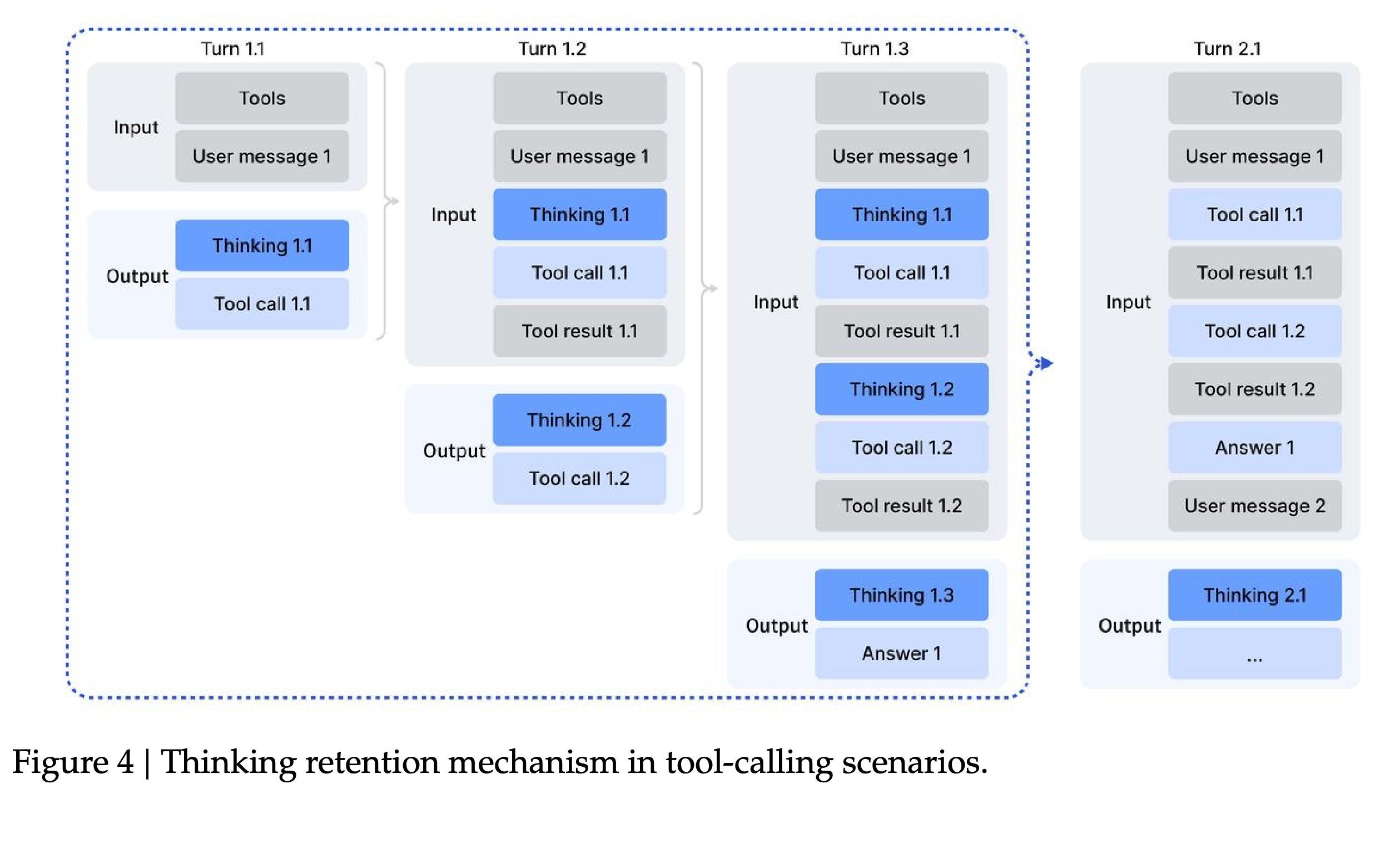
3.2.1. Thinking Context Management retains reasoning across tool calls and tool results within a user turn, then removes historical reasoning when a new user message arrives. Tool calls and their results remain in the conversation after reasoning is removed; the mechanism is intended to avoid repeatedly reasoning through the same problem.
- Roo Code and Terminus can represent tool interactions as user messages, which triggers reasoning removal. The paper recommends non-thinking mode for such frameworks.
- 3.2.2. Cold-Start, the initial construction of training examples before subsequent RL, uses designed prompts to combine existing reasoning data with non-reasoning agent data. The model occasionally produces the desired trajectories, sequences of reasoning, tool calls, and results, providing an initial basis for RL despite limited robustness.
Successive tool calls within one user turn retain earlier reasoning. A new user message removes those reasoning traces while retaining previous calls, results, and the answer, explaining why frameworks that encode tool results as user messages lose reasoning persistence.
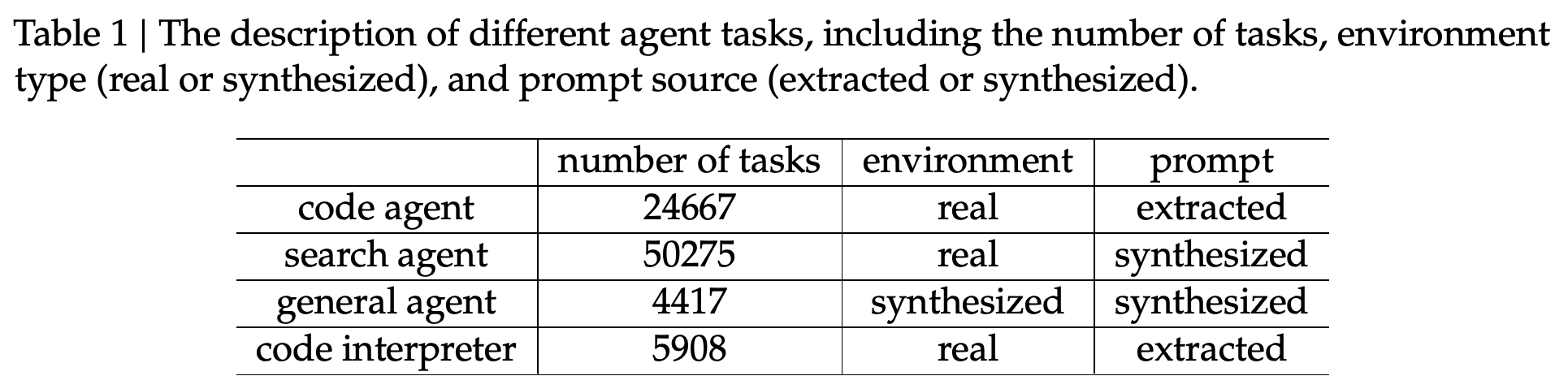
3.2.3. Large-Scale Agentic Tasks combines code agents, search agents, general agents, and code interpreter agents. Table 1 distinguishes real tool environments from synthetic environments and extracted prompts from synthesized prompts; these prompts are not drawn from actual user interactions.
- Search Agent constructs questions around long-tail entities, generates candidate answers with different model configurations, and uses search-based verification. It retains verifiable questions whose reference answer is correct and whose generated candidates are all incorrect, then adds helpfulness-oriented examples scored with evaluation rubrics.
- Code Agent mines GitHub issue–Pull Request pairs, linking reported software problems to proposed code changes, and builds executable environments with an automated setup agent. A reference patch must fix previously failing tests and introduce zero pass-to-fail regressions; test results use JUnit format for consistent parsing.
- Code Interpreter Agent uses Jupyter Notebook, an executable notebook environment, for mathematics, logic, and data science problems. The training counts are 24667 code agent tasks, 50275 search agent tasks, 4417 general agent tasks, and 5908 code interpreter tasks.
Search and code account for most listed tasks. Only the general agent row combines synthesized environments with synthesized prompts, distinguishing its 4417 tasks from the collections built around real tools.
General Agent synthesizes databases, function-based tools, tasks, reference solutions, and verification functions, then iteratively increases task difficulty and expands the toolset when needed. Solutions must operate through the tool interface rather than directly accessing the database; retaining tasks with non-zero pass@100, meaning at least one successful attempt among 100, yields 1,827 environments and 4,417 tasks.
- The trip-planning example on page 12 requires a three-day itinerary from Hangzhou for October 1st to October 3rd, 2025, with no repeated cities, hotels, attractions, or restaurants and with recommendations located in the corresponding daily city.
- Its second-day conditions link hotel prices to meal costs, restaurant ratings, and attraction prices: a hotel costing 800 CNY or more requires restaurant spending under 350 CNY, both ratings at least 4.0, and an attraction ticket below 120 CNY; the stated 500–800 CNY range requires one rating at least 4.0 and a ticket below 180 CNY; the stated 200–500 CNY range requires one rating at least 3.2. CNY denotes the currency used in the example; the source leaves the range boundaries overlapping.
- This example illustrates the design criterion: searching for a solution that satisfies all constraints is difficult, while checking a submitted solution is comparatively straightforward.
4. Evaluation
Evaluation covers knowledge and reasoning, mathematics, programming, software issue resolution, search, and tool use. The subsequent sections examine benchmark performance, Speciale’s accuracy and output-token requirements, synthetic-task transfer, and inference-time context management.
4.1. Main Results
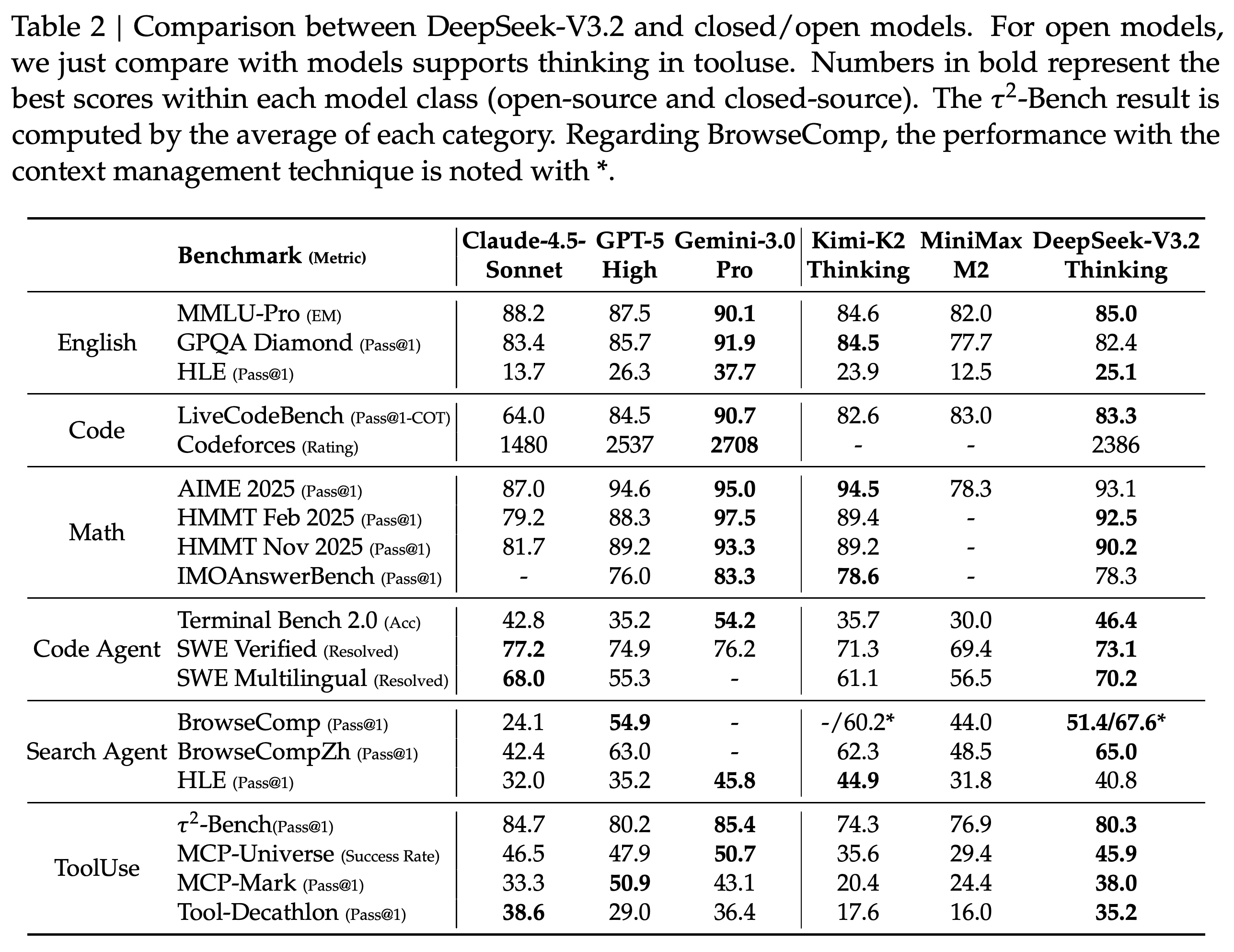
The main evaluation uses temperature 1.0, the setting controlling sampling randomness, and a 128K-token context window, with thinking mode and standard function calls for tool-use benchmarks. DeepSeek-V3.2 scores 93.1 on AIME 2025, a mathematics competition benchmark, compared with GPT-5-High’s 94.6, and 92.5 on HMMT Feb 2025, another mathematics competition benchmark, compared with 88.3.
- HLE, the text-only Human Last Exam benchmark as named in the paper’s evaluation section, scores 25.1 with the authors’ step-by-step and boxed-answer template, but 23.9 with the official template. Table 2 also reports 82.4 on GPQA Diamond, a graduate-level question-answering benchmark, below Gemini-3.0-Pro’s 91.9.
- On SWE Verified, the software issue-resolution benchmark, DeepSeek-V3.2 resolves 73.1%, compared with Kimi-K2 Thinking’s 71.3% and Claude-4.5-Sonnet’s 77.2%. The primary score uses the authors’ internal framework; robustness evaluations with other frameworks and non-thinking mode range from 72 to 74.
- Terminal Bench 2.0, an evaluation of terminal-based tasks, scores 46.4 using Claude Code in thinking mode; Terminus in non-thinking mode scores 39.3. These comparisons change both the execution framework and response mode.
- BrowseComp, a browsing-agent benchmark, improves from 51.4 to 67.6 with context management. The authors report that approximately 20%+ of search test cases exceed 128K tokens without intervention.
- Tool-use scores include 80.3 on τ²-Bench, a conversational-agent benchmark, 45.9 on MCP-Universe, 38.0 on MCP-Mark, and 35.2 on Tool-Decathlon, an evaluation of diverse, long-horizon tool tasks. The MCP benchmarks evaluate agents using Model Context Protocol tool environments; all models are tested in the authors’ internal environments, whose search and Playwright browser-automation settings may differ from official settings.
- The evaluated toolsets and environments were not encountered during RL training. Tool outputs use the tool message role to preserve reasoning, but redundant self-verification can still produce trajectories that exceed the context limit, particularly in MCP-Mark GitHub and Playwright tasks.
DeepSeek-V3.2 leads the listed open comparisons on several agent benchmarks, while proprietary models retain advantages on knowledge and some tool-use evaluations. BrowseComp’s 51.4/67.6 entries distinguish results without and with context management; open-model comparisons are restricted to models supporting thinking during tool use.
4.2. Results of DeepSeek-V3.2-Speciale
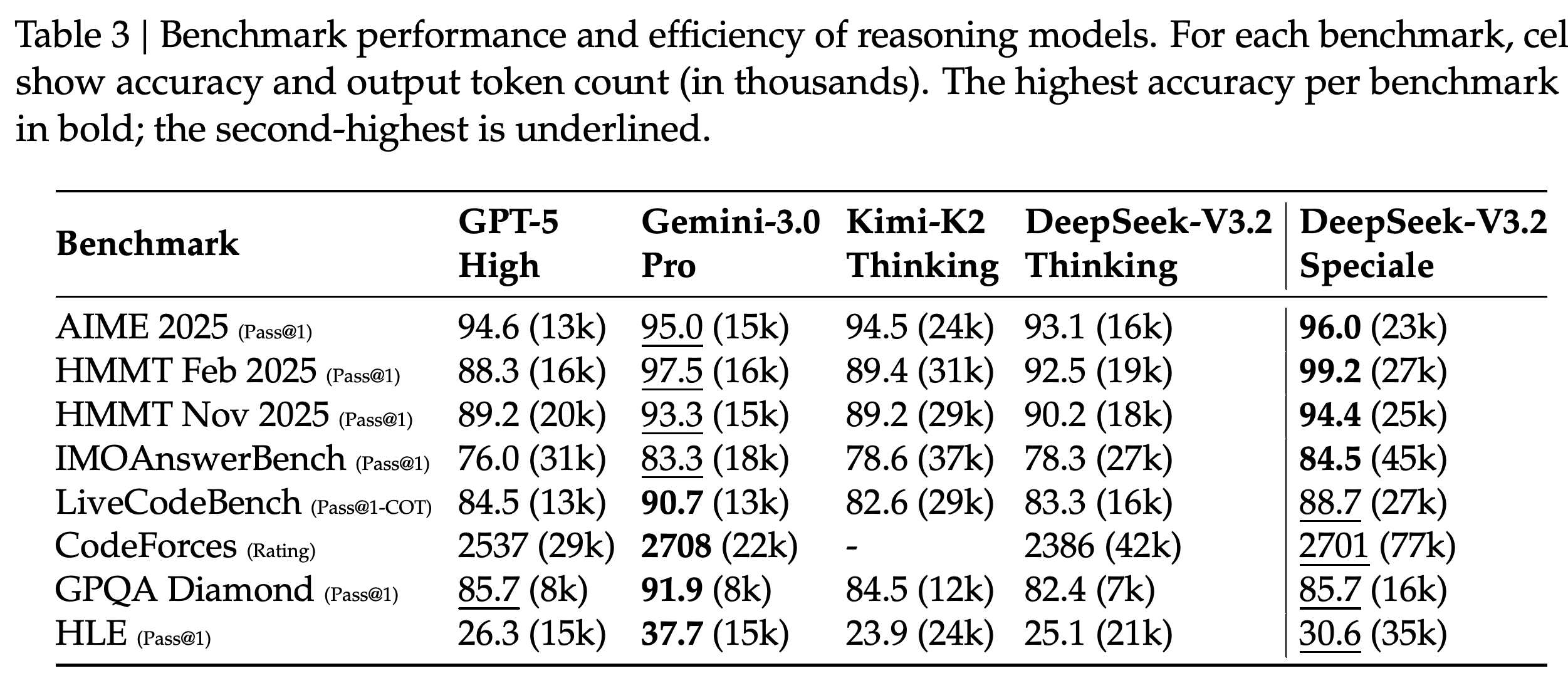
DeepSeek-V3.2-Speciale improves several reasoning scores with longer outputs: Table 3 reports 96.0 on AIME 2025 with 23k output tokens, compared with Gemini-3.0-Pro’s 95.0 with 15k, and 99.2 on HMMT Feb 2025 with 27k, compared with 97.5 with 16k. Its advantage depends on the benchmark: it scores 30.6 on HLE versus Gemini-3.0-Pro’s 37.7, and 2701 on the CodeForces programming-contest rating versus 2708.
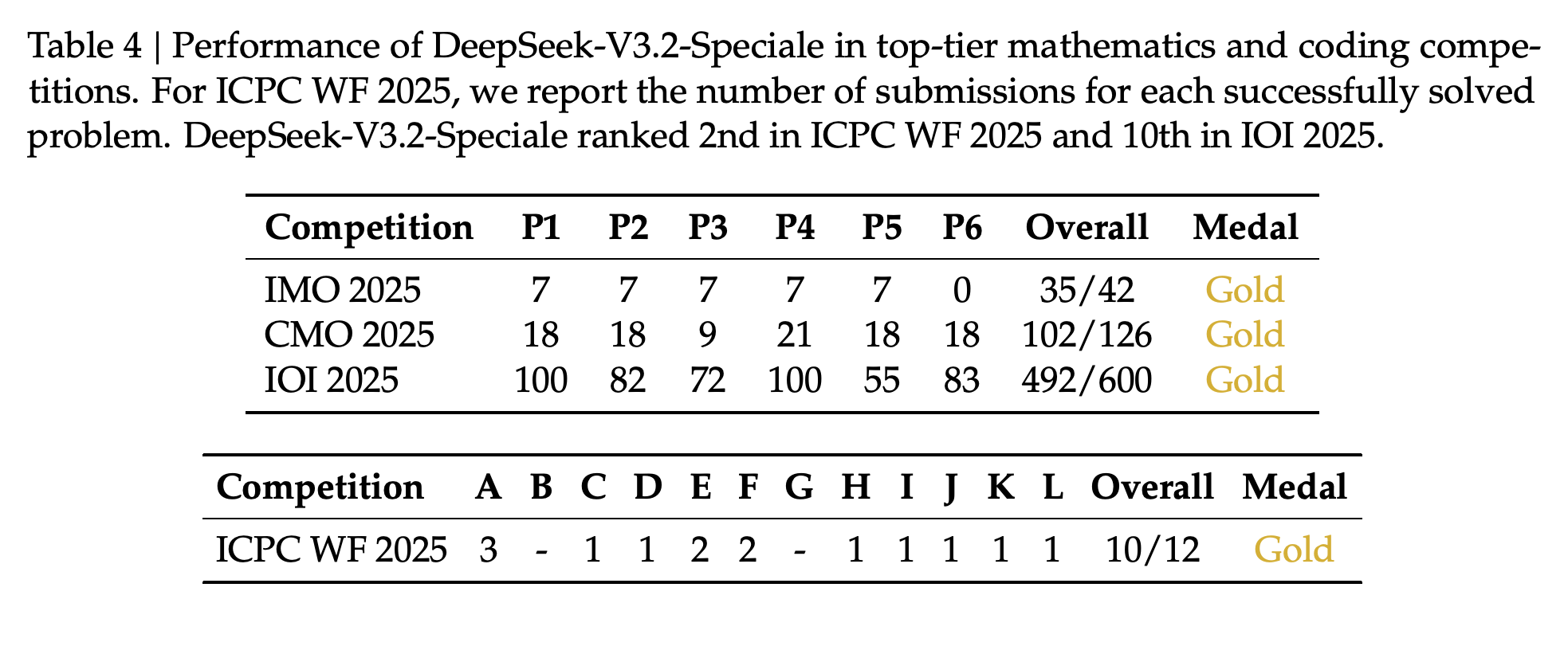
- Speciale reaches 35/42 on IMO 2025, the International Mathematical Olympiad; 102/126 on CMO 2025, the China Mathematical Olympiad; 492/600 on IOI 2025, the International Olympiad in Informatics; and 10/12 solved problems at ICPC WF 2025, the ICPC World Finals programming competition.
- The reported competition standings are 10th at IOI 2025 and 2nd at ICPC WF 2025. These results use the candidate-selection and refinement protocols in Appendix D rather than single-response benchmark sampling.
- Speciale uses 45k versus 18k output tokens on IMOAnswerBench, a mathematical reasoning benchmark, and 77k versus 22k on CodeForces. The official DeepSeek-V3.2 applies stricter length constraints to balance accuracy, latency, and cost.
- CMO 2025 is evaluated in English. The paper references problems and inference code at https://github.com/deepseek-ai/DeepSeek-Math-V2.
Pairing scores with output-token counts shows the inference requirements of Speciale’s gains. Its HMMT Feb 2025 score exceeds Gemini-3.0-Pro’s while using 27k versus 16k tokens; on CodeForces, it uses 77k versus 22k tokens while achieving a slightly lower rating.
The totals meet the paper’s reported gold-medal thresholds across four competitions. The breakdown also shows remaining failures: IMO problem 6 receives zero, and ICPC problems B and G remain unsolved. ICPC per-problem entries count submissions for solved problems; the results depend on Appendix D’s selection and refinement protocols.
4.3. Synthesis Agentic Tasks
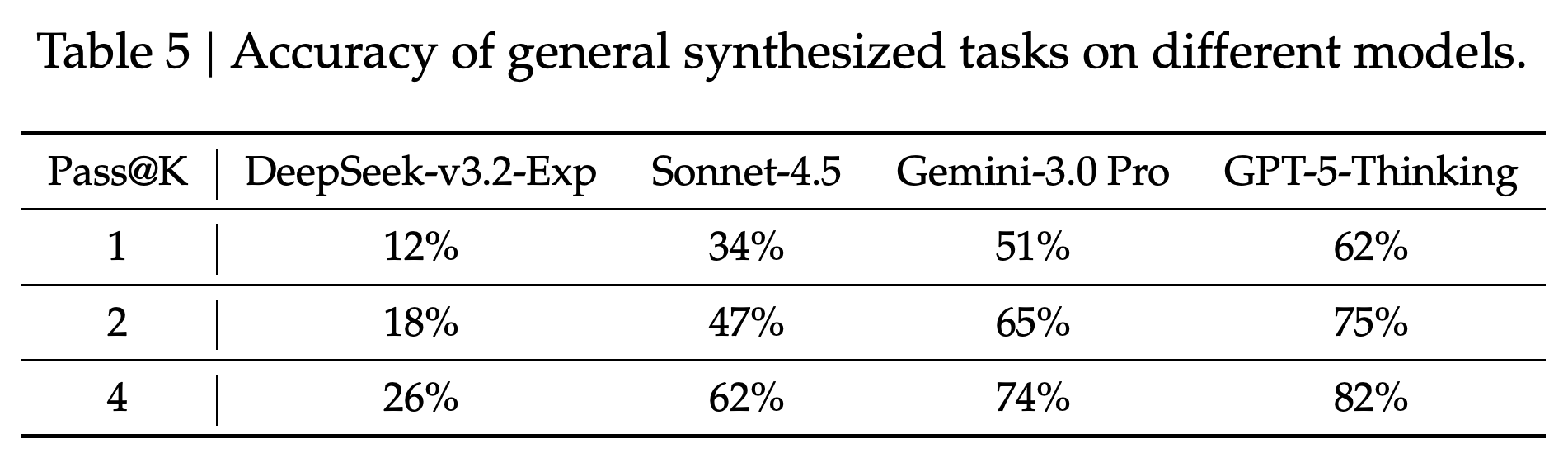
A difficulty check randomly samples 50 synthesized general agent tasks and reports pass@1, success with one attempt, of 12% for DeepSeek-V3.2-Exp, 34% for Sonnet-4.5, 51% for Gemini-3.0 Pro, and 62% for GPT-5-Thinking. The sampled tasks challenge all four models, although the small sample limits the precision of this comparison.
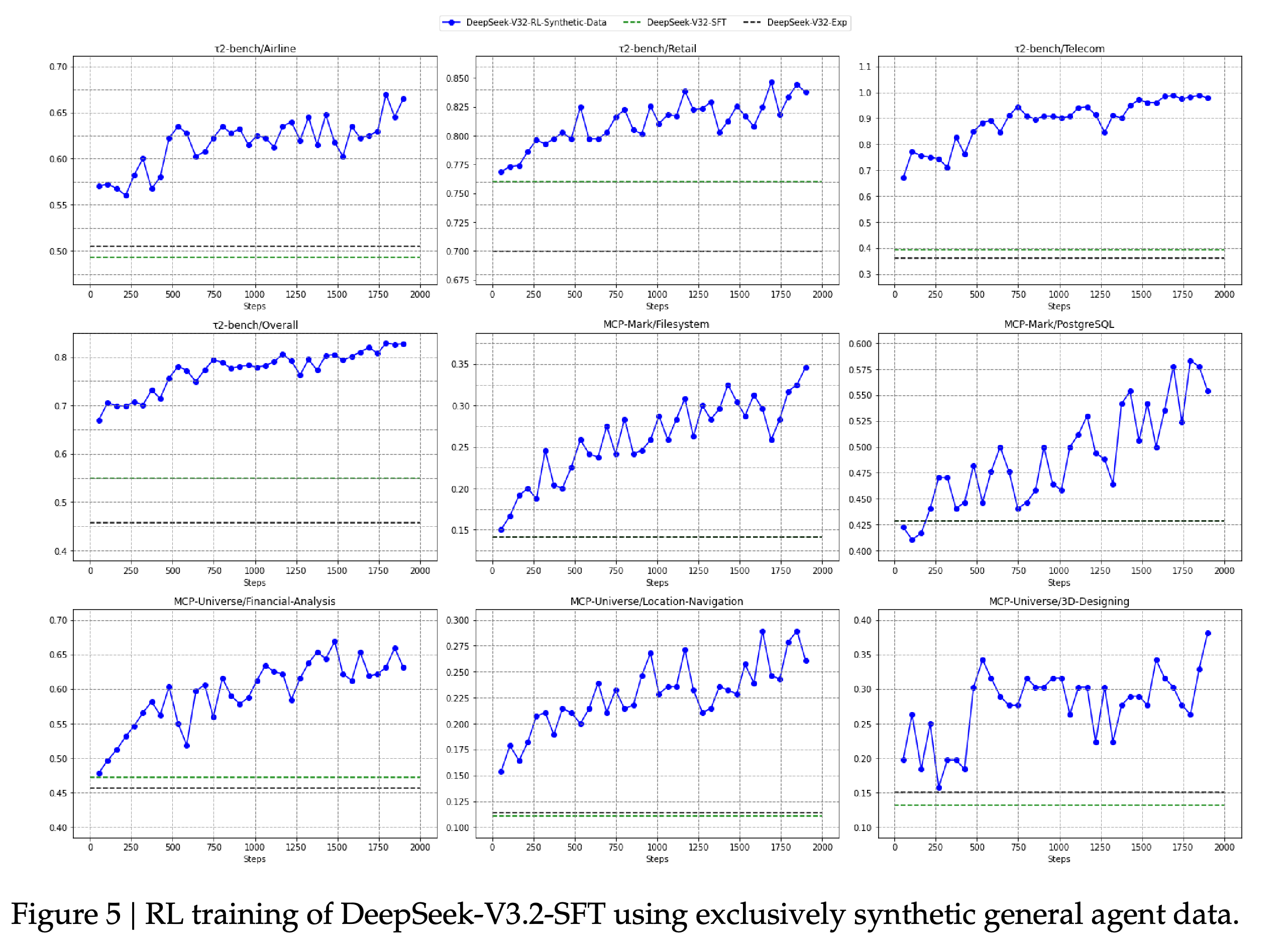
- The transfer experiment starts from DeepSeek-V3.2-SFT, the supervised fine-tuning checkpoint, and applies RL only to synthetic general agent tasks in non-thinking mode. This excludes extended reasoning traces and other RL data from the intervention.
- Figure 5 shows improvements on τ²-bench categories and selected MCP-Mark and MCP-Universe tasks relative to the supervised checkpoint. DeepSeek-V3.2-Exp, trained with RL in code and search environments, does not show comparable transfer to these benchmarks.
- This experiment directly tests transfer from synthetic general agent training to other tool environments. The plotted training trajectories do not include uncertainty intervals.
Pass@2 and pass@4, success with up to two or four attempts, increase for every model. GPT-5-Thinking rises from 62% at pass@1 to 82% at pass@4, while DeepSeek-v3.2-Exp rises from 12% to 26%, showing persistent difficulty on the 50 sampled tasks.
Across nine panels, RL using only synthetic general agent data generally raises evaluation performance above the supervised and experimental comparison baselines. The gains extend to multiple tool domains, although individual trajectories fluctuate and no uncertainty bands are provided.
4.4. Context Management of Search Agent
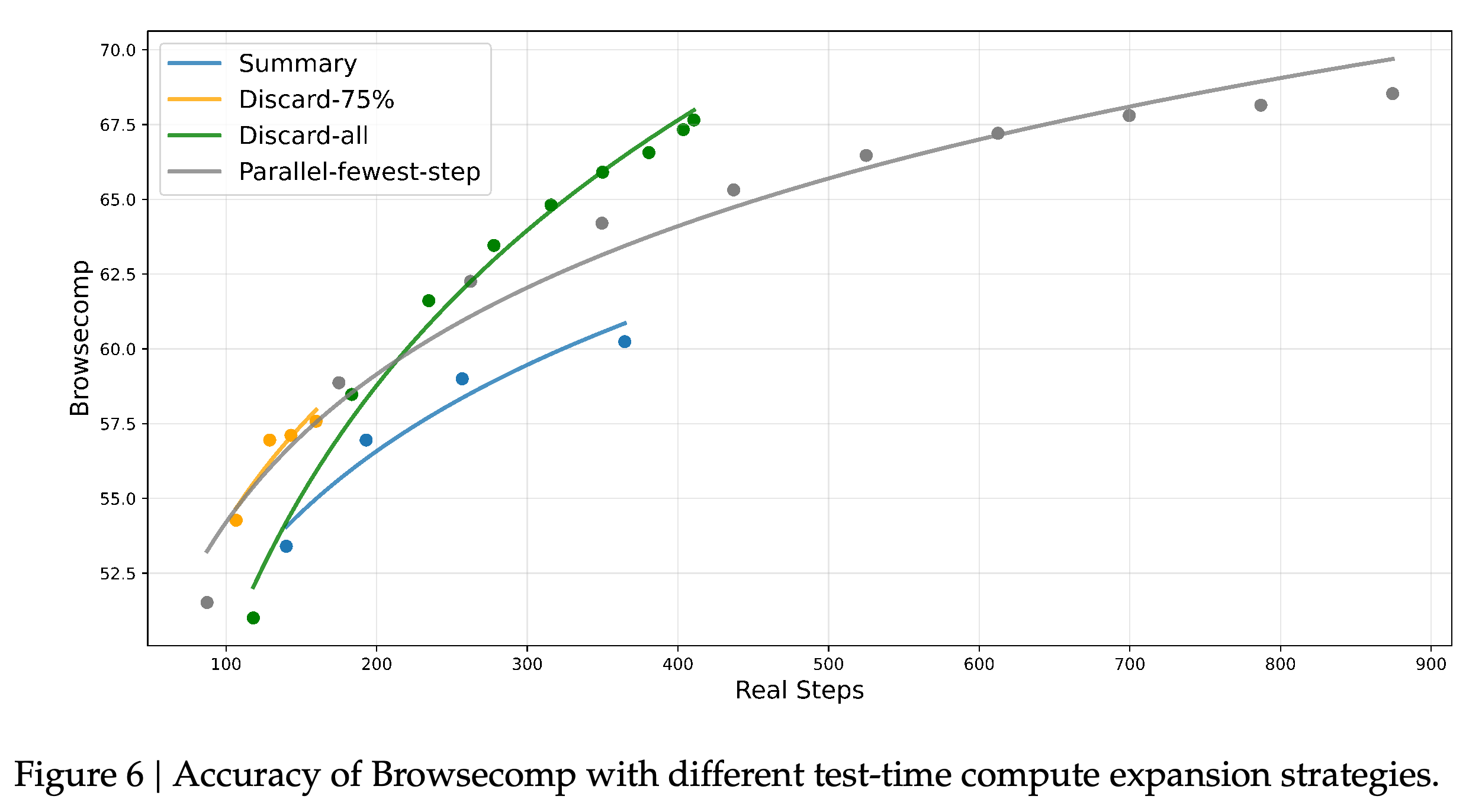
Search-agent context management activates when token usage exceeds 80% of the context window. Summary compresses the trajectory and restarts generation; Discard-75% removes the first 75% of tool-call history; Discard-all removes all previous tool-call history; Parallel-fewest-step generates N independent trajectories and selects the one with the fewest steps.
- On BrowseComp, Summary reaches 60.2 with 364 average steps. Discard-all reaches 67.6 and achieves accuracy comparable to parallel scaling with substantially fewer execution steps in Figure 6.
- The search score depends on inference-time computation and context policy as well as model weights. Execution steps provide the figure’s comparison axis; they do not directly establish equal token usage, latency, or monetary cost.
The accuracy-versus-steps curves show different efficiency profiles for context-management and parallel-sampling strategies. Discard-all reaches accuracy comparable to parallel sampling with substantially fewer execution steps, while Summary reaches a lower reported score; the plot does not directly measure monetary cost.
5. Conclusion, Limitation, and Future Work
The paper combines sparse attention, expanded RL compute, and synthesized agent tasks to improve the measured efficiency and capabilities of an open language model. It acknowledges remaining weaknesses in breadth of world knowledge, output-token efficiency, and complex-task performance relative to frontier proprietary models.
- The authors attribute the knowledge gap to fewer total training FLOPs, floating-point operations used to measure computational work, and propose scaling pre-training.
- Other proposed directions include more efficient reasoning traces, improved foundation-model and post-training recipes, and better combinations of sequential context management and parallel inference. These are proposed research directions.
Appendix
- A. MHA and MQA Modes of MLA illustrates the transformation between multi-head and multi-query implementations of the inherited latent attention mechanism. DeepSeek-V3.1-Terminus uses MHA for training and prefilling and MQA for decoding; this supplies architectural context for DSA’s use of shared latent key-value entries.
- B. Cold Start Template presents three prompt examples for the same linked-list programming task: reasoning without tools, tool use without explicit reasoning, and tool calls embedded within reasoning. Tables 6–8 use the markers <think></think>, {TOOL-DESCRIPTIONS}, and {TOOLCALL-FORMAT}; the combined example permits a maximum of 20 code executions.
- C. Non-thinking DeepSeek-V3.2 Agentic Evaluation compares modes in Table 9. With Claude Code, Terminal Bench 2.0 rises from 37.1 in non-thinking mode to 46.4 in thinking mode; SWE Verified rises from 72.1 to 73.1, MCP-Mark from 26.5 to 38.0, and Tool-Decathlon from 25.6 to 35.2.
- D. Evaluation Method of IOI, ICPC World Final, IMO, and CMO sets a maximum generation length of 128k and reports generation without tools or internet access, with contest time and attempt limits enforced. IOI generates 500 candidates per problem, filters candidates that fail sample tests or length constraints and those expressing inability or refusal, and selects the 50 valid candidates with the longest reasoning traces for submission; ICPC generates 32 candidates per problem with the same filtering criteria. IMO and CMO use an iterative generate-verify-refine loop until perfect self-evaluation or a maximum revision cap.
- E. Author List groups contributors under Research & Engineering, Data Annotation, and Business & Compliance. Names are ordered alphabetically by first name, and an asterisk identifies individuals who have departed from the team.
Brief Thoughts
The clearest evidence concerns two engineering choices: sparse attention lowers measured long-context service costs without reported parity regressions, and the synthetic-only RL experiment demonstrates transfer to other tool environments. Attribution of the final model’s gains specifically to expanded RL compute is less isolated because specialist distillation, rewards, data, and training stability measures also contribute to the training pipeline. Deployment comparisons should report accuracy alongside output-token counts, execution framework, context policy, and candidate-generation protocol. Tables 3–4 and Figure 6 show how additional inference work affects the reported results. Figure 1’s DeepSeek-V3.2-Thinking HMMT value is 90.2, while its caption identifies the February competition; Tables 2–3 report February as 92.5 and November as 90.2. The detailed tables distinguish the competitions, but the figure discrepancy remains unresolved. The paper provides implementation and competition-protocol details, but does not provide a quantitative ablation separating all four GRPO stability measures or uncertainty estimates for the synthetic-task transfer curves.