


Guided Self-Evolving LLMs with Minimal Human Supervision | Summary
02 Dec 2025 | Paper Review Self-Play Reinforcement Learning ReasoningContents
This article explains the key points of Guided Self-Evolving LLMs with Minimal Human Supervision.
- 2025-12-02 (arXiv)
- Yu, Wenhao, Liang, Zhenwen, Huang, Chengsong, Panaganti, Kishan, Fang, Tianqing, Mi, Haitao, Yu, Dong.
- Tencent AI Lab in Seattle, Washington University in St. Louis
- Paper
Summary
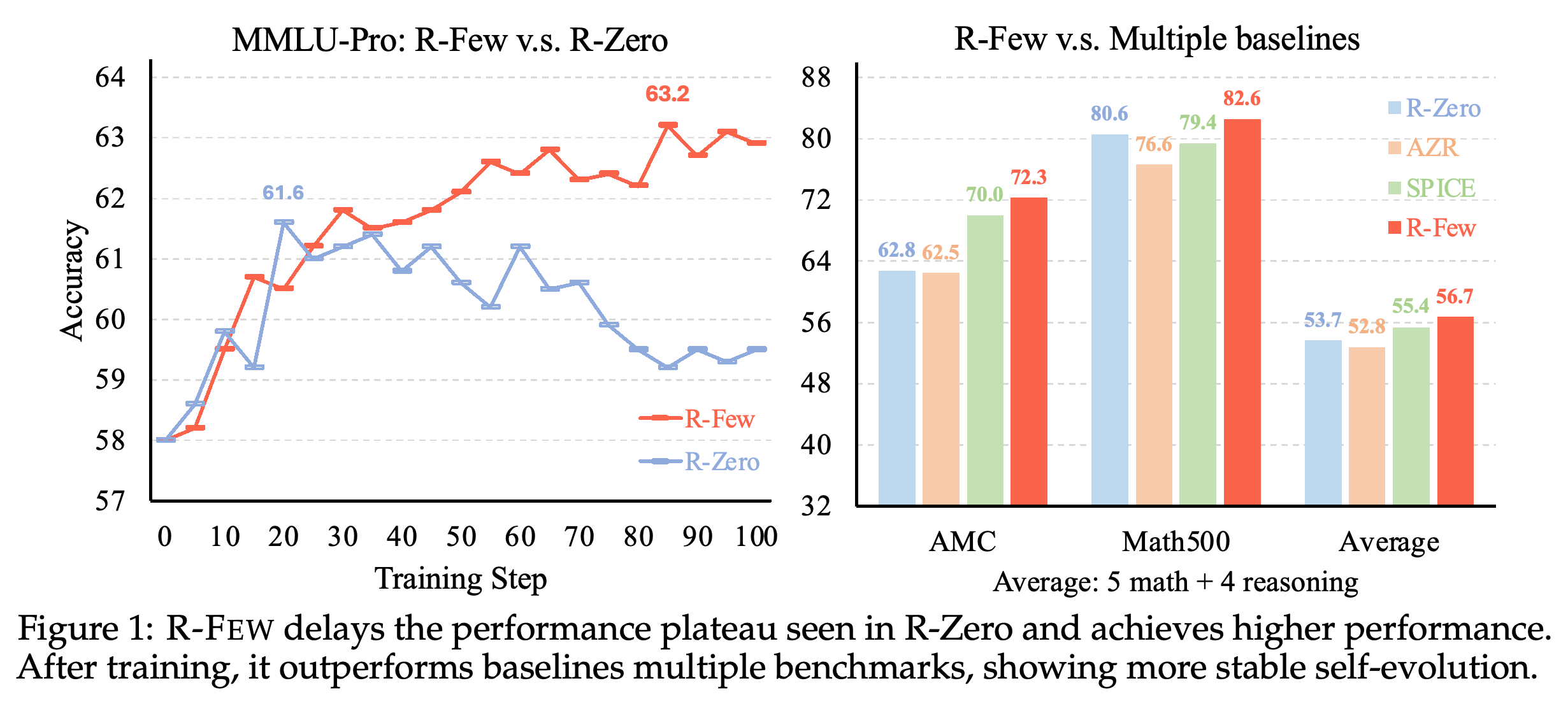
- The paper addresses how large language models (LLMs) can improve through self-play, repeated question generation and solving, without reinforcing their biases or losing task diversity. Using Qwen3-8B-Base, the eight-billion-parameter pretrained model, and 5% of WebInstruct, a web-mined reasoning dataset containing 232k examples, R-FEW achieves a nine-benchmark average of 56.7 versus 53.7 for the unguided self-play baseline R-Zero and 56.0 for General-Reasoner, which uses the full dataset.
- R-FEW couples a Challenger, the model generating questions, with a Solver, the model answering them. The Challenger receives zero to five human anchor examples, labeled examples that guide generation, while an online curriculum, training-question selection adapted to current solving ability, selects moderately difficult human and synthetic questions for Solver training. Both models learn through reinforcement learning, parameter updates guided by rewards.
- Experiments cover Qwen3-4B-Base and Qwen3-8B-Base on five mathematical and four general reasoning benchmarks, using either 1% or 5% of WebInstruct. R-FEW improves over reproduced R-Zero results at both model sizes, but the 4B model remains below SPICE, a document-grounded self-play baseline, and General-Reasoner on the overall average. Ablations, experiments removing individual components, support contributions from Challenger training, its format warm-up, and curriculum selection.
- Training curves show approximately stable question length and lexical diversity, variation in word sequences, for R-FEW over 100 Solver steps, whereas R-Zero first loses diversity and later produces much longer questions. These measurements support improved stability within the tested horizon, but do not establish semantic diversity or sustained improvement beyond it. The report also contains inconsistencies between its equations, tables, and explanatory prose.
1 Introduction
The introduction identifies concept drift, reinforcement of biased reasoning away from factual correctness, and diversity collapse, concentration of generated tasks in familiar regions, as obstacles to autonomous self-improvement. R-FEW uses a small human data pool to guide question generation and combines human and synthetic examples in a difficulty-based training stream. Sampling zero demonstrations permits unguided question generation; it does not remove human examples from the overall Solver training pipeline.
On MMLU-Pro, the multitask language understanding benchmark, R-FEW continues improving after R-Zero peaks and declines; highlighted scores are 63.2 and 61.6. The bar panel reports R-FEW scores of 72.3 on AMC and 82.6 on MATH-500, two mathematical problem-solving benchmarks, and a nine-benchmark average of 56.7. These selected comparisons illustrate the training trajectory and final performance without establishing superiority on every benchmark.
2 Preliminaries: Self-Play For Data-Free Training
The preliminary framework extends self-play from games to language models that construct their own training tasks. The same pretrained model initializes separate question-generation and answer-generation roles, which improve iteratively through reward feedback. This establishes the data-free setting that R-FEW modifies with limited human supervision.
2.1 Unified View of Self-Play Objectives and Reward Design
The Challenger Qθ generates questions conditioned on historical context, and the Solver Sϕ samples answers conditioned on those questions; θ and ϕ denote their respective parameters. A verifier, an answer-checking mechanism, or self-consistency, agreement among sampled answers, supplies rewards; Group Relative Policy Optimization (GRPO), the reinforcement learning optimizer used in the report, updates both models. The unified objective is bilevel, with Challenger optimization depending on the Solver’s current abilities and Solver optimization maximizing answer rewards on generated tasks.
- Absolute Zero rewards difficult but solvable tasks and uses verified answers. R-Zero targets an estimated success rate near 0.5, penalizes repeated questions, and uses majority-vote answers as pseudo-labels, synthetic targets derived from sampled answers.
- Self-Questioning LMs (SQLM) target answerable, informative questions through success-rate statistics. SPICE conditions task generation on documents and supervises answers from the source text.
3 Method
R-FEW modifies the self-play data pipeline through human-conditioned task generation and adaptive selection of training questions. Separate Challenger and Solver models receive reward-based updates, allowing generated tasks and answering abilities to change together.
3.1 Overview
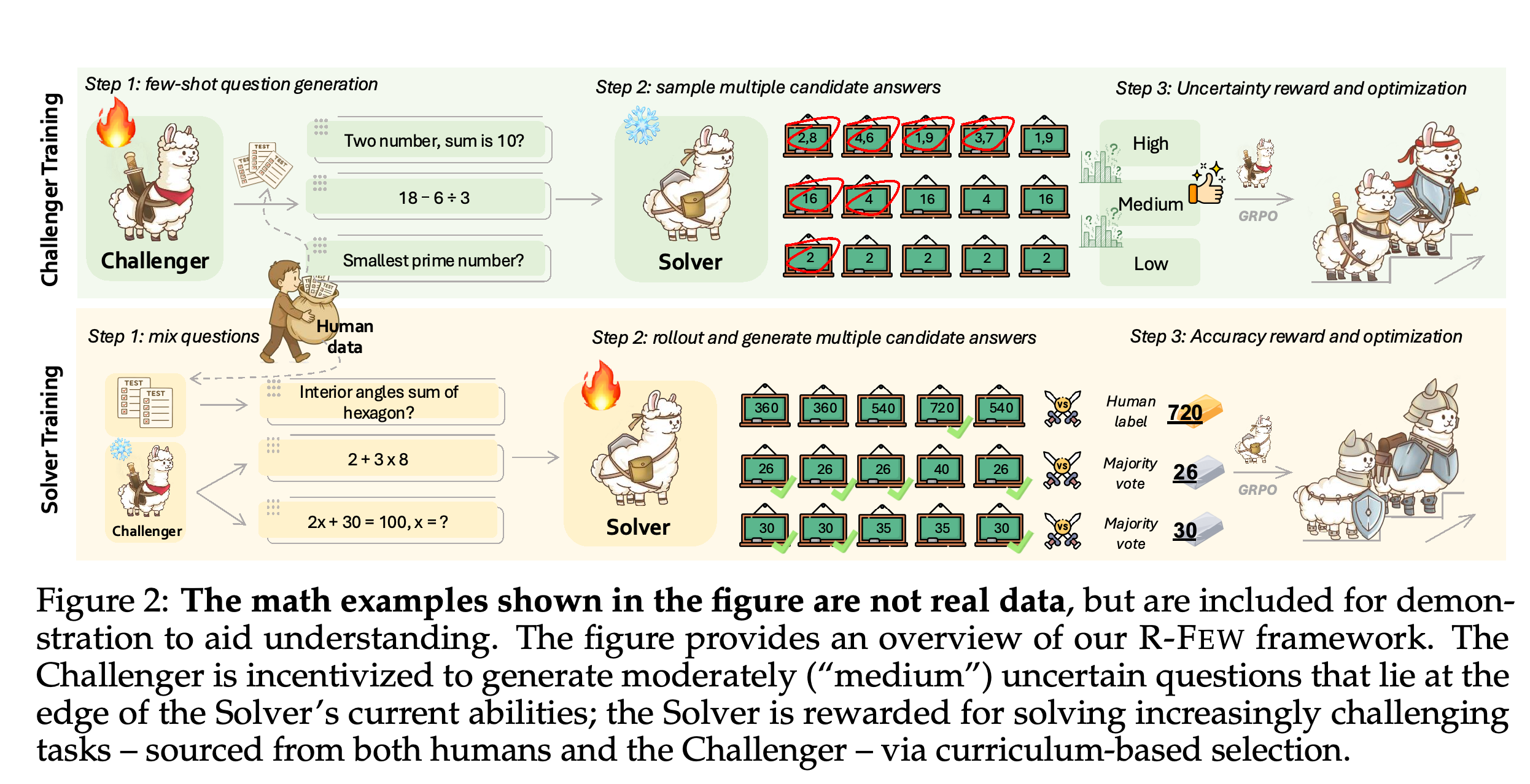
The method combines a few-shot grounded Challenger, question generation conditioned on a small number of labeled demonstrations, with an online curriculum Solver. Figure 2 separates Challenger optimization through uncertainty rewards from Solver optimization through answer rewards. Its mathematical examples illustrate the workflow and are explicitly not actual training data.
The upper workflow uses human demonstrations to guide the Challenger and sampled Solver answers to reward medium uncertainty. The lower workflow mixes human and generated questions, using human labels for human examples and majority-vote labels for synthetic examples. The arithmetic problems are explicitly illustrative rather than actual training data.
3.2 Few-Shot Grounded Challenger
At each rollout, a sampled generation attempt, the Challenger randomly receives k ∈ {0,1,…,5} examples from the human anchor pool. Its displayed reward is R_chal(q) = 1 − 2|p̂_succ(q) − 1/2| − λ_rep RepPenalty(q), where p̂_succ estimates Solver success, RepPenalty penalizes duplicate questions, and λ_rep weights that penalty. Before the repetition penalty, this reward peaks at estimated success 0.5.
- A supervised fine-tuning (SFT) warm-up, training on example outputs, helps the base model follow the required question format when demonstration prompts become longer.
- The surrounding prose describes Align(q, D_H), cosine similarity between generated questions and the human anchor distribution in an embedding space, a numerical representation of text. Equation (5) and Algorithm 1 contain no alignment term, leaving its role in optimization unspecified.
3.3 Online Curriculum Solver
The Solver samples multiple answers per question to estimate success, then filters the combined human and synthetic pool to moderately difficult questions. The report calls [0.3, 0.7] a quantile interval, bounds on positions in a ranked distribution, while Equation (8) applies those values directly to estimated success rates; the intended selection rule is unclear. The displayed Solver reward combines curriculum-weighted agreement with a majority-vote answer and an additional human-example weighting term, whose coefficient is set to 2.0.
- Figure 2 depicts human questions being scored against human labels and synthetic questions against majority-vote labels.
- Equation (9) writes the extra human term as an indicator of membership in the human pool, rather than an explicit correctness indicator. Its relationship to the accuracy reward described in the appendix is unspecified.
3.4 Iterative Co-Evolution
Each iteration generates tasks using human demonstrations, samples Solver answers to estimate difficulty, and selects training examples from both data sources. Algorithm 1 also penalizes invalid generated questions before updating the Challenger. Alternating Challenger and Solver updates refreshes the training pool as solving ability changes.
4.1 Experiments Setting
The experiments test two pretrained model sizes, two fractions of human anchor data, and mathematical and general reasoning tasks. They include baseline comparisons, component ablations, domain-specific anchor sampling, and measurements of question generation during training.
4.1.1 Baseline Methods
The backbones are Qwen3-4B-Base and Qwen3-8B-Base; the report provides https://huggingface.co/Qwen/Qwen3-4B-Base for the former. Base checkpoints and R-Zero are reproduced under identical training infrastructure, while Absolute Zero and SPICE scores are taken from Liu et al. (2025a). R-FEW (1%) and R-FEW (5%) use randomly sampled fractions of the 232k-example WebInstruct dataset, and General-Reasoner supplies a full-dataset reference.
- Absolute Zero verifies code tasks through Python execution. SPICE retrieves document contexts to generate questions with document-grounded answers.
- The common-infrastructure condition applies to the reproduced baselines. The report does not establish the same controlled training comparison for the imported scores.
4.1.2 Evaluation Benchmark
Mathematical evaluation uses AMC, Minerva, MATH-500, GSM8K, and Olympiad-Bench, five mathematical problem-solving benchmarks. GPT-4o compares final answers with reference answers for semantic equivalence. General reasoning uses MMLU-Pro, a multitask language understanding benchmark; SuperGPQA, a benchmark spanning graduate disciplines; GPQA-Diamond, a graduate-level question-answering subset; and BBEH, Big-Bench Extra Hard.
- General reasoning scores use Exact Match (EM), exact agreement with the reference answer, under greedy decoding, selection of the highest-probability next token.
- The domains include physics, biology, business, economics, and law. Mathematical and general reasoning scores use different answer-checking procedures.
4.2 Experimental Results
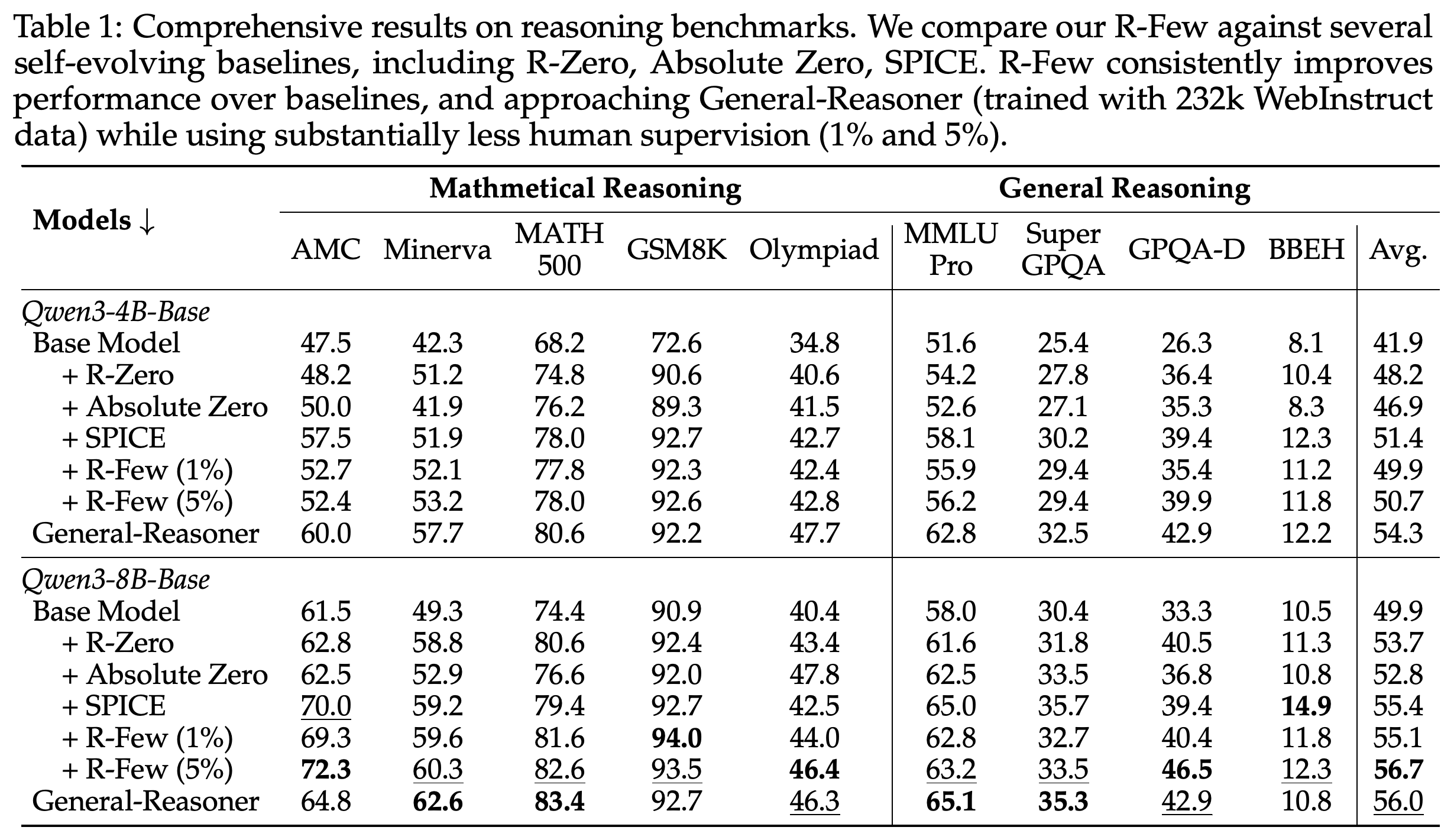
The results examine aggregate benchmark performance, individual training components, anchor-domain choice, and changes in generated questions. Table 1 reports benchmark scores, Table 2 reports component removals, and Figures 3–4 examine domain steering and generation stability.
4.2.1 Comparison with Baseline Methods
For Qwen3-4B-Base, the overall average rises from 41.9 for the base model and 48.2 for R-Zero to 49.9 with R-FEW (1%) and 50.7 with R-FEW (5%). These scores remain below SPICE’s 51.4 and General-Reasoner’s 54.3. For Qwen3-8B-Base, R-FEW reaches 55.1 and 56.7, respectively, compared with R-Zero’s 53.7, SPICE’s 55.4, and General-Reasoner’s 56.0.
- The 8B, 5% variant achieves AMC 72.3, MATH-500 82.6, and GPQA-Diamond 46.5. It does not lead every benchmark: General-Reasoner scores higher on Minerva, MATH-500, and MMLU-Pro, while SPICE scores higher on SuperGPQA and BBEH.
- The abstract describes a +3.0-point improvement on math tasks. Table 1 supports +3.0 for the reported nine-benchmark average; averaging its five displayed mathematical scores gives approximately +3.4 over R-Zero.
- The 20-times data comparison applies to R-FEW (5%) versus the full WebInstruct dataset. The prose also says both 8B variants surpass General-Reasoner, but the 1% average of 55.1 is below 56.0.
R-FEW (5%) reaches an overall average of 56.7 at 8B, above General-Reasoner’s 56.0, but its 4B score of 50.7 remains below SPICE’s 51.4 and General-Reasoner’s 54.3. Individual columns show that R-FEW does not lead every benchmark. Absolute Zero and SPICE scores are imported from another report, while R-Zero is reproduced.
4.2.2 Ablation Studies
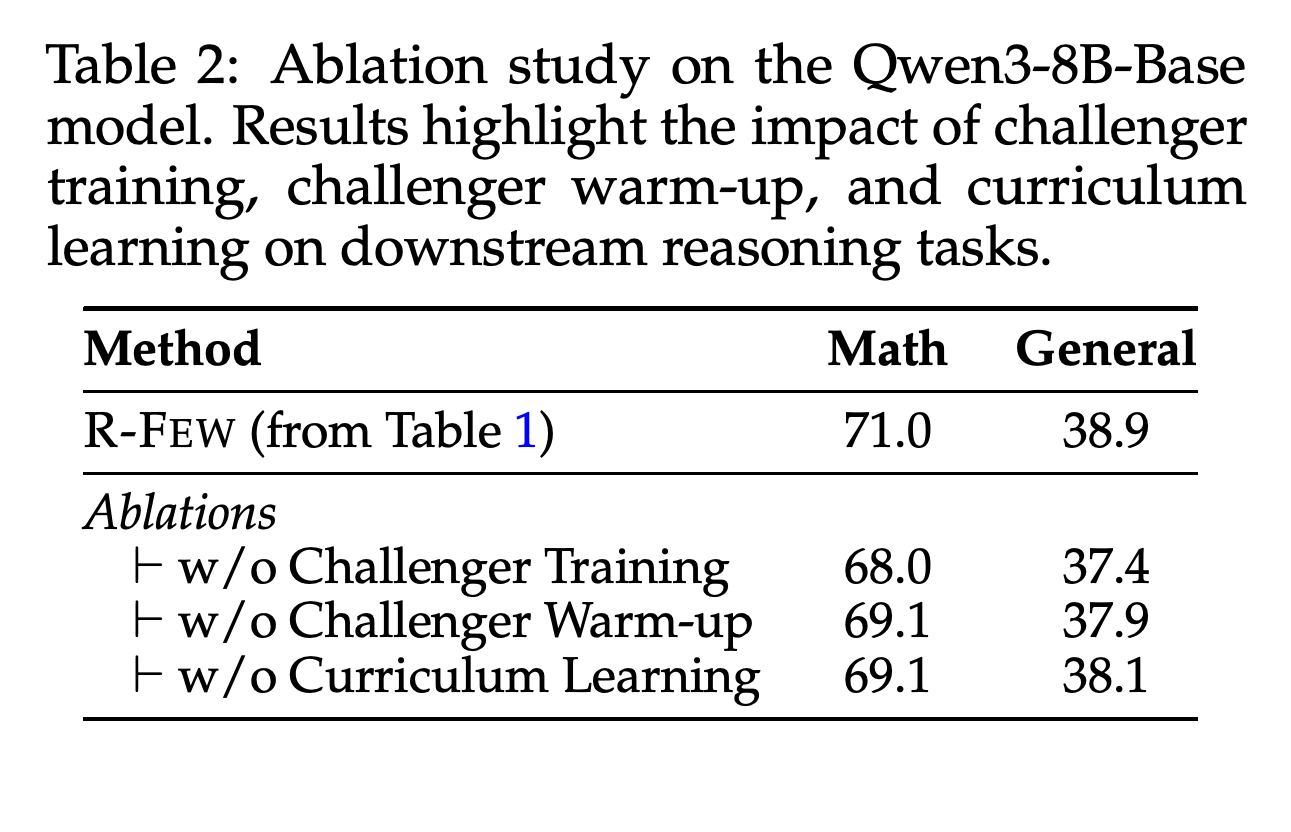
The ablations use Qwen3-8B-Base with the 5% anchor setting. Table 2 reports Math/General averages of 71.0/38.9 for R-FEW, 68.0/37.4 without Challenger training, 69.1/37.9 without Challenger warm-up, and 69.1/38.1 without curriculum learning. Each removal lowers performance, with removing Challenger training producing the largest decline.
- The table implies losses of 3.0 Math points and 1.5 General points when Challenger training is removed. The accompanying prose instead states 1.9 and 1.0.
- These ablations support contributions from the three tested components in this setting. They do not separately isolate the effects of human demonstrations for generation and human examples used directly in Solver training.
Removing Challenger training reduces Math/General scores from 71.0/38.9 to 68.0/37.4, the largest decrease among the tested removals. Removing warm-up or curriculum learning also lowers scores. The table’s 3.0/1.5-point Challenger-training losses conflict with the accompanying prose’s 1.9/1.0-point statement.
4.2.3 Domain Corelation with Human Data
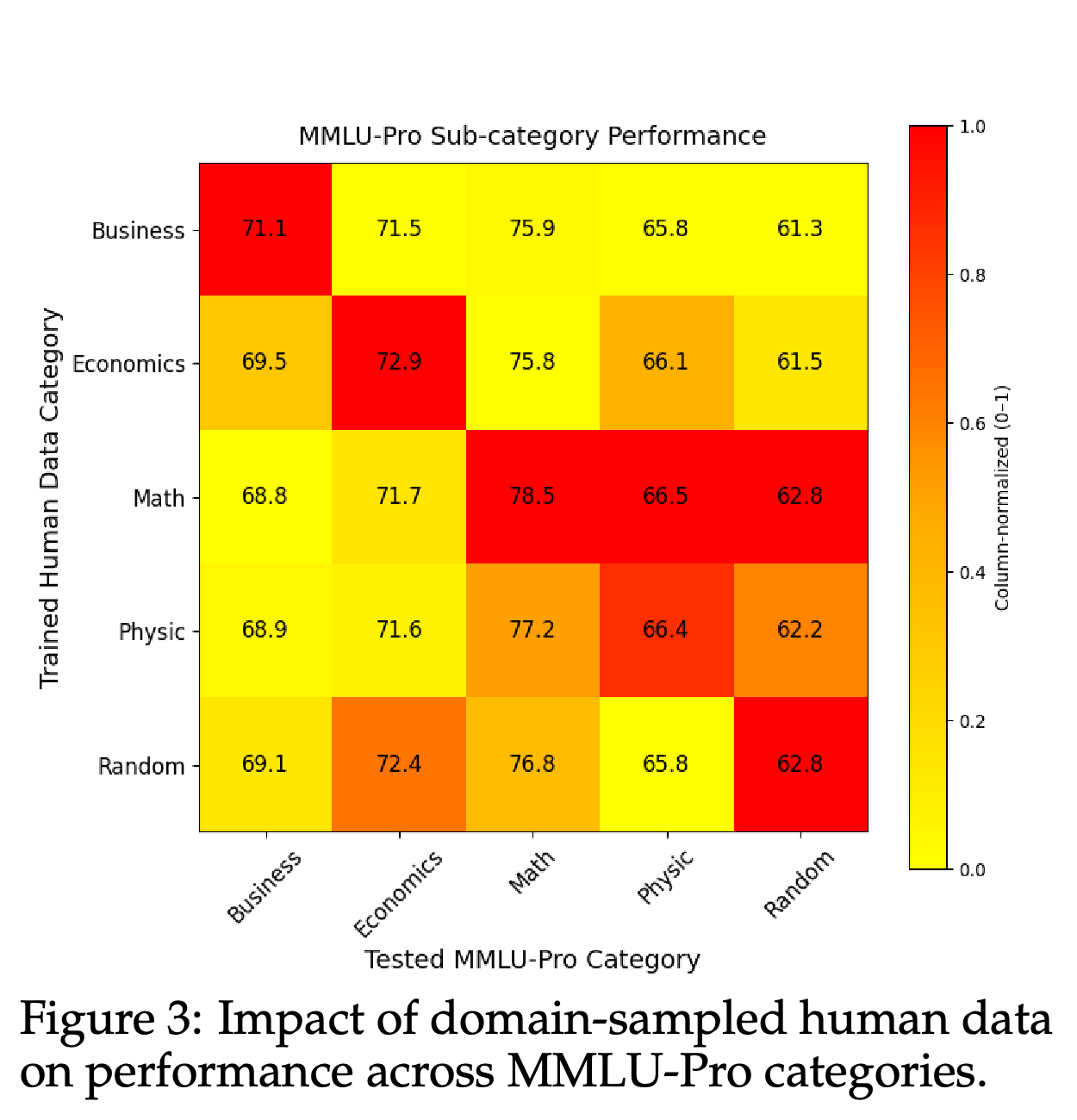
Models trained with domain-specific WebInstruct anchors are evaluated across MMLU-Pro categories. Figure 3 shows that business anchors produce the highest displayed business score, 71.1; economics anchors produce the highest economics score, 72.9; and math anchors produce the highest math score, 78.5. Math anchors also achieve the highest displayed physics score, 66.5, narrowly above physics anchors at 66.4.
- The matrix supports domain steering through anchor selection, although the matching training domain does not lead every evaluation column.
- The authors interpret the math–physics and business–economics relationships as transfer through shared reasoning structure. The matrix shows performance associations without establishing that mechanism.
Rows represent training anchor categories and columns represent evaluation categories. Business, economics, and math anchors lead their matching columns, while math anchors score 66.5 on physics versus 66.4 for physics anchors. Colors are normalized within each column, so the printed scores are needed for comparisons across evaluation categories.
4.2.4 Improved Stability and Reduced Reward Hacking
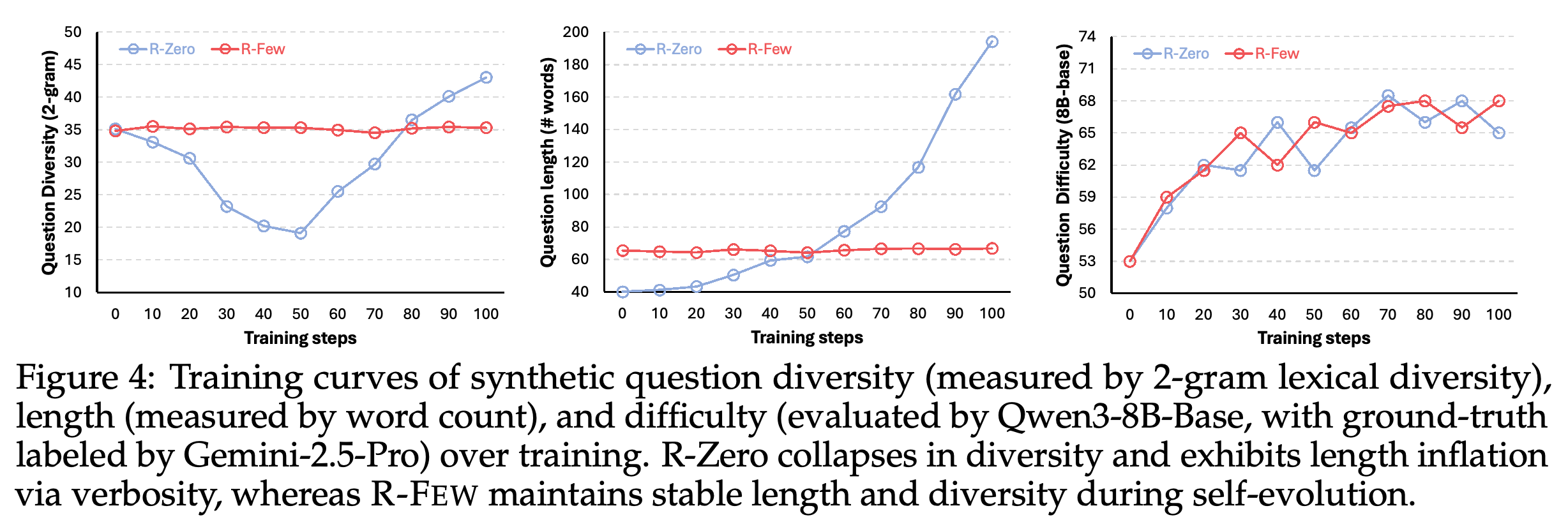
Figure 4 measures question diversity through 2-gram lexical diversity, variation in adjacent word pairs; length through word count; and difficulty through Qwen3-8B-Base’s error percentage on questions relabeled by Gemini-2.5-Pro. R-Zero’s diversity falls from about 35 to below 20 during the first 50 steps, then rises alongside substantial question-length growth. R-FEW keeps diversity near its starting level and question length approximately stable while measured difficulty increases.
- The authors interpret R-Zero’s later length growth as reward hacking, exploitation of superficial features that raise reward-related signals. The curves show a verbosity-related failure pattern, but do not isolate length as the cause of increased difficulty.
- Lexical diversity is sensitive to output length and does not directly measure semantic diversity. The difficulty measurement also depends on the labeling model and the fixed model answering the generated questions.
R-Zero’s late increase in adjacent-word-pair diversity accompanies a sharp rise in word count, limiting its interpretation as renewed semantic exploration. R-FEW maintains approximately stable length and lexical diversity while generated questions become harder for the fixed evaluation model. Together, the panels support reduced verbosity-related instability over the measured training horizon.
5 Related Work
The related work places R-FEW within self-play systems that generate their own learning tasks and reinforcement learning methods for language-model reasoning. R-FEW combines a small labeled anchor pool with adaptive selection of human and synthetic training questions.
5.1 Self-Evolving LLMs and Self-Play
Prior self-play methods include repeated task generation and solving, code generation checked by unit tests, and data-free training based on internal verification signals. Other methods introduce seed examples or document context to guide generated tasks. R-FEW uses limited labeled demonstrations and direct training on human examples while retaining synthetic task generation.
5.2 Reinforcement Learning for LLM Reasoning
The paper reviews reinforcement learning from human feedback (RLHF), optimization using human preference signals, and reinforcement learning with verifiable rewards (RLVR), optimization using externally checkable correctness feedback. It also discusses label-free rewards based on model confidence, answer consistency, and output entropy, uncertainty in the output distribution. These methods provide context for R-FEW’s combination of self-generated labels and limited human grounding.
6 Conclusion and Future Work
The conclusion attributes R-FEW’s improvements to combining human-guided generation with an online Solver curriculum. The strongest aggregate result is the Qwen3-8B-Base, 5% setting, which exceeds General-Reasoner’s reported overall average by 0.7 points. Proposed future work concerns training efficiency, richer verification, and extension to open-ended domains without objective correctness signals; these extensions are not evaluated.
Appendix
- A.1 Training Details: Implementation builds on EasyR1, a reinforcement learning training framework, and R-Zero. Training alternates five Challenger updates with ten Solver updates, reaching 50 Challenger steps and 100 Solver steps. Both use batch size 512, eight rollouts, and learning rate 5 × 10^−7; Solver rewards weight format correctness at 0.1 and accuracy at 0.9. Figure 5 shows fluctuating accuracy rewards as generated questions refresh the training set, while the format reward remains high after its initial rise.
- A.2 Training Hyperparameter, A.2.1 Solver Training, and A.2.2 Challenger Training: Both roles use a global batch size of 512, learning rate 5 × 10^−7, Kullback–Leibler (KL) penalty coefficient 1 × 10^−2, eight rollouts, temperature 1.0, and top-p 0.99. The KL penalty constrains distribution divergence; temperature controls sampling randomness, and top-p specifies the cumulative probability threshold for token sampling. Maximum steps are 100 for the Solver and 50 for the Challenger. Experiments use BFloat16 (BF16), a numeric format for mixed-precision computation, and FlashAttention 2, an efficient attention implementation.
- A.3 Prompt Templates: The Solver Prompt Template requests step-by-step reasoning and a final answer within \boxed{}, with <problem_statement> supplying the question. The Challenger Prompt Template requests a new reasoning problem from high-school or university disciplines, includes example placeholders, and requires {question} and {/question} delimiters. Its condition that fewer than 30% of college students could solve the problem is a prompt requirement; the report provides no student evaluation validating it.
- A.4 GPT-4o Judge Prompt and Configuration for GPT-4o as Judge: Mathematical answer checking uses gpt-4o at temperature 0.0 and requests a Yes or No response without a rationale. Examples allow trivial simplifications and tolerate omitted units, but explicitly label 3245/5 versus 649 as No despite their equality, because the template excludes simplifications it treats as nontrivial. Reported mathematical accuracy therefore reflects this operational equivalence criterion.
Brief Thoughts
R-FEW provides evidence that a small labeled pool can improve self-play when used for both task generation and Solver training. Its strongest comparison is the 8B, 5% setting; the 4B setting remains behind SPICE and General-Reasoner. Results at these two model sizes do not establish a general relationship between model capacity and the benefit of human grounding.
Reproduction requires clarification of the alignment term, quantile-versus-success-threshold selection, and the Solver’s human reward term. The headline mathematical improvement and ablation arithmetic also disagree with the displayed tables. Without reported repeated-run uncertainty or evaluation beyond 100 Solver steps, the evidence supports improved performance and generation stability in the tested settings, while sustained self-evolution remains unverified.