

Paper2Rebuttal: A Multi-Agent Framework for Transparent Author Response Assistance | Summary
20 Jan 2026 | Paper Review Rebuttal Generation Multi-Agent Coordination Rubric-Based EvaluationContents
- Summary
- 1 Introduction
- 2 Related Works
- 3 RebuttalAgent
- 4 RebuttalBench
- 5 Experiments
- 6 Conclusion
- Limitations and Future Work
- Broader Impact and Ethics Statement
- Appendix
- Brief Thoughts
This article explains the key points of Paper2Rebuttal: A Multi-Agent Framework for Transparent Author Response Assistance.
- 2026-01-20 (arXiv)
- Ma, Qianli, Guo, Chang, Tian, Zhiheng, Wang, Siyu, Xiao, Jipeng, Yue, Yuanhao, Zhang, Zhipeng.
- AutoLab, School of Artificial Intelligence, Shanghai Jiao Tong University
- Paper
- Github
- Project Page
Summary
- Paper2Rebuttal introduces RebuttalAgent, which treats rebuttal writing as evidence organization and response planning rather than immediate text generation. It extracts atomic reviewer concerns, combines concern-specific manuscript passages with external evidence briefs, and checks an inspectable response plan before drafting.
- RebuttalBench uses ICLR 2023 discussion data, with a challenge set of 20 papers and 106 multi-turn evaluation cases. Under matched model backbones and fully automated execution, RebuttalAgent improves all nine reported rubric components over direct-to-text prompting, particularly coverage and specificity; Table 1 reports overall gains of +0.38 to +0.57, although some aggregate values differ from the means of the listed components.
- An author study involving 9 researchers and 33 review-rebuttal test samples supports the usefulness of the generated responses, with reported agreement between human and automated scores of Kendall τ = 0.646. These findings do not establish guaranteed factual reliability: checker ablations have mixed effects, and a showcased response asserts r > 0.9 without supplying the measurements.
1 Introduction
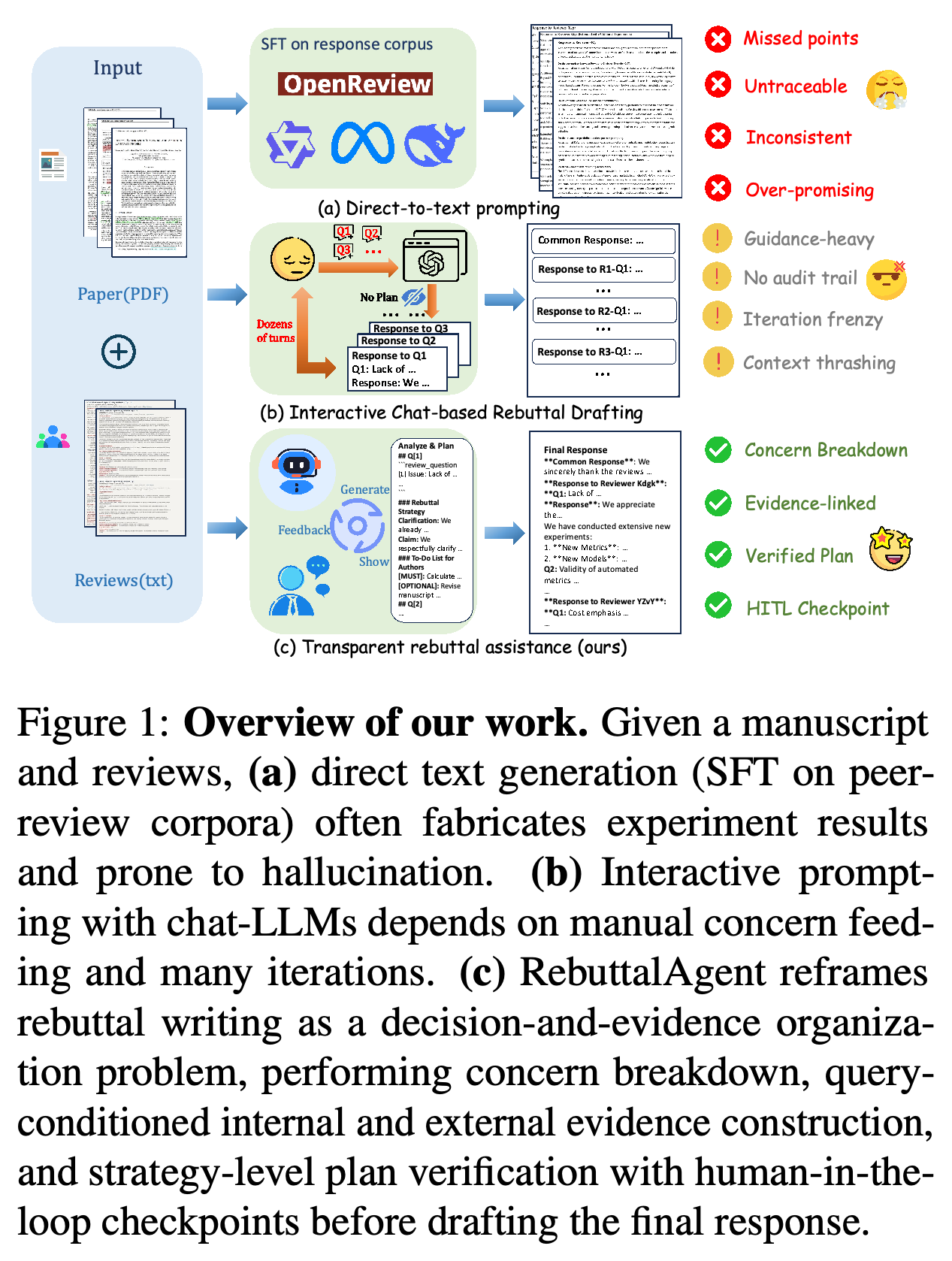
The introduction identifies four requirements for reliable rebuttal assistance: Comprehensive Coverage, Strict Faithfulness, Verifiable Grounding, and Global Consistency. It argues that direct-to-text generation can omit critiques or invent results, while interactive chat workflows require repeated author guidance without necessarily exposing an auditable process.
- RebuttalAgent separates evidence collection and strategic decisions from final wording through a “verify-then-write” workflow.
- Human-in-the-loop checkpoints expose concern lists, evidence links, and response plans so authors can revise proposed commitments before drafting.
- Resources are listed at https://Paper2Rebuttal.github.io and https://huggingface.co/spaces/RebuttalAgent.
The three workflows differ in whether concerns, evidence, and commitments are exposed before final prose is produced. The diagram motivates author control and auditability, but its listed failure modes and advantages are conceptual claims rather than measured outcomes.
2 Related Works
The related-work discussion connects the framework to tool-using LLM agents, role-specialized multi-agent systems, and AI-assisted peer review. DISAPERE, APE, and Re2 provide discourse alignment or discussion corpora; RebuttalAgent instead emphasizes an explicit concern-to-evidence-to-plan workflow.
- The agent literature combines reasoning with search, tool use, memory, and execution feedback, while multi-agent systems distribute work across specialized roles.
- The paper argues that prior rebuttal methods insufficiently expose concern decomposition and evidence-based planning; this is its positioning claim rather than a comprehensive experimental comparison of all prior systems.
3 RebuttalAgent
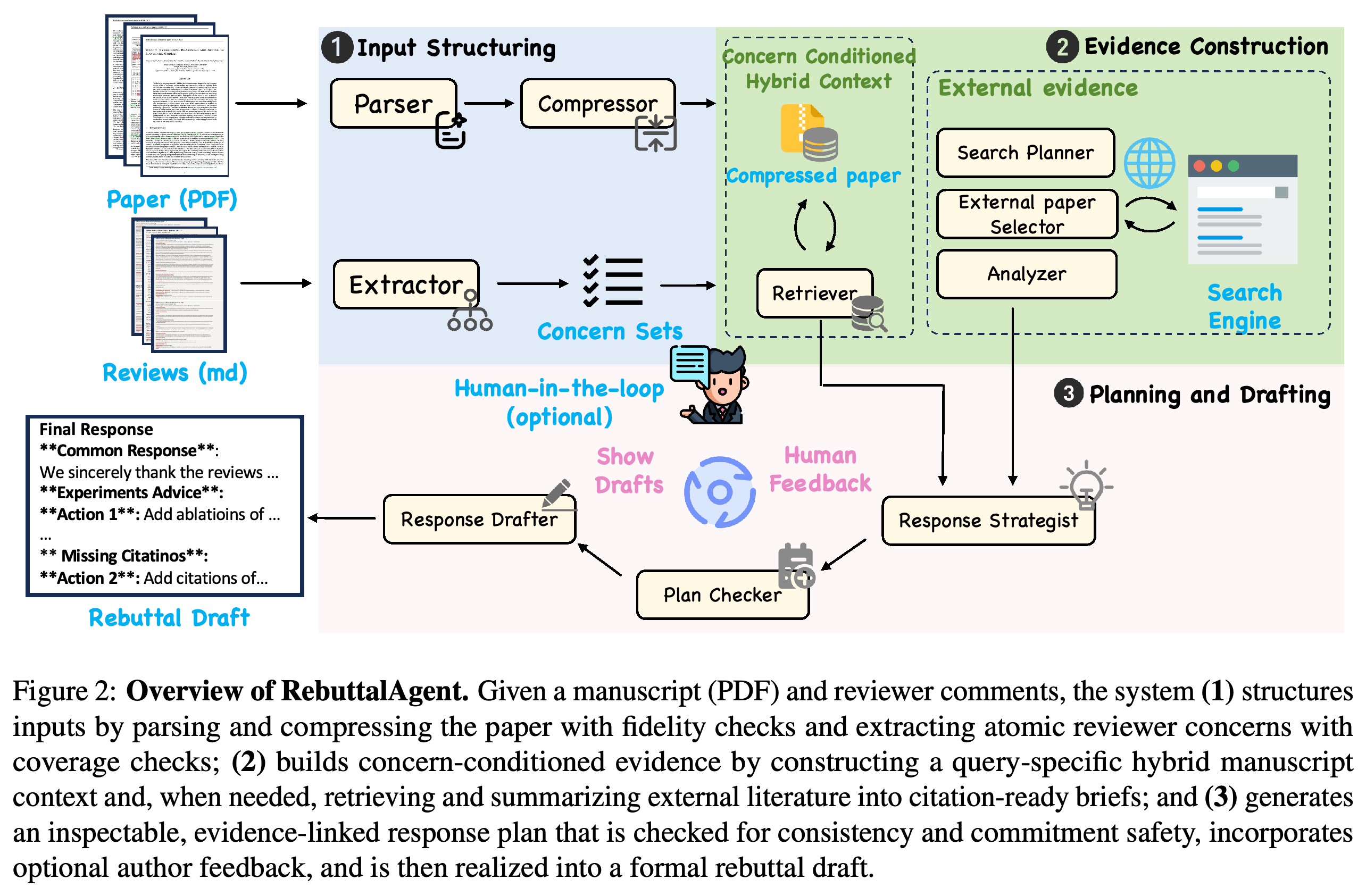
RebuttalAgent has three stages: Manuscript and Review Structuring, Evidence Construction, and Planning and Drafting. Specialized agents produce intermediate artifacts, while checkers inspect fidelity, coverage, evidence linkage, and consistency; optional author feedback modifies the response strategy.
- The contribution is an inference-time workflow, not a newly trained language model.
- Authors remain responsible for scientific claims, commitments, and final wording.
Manuscript compression and concern extraction feed two evidence paths: selective recovery of original manuscript passages and external literature retrieval. These paths converge at the response strategist, followed by plan checking, optional author feedback, and drafting.
3.1 Manuscript and Review Structuring
A parser converts the manuscript into paragraph-indexed text, and a compressor creates a compact representation retaining technical statements and experimental results. A consistency checker compares condensed units with their sources and triggers reprocessing when it detects missing claims or semantic drift.
- The compressed representation is a navigation and retrieval surface; downstream modules can still recover original passages.
- In parallel, an extractor converts reviews into atomic concerns, grouping related questions while preserving independently addressable issues.
- A coverage checker examines reviewer intent and granularity to reduce omissions, excessive splitting, and inappropriate merging.
3.2 Evidence Construction
For each atomic concern, the system locates relevant compressed manuscript units and replaces them with their corresponding original passages. This hybrid context retains a compact global view while supplying detailed local evidence.
- External retrieval is triggered when manuscript evidence is insufficient, including novelty disputes, requested references, and baseline comparisons.
- A search planner produces queries, a screening agent selects useful papers, and an analyzer constructs citation-ready briefs describing relevant claims and comparisons.
- The scholarly retrieval endpoint identified in the paper is https://export.arxiv.org/api/query.
3.3 Planning and Drafting
The Strategist Agent distinguishes interpretative defense based on existing evidence from necessary interventions requiring new experiments or analyses. For interventions, it is instructed to generate Action Items rather than outcomes; the plan is checked and can be revised through author feedback before drafting.
- Authors can narrow proposed work or correct the reasoning to match their capabilities and intended stance.
- Submission-style drafts should mark unavailable numerical results with [TBD] until authors provide verified values.
- These controls are workflow safeguards, not formal guarantees of correctness; the main experiments bypass author intervention.
4 RebuttalBench
RebuttalBench combines real review-response interactions with a rubric for relevance, argumentation, and communication. It evaluates substantive engagement and evidence support rather than fluency or similarity to a single reference rebuttal.
4.1 Evaluation Dataset
RebuttalBench-Corpus contains approximately 9.3K review-rebuttal pairs from public ICLR discussions; Appendix A identifies the source as the ICLR 2023 subset of Re2, approximately 9,310 entries. The challenge set prioritizes papers with both resolved and unresolved concerns and substantial reviewer participation, yielding 20 papers and 106 multi-turn cases.
- Reviewer follow-up comments and score changes provide outcome signals, while confidence tiers indicate the reliability of those signals.
- Tier 1 uses objective metadata or explicit revision statements; Tier 2 uses high-confidence textual signals; Tier 3 contains ambiguous cases.
- The main text describes removing ambiguous cases, whereas Appendix D specifies retaining a small fraction for stress testing.
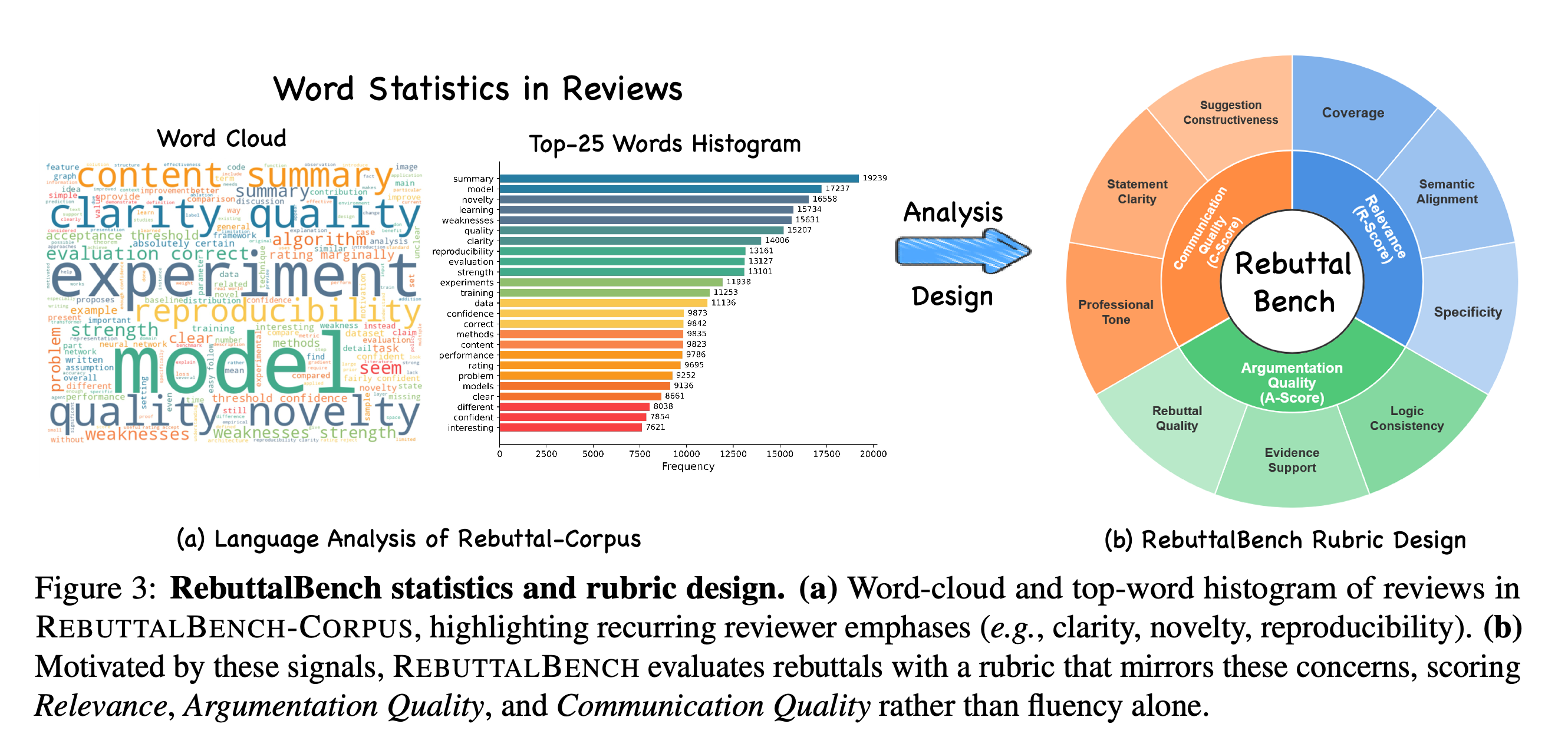
- Figure 3 motivates rubric dimensions using recurring review vocabulary, but word frequencies alone do not validate the scoring criteria.
The word cloud and Top-25 Words Histogram show recurring review terms concerning models, experiments, clarity, reproducibility, and novelty. The adjacent wheel groups evaluation into three dimensions and nine components; it labels one argumentation component Rebuttal Quality, while the metric text and tables use Response Engagement. The vocabulary analysis motivates the rubric without statistically validating it.
4.2 Evaluation Metrics
An LLM judge scores nine components on a 0–5 scale, with half-point upgrades defined in Appendix H. Relevance covers Coverage, Semantic Alignment, and Specificity; Argumentation Quality covers Logic Consistency, Evidence Support, and Response Engagement; Communication Quality covers Professional Tone, Clarity, and Constructiveness.
- Each dimension averages its three components, and the final score averages the three dimensions equally.
- The evaluator also returns explanations and qualitative warnings or diagnoses.
- The checker case study suggests a limitation of Coverage scoring: a response can mention relevant keywords while remaining unfocused or insufficiently actionable.
5 Experiments
The experiments compare matched-backbone direct-to-text prompting with the full pipeline and examine three component removals. Appendix experiments add alternative baselines, a second judge model, and author assessments on CVPR 2026 submissions.
5.1 Experimental Setup
The four main backbones are GPT-5-mini, Grok-4.1-fast, Gemini-3-Flash, and DeepSeekV3.2. Each baseline and its RebuttalAgent counterpart receive the same manuscript and reviewer comments, produce the same point-by-point output format, and use consistent decoding settings; Gemini-3-Flash is the default judge.
- All main-paper experiments disable human intervention, evaluating the automated pipeline rather than the complete author-in-the-loop workflow.
- Matching backbones controls model identity, but does not match the pipeline’s additional inference calls, retrieval, or computational budget.
- The authors call automated performance a conservative lower bound on real-world usage, but the experiments do not directly measure gains from author intervention.
5.2 Main Results
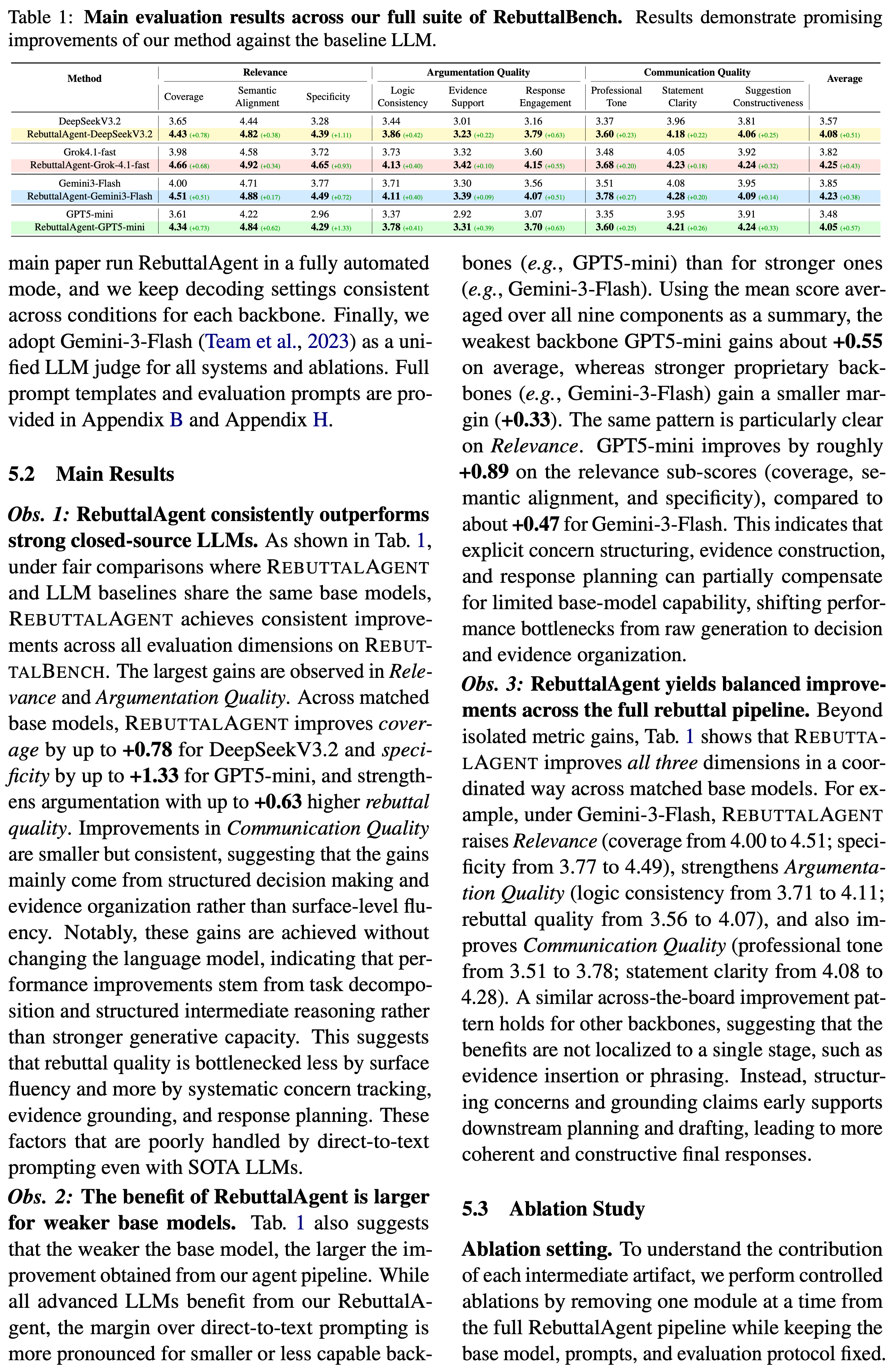
Table 1 reports higher RebuttalAgent scores on all nine components under every backbone. Its reported overall averages increase from 3.57 to 4.08 for DeepSeekV3.2, 3.82 to 4.25 for Grok-4.1-fast, 3.85 to 4.23 for Gemini-3-Flash, and 3.48 to 4.05 for GPT-5-mini.
- The largest Coverage gain is +0.78 for DeepSeekV3.2, and the largest Specificity gain is +1.33 for GPT-5-mini.
- Evidence Support gains are smaller for Grok-4.1-fast and Gemini-3-Flash, at +0.10 and +0.09 respectively; increased detail should not be equated with an equally large improvement in evidential strength.
- The reported averages are not consistently reproducible from the nine listed components. Those components imply mean gains of approximately +0.55 for GPT5-mini and +0.33 for Gemini-3-Flash, agreeing with the narrative rather than the table’s +0.57 and +0.38.
- The larger gains for lower-scoring baselines suggest that the workflow helps compensate for weaker direct-to-text performance in this benchmark; they do not independently establish a general relationship between model capability and benefit.
Every matched-backbone comparison favors RebuttalAgent on all nine components, with particularly large coverage and specificity gains. The table reports overall improvements of +0.51, +0.43, +0.38, and +0.57, but some averages differ from the means of the listed components; for Gemini and GPT5-mini, component-based gains are approximately +0.33 and +0.55. No uncertainty estimates or inference-budget matching are provided.
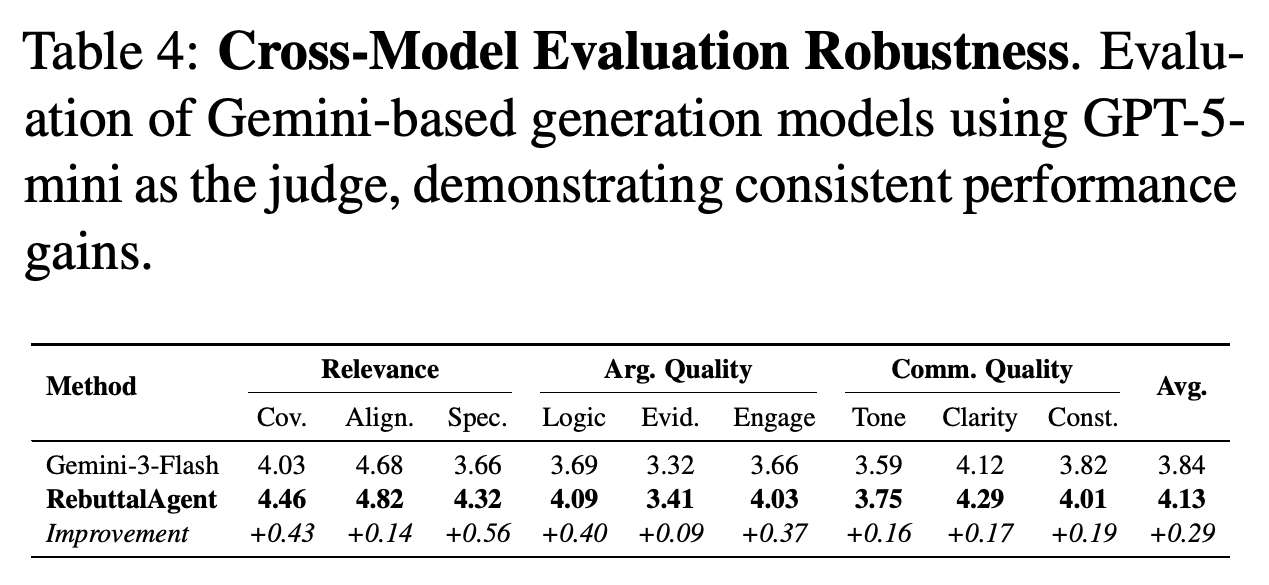
Appendix E checks automated evaluation through author scoring on 33 review-rebuttal test samples and re-evaluation of Gemini-generated outputs with GPT-5-mini as judge. The second judge preserves the improvement direction, reporting an overall increase from 3.84 to 4.13.
- Nine authors assess responses to their own recent CVPR 2026 submissions under four matched-backbone generation conditions and three human evaluation dimensions.
- Human Faithfulness & Argumentation scores rise from 2.88 to 4.33 for Gemini3-Flash and from 2.30 to 3.97 for GPT5-mini.
- The reported Kendall τ = 0.646 supports agreement with author judgments, but the small study and absence of uncertainty estimates limit stronger claims about evaluator reliability or freedom from bias.
5.3 Ablation Study
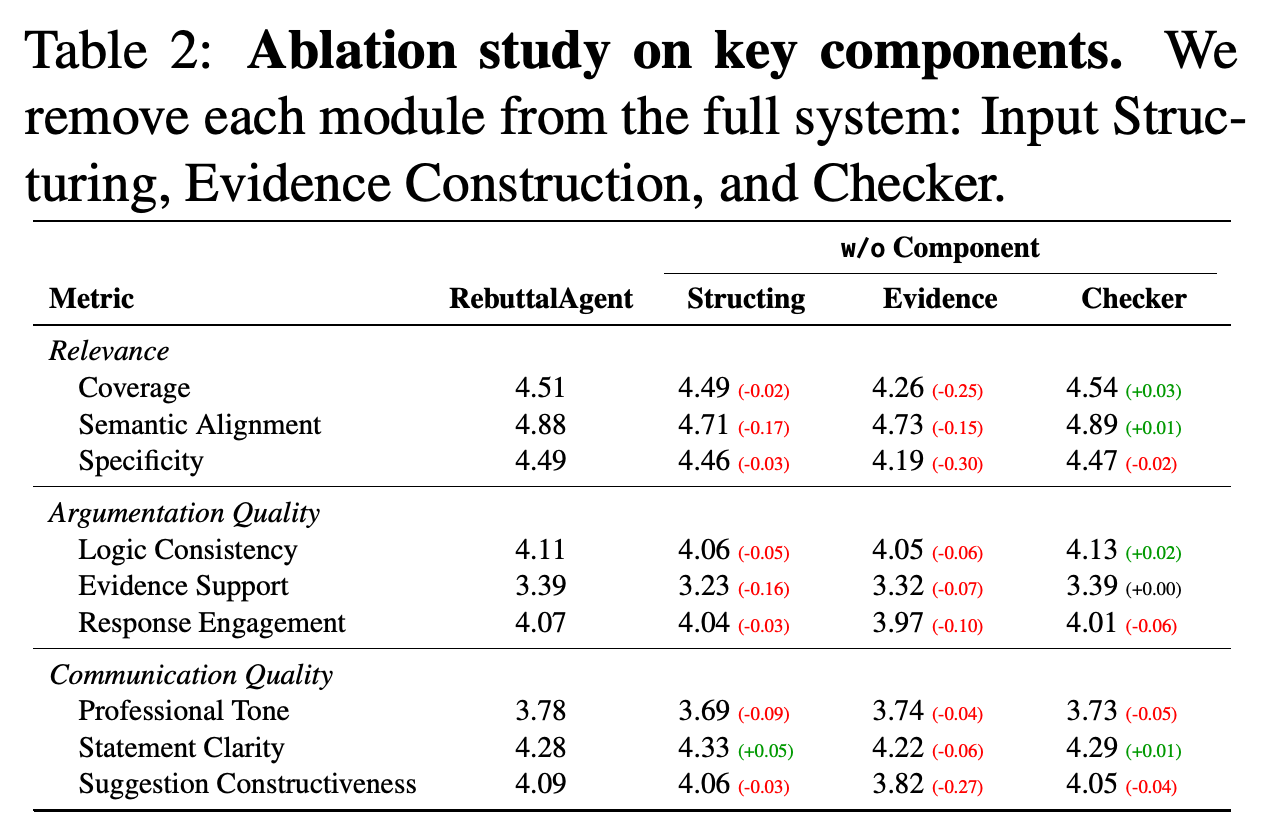
Table 2 removes explicit concern structuring, external Evidence Construction, or plan-level Checkers from the Gemini-based pipeline. Disabling external retrieval and citation-ready briefs produces the largest reductions, including Coverage from 4.51 to 4.26, Specificity from 4.49 to 4.19, and Suggestion Constructiveness from 4.09 to 3.82.
- The Input Structuring ablation handles reviewer concerns in raw form without explicit decomposition and merging; the Evidence Construction ablation disables external retrieval and briefs, not all internal manuscript grounding.
- Without Input Structuring, Semantic Alignment falls from 4.88 to 4.71 and Evidence Support from 3.39 to 3.23.
- Checker removal has mixed effects: Coverage increases to 4.54, Logic Consistency to 4.13, and Statement Clarity to 4.29, while Response Engagement falls to 4.01 and Constructiveness to 4.05.
- The prose claims that checker removal reduces Evidence Support from 3.39 to 3.33, but Table 2 reports 3.39 with a +0.00 change. Its aggregate pattern therefore provides limited evidence for a broad factual-reliability benefit from checking.
Disabling external retrieval and evidence briefs produces the clearest deterioration, especially in specificity and constructiveness. Checker removal is mixed: several components increase slightly, while Evidence Support remains 3.39, contrary to the prose’s claimed decrease to 3.33.
5.4 Case Study
The case studies compare explicit revision plans with shorter narrative defenses. They address theoretical rigor, the distinction between an upper bound and monotonic behavior, and whether Hausdorff-based topographic similarity demonstrates compositionality.
- The plans expose proposed proof revisions, diagnostic analyses, and manuscript edits before authors commit to them.
- Appendix G illustrates the “Coverage Paradox”: a checker-free glossary mentions relevant keywords but introduces tangential concepts, whereas the checked response proposes focused mathematical edits.
- The examples do not consistently demonstrate hallucination prevention: the upper-bound example ends by asserting a strong positive correlation of r > 0.9 without presenting completed measurements.
6 Conclusion
The conclusion attributes improved rebuttal quality to structured concerns, concern-conditioned contexts, external evidence synthesis, and checked response plans. The comparisons support higher rubric scores and author-rated utility, but cognitive-burden reduction and guaranteed traceability are not directly measured.
Limitations and Future Work
The stated limitations concern latency and cost, incomplete reuse of intermediate artifacts across concerns or author iterations, and differing rebuttal conventions across venues and subfields. Proposed improvements include caching, incremental updates, adaptive early-exit policies, and lightweight venue-specific style and policy constraints.
- No quantitative latency, cost, or author-time savings are reported.
- The primary challenge set contains 20 ICLR 2023 papers; the CVPR author study offers a small cross-venue check rather than broad validation.
Broader Impact and Ethics Statement
The ethics statement identifies persuasive but misleading responses, fabricated results, unrealistic commitments, and confidentiality risks as potential harms. It recommends author accountability, provenance-preserving retrieval, inspectable intermediate artifacts, and local or institution-approved deployment for confidential manuscripts and reviews.
- The dataset comes from public ICLR 2023 forums, with commitments to follow source terms and avoid distributing sensitive or personally identifying information.
- These safeguards depend on effective checking and author verification; the paper does not demonstrate that misuse or privacy exposure has been eliminated.
Appendix
- A Evaluation Dataset describes four stages: outcome-based classification into Improved and Unimproved groups, reliability stratification, curation of 20 representative papers, and multi-round baseline generation. Tier 2 uses confidence ≥ 0.7 and Tier 3 uses 0.4 ≤ conf < 0.7; each baseline round receives the manuscript, current review, and optional prior-round context, then produces a factual abstract of fewer than 200 words for the next round. Outputs and token usage are logged, although comparative resource measurements are not reported.
- B Evaluation Metric defines nine components, component-level justifications, and equal-weight aggregation: (R = \frac{R_1 + R_2 + R_3}{3}) and (\mathrm{Score} = \frac{R + A + C}{3}), with analogous averages for A and C. Thus, despite the term “weighted score,” the stated final aggregation gives equal weight to all nine components; some reported table averages do not follow that calculation.
- C Related Works situates rebuttal assistance within automatic scientific research, including literature search, hypothesis generation, research ideation, experiment planning, and scientific visualization. Its focus is communicating and defending research while tracking reviewer intent and grounding responses in manuscript evidence.
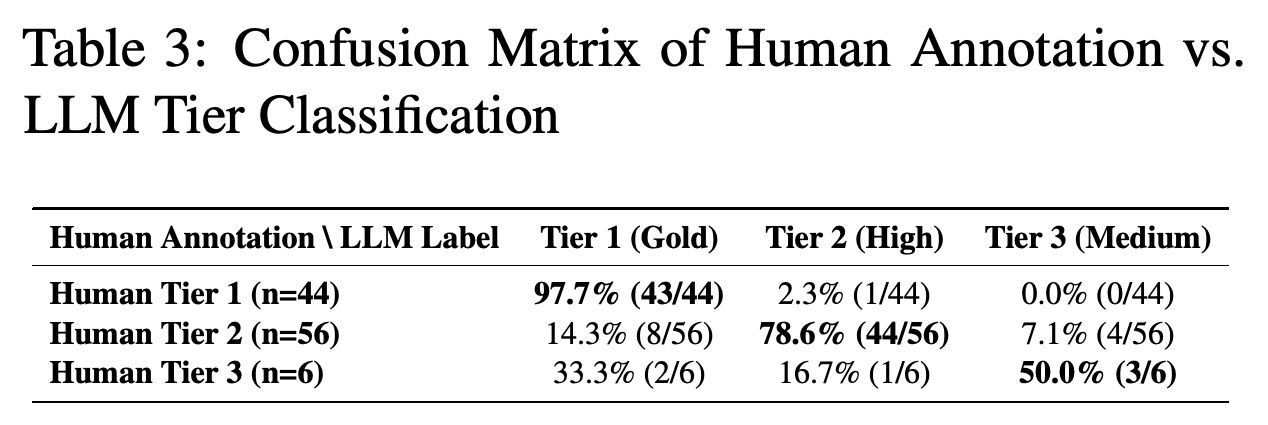
- D Data Filtering Pipeline distinguishes Resolved versus Unresolved outcome labels from confidence tiers used as reliability filters. D.1 extracts outcomes from reviewer follow-up text and score changes, assigns tiers, and prioritizes papers with both outcomes and more reviewers; D.2 deliberately retains a small fraction of mixed or contradictory Tier 3 cases for stress testing. D.3 reports 100.0% outcome-label agreement with expert annotators on 106 cases, but Table 3 assigns 2/6 human Tier 3 cases to Tier 1, contradicting the claim of strictly 0.0% leakage between those tiers; sample-level agreement also does not establish unbiased ground truth in general.
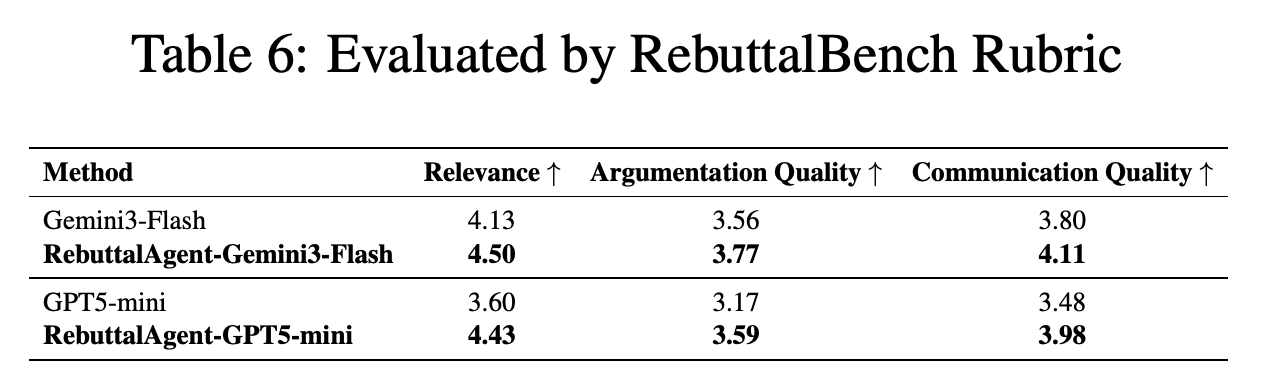
- E Evaluation Setup and Metric Validation assesses human agreement and sensitivity to judge choice. E.1 reports Kendall τ = 0.646 and a GPT-5-mini judge check that preserves Gemini-based RebuttalAgent’s advantage; E.2 describes 9 authors evaluating four generation conditions on 33 review-rebuttal test samples from their own CVPR 2026 submissions. Authors use a 1–5 Likert scale for Responsiveness & Coverage, Faithfulness & Argumentation, and Communication & Practical Utility; Tables 5 and 6 preserve the same system ranking, but human and automated score differences are not interchangeable.
- E.3 Limitations of Standard N-gram Metrics presents a novelty-defense example in which direct-to-text generation receives BLEU-4 = 6.96 and ROUGE-L = 18.49, compared with BLEU-4 = 2.38 and ROUGE-L = 14.05 for RebuttalAgent. The expanded response invokes Information Bottleneck reasoning, latent alignment, and a proposed mutual-information argument rather than closely paraphrasing the reference. The example shows that elaboration can reduce reference overlap; it does not independently verify the expanded response’s scientific correctness.
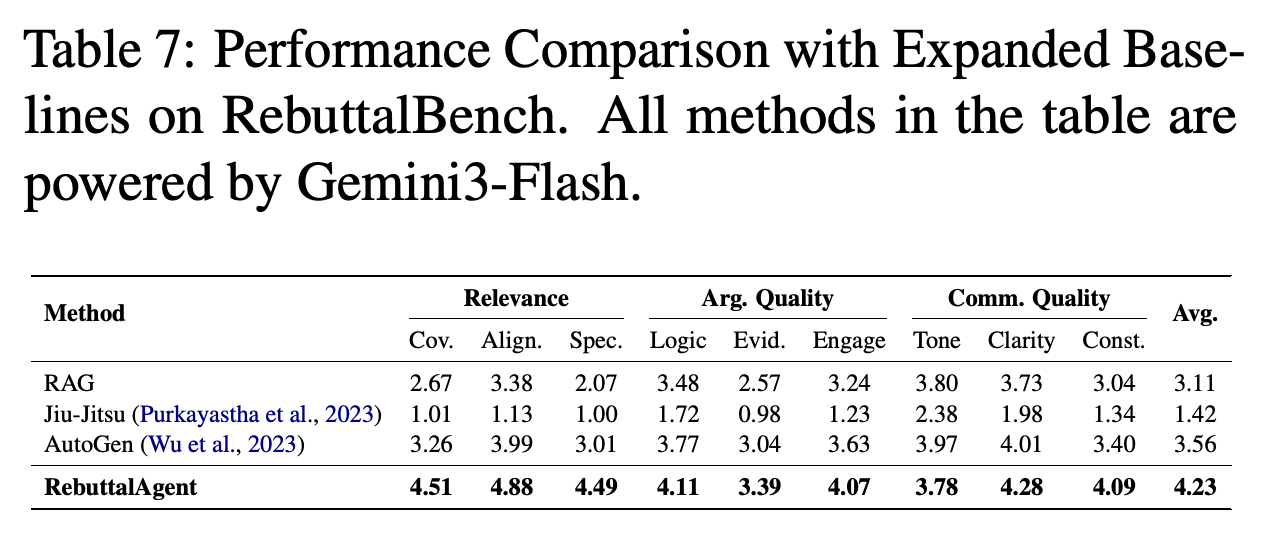
- F Additional Baseline Comparisons evaluates Standard RAG using all-MiniLM-L6-v2, AutoGen, and Jiu-Jitsu, all powered by Gemini3-Flash. Table 7 reports overall scores of 3.11, 3.56, and 1.42 respectively, versus 4.23 for RebuttalAgent, although the latter’s nine listed components average approximately 4.18. These results favor the specialized pipeline under the reported setup, but limited adaptation and budget details constrain explanations of baseline underperformance; Standard RAG also scores below direct-to-text Gemini in Table 1, contrary to the appendix’s claim that it improves on naive prompting.
- G Case Study: The Coverage Paradox and the Role of Checkers examines a reviewer request to clarify a non-Markovian formulation and distinguish Utility from Reward. The checker-free response supplies a broad glossary, introduces Social Graph and Adversarial Interaction, and attributes non-Markovian behavior to a generic POSG; the checked response instead proposes separating instantaneous Reward Ri(s, a) from meta-game Utility Ui(π) and conditioning Eq. 4 on opponent action history τt−1 rather than only current state st. These are focused proposed revisions, but the example does not independently establish their theoretical correctness or prove that verbosity explains the aggregate Coverage increase.
- H Prompt Templates specifies the operational constraints of extraction, retrieval, revision, drafting, and judging. The Rebuttal Strategist uses the compressed manuscript, review text, and optional multi-round context to extract new or unresolved issues; it splits concerns requiring different evidence, merges equivalent objections, filters generic praise and empty review fields, and records each issue in [qN] blocks with verbatim sources, paper hooks, and P1–P3 priorities. The Strategist Checker repeats this extraction schema and adds an omission-revision task. The Literature Retrieval Assistant searches for reviewer-named references, outside methods or datasets, requested comparisons, or missing manuscript evidence, but skips search when existing evidence suffices or the issue is minor formatting; it normally generates fewer than 5 queries, preserves supplied titles or links without fabrication, and returns need_search, queries, links, and reason. The Rebuttal Expert screens abstracts for direct usefulness, normally selects no more than 6 papers, retains reviewer-specified references under the stated exceptions, rejects redundant papers, and returns selected_papers with a reason. The Reference Extractor keeps external findings distinct from manuscript claims and produces a brief of no more than 600 words containing the title, summary, relevance, safely citable content, limitations, and URL; it must acknowledge empty, abstract-only, or low-value sources rather than invent evidence. The Human-In-The-Loop Strategy Revisor combines the manuscript, concerns, reference summaries, current plan, and author feedback to revise the strategy without adding schedules. The Rebuttal Letter Writer maps the plan back to each reviewer in order, uses Common Response and reviewer-specific Q1/A1 or Comment/Response formatting, requires professional wording and LaTeX notation, and mandates [TBD] for unavailable numerical results; a later instruction about speculative data marked with an asterisk is inconsistent with that prohibition. The Unified Rebuttal Evaluation prompt assigns integer component scores from 0–5 for coverage, alignment, specificity, logic, evidence, engagement, tone, clarity, and constructiveness, then permits +0.5 only for base scores of 3 or 4 when at least two specified upgrade conditions are met. It scrutinizes repetition, indirect answers, unsupported promises, unexplained citations, and polished wording that masks weak evidence; its two example output schemas differ between quality_warnings and red_flags while both include component scores and an explanation.
- I Case Study presents three comparisons: “Rigorous formalization & verification v.s. High-level intuitive explanation,” “Actionable theoretical expansion v.s. Passive logical defense,” and “Methodological triangulation v.s. Linear request fulfillment.” In the first, a concern about Proposition 1 produces a plan for explicit assumptions, numbered lemmas, per-layer diagnostics, synthetic validation, correlations, and robustness sweeps over k ∈ {5, 15, 29} and δ ∈ {0.05, 0.1, 0.2}; the baseline mainly supplies intuition and promises clearer definitions. In the second, the plan distinguishes an upper bound from monotonicity and proposes a new lemma, scatter plots, and bound diagnostics, but its summary asserts r > 0.9 without presenting measurements; the baseline gives a concise upper-bound clarification. In the third, the plan reframes Hausdorff-based similarity as descriptive and proposes constituent decodability, latent-space linearity, and calibration on 10–15 public ideograms, whereas the baseline primarily accepts the request for external validation. The deliverables and to-do lists describe recommended revisions rather than completed RebuttalAgent experiments, and the claimed feasibility depends on access to the original papers’ checkpoints and code.
Brief Thoughts
The strongest design choice is separating evidence-backed clarification from work that remains to be performed. Hybrid manuscript contexts, external evidence briefs, and explicit action items expose decisions that authors can inspect, and the matched-backbone comparisons and author study support the workflow’s usefulness.
The main reservation is the gap between better-rated responses and demonstrated factual reliability. Mixed checker effects, inconsistent aggregate scores, and the unsupported r > 0.9 statement favor treating RebuttalAgent as an inspectable drafting assistant rather than a verified scientific reasoner; factual-error audits and resource-matched comparisons would provide stronger evidence.
The classifier retains 43/44 human Tier 1 cases as Tier 1. However, 2/6 human Tier 3 cases are also assigned Tier 1, so the matrix contradicts the assertion of strictly zero Tier 1–Tier 3 leakage; leakage is absent only in the human Tier 1-to-LLM Tier 3 direction.
Replacing Gemini-3-Flash with GPT-5-mini as evaluator preserves RebuttalAgent’s advantage on all nine components for Gemini-generated responses. The reported overall score increases from 3.84 to 4.13, supporting robustness to this judge substitution rather than complete freedom from evaluator bias.
Authors rate both RebuttalAgent variants above their direct-to-text counterparts in responsiveness, faithfulness, and practical utility. Evaluating responses to their own submissions supplies relevant expertise, but the study includes only 9 researchers and 33 review-rebuttal test samples under four generation conditions.
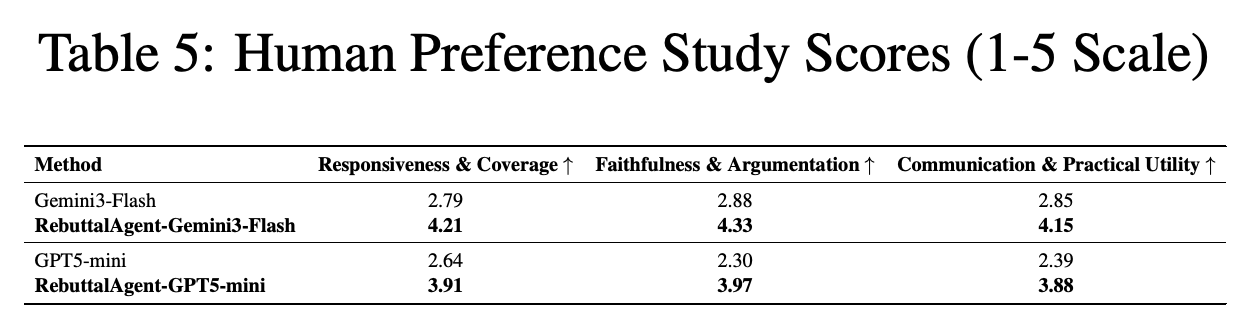
Automated evaluation on the same 33 test samples agrees with the human study’s system ranking. Its score differences are smaller than the human-rated differences, so ranking agreement does not make the absolute scores interchangeable.
RebuttalAgent’s reported 4.23 average exceeds Standard RAG at 3.11, AutoGen at 3.56, and Jiu-Jitsu at 1.42, although its component scores average approximately 4.18. Its advantage is not universal at component level: AutoGen and RAG score higher on Professional Tone, at 3.97 and 3.80 versus 3.78.