


Efficient Exploration at Scale | Summary
18 Mar 2026 | Paper Review Reinforcement Learning From Human Feedback Active Exploration Epistemic Neural NetworksContents
- Summary
- 1. Introduction
- 2. Literature Review
- 3. Experiment Pipeline
- 4. Algorithms
- 5. Results
- 6. Conclusions and Future Work
- Appendix
- Brief Thoughts
This article explains the key points of Efficient Exploration at Scale.
- 2026-03-18 (arXiv)
- Asghari, Seyed Mohammad, Chute, Chris, Dwaracherla, Vikranth, Lu, Xiuyuan, Jafarnia, Mehdi, Minden, Victor, Wen, Zheng, Van Roy, Benjamin.
- Google DeepMind
- Paper
Summary
- Efficient Exploration at Scale studies how to reduce the preference-label requirements of LLM alignment. Its algorithm incrementally updates a reward model and a language model, combining an affirmative nudge for policy-update stability with epistemic uncertainty modeling and uncertainty-guided response-pair selection.
- Experiments use Gemma 9B policies, an internal collection of 202K prompts, and simulated preferences from a Gemini 1.5 Pro-based reward model trained on real human feedback. Information-directed exploration matches offline RLHF trained on 200K choices using fewer than 20K choices, giving more than a 10x improvement in label efficiency under this evaluation setup.
- The reported 1,000x gain at 1M labels is an extrapolation, not a measured result. The evidence is limited to simulated feedback and a particular model-and-prompt pipeline, and the authors explicitly state that the report does not provide sufficient detail to reproduce the experiments.
1. Introduction
The research problem is to collect more informative preference data rather than simply increase its volume. The proposed RLHF procedure fits a reward model to incoming choices and uses its predictions to update the language model through a variant of reinforce; its three distinguishing components are the affirmative nudge, an epistemic neural network, and information-directed exploration.
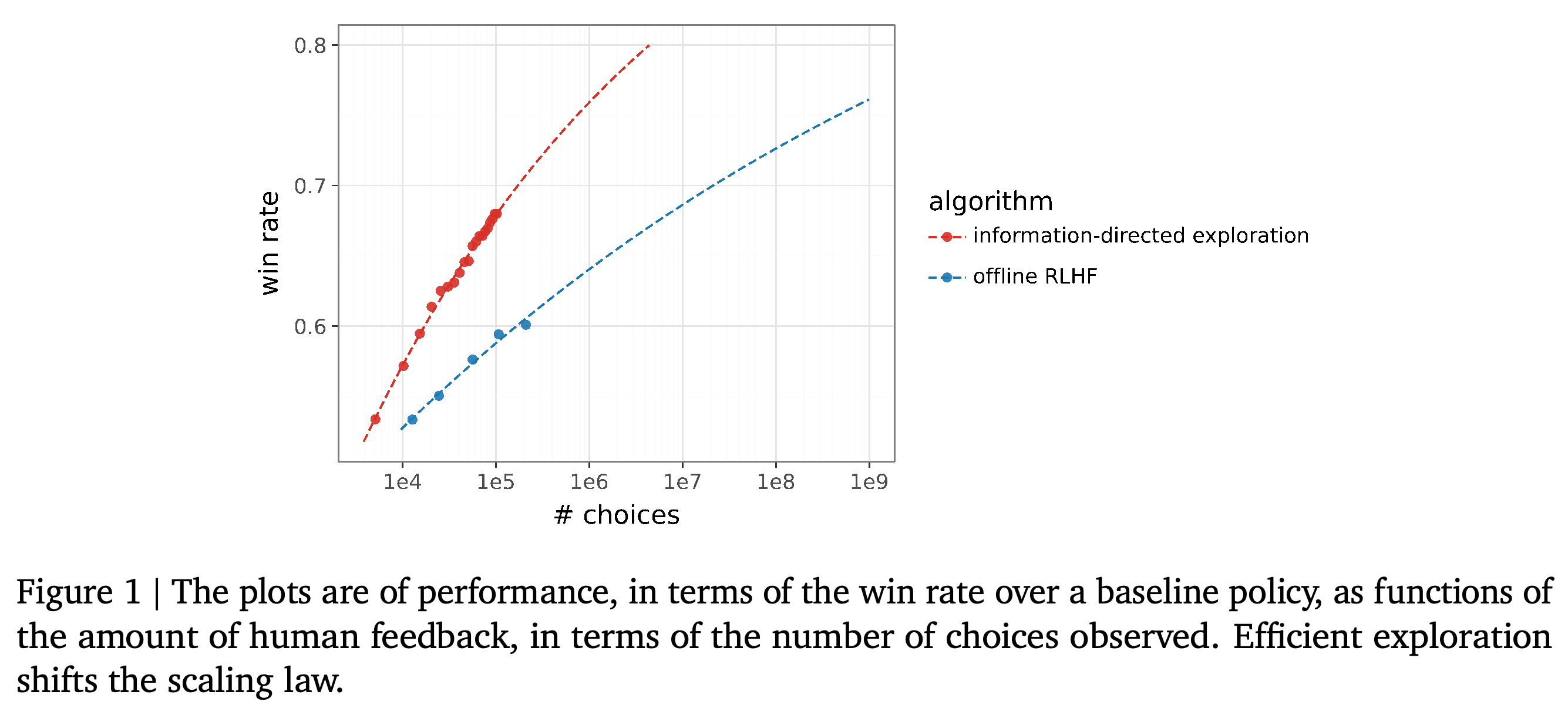
- Figure 1 presents measured points and extrapolated curves on a logarithmic label-count axis. Their separation indicates improved label efficiency, while the distant portions of the curves are projections rather than additional experiments.
Measured points show information-directed exploration improving faster than offline RLHF as labels accumulate. The logarithmic horizontal axis makes the different fitted trends visible, but the dashed continuation to very large choice counts is extrapolation rather than measured performance.
2. Literature Review
The literature review connects sample-efficient LLM alignment with online adaptation, active exploration, and scaling laws. These strands address how response distributions evolve, which comparisons receive labels, and how policy quality changes with the amount of preference data.
Online Adaptation.
Online adaptation repeatedly collects responses from the current policy, allowing the sampling distribution to move toward better outputs. The paper contrasts this with offline preference collection from a fixed policy, where limited coverage can constrain subsequent optimization, and discusses iterative DPO and hybrid preference optimization as related approaches.
Active Exploration.
Active exploration selects comparisons expected to resolve uncertainty, often using uncertainty or diversity metrics. The reviewed approaches include active contextual dueling bandits, active preference optimization, exploratory preference optimization, information-directed sampling, and methods that use LLM output variability as an uncertainty proxy.
- The authors distinguish their work from earlier uncertainty-guided reward-model training that kept the language model fixed.
- The review reports gains of 2X to 5X in the cited literature and describes those studies as using a more limited range of prompts; this is the authors’ contextual comparison, not a shared-benchmark evaluation.
Scaling Laws.
The paper investigates scaling of overall RLHF policy performance with preference-data volume, rather than scaling of pretraining, supervised fine-tuning, or reward models alone. It argues that logarithmic label-count axes reveal differences in scaling behavior that linear axes can obscure.
- The fitted curves describe different scaling rates over the observed data range, but extending them to much larger datasets assumes that those trends continue.
3. Experiment Pipeline
The experiment pipeline collects pairwise choices, trains reward models and policies, and evaluates adapted policies against a fixed baseline. All four algorithms operate within this common pipeline, with differences in when models are updated and how response pairs are selected.
3.1. Baseline and Experimentation Policies
The baseline is a pretrained and supervised-fine-tuned Gemma 9B model without RLHF, evaluated using deterministic top-1 decoding. Candidate responses for preference collection use stochastic top-5 decoding, which samples each next token from the five highest-probability tokens according to their conditional probabilities.
- Adapted policies are also evaluated with top-1 decoding, so the reported win rates compare deterministic responses rather than the stochastic responses used during exploration.
3.2. Human Feedback Simulator
Human feedback is simulated by a Gemini 1.5 Pro-based reward model trained on real human feedback. For rewards R1 and R2 assigned to two responses, it computes (P = \frac{\exp(R_1)}{\exp(R_1)+\exp(R_2)}) and samples a choice C from (\operatorname{Bernoulli}(P)).
- The authors use a simulator substantially larger than the Gemma policies, arguing that its more complex preference behavior makes transfer to human feedback more plausible.
- The experiments do not directly establish equivalent label-efficiency gains with human raters.
3.3. Prompts
The dataset contains 202K unique, randomly ordered prompts from an internal post-training repository, covering writing, coding, summarization, reading comprehension, math, science, ideation, and other topics. The split is 200K training prompts, 1K prompts for testing and hyperparameter selection, and 1K separate prompts for out-of-sample evaluation.
3.4. Gathering Feedback and Training
Feedback collection proceeds through batches of 64 prompts, with one labeled response-pair comparison per prompt. After each batch, an algorithm can update its parameters; (\theta_t) denotes the policy parameters after t batches of choice data.
- Figure 2 depicts the feedback loop: a prompt produces two responses for comparison, and the returned choice supplies training information.
- The online methods generate a larger candidate pool internally, but only the selected pair receives a simulator label.
3.5. Performance Evaluation
Evaluation compares the adapted policy and the original baseline on the same 1K out-of-sample prompts using top-1 responses. The reported win rate is the average simulator preference probability for the adapted response, rather than an empirical fraction of sampled binary wins.
- A value of 1 means the simulator always prefers the adapted policy, while 0 means it always prefers the baseline.
- Figure 3 shows that the same feedback simulator supplies the evaluation probabilities, making the results specific to its preference function.
4. Algorithms
The comparison includes offline RLHF, periodic RLHF, online RLHF, and information-directed exploration. Reward models and policies have approximately comparable parameter counts and related update rules, while data collection and update schedules differ.
- Each alternative was developed through algorithm-design and hyperparameter iteration. The authors explicitly aim to describe salient mechanisms rather than provide a fully reproducible specification.
4.1. Reward Models and Policies
Every reward model starts from the same Gemma 9B transformer backbone, with the language-model unembedding matrix and softmax removed. A randomly initialized reward head maps the last-layer embedding to a scalar; offline, periodic, and online RLHF use a linear head, whereas information-directed exploration uses MLP-based point-estimate and ensemble heads.
- The reward backbone and head are trainable. The authors report that replacing the linear head with an MLP did not improve the other algorithms.
4.2. Update Rules
The reward model uses a Bradley–Terry preference probability derived from the two predicted rewards. For a chosen response Y and rejected response Y′, its update maximizes the log probability of choosing Y; batch gradients are summed, clipped, and applied with AdamW.
The policy update weights the response log-probability gradient by the reward model’s preference probability minus 1/2. It also applies tokenwise KL regularization using an exponential-moving-average policy anchor; summed and clipped gradients are applied with AdamW.
- The anchor follows the evolving policy, rather than remaining fixed at the initial SFT model.
- The online algorithms modify the reinforcement signal by adding a small positive scalar ε, the affirmative nudge.
4.3. Alternatives
4.3.1. Offline RLHF collects all labeled preference pairs independently from the initial top-5 policy, fits a reward model, and then optimizes the policy against that fixed reward model. During policy optimization, it samples fresh response pairs from the evolving top-5 policy and uses each pair in both orders. It stores checkpoints every 160 updates and selects the checkpoint with the best win rate on the test set.
4.3.2. Periodic RLHF refreshes the response-collection policy every (\tau = 400) batches. At each refresh, the reward model and policy are reinitialized from their original parameters and trained using all accumulated choice data.
- This updates the sampling distribution without fully incremental training. Repeated retraining increases the computational burden as the refresh period shrinks.
4.3.3. Online RLHF interleaves incremental reward-model and policy updates. Its policy reinforcement signal becomes p(Y ⪰ Y′ | X) − 1/2 + ε, where (\epsilon) is a small positive affirmative nudge intended to avoid the performance collapse described as tanking.
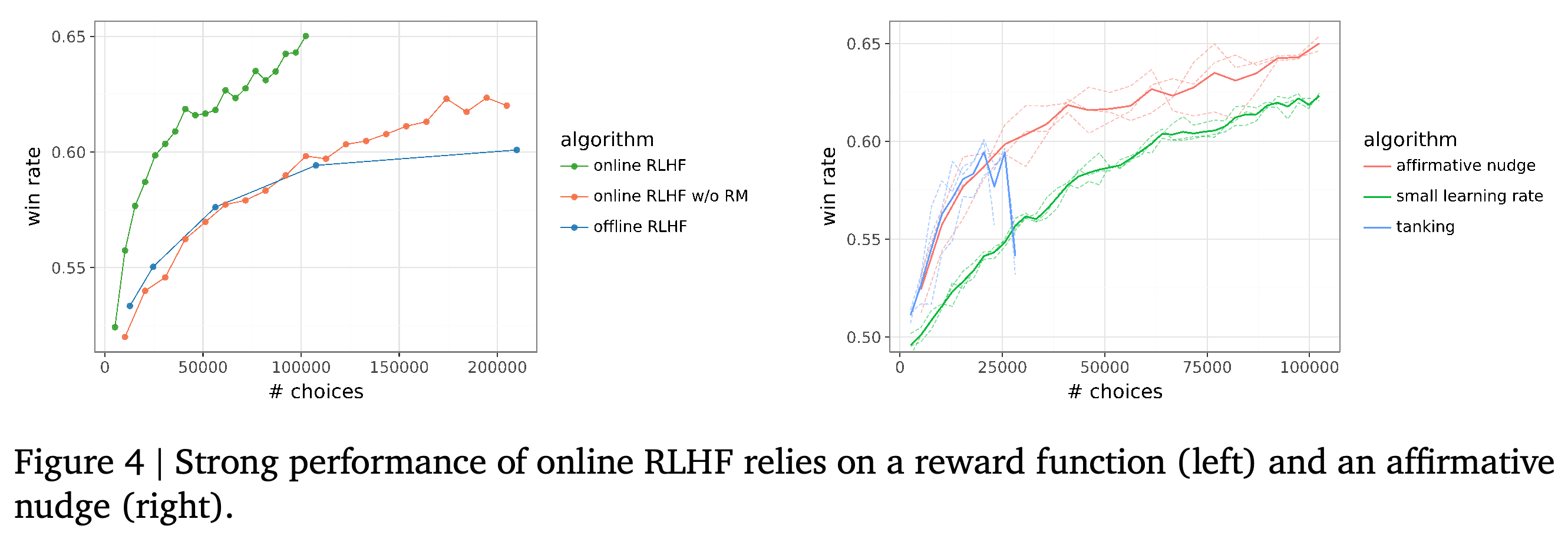
- Figure 4(left) shows that the best reward-model-free alternative the authors obtained trails their reward-model-based online algorithm.
- Figure 4(right) shows that the affirmative-nudge configuration avoids the illustrated collapse and outperforms a reduced-learning-rate alternative. The report does not give a numerical value for ε or a theoretical explanation of this stabilization.
The left panel supports using a learned reward model in the authors’ online procedure: their best reward-model-free alternative improves less. The right panel shows the affirmative-nudge configuration continuing to improve where the tanking configuration collapses, while reducing the learning rate gives lower performance. These comparisons concern the tested configurations, not all reward-model-free or online methods.
For each of 64 prompts, online RLHF samples sixteen responses and randomly selects two for labeled feedback. After updating the reward model, it updates the policy using the queried pair and its reverse, plus the highest-reward/lowest-reward pair and its reverse.
- A second policy update uses a new batch of 64 prompts with sixteen responses each. Its four ordered pairs are highest/lowest, lowest/highest, second-highest/second-lowest, and second-lowest/second-highest.
- The updated reward model supplies additional policy-training comparisons beyond the single labeled pair per feedback prompt.
4.3.4. Information-Directed Exploration — Architecture: the reward model uses a point-estimate head, mlp0, with two hidden layers of width 1024 and a linear output. It adds 100 fixed prior MLPs with two hidden layers of width 256 and 100 trainable differential MLPs with two hidden layers of width 1024.
- All heads begin with random weights. Paired prior and differential networks form an ensemble with randomized prior functions.
- Figure 5 contrasts a scalar reward predictor with an epistemic neural network whose additional input Z indexes different reward hypotheses.
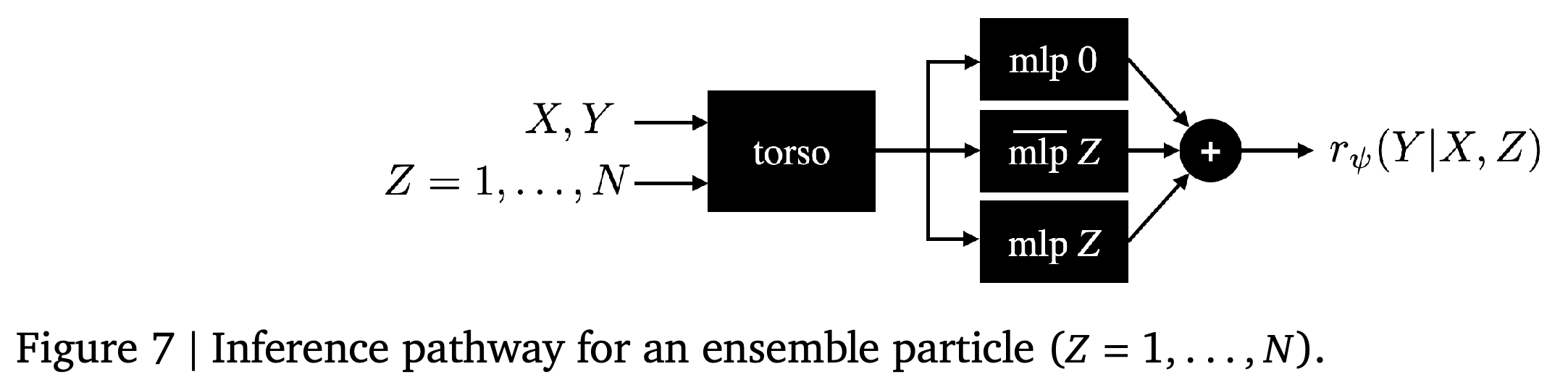
The epistemic index Z takes integer values from 0 to 100. (Z=0) uses the point-estimate pathway; for Z > 0, the output combines the point estimate with the indexed prior and differential heads.
- Figures 6 and 7 show how these pathways share one transformer backbone rather than requiring separate full reward models.
- The authors report that the additional parameters are well under 5% of the original approximately nine-billion-parameter model; this parameter comparison does not quantify total training or inference cost.
The Z = 0 path uses the shared transformer representation and the point-estimate MLP alone. It isolates the central reward prediction from the additional heads that represent ensemble variation.

Each ensemble particle adds its indexed fixed prior and trainable differential outputs to the point estimate while reusing the same backbone. This architecture represents multiple reward hypotheses without duplicating the full approximately nine-billion-parameter transformer.
Queries: for each prompt, the algorithm generates sixteen responses and evaluates candidate-pair preference probabilities across ensemble particles Z = 1, …, 100. It labels the pair with the largest variance across those probabilities, using ensemble disagreement as a proxy for informativeness.
- The selection criterion concerns uncertainty about which response is preferred, not merely variation in individual response rewards.
- Prompt order remains fixed by the randomly ordered dataset; this method actively selects responses, not prompts.
Training: the point-estimate reward model is updated using the same preference loss as online RLHF, while prior and differential heads are left untouched during that step. Each differential head is then updated individually using its indexed reward output with the backbone frozen; prior heads are never trained.
- The policy-training procedure otherwise follows the online RLHF approach. Feedback collection uses uncertainty-guided selection instead of random pair selection.
5. Results
The results compare label-efficiency curves, extrapolate their scaling behavior, and provide selected response examples. These offer distinct kinds of evidence: measured policy comparisons, fitted projections, and qualitative illustrations of response quality and query selection.
5.1. Win Rates
Figure 8 shows that periodic and online RLHF improve on offline RLHF, with information-directed exploration attaining the highest win rates. The authors report that offline RLHF requires more than 200K choices to match information-directed exploration at 20K choices, corresponding to more than a 10x gain in data efficiency.
- The introduction states the complementary comparison: fewer than 20K exploration labels match the offline result at 200K labels.
- The separation between online RLHF and information-directed exploration supports an additional benefit from the uncertainty-modeling and query-selection configuration beyond incremental training alone. Figure 8 does not display confidence intervals or repeated-run variability.
5.2. Projected Gains
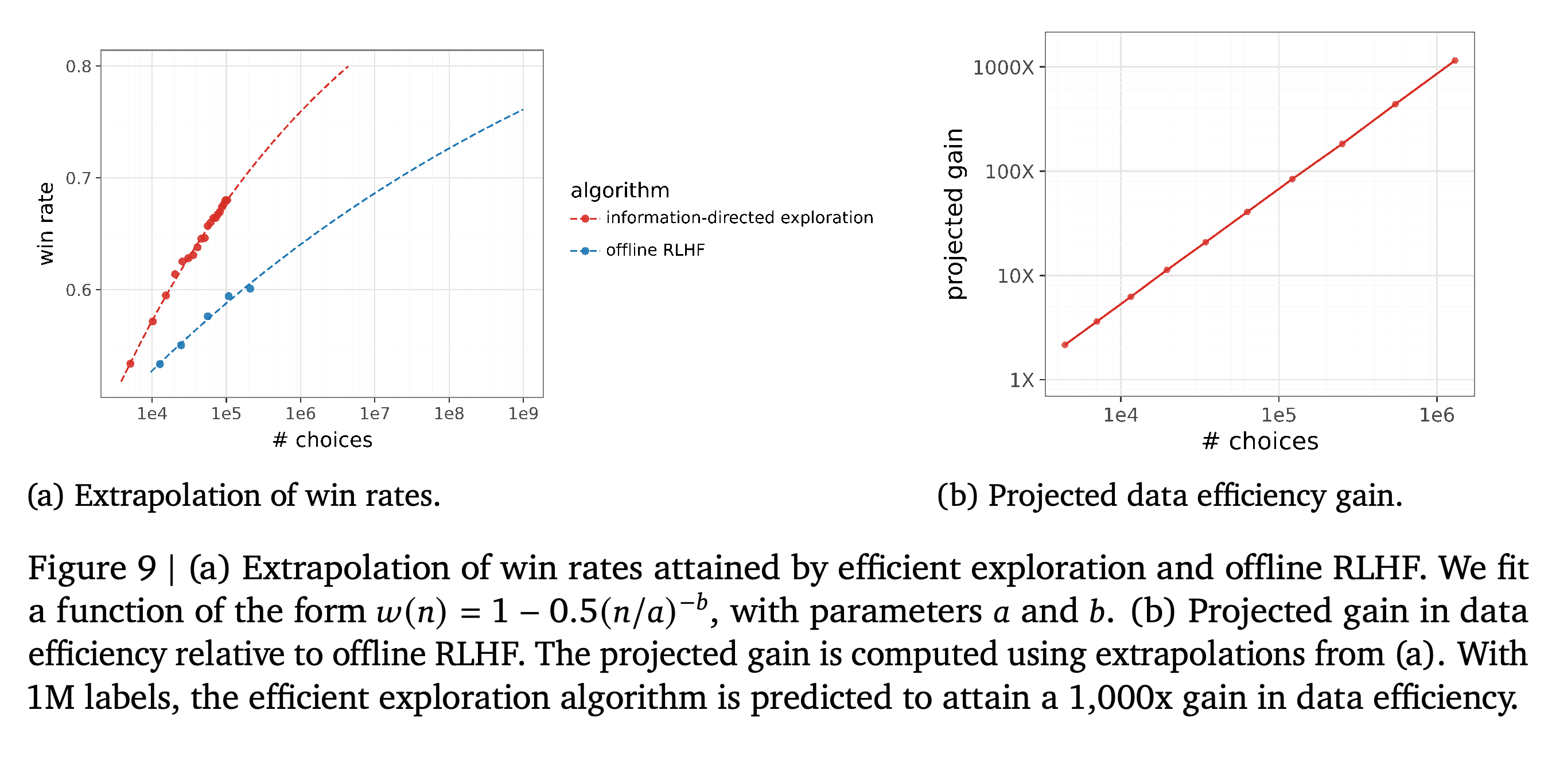
Figure 9 fits win-rate curves of the form (w(n)=1-0.5(n/a)^{-b}), with parameters a and b, and converts equal-performance comparisons into projected data-efficiency gains. The extrapolation predicts that information-directed exploration with 1M labels could match offline RLHF with 1B labels, a gain of about 1,000x.
- This estimate extends substantially beyond the measured label counts. The report does not provide fitted parameter values or uncertainty bounds for the projection.
- The prediction assumes that the fitted scaling behavior continues at larger data volumes; it is not an observed 1,000x improvement.
Panel (a) extends fitted win-rate curves beyond the measured data, and panel (b) translates them into equal-performance label-count ratios. The approximately 1,000x value at 1M exploration labels therefore depends on the extrapolated curves, not on experiments at 1M and 1B labels.
5.3. Simple and Extreme Instances
The paper introduces deliberately simple and extreme prompt-response examples to make the mechanisms easier to inspect. They illustrate possible sources of the quantitative gains but do not provide a representative evaluation of error frequencies or response diversity.
5.4. Winning Responses
The winning-response example asks for the actual distance traveled when walking at 14 km/hr rather than 10 km/hr would add 20 km; the options are A. 50 km, B. 56 km, C. 70 km, and D. 80 km. The offline RLHF response sets up the relevant equations but makes an algebraic error and concludes approximately 33.33 km.
- The information-directed exploration response uses the speed difference of 4 km/hr to obtain 5 hours, then computes 50 km at 10 km/hr and selects A.
- This selected case demonstrates a correct answer and a shorter derivation, not a general mathematical-reasoning improvement.
5.5. Diverse Responses
The diversity examples use the initial ENN reward model to select maximum-variance infomax and minimum-variance infomin pairs from sixteen generated responses. For the water-intake sentiment prompt, infomin compares “Positive.” with “Positive sentiment.”, whereas infomax compares “positive” with “Neutral.”.
- The maximum-variance pair exposes a substantive classification disagreement rather than a minor wording difference.
- Expected informativeness changes as the uncertainty model learns; these examples show initial-model selections rather than a fixed property of each response pair.
For a reading-comprehension prompt about Executive Order 6102, both infomin responses restate the article’s explanation that the order removed a constraint on Federal Reserve money-supply expansion. The infomax responses reach the same broad conclusion but provide substantially different supporting explanations.
- One response discusses the gold standard, the Depression, and Proclamation 2039, including a claim about reducing the gold supply that the supplied article does not support. The other quotes the article and explains its stated 40% gold-backing requirement.
- The example shows how uncertainty-guided comparisons can expose differences in reasoning and textual support even when conclusions agree. No numerical information-gain measurement is reported for these examples.
6. Conclusions and Future Work
The authors conclude that incremental online learning and uncertainty-guided response selection both improve label efficiency in their pipeline. They identify the affirmative nudge as necessary for overcoming the illustrated tanking behavior and treat the potential 1,000x gain as a motivation for further research.
- Proposed algorithmic directions include modeling uncertainty deeper in reward models, representing language-model uncertainty, and improving policy optimization from reward-model information.
- Other proposed extensions are informative prompt selection, multiturn dialogue with value models, agents with delayed consequences, and AI-assisted feedback. None of these extensions is evaluated in the reported experiments.
Appendix
- The supplied PDF contains no appendix. After the conclusions and acknowledgments, pages 16–18 contain references; no additional experimental specifications or supplementary results are provided.
Brief Thoughts
The strongest evidence is the measured separation between label-efficiency curves, including the improvement from online RLHF to the uncertainty-guided exploration configuration. The method also distinguishes feedback labels from reward-model-generated policy-training signals, allowing each label to support multiple updates. The more than 10x comparison is supported by the reported experiments, whereas the 1,000x headline depends on extrapolation. Training and evaluation share one preference simulator, the prompts are internal, and important hyperparameters are omitted. These conditions limit independent reproduction and conclusions about alignment with real human preferences. Sixteen candidate responses per prompt, additional policy updates, and 100 uncertainty heads introduce computation beyond the label count. Without wall-clock or compute-normalized results, label efficiency should not be equated with overall resource efficiency.