


Pico-Banana-400K: A Large-Scale Dataset for Text-Guided Image Editing | Summary
22 Oct 2025 | Paper Review Instruction-Based Image Editing Datasets Data CurationContents
This article explains the key points of Pico-Banana-400K: A Large-Scale Dataset for Text-Guided Image Editing.
- 2025-10-22 (arXiv)
- Qian, Yusu, Bocek-Rivele, Eli, Song, Liangchen, Tong, Jialing, Yang, Yinfei, Lu, Jiasen, Hu, Wenze, Gan, Zhe.
- Apple
- Paper
- Github
Summary
- Text-guided image editing, which modifies an image according to a natural-language request, lacks sufficiently diverse, quality-controlled training data grounded in real photographs. Pico-Banana-400K reports 386K examples across single-turn edits, successful/failed output pairs, and sequential editing sessions, compared with approximately 10K human-annotated image-editing triplets in MagicBrush; this is a comparison of dataset scale and structure, not measured editing quality.
- The pipeline generates instructions with Gemini-2.5-Flash, edits photographs from OpenImages, a public image dataset, with Nano-Banana, the Gemini-2.5-Flash-Image model, and filters outputs with Gemini-2.5-Pro as an automated evaluator. Its edit taxonomy, a classification of editing operations, covers 35 types across eight categories; the reported composition is 258K single-turn supervised fine-tuning examples for training on instruction/input/output records, 56K preference pairs linking successful and failed outputs, and 72K multi-turn sequences of consecutive edits.
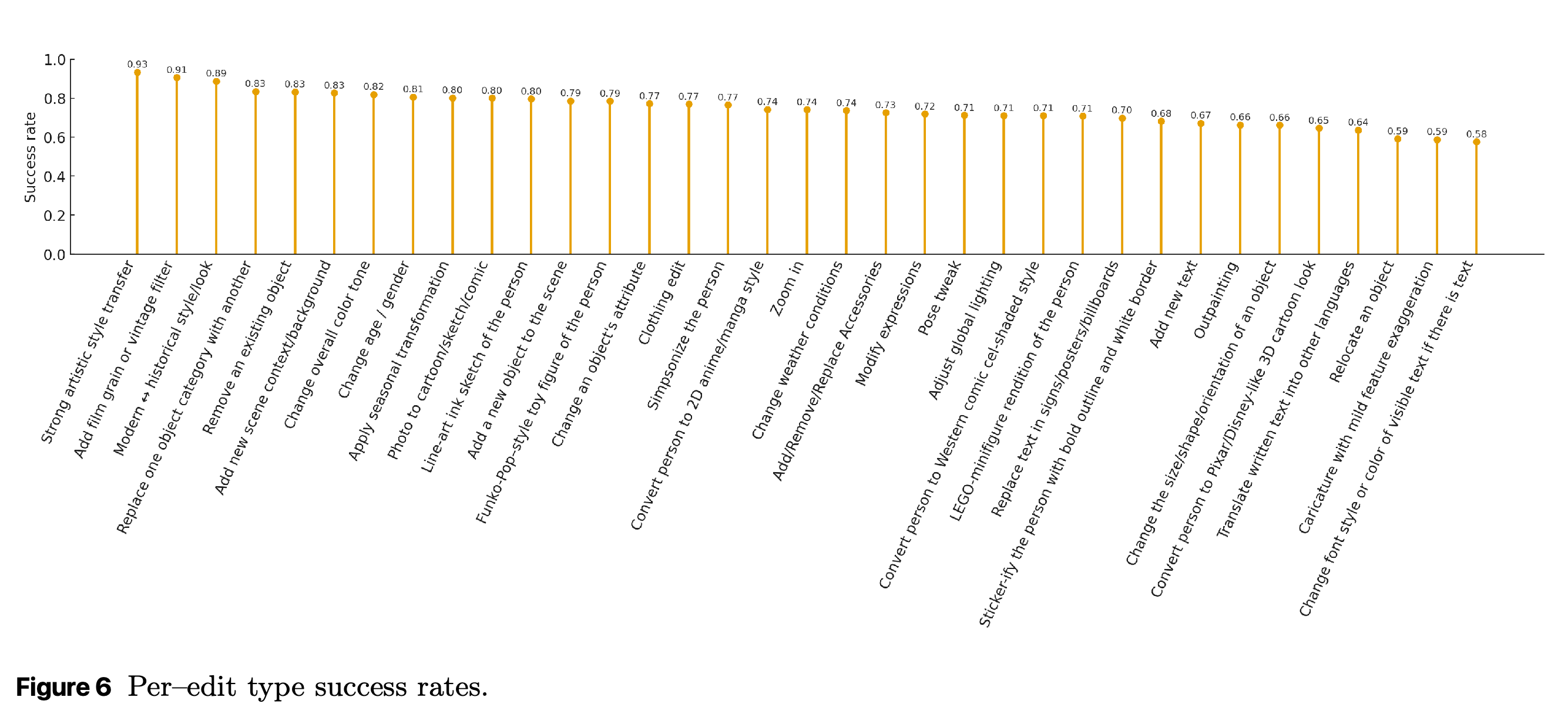
- Under the automated evaluator, strong artistic style transfer, which changes an image’s visual rendering to an artistic style, achieves a success rate of 0.9340, whereas object relocation achieves 0.5923 and changing visible text’s font style or color achieves 0.5759. These results characterize the generation pipeline’s reliability across edit types; downstream model training and benchmarking remain future work.
- The resource combines detailed and concise instructions with accepted edits, rejected alternatives, and sequential editing histories. The paper does not report downstream training gains, quantified agreement between the automated evaluator and human evaluators, or controlled comparisons of edit quality against existing datasets.
1 Introduction
The introduction identifies domain shifts, differences between training and target image distributions, uneven edit-type distributions, and inconsistent quality control as limitations of existing editing datasets. Pico-Banana-400K uses real photographic inputs, explicitly categorized edits, automated scoring, and specialized subsets intended for different training objectives.
- The 56K preference subset supports alignment research, which trains models toward preferred outputs, including Direct Preference Optimization, a method using preferred and rejected examples, and reward modeling, which learns to score output quality.
- The introduction mentions automated scoring and manual verification, but does not describe the manual verification procedure quantitatively or report its agreement with automated decisions.
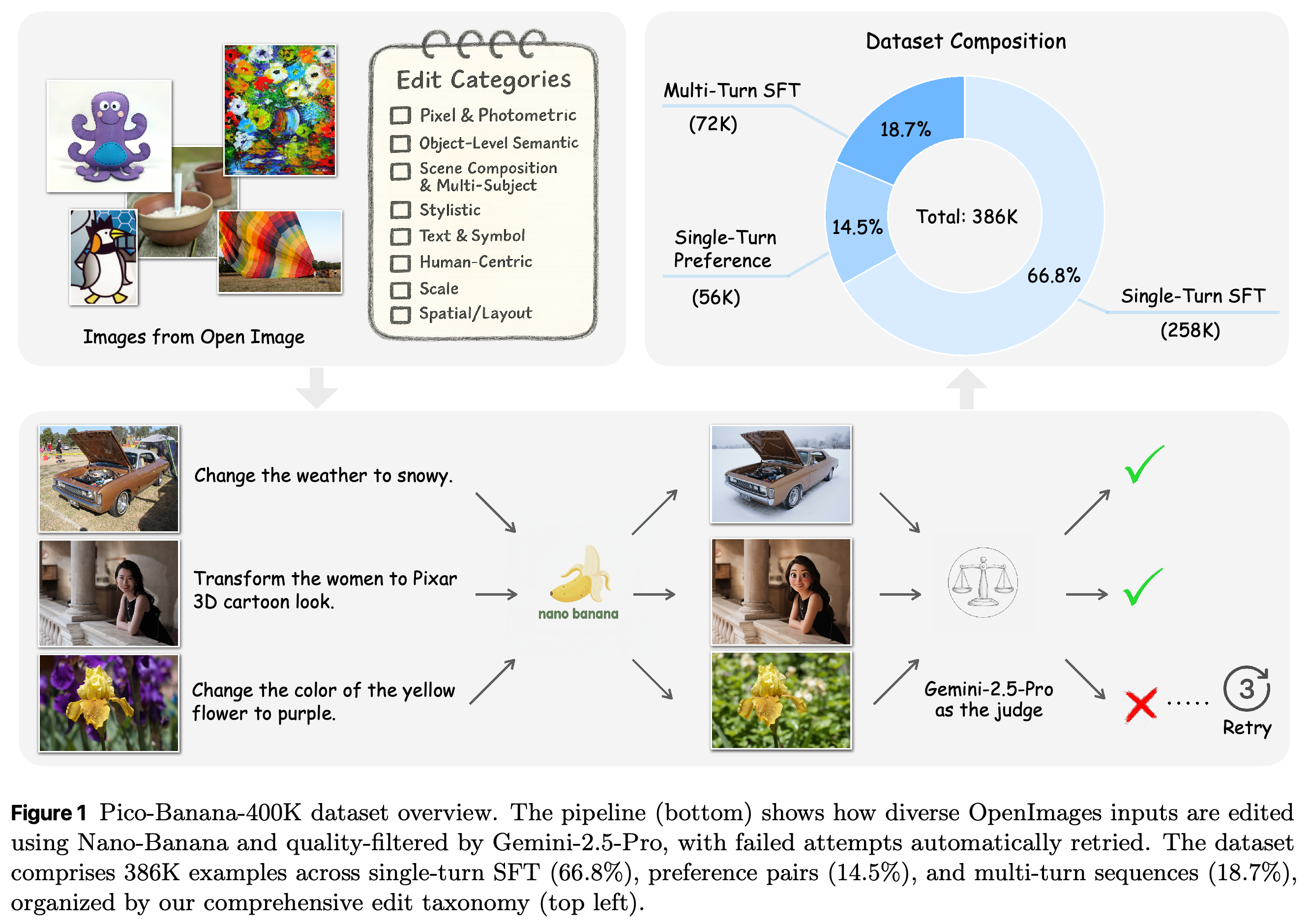
- Figure 1 reports 386K examples, while the title and introductory prose use approximately 400K. The total combines different record types rather than counting only accepted single-turn edits.
The diagram connects real source images and edit categories to generation, automated judgment, and repeated attempts. Its composition chart separates 258K single-turn supervised fine-tuning examples, 56K preference pairs, and 72K multi-turn sequences, making the reported total of 386K explicit.
2 Dataset Construction
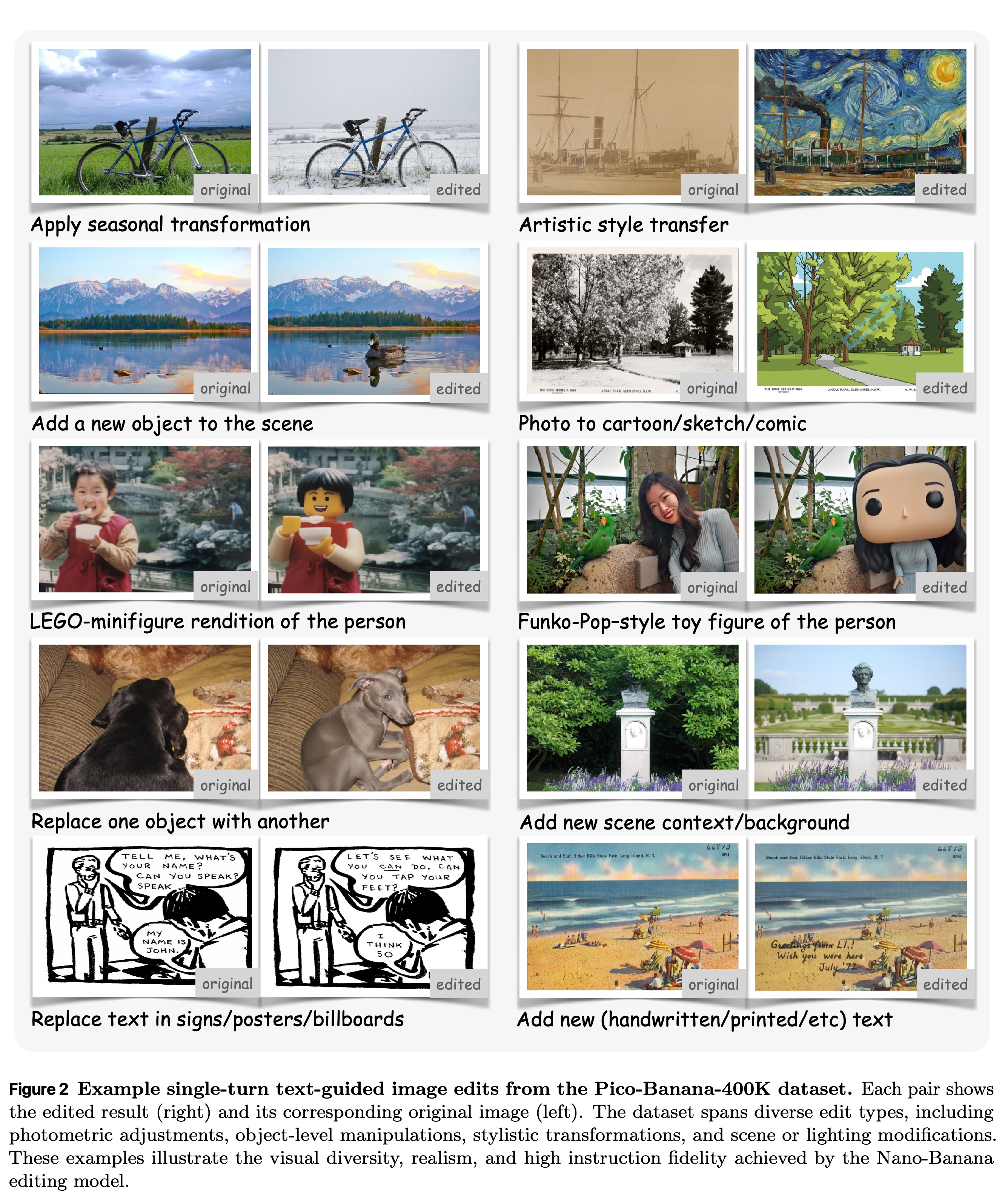
Dataset construction proceeds through source-image selection and edit categorization, generation of two instruction variants, single-turn editing with quality assessment, and expansion into multi-turn sequences. Figure 2 illustrates selected transformations, and a footnote reports an approximate total production cost of 100K USD.
The original/edited pairs demonstrate selected seasonal, object, style, background, human-stylization, and text transformations. They illustrate the range of included operations, but the selected examples do not establish their typical success rates.
2.1 Overview and Edit Taxonomy
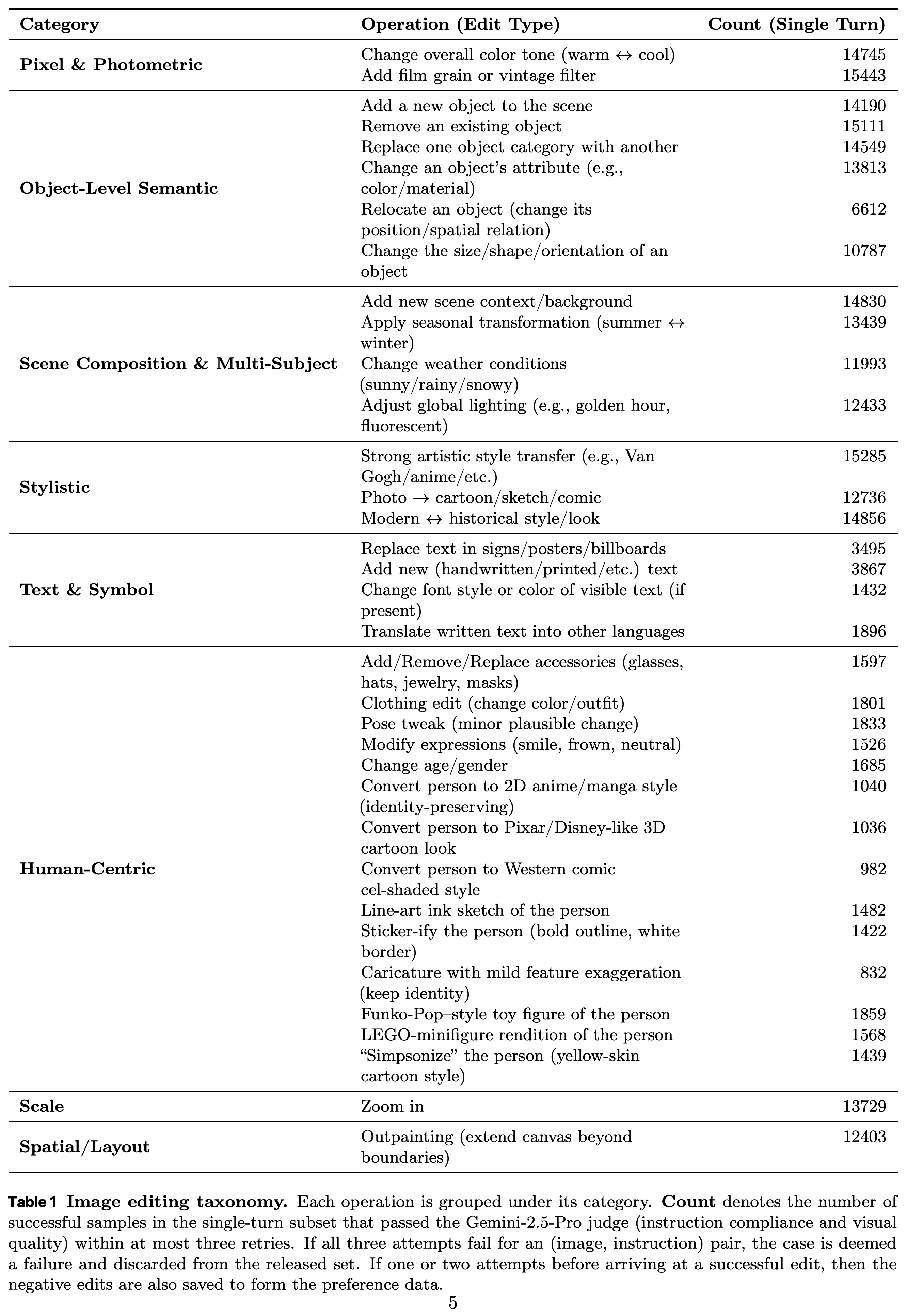
OpenImages inputs are selected to cover humans, objects, and textual scenes, with one primary edit type assigned to each image-instruction pair. The eight categories listed in Table 1 are Pixel & Photometric, Object-Level Semantic, Scene Composition & Multi-Subject, Stylistic, Text & Symbol, Human-Centric, Scale, and Spatial/Layout; these encompass color and texture changes, object changes, scene changes, visual styles, text, people, zooming, and canvas extension. Human-centric and text-related operations receive category-specific input filtering.
- Brightness, contrast, saturation, sharpening, and blurring operations were excluded because their changes were often negligible or unstable.
- Strong object perspective or pose rewrites were excluded because of structural artifacts, and two-image composition, merging content from two inputs, was excluded because its outputs were insufficiently reliable.
- Table 1 records accepted samples rather than balanced quotas: adding film grain or a vintage filter has 15443 samples, whereas caricature with mild feature exaggeration has 832.
The taxonomy lists 35 operations and their accepted single-turn sample counts. Counts differ substantially, including 15443 film-grain/vintage samples, 6612 object-relocation samples, and 832 caricature samples; the accompanying acceptance rules explain how failed attempts preceding a success become preference negatives.
2.2 Instruction Generation
Gemini-2.5-Flash generates detailed instructions grounded in visible objects, colors, and positions. Qwen2.5-7B-Instruct rewrites them into concise user-style requests using human-written examples as in-context demonstrations, examples supplied in its prompt rather than a reported training update.
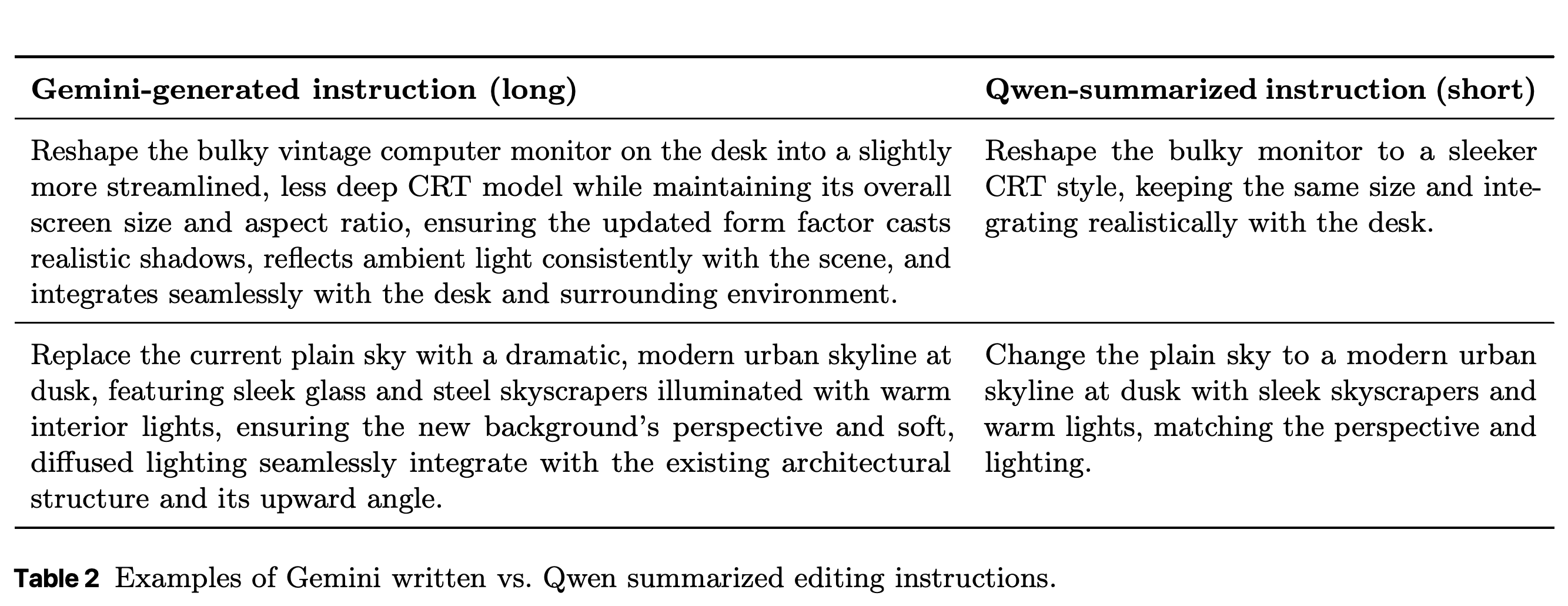
- Table 2 shows shorter versions of monitor-reshaping and skyline-replacement requests that retain the principal edit and selected preservation constraints. The paper does not quantitatively evaluate rewriting fidelity.
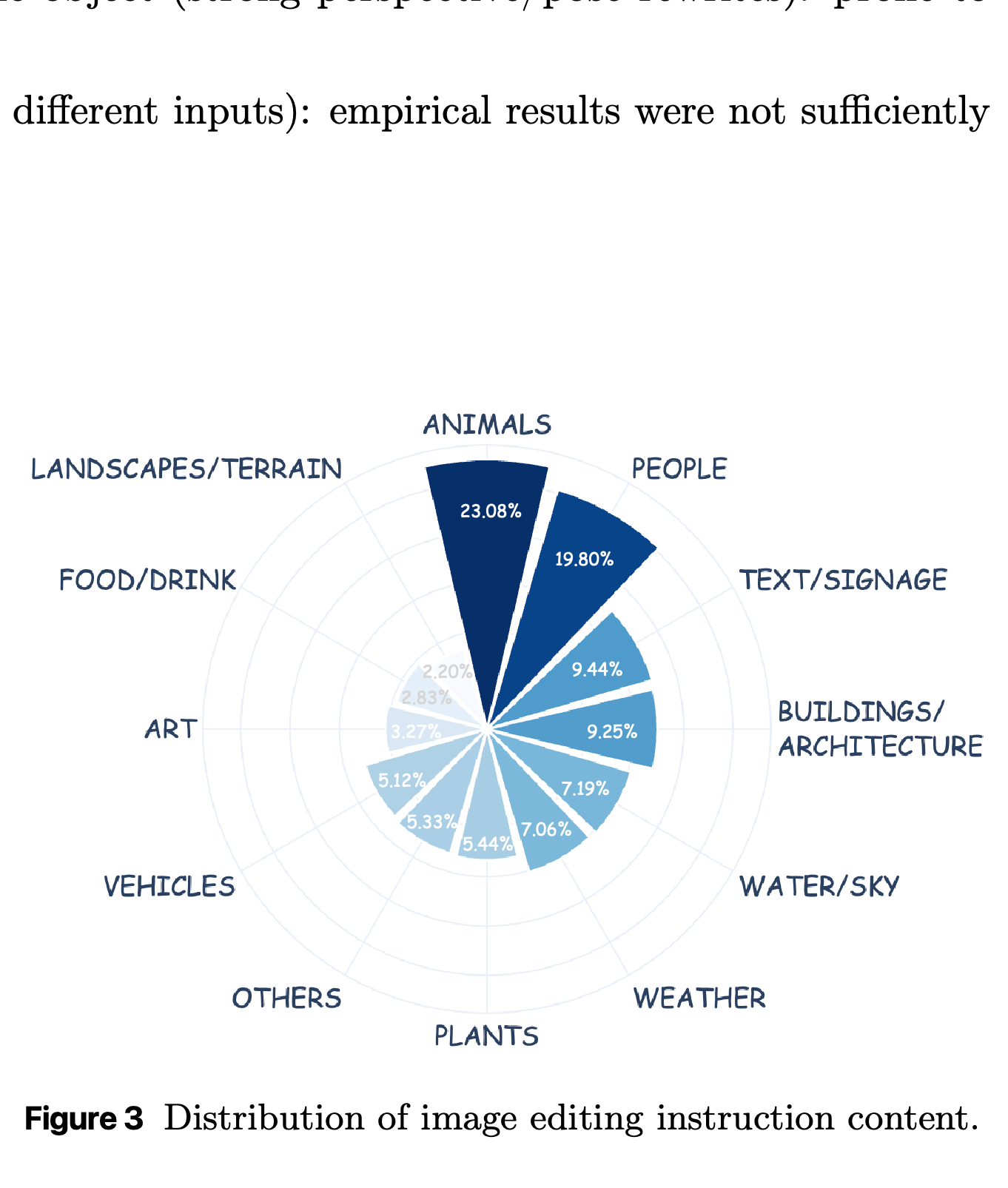
- Figure 3’s instruction-content categories are inferred through keyword and phrase matching, with multiple labels allowed per instruction. They describe prompt-derived content coverage rather than independently annotated image classes.
- The introduction states that all examples include both instruction variants, whereas Section 2.2 later says each example may contain them. The paper does not resolve this coverage ambiguity.
Animals and people account for the largest displayed instruction-content shares, 23.08% and 19.80%, followed by text/signage at 9.44% and buildings/architecture at 9.25%. Because categories come from keyword matching and permit multiple labels, these values describe aggregated prompt categories rather than mutually exclusive image classes.
The monitor and skyline examples show how Qwen shortens Gemini-generated instructions while retaining the central request and selected constraints on size, perspective, lighting, and integration. Some detailed constraints disappear, so the examples illustrate compression rather than demonstrating complete preservation of every instruction detail.
2.3 Single-Turn Image Editing
Nano-Banana executes each instruction, and Gemini-2.5-Pro evaluates the result against the input image and request. The judge combines Instruction Compliance at 40%, assessing whether the requested change occurs; Seamlessness at 25%, assessing natural integration and artifacts; Preservation Balance at 20%, assessing unchanged regions; and Technical Quality at 15%, assessing sharpness, color, and exposure. Scores above an empirically chosen threshold of approximately 0.7 are accepted.
- The paper discloses the scoring rubric in Appendix B, but does not report human agreement, threshold sensitivity, or uncertainty estimates for the resulting labels.
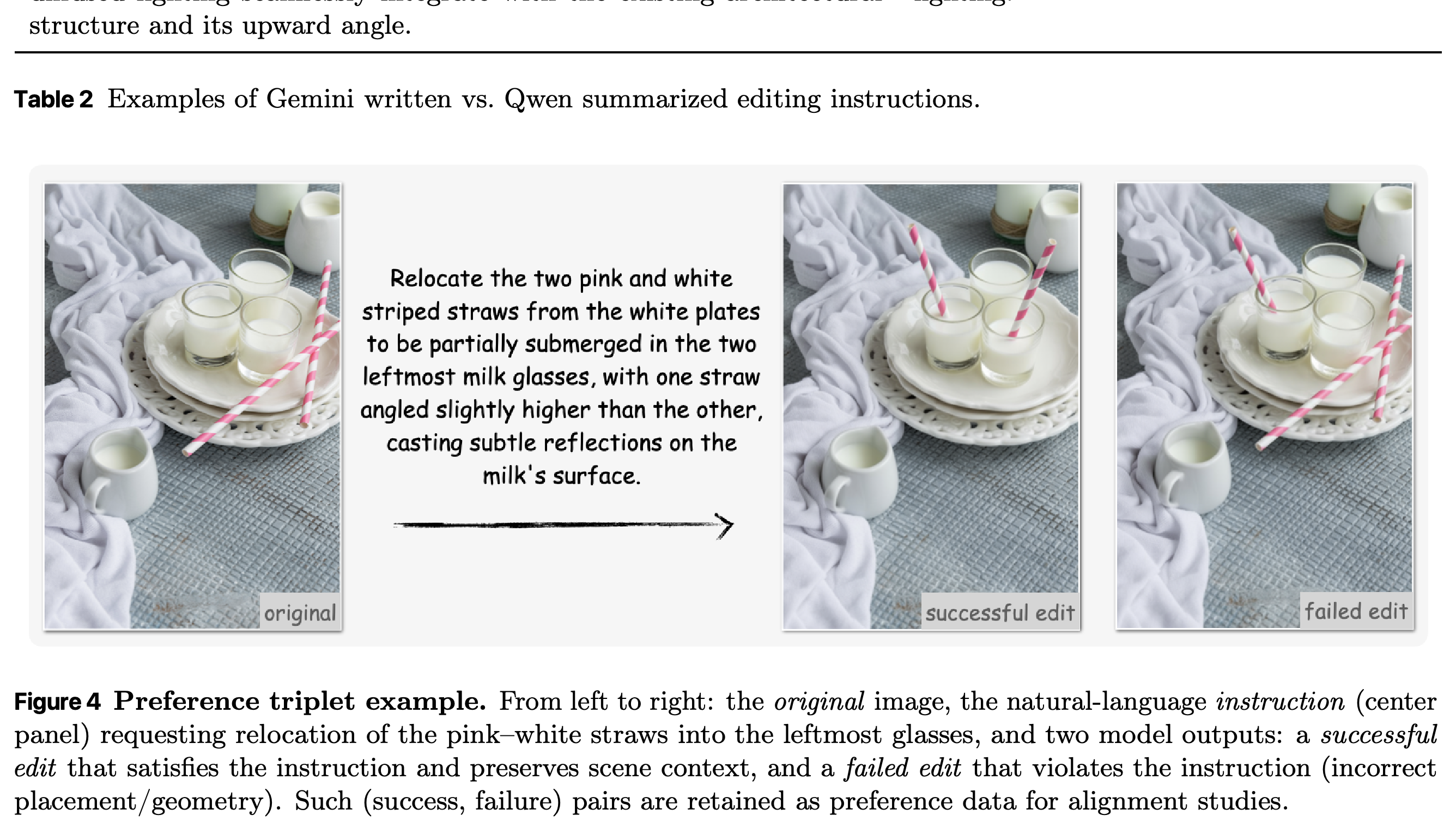
Successful outputs form the approximately 258K single-turn subset, while approximately 56K failed outputs are paired with successful alternatives for preference learning, training from preferred and rejected results for the same request. Table 1 specifies that cases failing all three attempts are discarded; unsuccessful attempts preceding a successful output are retained as negative examples, as illustrated in Figure 4.
- The caption uses both “at most three retries” and “all three attempts,” leaving the distinction between retries and total attempts unclear.
- The retained negatives therefore represent failures for requests that eventually succeed, rather than every unsuccessful request encountered during construction.
The successful output places the two striped straws into the requested leftmost glasses, whereas the rejected output leaves the relocation incomplete. The shared source image and request isolate instruction compliance as the visible reason for preferring one output.
2.4 Multi-Turn Image Editing
The authors uniformly sample 100K single-turn examples and randomly select 1–4 additional edit types for each, producing sessions with 2–5 total editing turns. Gemini-2.5-Pro generates instructions conditioned on the image and edit-type history, including references to previous modifications; each instruction is applied to the current image and evaluated with the single-turn procedure.
- Coreference, using an expression to refer back to a previously introduced entity, is encouraged through requests such as changing the color of a hat added in an earlier turn.
- The released subset contains 72K multi-turn sequences, but the paper does not explain the reduction from 100K sampled starting examples or report sequence-level success by length.
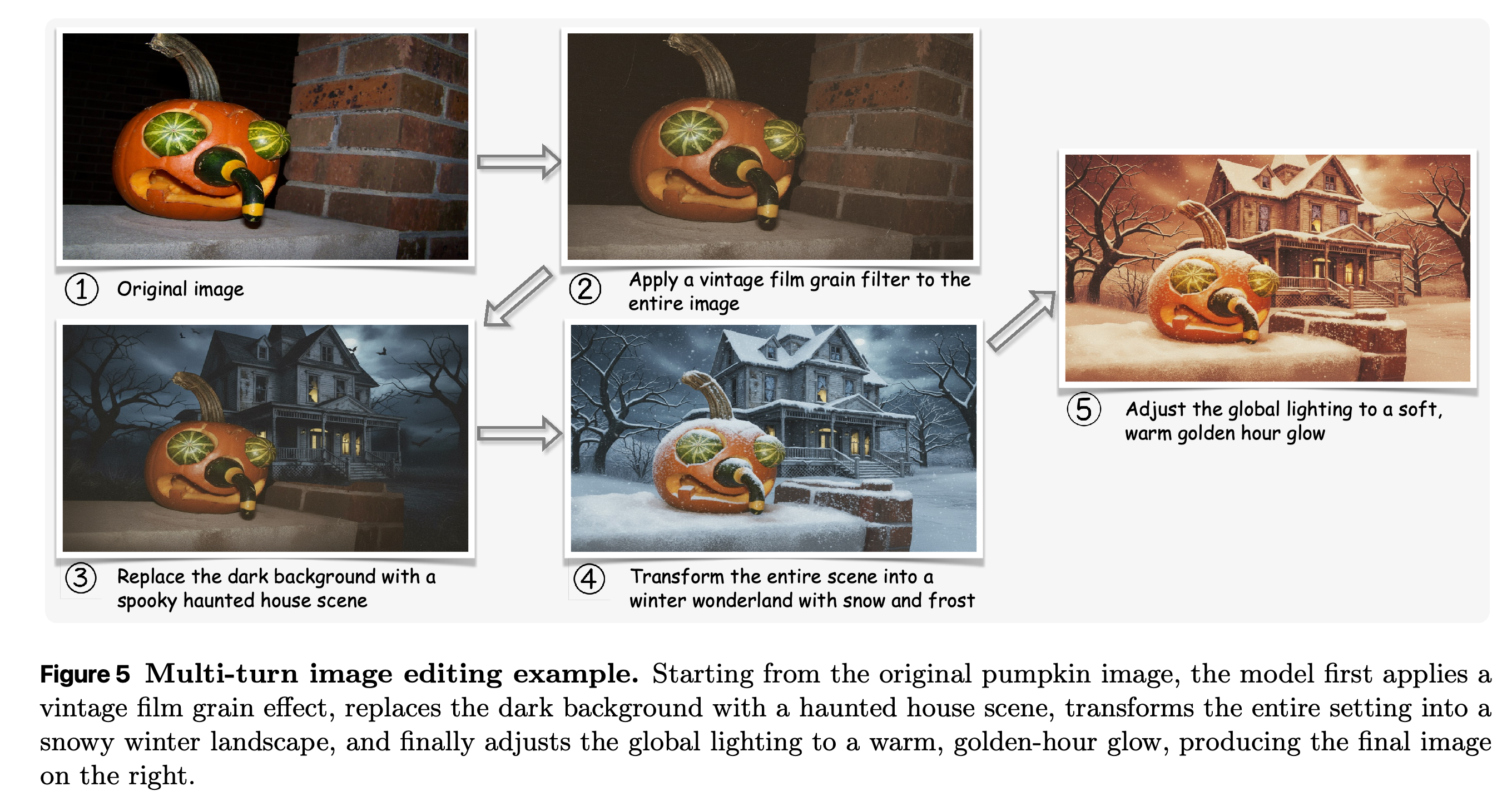
- Figure 5 illustrates successive changes to texture, background, season, and lighting while retaining the central pumpkin.
The sequence applies film grain, introduces a haunted-house background, adds snow and frost, and changes lighting while preserving the recognizable pumpkin. Each result becomes the input to the next edit, illustrating accumulated editing state over four operations.
3 Dataset Analysis
Dataset analysis reports the highest success rates for global appearance transformations: strong artistic style transfer reaches 0.9340, film grain/vintage 0.9068, and modern↔historical restyling 0.8875. Coarse object and scene operations also perform relatively well: removing an object reaches 0.8328, replacing its category 0.8348, seasonal change 0.8015, and photo→cartoon/sketch 0.8006.
- Fine spatial operations are less reliable: relocating an object reaches 0.5923, changing size/shape/orientation 0.6627, and outpainting, extending the canvas beyond its boundaries, 0.6634.
- Changing visible text’s font style or color has the lowest reported rate, 0.5759; Pixar/Disney-like 3D human stylization reaches 0.6463 and caricature 0.5884.
- The authors associate failures with inaccurate placement, perspective inconsistencies, broken object structure, discontinuities at image boundaries, errors in letter shapes or alignment, and changes to a person’s identity. These explanations are descriptive observations rather than controlled causal tests.
- The authors propose stronger guidance about edit locations, geometry-aware training, supervision for rendering text, and constraints that preserve identity. Their effectiveness is not evaluated in this paper.
The ranked rates show a substantial gap between global style transformations and operations requiring precise placement or text rendering. The body gives exact rates of 0.9340 for strong artistic style transfer, 0.5923 for object relocation, and 0.5759 for changing visible text’s font style or color; the chart displays rounded values without confidence intervals.
4 Related Work
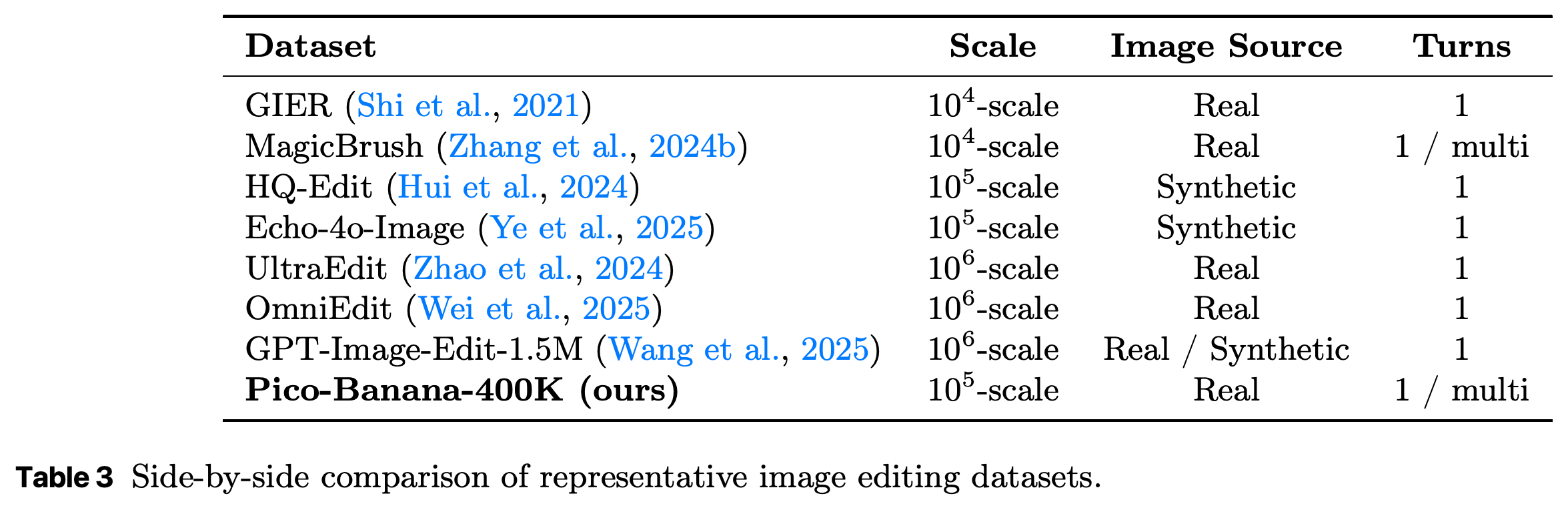
Related work discusses datasets built from real-image edits and grounded requests, as well as datasets expanded through synthetic or mixed pipelines. It also distinguishes editing without retraining from supervised fine-tuning on instruction/before/after triplets, records containing a request and the corresponding original and edited images. Table 3 places Pico-Banana-400K at 10^5-scale with real source images and both single- and multi-turn editing, alongside 10^6-scale resources such as UltraEdit, OmniEdit, and GPT-Image-Edit-1.5M.
- The authors position the dataset through its combination of quality filtering, fine-grained edit coverage, preference triplets, and human-centric transformations.
- “Real” in Table 3 describes the image source; Pico-Banana-400K’s edited targets are model-generated.
- The table compares scale, source, and supported turns. It provides neither a common quality benchmark nor a controlled training comparison.
The comparison places Pico-Banana-400K above GIER and MagicBrush in scale and below the listed million-scale resources, while retaining real source images and support for multiple turns. Its columns compare dataset structure and source, without measuring output quality or training effectiveness.
5 Conclusion
The conclusion presents the instruction-generator, image-editor, and verification-model pipeline as a scalable approach to constructing editing data and states that images and metadata are publicly released. The PDF provides https://github.com/apple/pico-banana-400k; model benchmarking and training studies measuring controllability, adherence to requested changes, and visual fidelity, the quality and consistency of edited images, are explicitly reserved for future work.
Appendix
- A System Prompt for Edit Instruction Generation documents Gemini-2.5-Flash’s instruction-generation prompt. Its “System Prompt:” requests a natural editing instruction grounded in visible objects, colors, and positions, with output represented as a JSON object containing a “prompts” array. The illustrative array contains “<first prompt>” and “<second prompt>” despite the prose requesting ONE instruction.
- B System Prompt used by Gemini-2.5-Pro as a Judge documents the evaluation prompt and its “System Prompt:” input order: edited result, input image or images, then editing instruction. “Evaluation Criteria (Weighted Scoring for Image Editing):” assigns 40% to Edit Instruction Compliance, 25% to Editing Quality & Seamlessness, 20% to Preservation vs. Change Balance, and 15% to Technical Quality. The prompt also requests comparison with the original image and a final weighted score from 0.0 to 1.0 for threshold-based acceptance.
Brief Thoughts
The dataset’s organization supports separate investigations of accepted edits, rejected alternatives, instruction wording, and sequential editing. The reported 0.9340 style-transfer success rate and 0.5759 font-style/color rate show how strongly generation reliability varies by operation. Several unreliable operations are excluded, and Table 1 shows substantial count differences across retained types. Broad categorical coverage therefore does not establish balanced coverage of editing difficulty. The disclosed rubric makes acceptance criteria inspectable. Independent human validation would help assess label reliability, while downstream training experiments would test the resource’s benefits for other editing models.