


Monthly AI Papers: January 2025
31 Jan 2025 | Paper Review Monthly Papers Compute Allocation Long-Context Models Verification and GeneralizationContents
Trends
January 2025’s theme is how to turn additional computation into useful capability: the three selected papers examine this through longer language-model inputs, search during image generation, and reward-based training. MiniMax-01 combines architecture and execution improvements to process million-token inputs, where tokens are the text units consumed by the model. The diffusion study searches the randomness used by generators that turn noise into images through repeated denoising. The post-training study compares supervised fine-tuning (SFT), learning from expert responses, with reinforcement learning (RL), learning through rewards for generated responses, under equal estimated training computation. 1, 2, 3
Verification connects image search with reward-based post-training, although it serves different roles. A verifier, a model or automated checker that scores generated outcomes, selects image candidates in the diffusion study and supplies rewards and textual feedback for response revision in the RL study. Its usefulness depends on what it measures: image search can increase classifier confidence while reducing diversity, and an ensemble of image scorers improves broad evaluation without leading on compositional correctness. Sequential revision improves transfer to unfamiliar task conditions in the RL experiments, but the starting checkpoint remains consequential. Direct RL without SFT initialization fails in the reported GeneralPoints trials. From an extremely overfitted SFT navigation checkpoint, RL fails to recover performance on unseen action rules.
The results also expose gaps between intermediate measurements and complete task performance. MiniMax’s retrieval of an inserted sentence at 4M tokens does not establish complex reasoning over documents of that length. Higher image-verifier scores can accompany worse diversity or another quality criterion. Improved accuracy on individual navigation actions leaves whole-route success under changed action rules at approximately 1% or lower. Read together, these findings support evaluating the intended task outcome alongside the measurement used to guide optimization.
Top Papers in January 2025
1. MiniMax-01: Scaling Foundation Models with Lightning Attention
- https://arxiv.org/abs/2501.08313
- MiniMax-01: Scaling Foundation Models with Lightning Attention | Summary
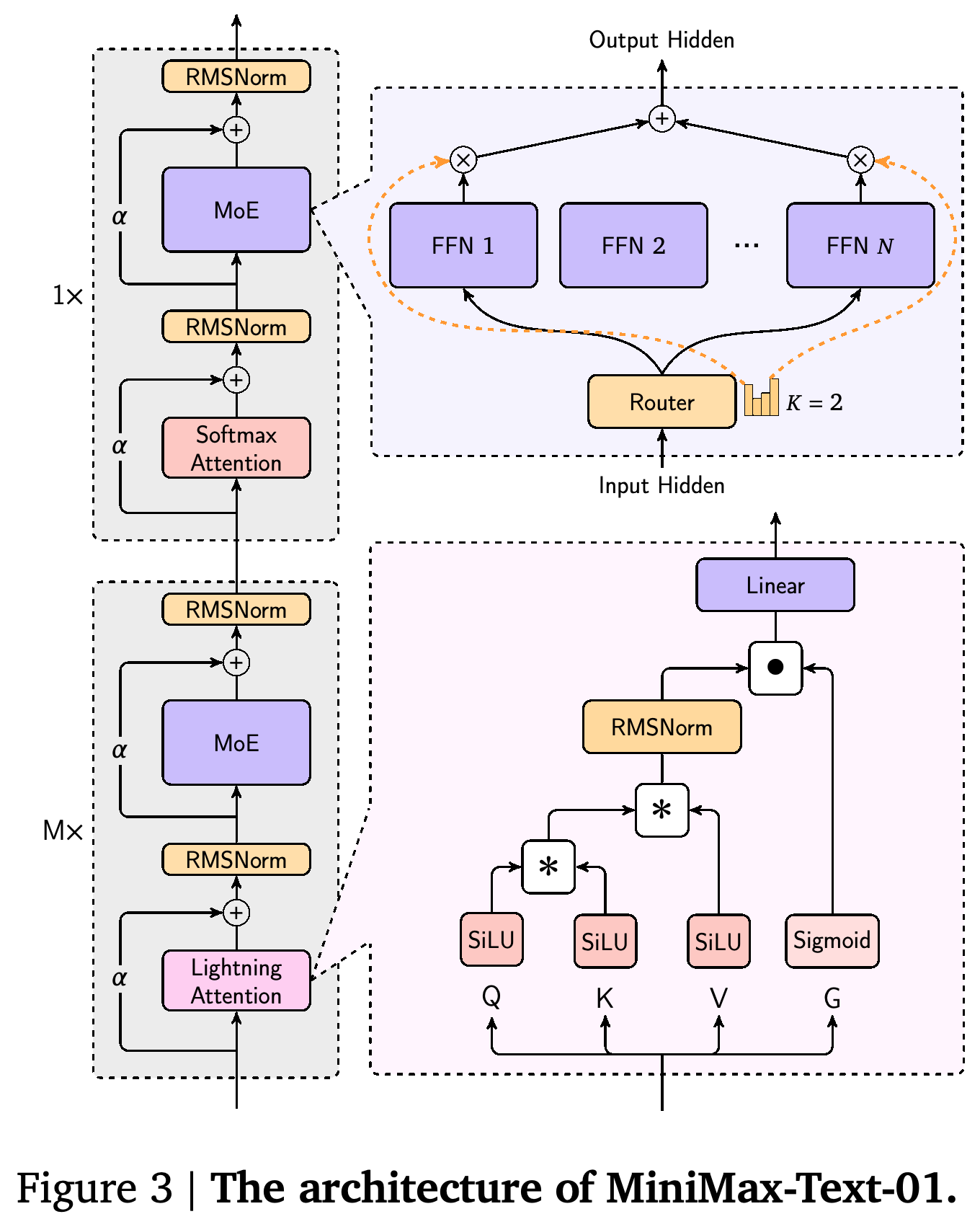
- MiniMax-01: Scaling Foundation Models with Lightning Attention combines seven lightning attention layers with one softmax attention layer in each repeating group. Lightning attention uses tiled computation and an accumulated summary of preceding inputs; softmax attention computes normalized weights over preceding tokens. A Mixture of Experts (MoE), which routes each token to selected feed-forward networks, provides 456 billion total parameters with 45.9 billion activated per token.
- Periodic softmax layers address the retrieval weakness observed with pure lightning attention. In the attention comparisons, Hybrid-lightning scores 95.7, 98.0, and 97.7 on Needle in a Haystack, a test of retrieving inserted information, at 1B, 3B, and 7B parameters. Approximately constant throughput as inputs lengthen applies to pure lightning attention within the tested range; hybrid throughput declines because it retains softmax layers.
- MiniMax-Text-01 reaches 0.910 average accuracy on RULER, a suite of 13 long-context tasks, versus 0.850 for Gemini-1.5-Pro (002), both at 1M input tokens. On LongBench v2, a long-context question-answering benchmark, it scores 56.5 with chain-of-thought, an explicitly generated reasoning process, versus 51.4 for GPT-4o (11-20) under the same evaluation mode.
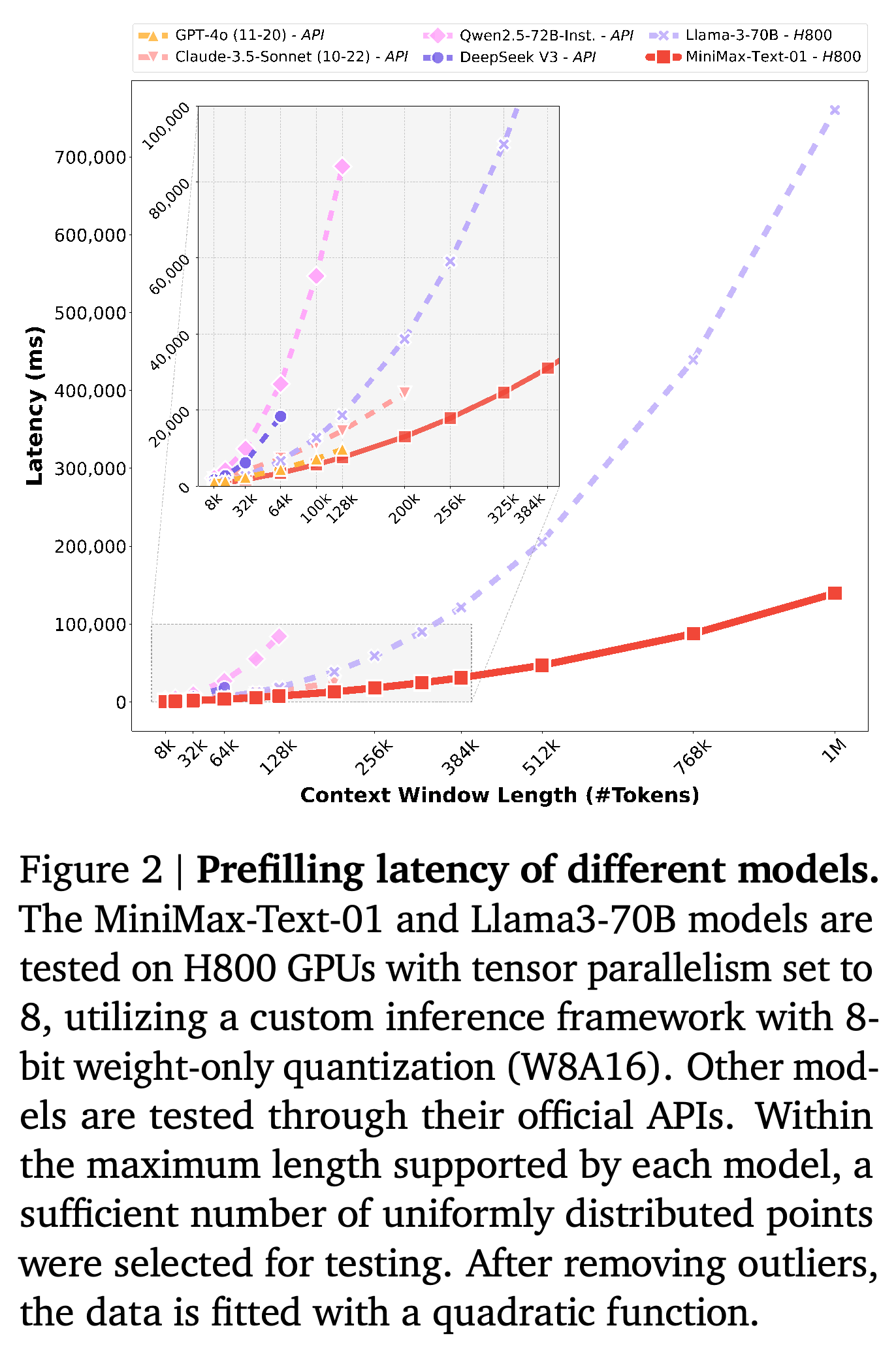
The curves show an increasing prefilling-latency advantage for MiniMax-Text-01 as inputs lengthen. The local comparison with Llama3-70B shares H800 hardware, tensor parallelism of 8, and W8A16, while API comparisons include different serving systems; outlier removal and quadratic fitting also affect interpretation.
The diagram connects the repeating attention mixture to sparse expert computation: seven lightning blocks precede a softmax block, and a router selects two feed-forward experts. The final architecture therefore retains both accumulated linear-attention state and direct softmax access to preceding inputs.
2. Inference-Time Scaling for Diffusion Models beyond Scaling Denoising Steps
- https://arxiv.org/abs/2501.09732
- Inference-Time Scaling for Diffusion Models beyond Scaling Denoising Steps | Summary
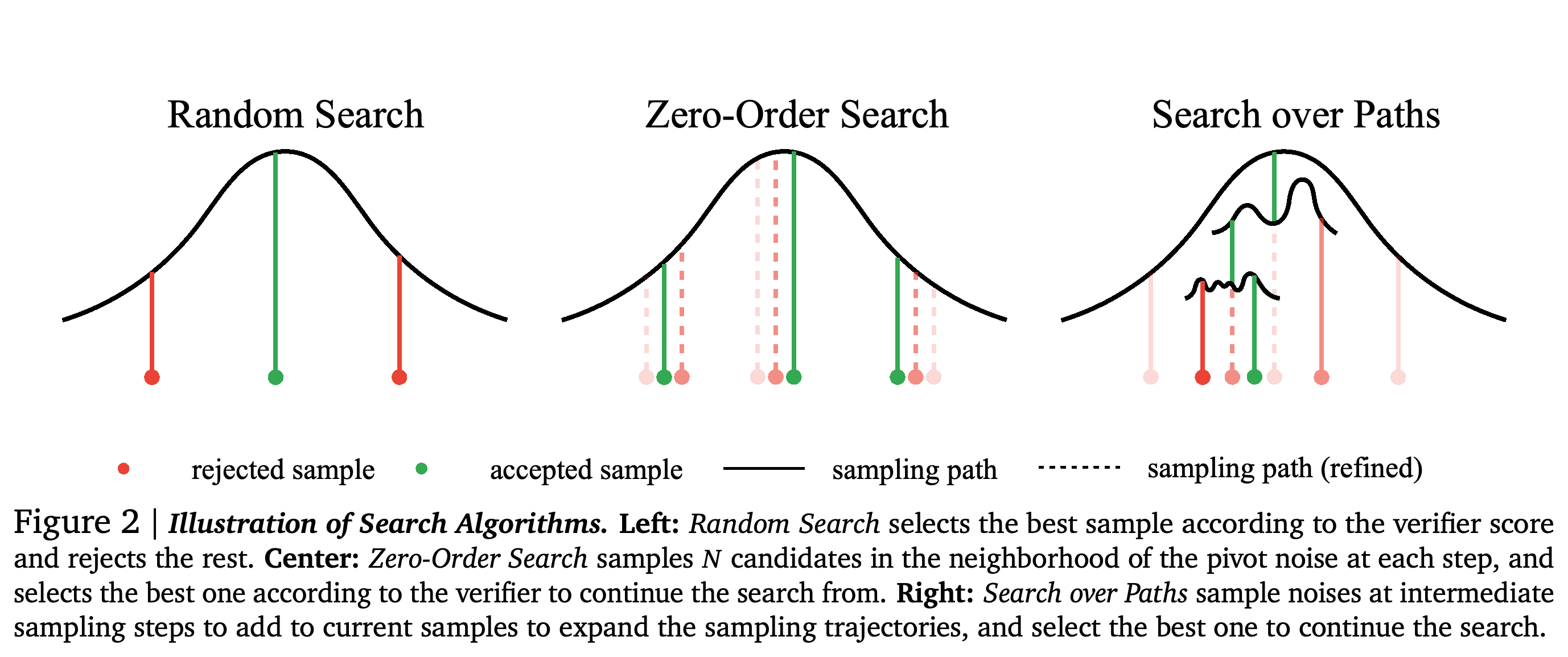
- Inference-Time Scaling for Diffusion Models beyond Scaling Denoising Steps separates candidate scoring from search over sampling noise. Random Search selects among independent candidates, Zero-Order Search refines neighboring initial noises without gradients, and Search over Paths branches intermediate denoising trajectories. These methods provide another use for inference computation after gains from additional denoising steps diminish.
- On DrawBench, a text-prompt image-generation benchmark, FLUX.1-dev with ensemble-guided Random Search raises LLM Grader, a language model’s image-quality assessment, from 84.29 without search to 88.18. The baseline uses 30 number of function evaluations (NFEs), meaning generator forward evaluations; search adds 2880 NFEs. At that search budget, Zero-Order Search and Search over Paths with two candidates or initial paths score 87.25 and 86.84, respectively.
- Verifier choice changes the outcome. On T2I-CompBench, a benchmark for specified attributes and object relationships, ImageReward, a learned human-preference scorer, guides Random Search to higher scores than the ensemble in all six categories at 1920 search NFEs. Local search partly mitigates diversity loss on ImageNet, a labeled-image benchmark, but does not eliminate deterioration from excessive search. Generator-evaluation counts and approximate arithmetic-cost comparisons do not establish deployment latency; the model-based quality grader also lacks a reported human validation study.
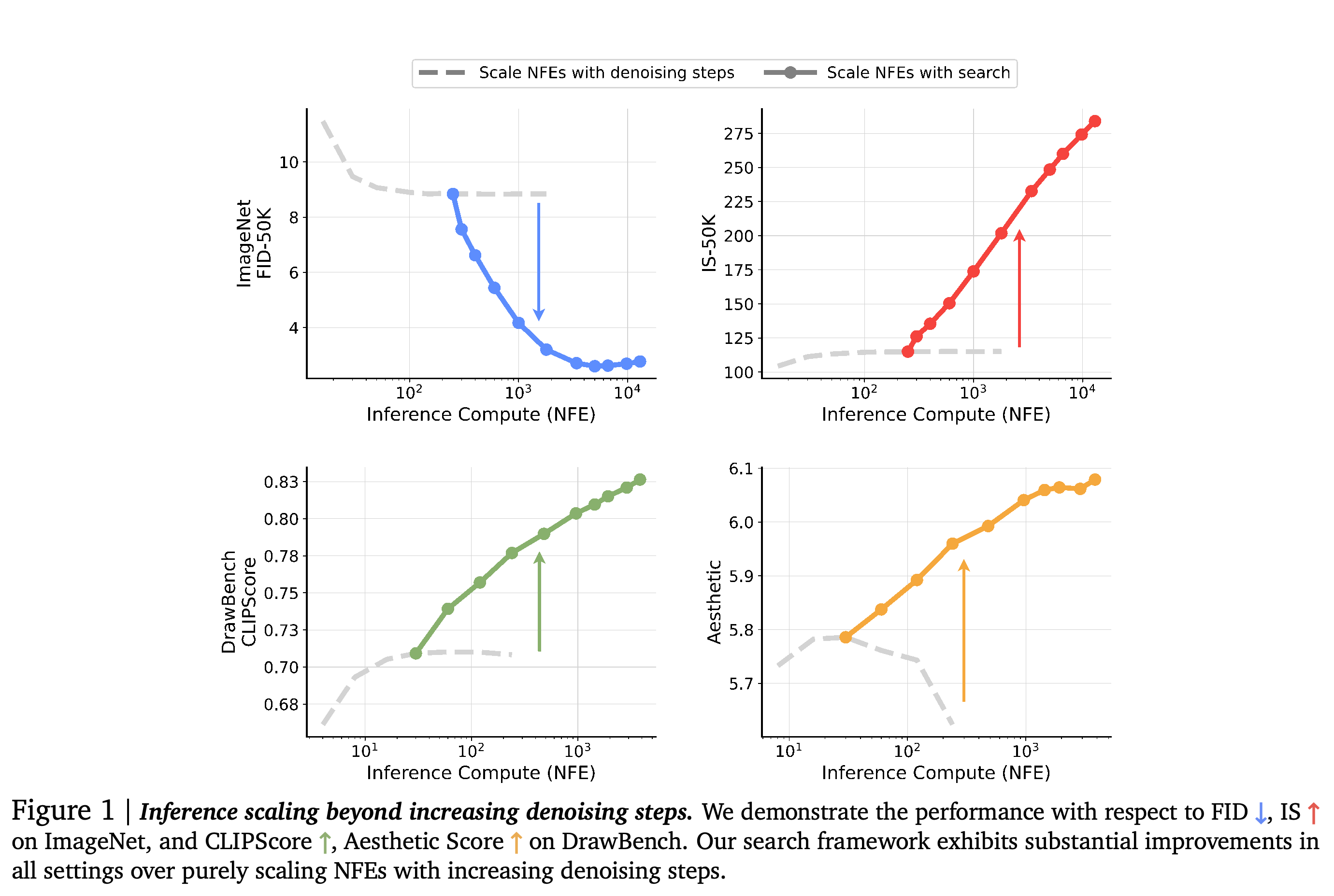
The four curves show that allocating additional generator evaluations to search continues to improve the plotted ImageNet and DrawBench metrics after increasing denoising evaluations alone produces little benefit. The panels measure different quality criteria and do not establish one universally optimal search configuration.
The diagram distinguishes independent candidate selection from local refinement of initial noise and refinement of intermediate trajectories. These restrictions on exploration help interpret the algorithms’ different behavior when maximizing individual-image scores reduces diversity.
3. SFT Memorizes, RL Generalizes: A Comparative Study of Foundation Model Post-training
- https://arxiv.org/abs/2501.17161
- SFT Memorizes, RL Generalizes: A Comparative Study of Foundation Model Post-training | Summary
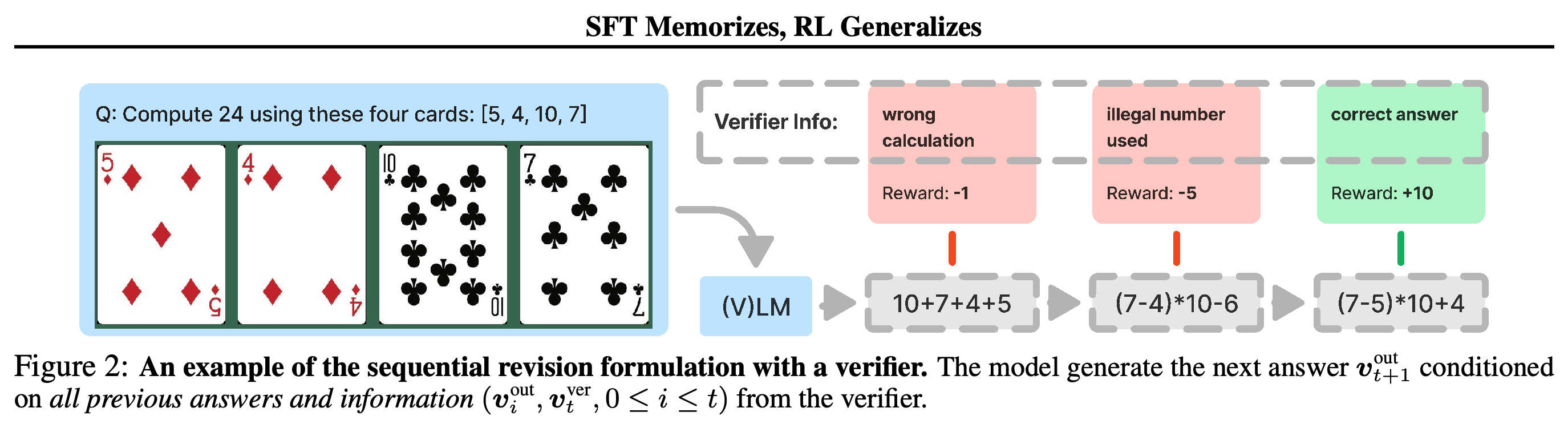
- SFT Memorizes, RL Generalizes: A Comparative Study of Foundation Model Post-training tests Llama-3.2-Vision-11B on GeneralPoints, which requires making 24 from four card values, and V-IRL, a street-view navigation environment. Both continued-SFT and RL branches start from a shared SFT-trained checkpoint. RL uses sequential revision with verifier feedback, and endpoint comparisons match estimated training computation, including generation of RL training responses.
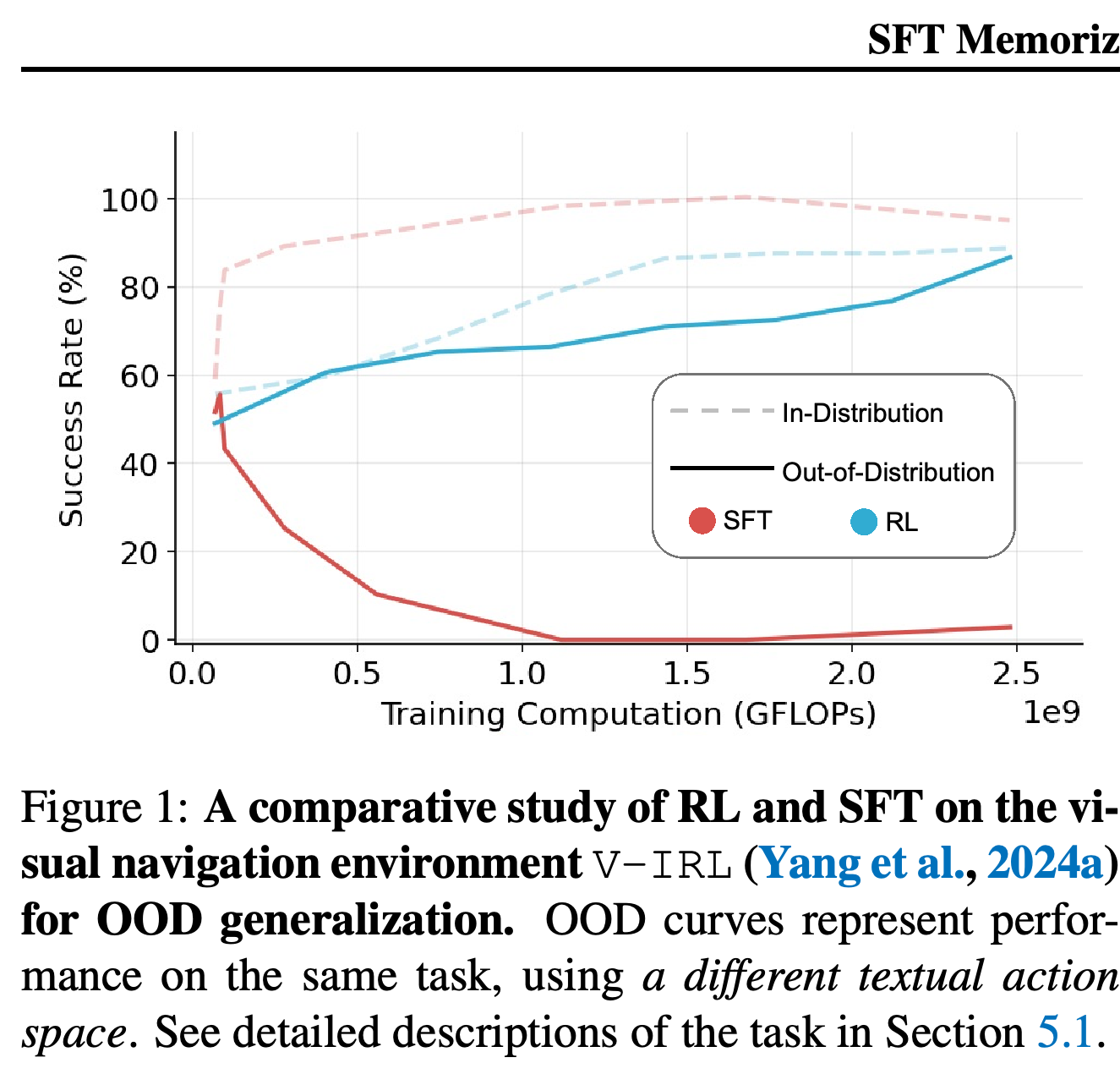
- Under an unseen navigation action space, image-and-text per-step accuracy rises from 35.7% at initialization to 45.0% with RL and falls to 2.5% with further SFT. With task rules fixed and visual conditions changed, RL raises GeneralPoints success from 23.6% to 41.2% and navigation route success from 16.7% to 77.8%; continued SFT lowers them to 13.7% and 11.1%, respectively.
- The evidence supports better transfer with this RL pipeline on the tested backbone and environments. It does not directly measure near-exact reproduction of training examples, and improved action accuracy coexists with whole-route success of approximately 1% or lower under changed navigation rules. Direct RL without SFT initialization fails in the reported GeneralPoints trials, while RL also fails to recover rule transfer from an extremely overfitted SFT checkpoint.
As training computation increases, SFT retains high performance on the trained navigation action space while performance on the changed action space collapses. RL improves both curves, motivating the paper's separation of training-task improvement from transfer. These curves report overall navigation success rather than the per-step metric used in Figures 5 and 6.
For cards [5, 4, 10, 7], verifier feedback distinguishes a wrong calculation from using an unavailable number before the model produces (7-5)*10+4. The diagram explains how revision uses feedback; its illustrative reward values of −1, −5, and +10 differ from the environment specification in Appendix A.3.
Sources
[1] MiniMax-01: Scaling Foundation Models with Lightning Attention
[2] Inference-Time Scaling for Diffusion Models beyond Scaling Denoising Steps
[3] SFT Memorizes, RL Generalizes: A Comparative Study of Foundation Model Post-training