


Monthly AI Papers: August 2025
31 Aug 2025 | Paper Review Monthly Papers Efficient Generation Agentic Reasoning Long-Context ModelingContents
Trends
August 2025’s theme is managing information and computation across extended generation: the three selected papers use execution feedback, selective access to earlier video content, or compact speech representations to support reasoning and sustained output. rStar2-Agent trains mathematical reasoning with Python checks. Mixture of Contexts retrieves relevant earlier video segments while retaining local context. VibeVoice encodes speech into compact continuous feature vectors to support long conversations with consistent voices. 1, 2, 3
The designs preserve different forms of useful context. rStar2-Agent preferentially trains on correctly answered trajectories, complete reasoning and tool-interaction sequences, with fewer execution and formatting errors. Mixture of Contexts makes caption and current-shot access mandatory while selectively retrieving earlier content; a shot is a continuous video segment between cuts. VibeVoice feeds both acoustic features, representing audio characteristics, and semantic features, representing transcript-related content, back into subsequent predictions. These mechanisms address different failure modes, so their results support domain-specific engineering choices rather than a shared performance ranking.
Efficiency evidence varies substantially across the papers. Mixture of Contexts reports a measured 2.2× end-to-end speedup for 64-second scenes, but its short-video pipeline is slower despite lower arithmetic work. rStar2-Agent reports shorter responses than selected baselines, while its training comparison combines extra candidate generation with trajectory selection. VibeVoice reduces speech-token rate but supplies no measured runtime comparison or systematic evaluation of quality throughout a 90-minute generation. For engineering decisions, generation length, arithmetic savings, and measured latency remain separate quantities.
Top Papers in August 2025
1. rStar2-Agent: Agentic Reasoning Technical Report
- https://arxiv.org/abs/2508.20722
- rStar2-Agent: Agentic Reasoning Technical Report | Summary
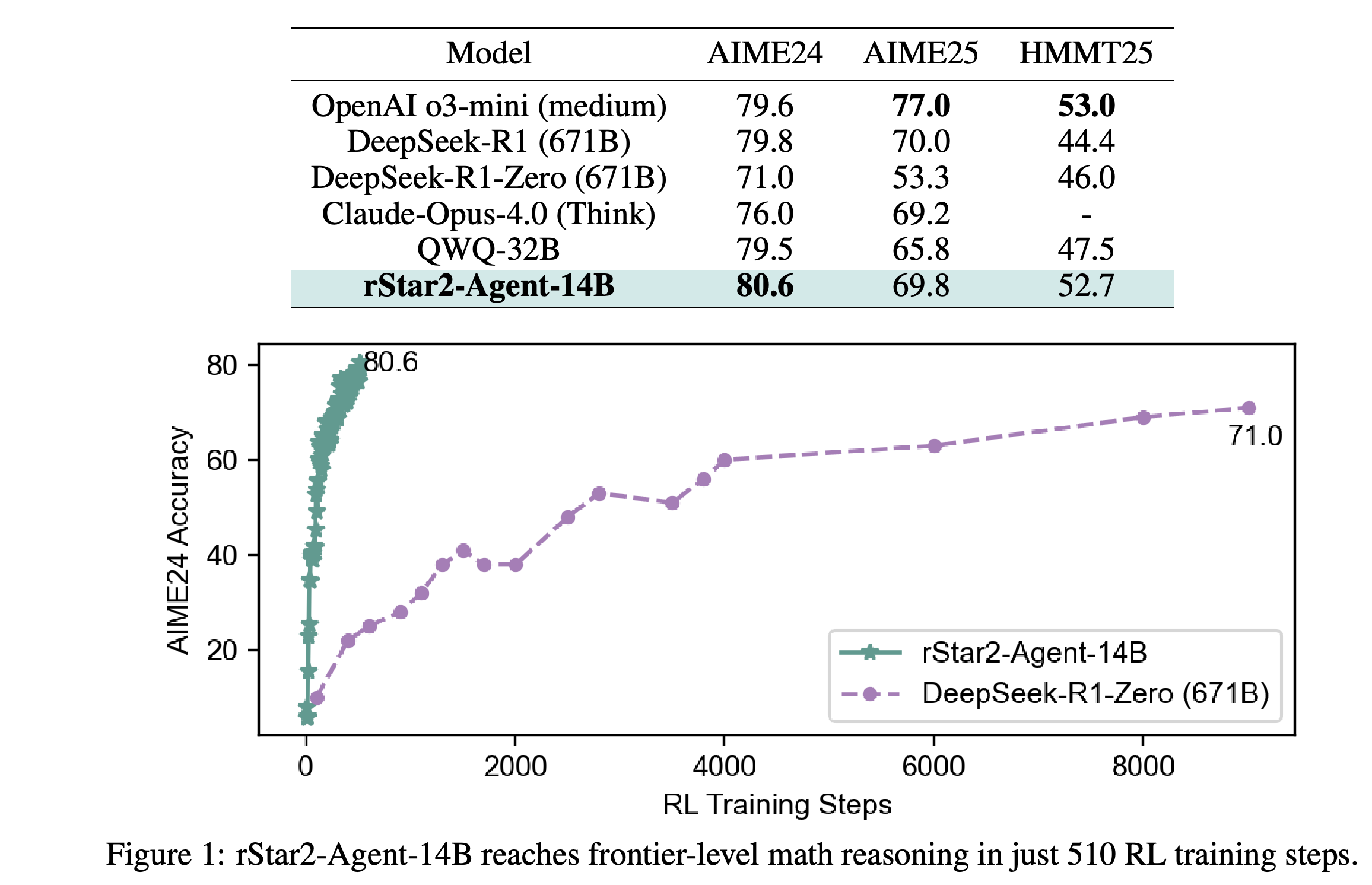
- rStar2-Agent uses Group Relative Policy Optimization with Resampling on Correct (GRPO-RoC), reward-based training that compares responses to the same question and preferentially selects cleaner successful trajectories. It generates 32 candidates per question and selects 16 for updates, favoring correct responses with fewer tool and formatting errors while retaining final-answer correctness as the sole reward. Training uses 42K curated mathematics problems and 510 reinforcement-learning steps on 64 AMD MI300X GPUs within one week.
- The 14-billion-parameter model scores 80.6% on AIME24 and 69.8% on AIME25, competitive mathematics benchmarks, versus 79.8% and 70.0% for DeepSeek-R1 (671B). These are average pass@1 scores, single-response correctness estimated from 16 samples per question, with up to 30K tokens, units of model text, and 30 interaction turns. Science question-answering performance on GPQA-Diamond rises from 42.1% after supervised fine-tuning, training on demonstrations, to 60.9% after mathematics reinforcement learning.
- Reported average response lengths are 9339.7 tokens on AIME24 and 10943.4 on AIME25, versus 14246.8 and 17132.9 for DeepSeek-R1-Zero. The resampling experiment shows higher accuracy and shorter training responses, but compares 32 generated candidates against a baseline generating 16, leaving equal-compute benefits unresolved. General tool-use and instruction-following scores decline slightly from the supervised checkpoint, and continued training beyond step 510 causes policy and reward collapse in the reported 14B experiments; its cause remains unestablished.
The overview combines benchmark scores with an AIME24 training curve. rStar2-Agent-14B reaches 80.6 in 510 RL steps, while the plotted DeepSeek-R1-Zero (671B) curve ends at 71.0 after substantially more steps. Different model sizes and recipes prevent this from serving as a controlled compute comparison.
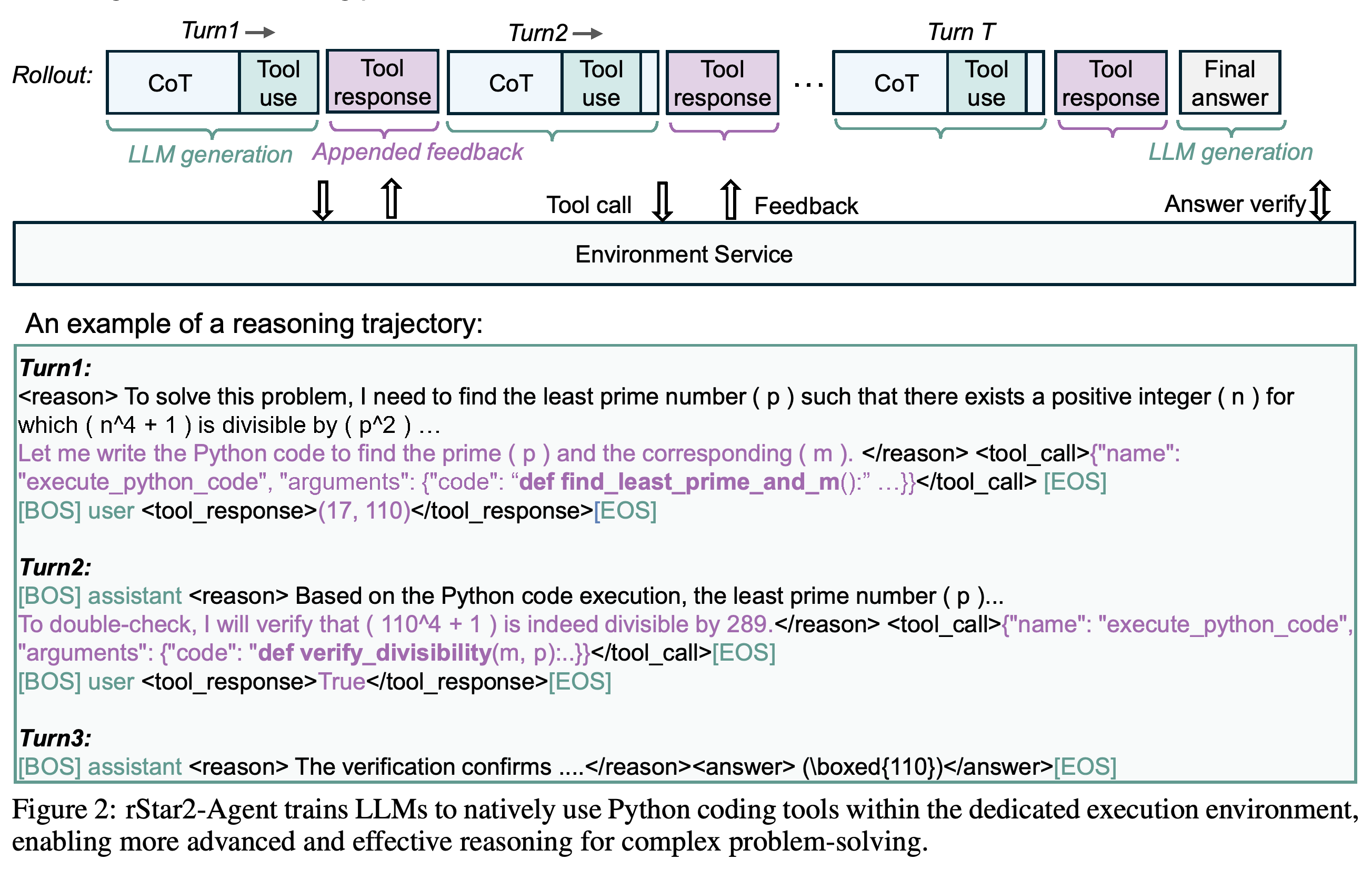
Execution feedback becomes part of the next model turn. The worked example obtains (17, 110), checks divisibility in a separate Python call, and returns 110, illustrating verification of an intermediate computation before submission.
2. Mixture of Contexts for Long Video Generation
- https://arxiv.org/abs/2508.21058
- Mixture of Contexts for Long Video Generation | Summary
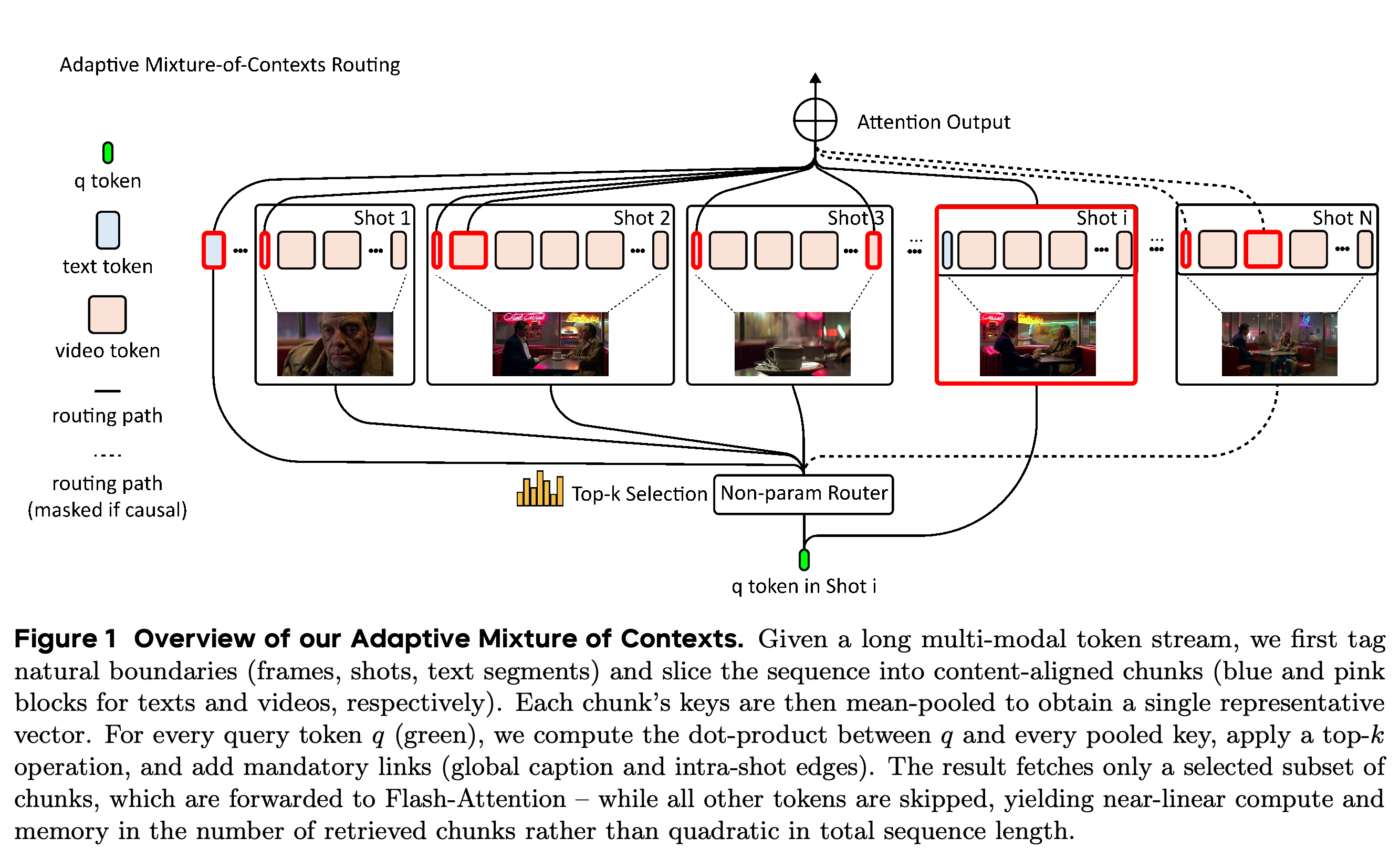
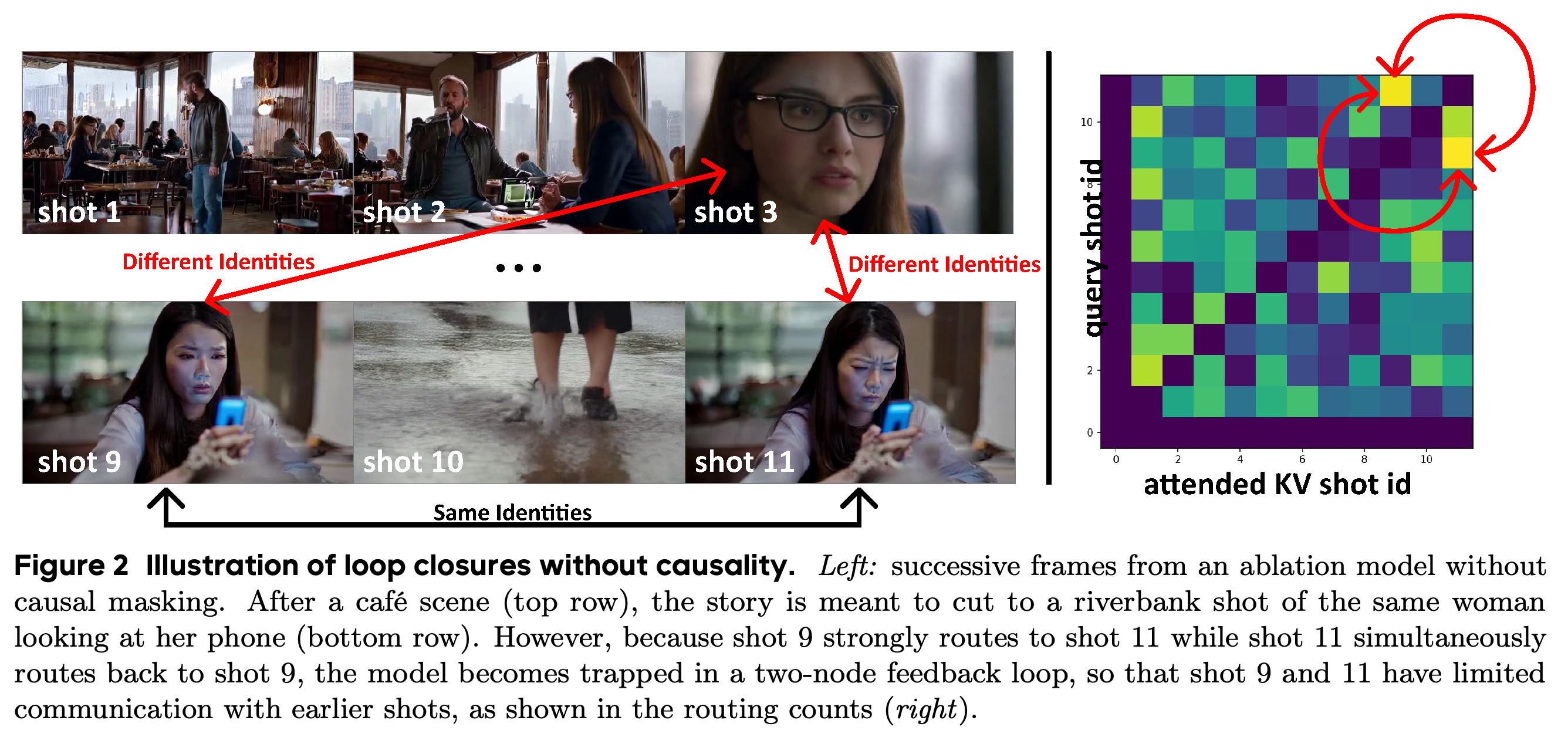
- Mixture of Contexts (MoC) replaces dense attention, which compares every pair of token features, with retrieval over chunks aligned to frames, shots, and captions. Each query feature selects the highest-scoring chunks using averaged matching features, then attends to their original tokens. Caption and current-shot connections remain mandatory, while optional retrieval is restricted to earlier chunks to prevent reciprocal routes from losing access to earlier identity information.
- Against dense Long-Context Tuning (LCT), a generator with a scene-level context window, MoC reports 2.2× end-to-end speedup at 85% attention sparsity, the fraction of token-pair interactions omitted. The comparison uses eight-shot, 64-second scenes at 480p and 12 frames per second, approximately 180K tokens. Five of six VBench video-quality metrics improve: Dynamic Degree, measuring motion extent, rises from 0.4583 to 0.5625, while Image Quality, measuring technical frame quality, falls from 0.5140 to 0.5003.
- The runtime benefit depends on sequence length: short single-shot generation runs more slowly because pooling and token-gathering overhead outweigh attention savings. The main long-video comparison is confined to LCT and reports no sample count or uncertainty intervals. Reported attention floating-point operations, a measure of arithmetic work, fall from 1.7 × 10^13 to 2.3 × 10^12, but the illustrative calculation conflicts with the stated formulas and inputs; those arithmetic estimates need clarification independently of the measured speedup.
The diagram separates optional retrieval from mandatory connections: a query scores pooled chunks, retrieves selected video tokens, and retains caption and current-shot access. Dashed routes identify connections removed by causal masking, showing how sparse context selection preserves local attention while restricting optional retrieval to earlier context.
The riverbank shots agree with each other on the woman's appearance but disagree with her earlier café identity. Strong reciprocal routing between shots 9 and 11 in the heatmap illustrates how local agreement can coexist with failed historical recall when optional routes form a feedback pair.
3. VibeVoice Technical Report
- https://arxiv.org/abs/2508.19205
- VibeVoice Technical Report | Summary
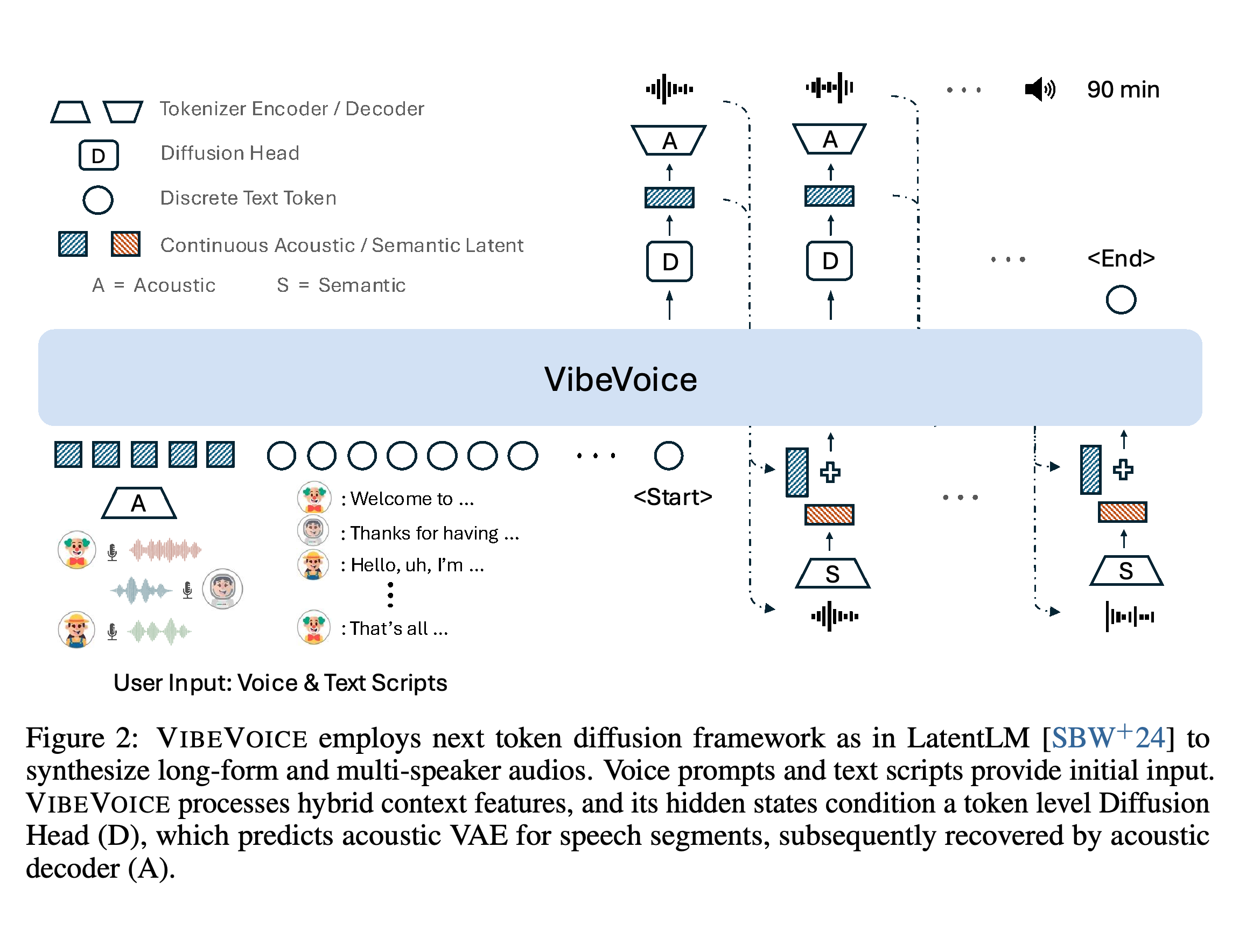
- VibeVoice combines continuous speech tokenizers, encoders that turn audio into compact feature vectors, with next-token diffusion, generation of successive vectors through iterative noise removal. Its acoustic tokenizer reduces 24 kHz audio to 7.5 frames per second. A pretrained language model processes voice prompts and speaker-labeled scripts, with generated acoustic and semantic features returning to its context. The report states capacity for up to 90 minutes and four speakers within a 64K-token context window.
- On eight conversational transcripts totaling about one hour, evaluated by 24 annotators, VIBEVOICE-7B receives the highest reported average human rating, 3.76 versus 3.66 for Gemini 2.5 Pro Preview TTS, a text-to-speech system that synthesizes speech from scripts. Gemini uses default voices because it lacks the speech-prompt control used for the other systems. VIBEVOICE-1.5B has lower transcription error than the 7B model under both tested speech recognizers, while the 7B model has higher human ratings and measured speaker similarity.
- The acoustic tokenizer leads the listed reconstruction systems on two quality metrics but trails several alternatives on objective intelligibility. Its 7.5-token-per-second rate is 80 times lower than the listed 600-token-per-second Encodec configuration; this ratio does not establish equivalent storage or runtime savings. Short-utterance results are mixed, and the report provides no controlled component ablation, experiment isolating a component’s contribution, or systematic 90-minute stability evaluation. Supported languages are English and Chinese, with no explicit generation of overlapping speech, background noise, music, or sound effects.
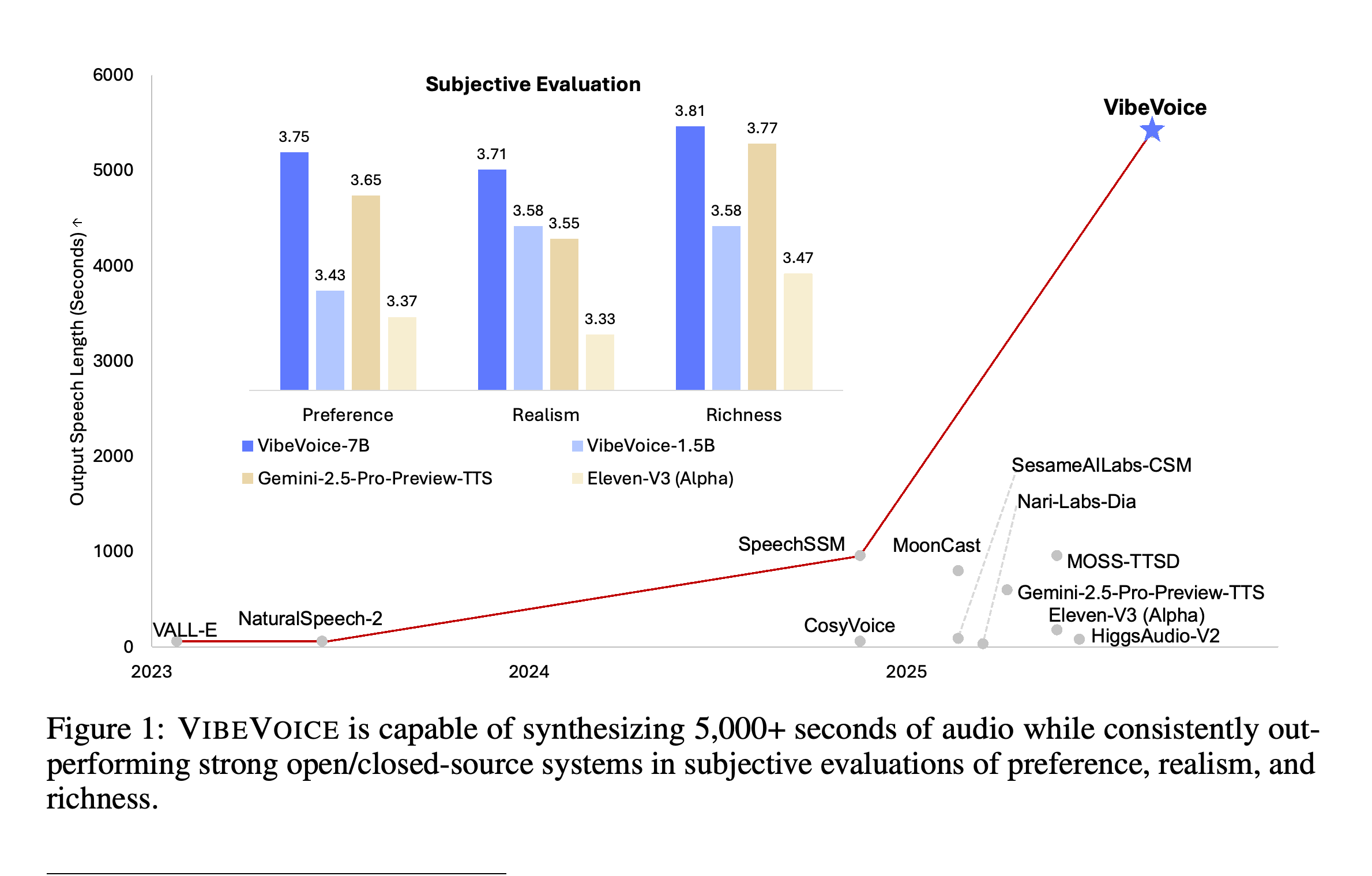
The plot places VIBEVOICE above 5,000 seconds of generation and combines this capacity claim with selected human-rating scores. The inset favors the 7B model, but several inset values differ slightly from Table 1; the detailed evaluation therefore uses Table 1. The generation-length comparison and listener ratings are separate evidence, and the figure does not establish quality throughout a controlled 90-minute test.
Voice prompts and speaker-labeled text initialize the sequence model. Its hidden states condition acoustic-feature generation through the diffusion head, the acoustic decoder converts features into speech, and acoustic and semantic encodings of generated speech return to the context for subsequent predictions.
Sources
[1] rStar2-Agent: Agentic Reasoning Technical Report
[2] Mixture of Contexts for Long Video Generation
[3] VibeVoice Technical Report
The selected papers were first submitted in August 2025. This retrospective digest uses the following PDF versions: rStar2-Agent v1, Mixture of Contexts v3, and VibeVoice v1.