


Seedream 3.0 Technical Report | Summary
15 Apr 2025 | Paper Review Text-to-Image Generation Text Rendering Diffusion AccelerationContents
This article explains the key points of Seedream 3.0 Technical Report.
- 2025-04-15 (arXiv)
- Gao, Yu, Gong, Lixue, Guo, Qiushan, Hou, Xiaoxia, Lai, Zhichao, Li, Fanshi, Li, Liang, Lian, Xiaochen, Liao, Chao, Liu, Liyang, et al.
- ByteDance Seed
- Paper
- Project Page
Summary
- Seedream 3.0 addresses Chinese-English image generation that must follow complex prompts, draw small text accurately, and produce detailed images at high resolution. On the paper’s benchmark of 180 Chinese and 180 English prompts, it achieves 94% text availability, the proportion of images judged acceptable for text correctness, integration, and aesthetics, compared with Seedream 2.0’s 78% for Chinese and 86% for English.
- The system combines expanded training data, training across multiple resolutions, positional encoding that represents locations across image and text, and post-training guided by detailed aesthetic descriptions and models that score image-text outputs. It generates images natively up to 2048×2048; the authors report a 4 to 8 times speedup while maintaining image quality, but do not provide a detailed timing comparison.
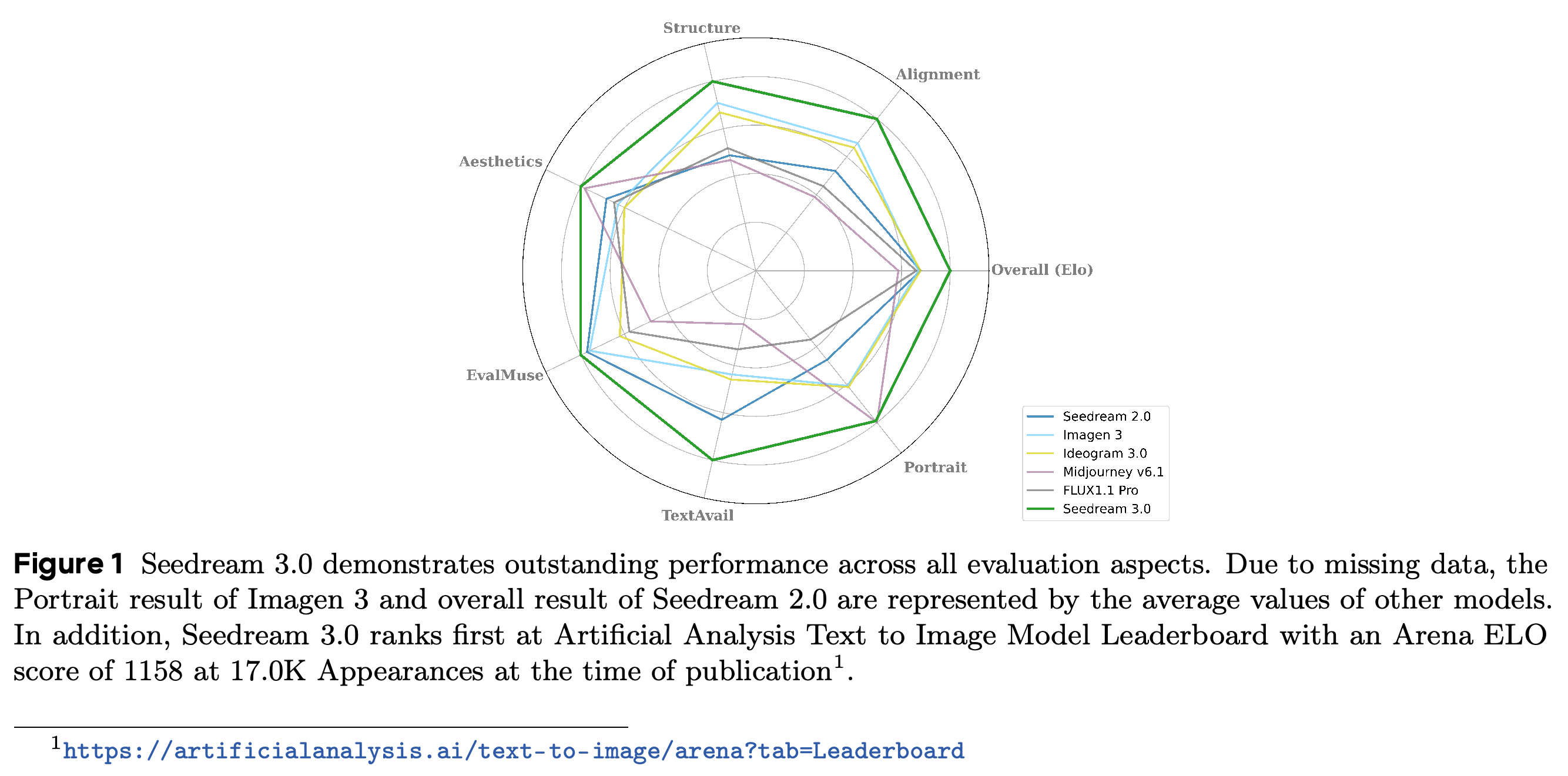
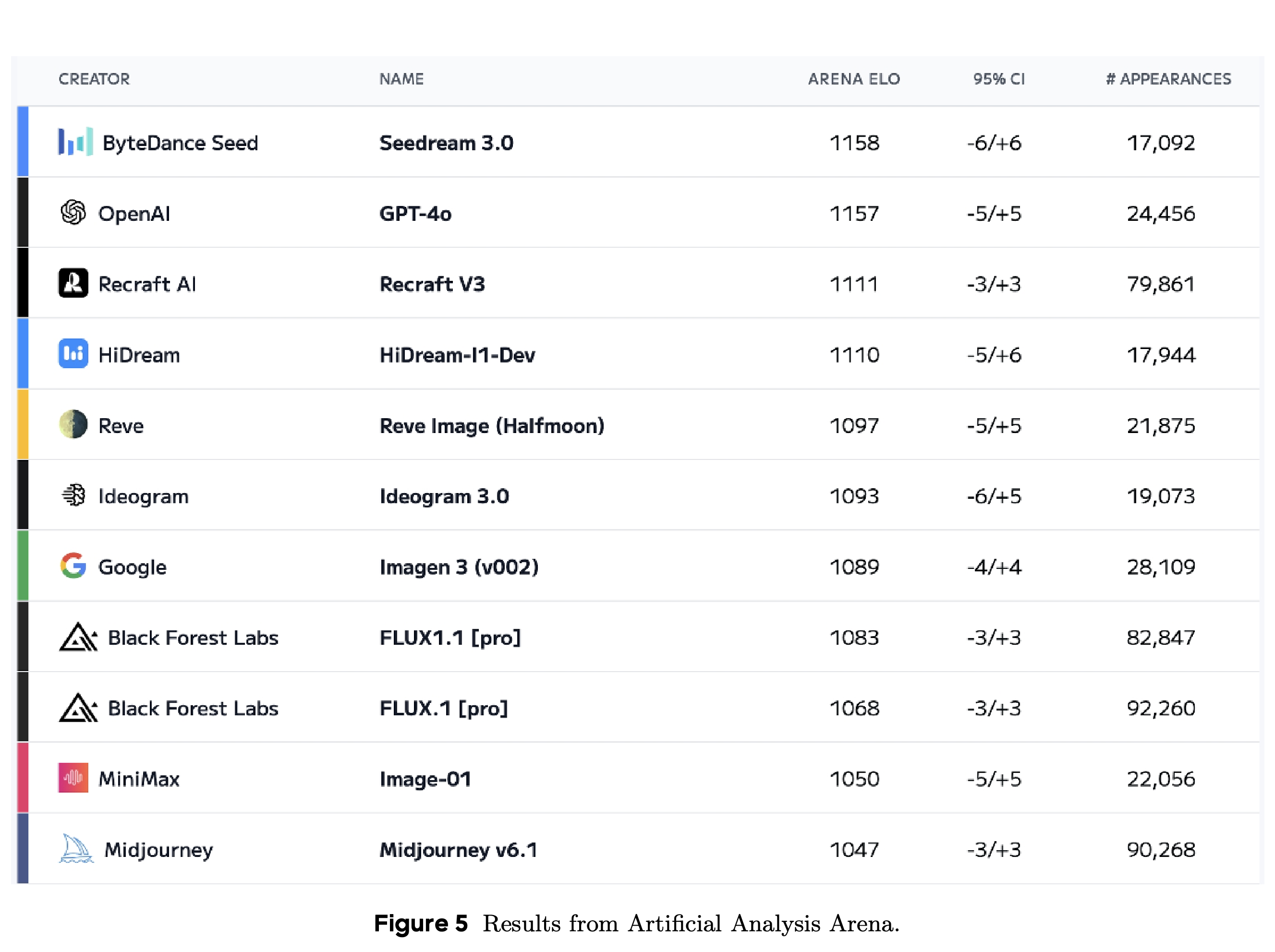
- Expert evaluation on 377 prompts reports stronger prompt following and structural correctness, and Seedream 3.0 leads all five listed automatic metrics; portrait preferences place it close to Midjourney v6.1. Its reported Artificial Analysis Arena Elo rating, a score derived from pairwise preferences, is 1158 versus GPT-4o’s 1157, with overlapping 95% confidence intervals; the separate direct GPT-4o comparisons use selected examples.
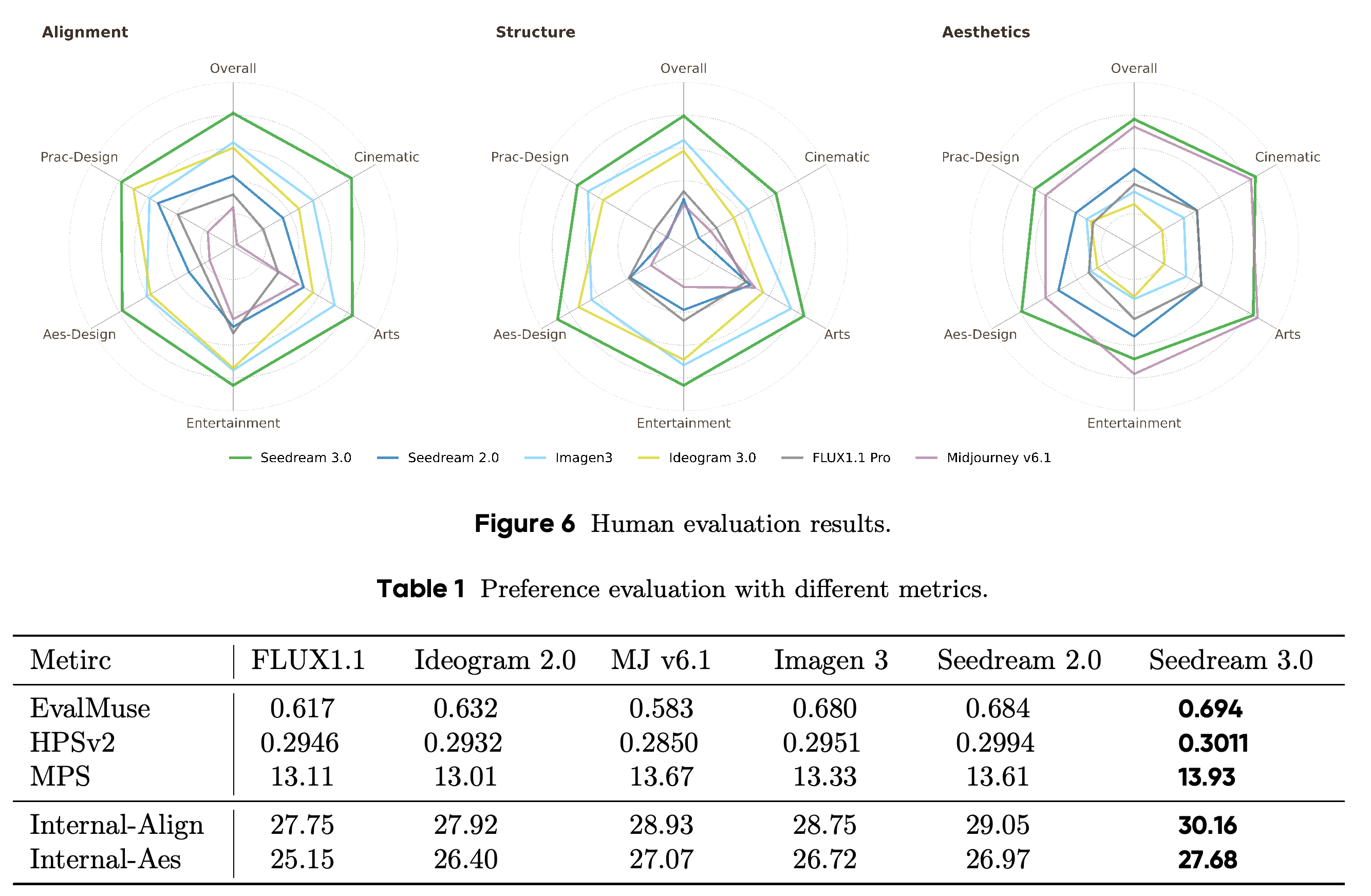
The radar chart summarizes results from several distinct evaluation procedures. Imagen 3’s portrait point and Seedream 2.0’s overall point are averages of other models’ results, so those coordinates cannot support direct comparisons.
1 Introduction
The introduction identifies four limitations of Seedream 2.0: numerical and spatial prompt following, small characters and multiline typography, visual aesthetics and portrait texture, and limited native resolution. Seedream 3.0 addresses these through changes to data construction, pre-training, post-training, and inference acceleration.
- The report states that a 1K image takes 3.0 seconds without Prompt Engineering (PE), its stage for adapting prompts, but does not specify the hardware configuration for this latency.
- Deployment began in early April 2025 through Doubao and Jimeng. The official page is https://team.doubao.com/tech/seedream3_0, and the model identifier is Doubao-Seedream-3.0-t2i.
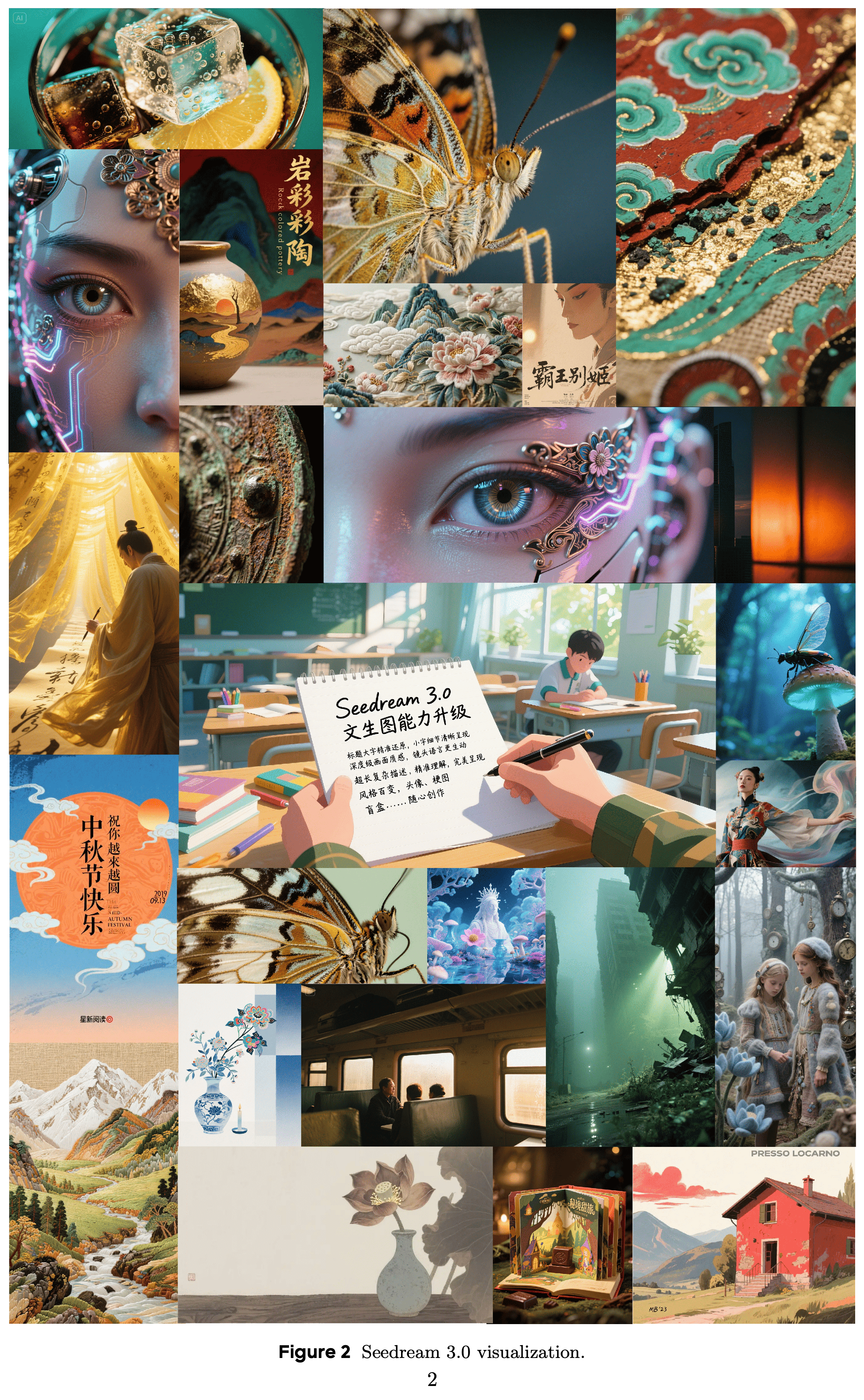
The collage illustrates fine textures, Chinese typography, realistic faces, illustrations, and landscapes. It shows the intended output range without measuring consistency across prompts.
2 Technical Details
The technical pipeline recovers usable regions of imperfect images, balances visual and textual training distributions, improves joint image-text modeling, aligns outputs with human preferences, and reduces sampling computation. The following subsections describe these components, although the report does not quantify their individual contributions through controlled ablations.
2.1 Data
Defect-aware training retains images whose detected defects occupy less than 20% of their area, a configurable threshold, and excludes gradients from those regions during loss computation in the latent representation, the compressed image space used for training. A detector trained on 15,000 manually annotated samples selected through active learning locates watermarks, overlaid text, subtitles, and mosaic patterns; this procedure expands the effective training dataset by 21.7%.
- The earlier filtering policy excluded affected samples representing approximately 35% of the original collection. The 21.7% expansion from defect-aware training is distinct from the broader claim that the complete data pipeline approximately doubles the dataset.
- Dual-axis sampling balances visual patterns through hierarchical clustering, which groups images at multiple levels, and textual semantics through term frequency and inverse document frequency (TF-IDF), a weighting scheme based on term frequency and rarity across documents.
- A shared image-text retrieval space represents paired images and descriptions for similarity searches. It supports targeted concept retrieval, similarity-weighted sampling, and enhancement using neighboring image-text pairs; the report provides no numerical results for its claimed retrieval superiority.
2.2 Model Pre-training
2.2.1 Model Architectures retains MMDiT, a multimodal diffusion transformer that jointly processes image and text tokens, and increases the base model’s parameter count without disclosing its size. Diffusion generation produces images by reversing a noise-corruption process. Mixed-resolution training packs images with different resolutions and aspect ratios, beginning at an average resolution of 256² and continuing with images from 512² to 2048²; size embeddings supply the target resolution as an additional model input.
- Cross-modality RoPE, rotary position embedding applied across image and text tokens, represents text as a two-dimensional sequence of shape [1,L], where L is the text sequence length. Text column positions are assigned consecutively after the corresponding image positions to represent relationships within and between modalities.
2.2.2 Model Training Details combines flow matching, which learns the velocity along an image-to-noise interpolation, with representation alignment loss (REPA), which matches intermediate model features to a pretrained DINOv2-L vision encoder using cosine distance. The REPA loss weight is \(\lambda = 0.5\), and the interpolation is \(\mathbf{x}_t=(1-t)\mathbf{x}_0+t\epsilon,\quad \epsilon\sim\mathcal{N}(\mathbf{0},I)\).
- Here x_0 is the clean image representation, t is the interpolation timestep, and ε is Gaussian noise. DINOv2-L supplies the visual features used as the alignment target.
- Resolution-aware timestep sampling starts from a logit-normal distribution, obtained by mapping a normally distributed variable into the timestep interval, and shifts it toward lower signal-to-noise ratios for higher resolutions. Training uses average dataset resolution, while inference uses the requested resolution and aspect ratio.
- The authors report faster convergence with representation alignment but provide no numerical convergence comparison.
2.3 Model Post-training
Post-training comprises Continuing Training (CT), further training after pre-training; Supervised Fine-Tuning (SFT), supervised training on image-caption examples; Human Feedback Alignment (RLHF), training to align outputs with human preferences; and PE. The separate Refiner stage for increasing output resolution is omitted because the model directly generates images across the stated range from 512² to 2048².
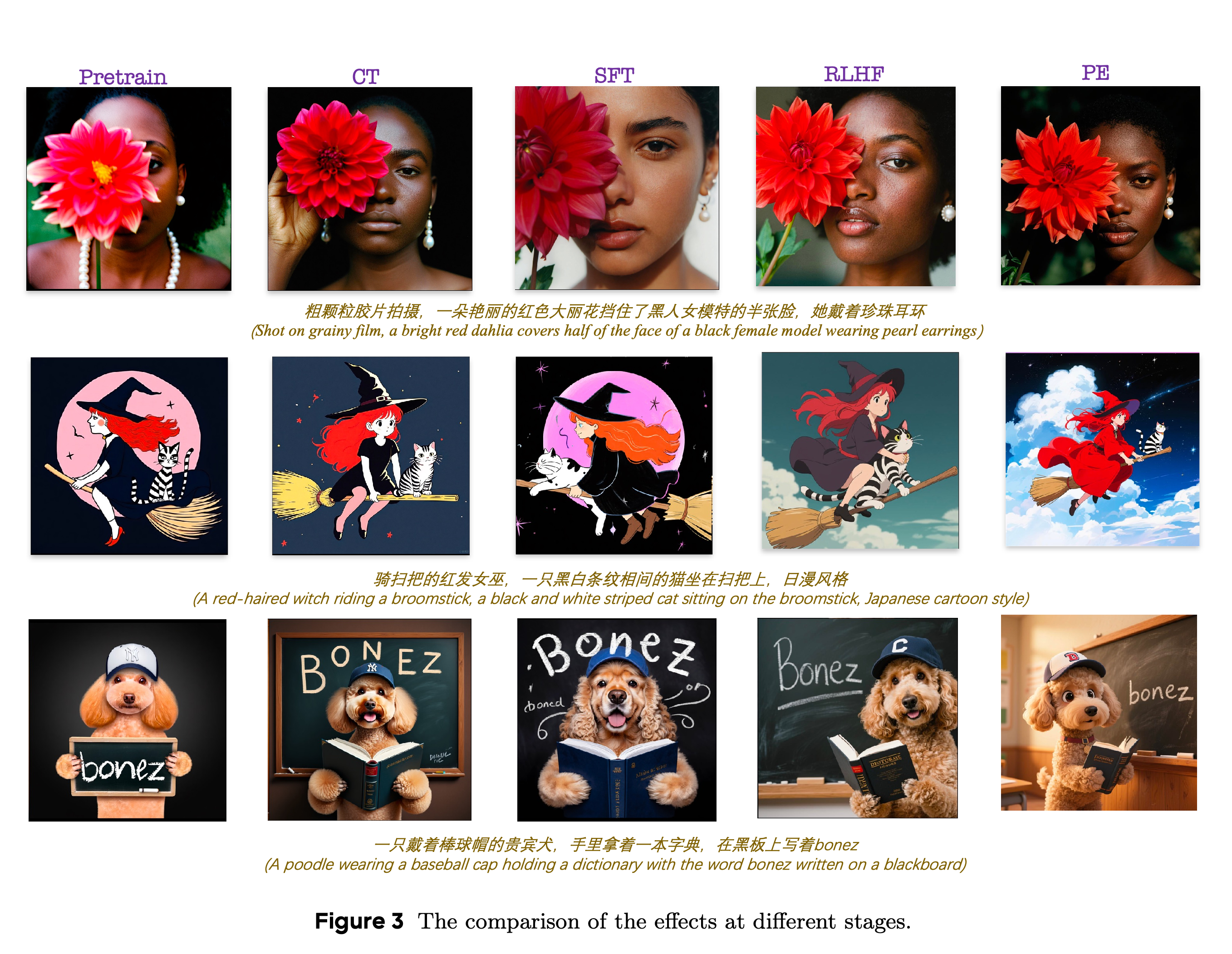
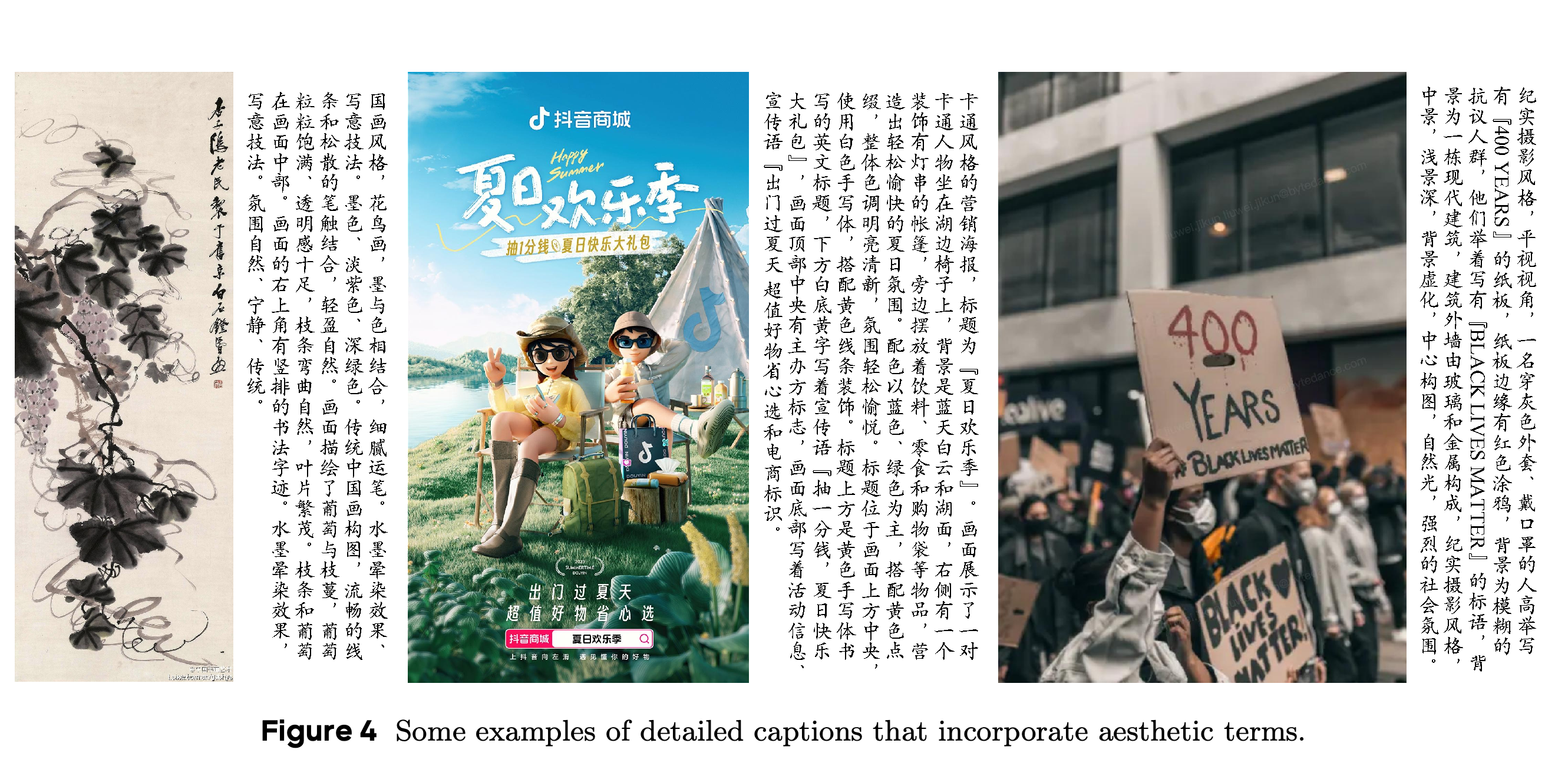
- 2.3.1 Aesthetic Caption uses multiple caption-model versions to describe aesthetics, style, and layout in CT and SFT data. Figure 3 illustrates changes across training stages, and Figure 4 shows examples of these descriptions.
- 2.3.2 Model Training Details balances the sampling of training data across resolutions to support prompt following at different output sizes.
Three prompts appear across Pretrain, CT, SFT, RLHF, and PE, showing changes in appearance and prompt following through the pipeline. These examples do not isolate the average contribution of each stage.
2.3.3 Reward Model Scaling replaces the previous CLIP image-text reward model with Vision-Language Models (VLMs), models that process images and text together. A reward model assigns scores to guide preference alignment: instructions become queries, and rewards come from the normalized probability of the response token “Yes.” Reward-model size increases from 1B to >20B parameters.
- The authors report that larger reward models improve reward-modeling performance, but provide no scaling curve or numerical comparison.
The descriptions specify composition, color, medium, layout, and scene content. They demonstrate the aesthetic information supplied during continuing training and supervised fine-tuning.
2.4 Model Acceleration
Acceleration builds on Hyper-SD, a consistency-based image-generation method, and RayFlow, a method using adaptive generation paths for individual samples. Each sample follows a trajectory toward an instance-specific target distribution. A unified noise expectation vector estimated by a pretrained model supplies a reference across timesteps to stabilize generation with fewer denoising steps.
- A learned timestep distribution combines Stochastic Stein Discrepancy (SSD), a statistical discrepancy measure, with a neural network to prioritize timesteps expected to reduce training loss.
- The authors report quality matching or exceeding an unaccelerated baseline requiring 50 Number of Function Evaluations (NFE), meaning 50 model evaluations during sampling. The abstract reports a 4 to 8 times speedup, but the report does not specify the accelerated sampling count or provide a detailed quality-versus-latency comparison.
- Other acceleration components, including quantization, which reduces numerical precision, follow Seedream 2.0.
3 Model Performance
Evaluation combines public preference voting, expert assessment, automatic scoring, bilingual text-rendering tests, and portrait comparisons. Figure 1 summarizes these different measurements, while Figure 2 illustrates generated textures, typography, portraits, and illustrations.
- The summary radar chart substitutes averages of other models for Imagen 3’s missing portrait result and Seedream 2.0’s missing overall result. Those two points are not direct measurements.
3.1 Artificial Analysis Arena
Artificial Analysis Arena ranks images through anonymous preference comparisons using identical prompts. In the reported snapshot, Seedream 3.0 has 1158 Elo, a 95% confidence interval of −6/+6, and 17,092 appearances; GPT-4o has 1157 Elo, −5/+5, and 24,456 appearances.
- Seedream 3.0 has the highest displayed point estimate, but the one-point difference and overlapping confidence intervals do not establish a clear advantage over GPT-4o.
- The authors also report leading results across most style and subject categories, including photorealism, illustration, traditional art, portraits, group activities, and physical spaces. These claims concern the publication-time leaderboard at https://artificialanalysis.ai/text-to-image/arena?tab=Leaderboard.
Seedream 3.0 leads the displayed point estimates by one Elo point over GPT-4o. Their overlapping 95% confidence intervals make the displayed ordering insufficient evidence of a clear separation.
3.2 Comprehensive Evaluation
3.2.1 Human Evaluation introduces Bench-377, a set of 377 prompts spanning cinematic scenes, arts, entertainment, aesthetic design, and practical design. Experts assess text-image alignment, meaning whether an image follows its prompt, structural correctness, and aesthetic quality. The reported results favor Seedream 3.0 in alignment and structure and place its overall aesthetics above Midjourney v6.1, although it remains weaker in some categories such as art.
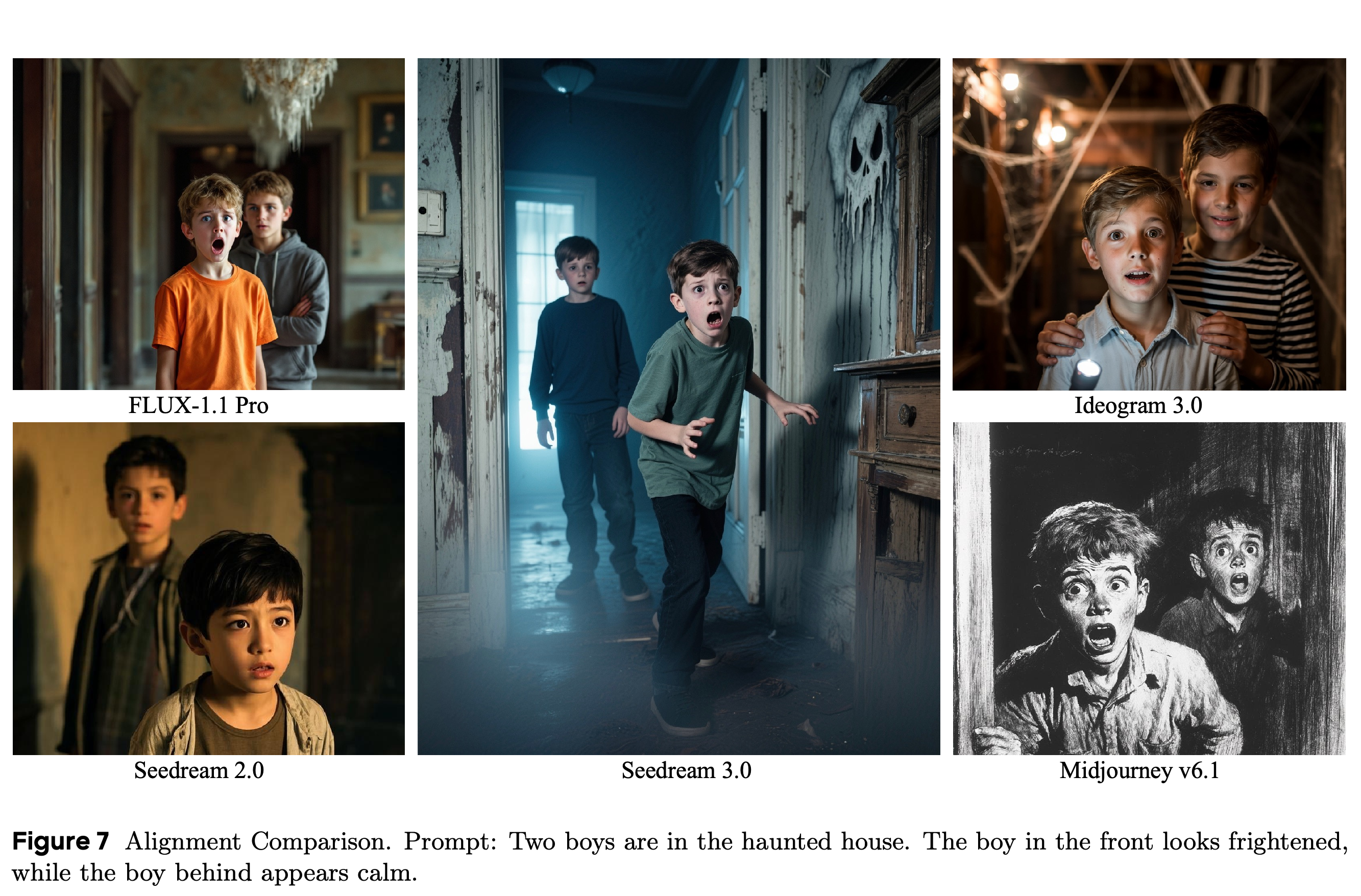
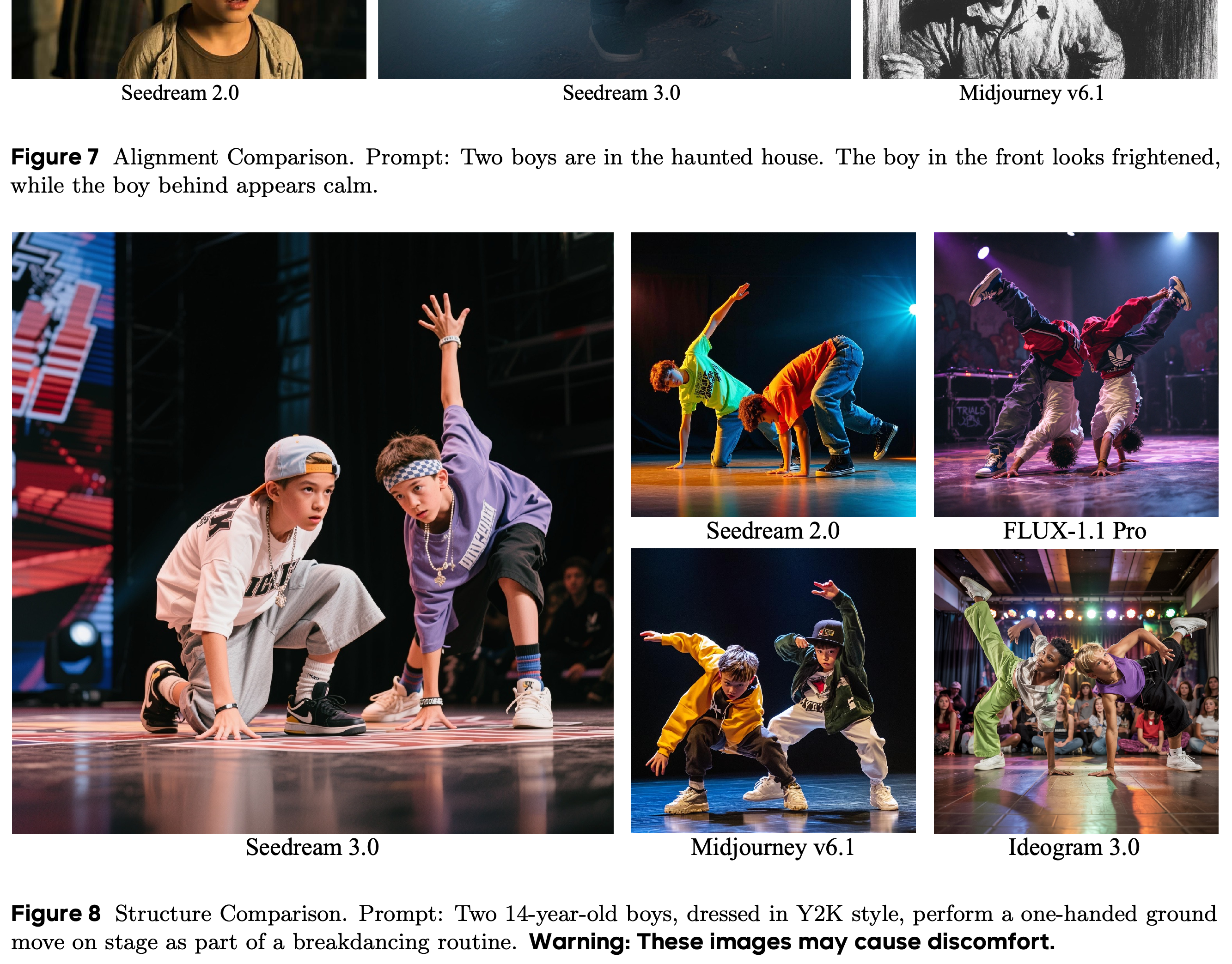
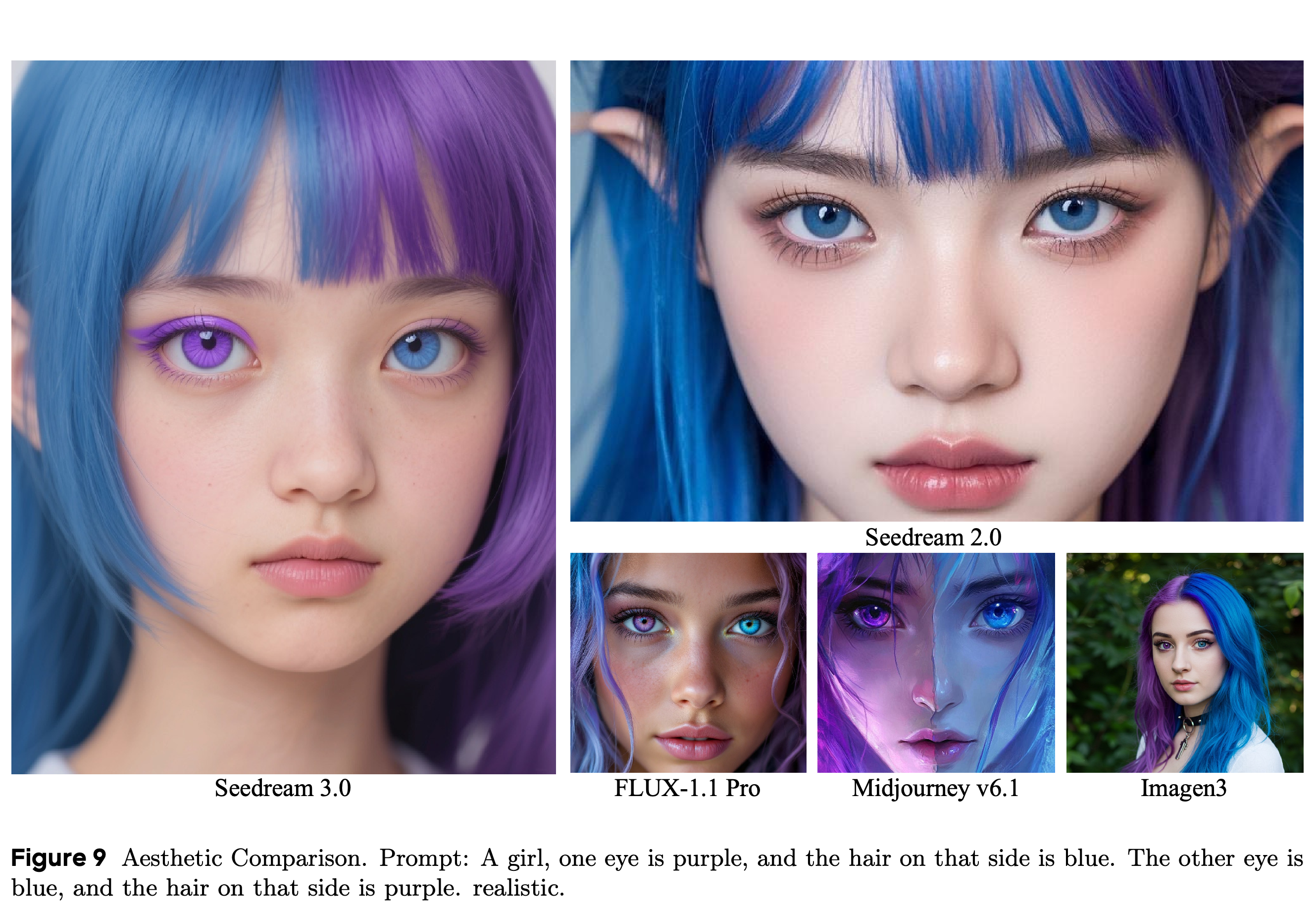
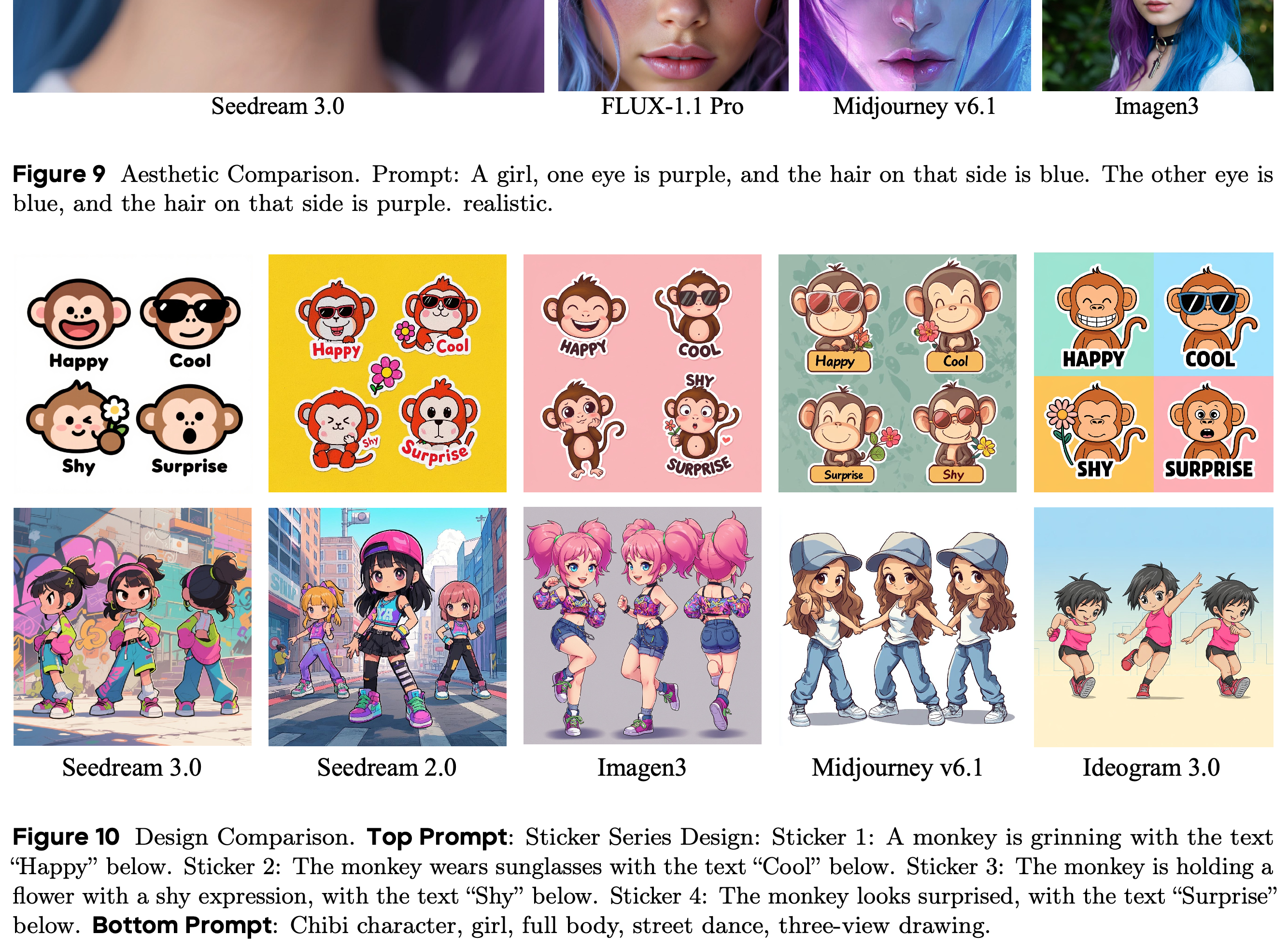
- Figures 7–10 illustrate expression following, anatomy during movement, paired color attributes, labeled stickers, and three-view character design. These examples show the evaluated capabilities without quantifying failure frequencies.
- The report does not provide evaluator counts, agreement statistics, or uncertainty estimates for Bench-377.
The radar plots show a broad reported advantage in alignment and structure across Bench-377 scenarios. Aesthetic results are closer to Midjourney v6.1 and vary by scenario.
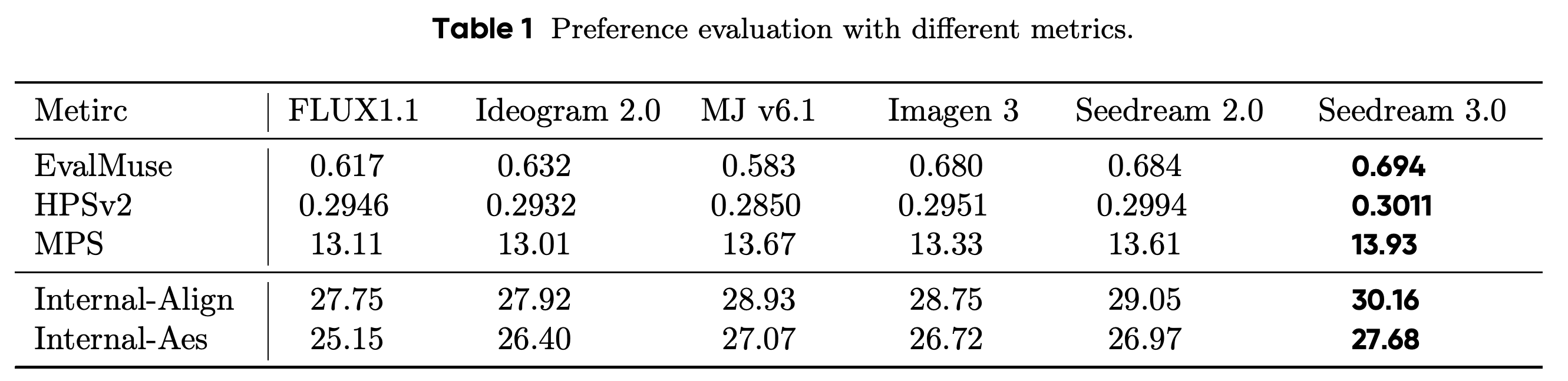
3.2.2 Automatic Evaluation reports the highest scores among the listed models on all five metrics: EvalMuse, a text-image alignment evaluator, reaches 0.694; HPSv2, Human Preference Score v2, reaches 0.3011; MPS, a multidimensional human-preference metric, reaches 13.93; and Internal-Align and Internal-Aes, the authors’ alignment and aesthetic evaluators, reach 30.16 and 27.68. Seedream 2.0 scores 0.684, 0.2994, 13.61, 29.05, and 26.97, respectively.
- Table 1 uses Ideogram 2.0 to maintain continuity with earlier reported evaluations, while the human comparison uses Ideogram 3.0.
- The table supplies point estimates without uncertainty, so it establishes the displayed ordering but not the statistical significance of the differences.
Seedream 3.0 has the highest displayed value on all five metrics, including EvalMuse at 0.694 and HPSv2 at 0.3011. The table provides no uncertainty estimates and uses Ideogram 2.0 rather than the version used in the human comparison.
The prompt requires a frightened foreground boy and a calm boy behind him. The outputs illustrate whether models preserve distinct expressions and spatial roles within one scene.
The selected breakdancing outputs expose differences in limb configuration and contact with the ground. The requested Y2K style refers to clothing associated with the turn of the millennium.
The prompt assigns each eye a different color and pairs it with the opposite hair color on the same side. The example tests whether each color remains attached to the requested feature while retaining a realistic portrait.
The sticker row tests matching expressions to “Happy,” “Cool,” “Shy,” and “Surprise.” The lower row requests three views of a chibi character, a stylized figure with exaggerated proportions, testing consistency across views.
3.3 Text Rendering
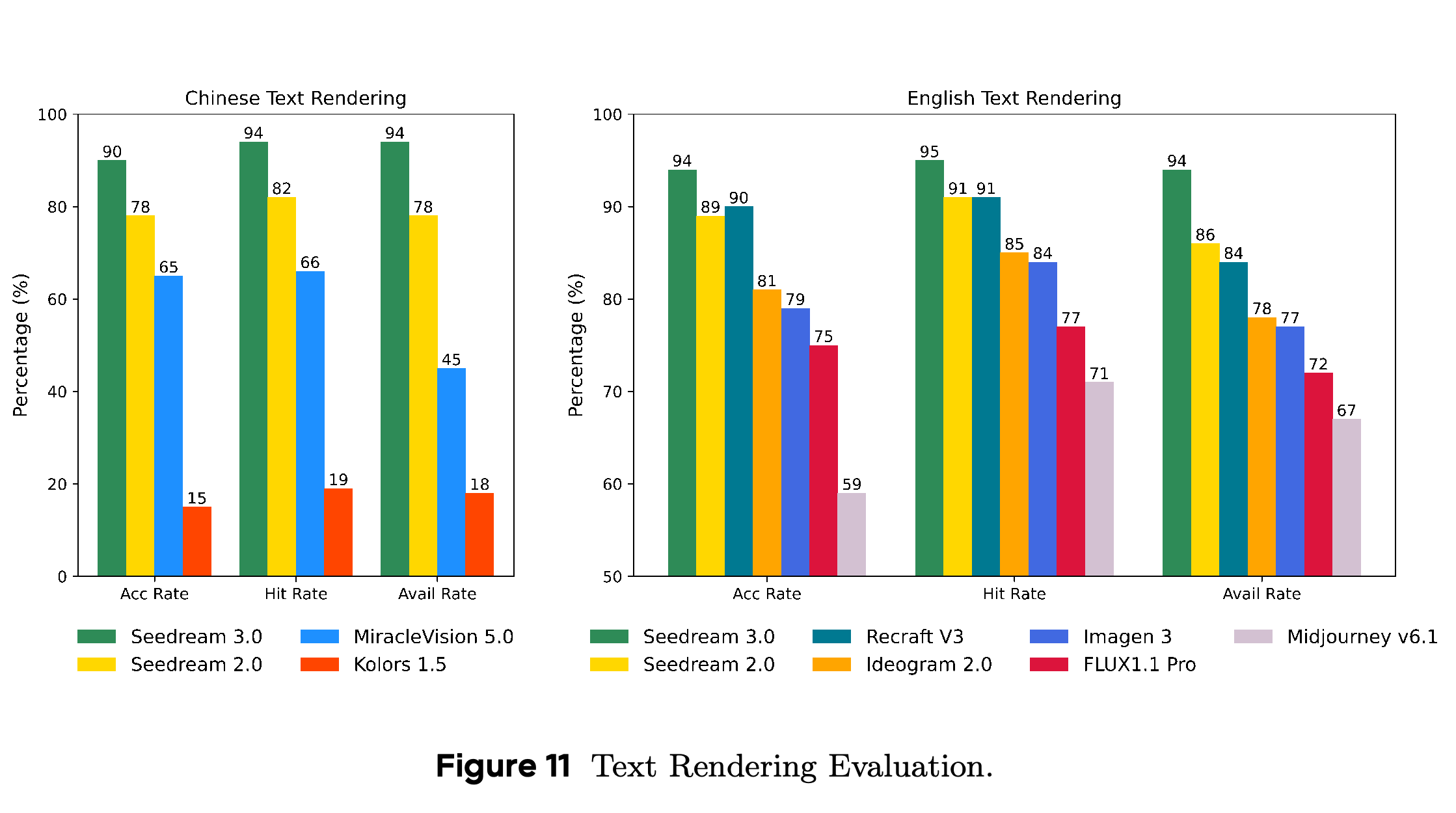
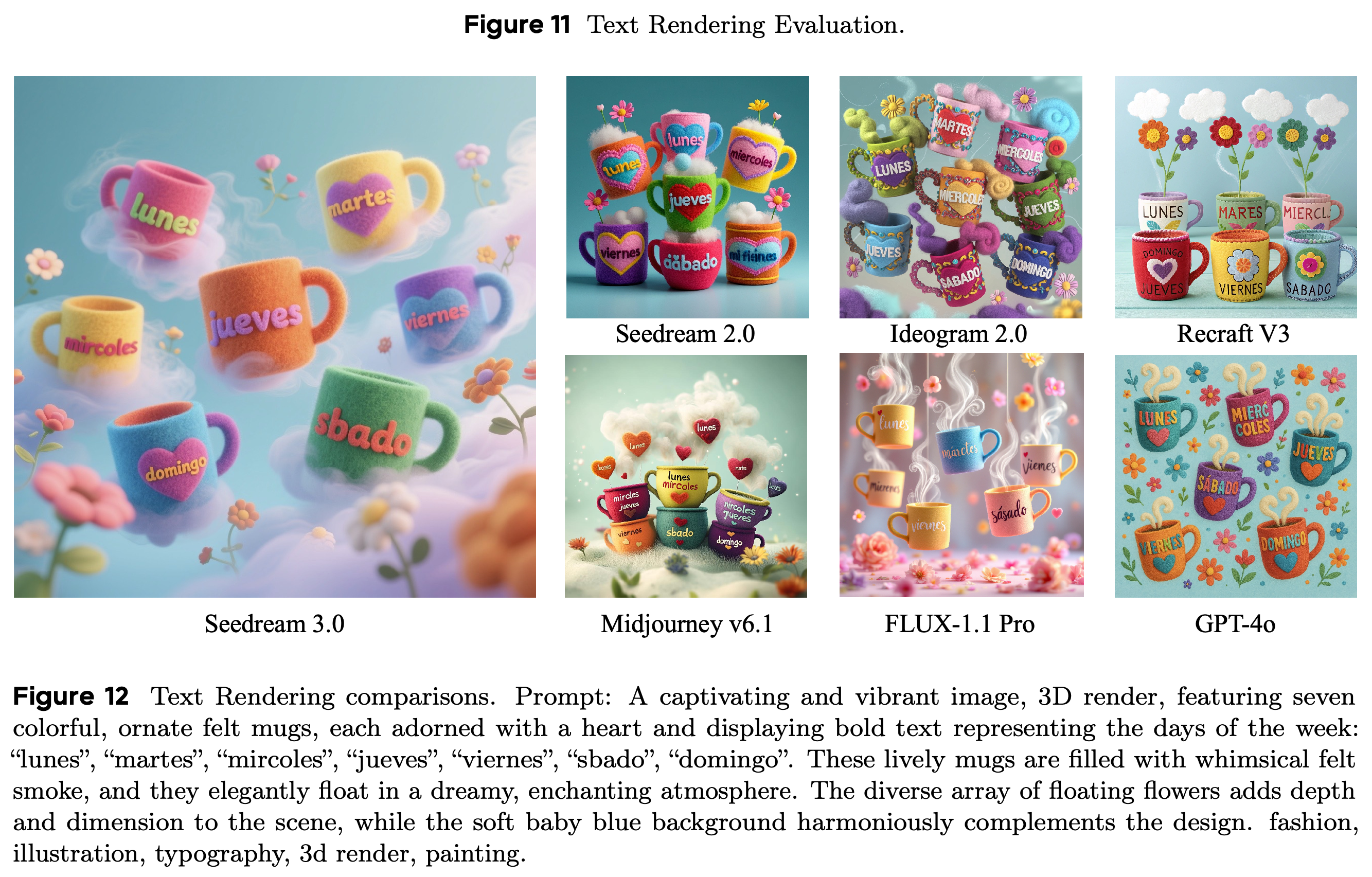
The text-rendering benchmark contains 180 Chinese and 180 English prompts covering logos, posters, electronic displays, printed text, and handwriting. Seedream 3.0 achieves Chinese accuracy, hit rate, and availability of 90%, 94%, and 94%, versus Seedream 2.0’s 78%, 82%, and 78%; English results are 94%, 95%, and 94%, versus 89%, 91%, and 86%.
- Accuracy is \(R_a=\left(1-\frac{N_e}{N}\right)\times100\%\), where N is the number of target characters and N_e is the minimum number of character edits needed to match the rendered and target text. Hit rate is \(R_h=\frac{N_c}{N}\times100\%\), where N_c counts correctly rendered characters.
- Availability considers text correctness, integration with other content, and overall aesthetics. Chinese availability rises by 16 percentage points, and English availability rises by 8 percentage points.
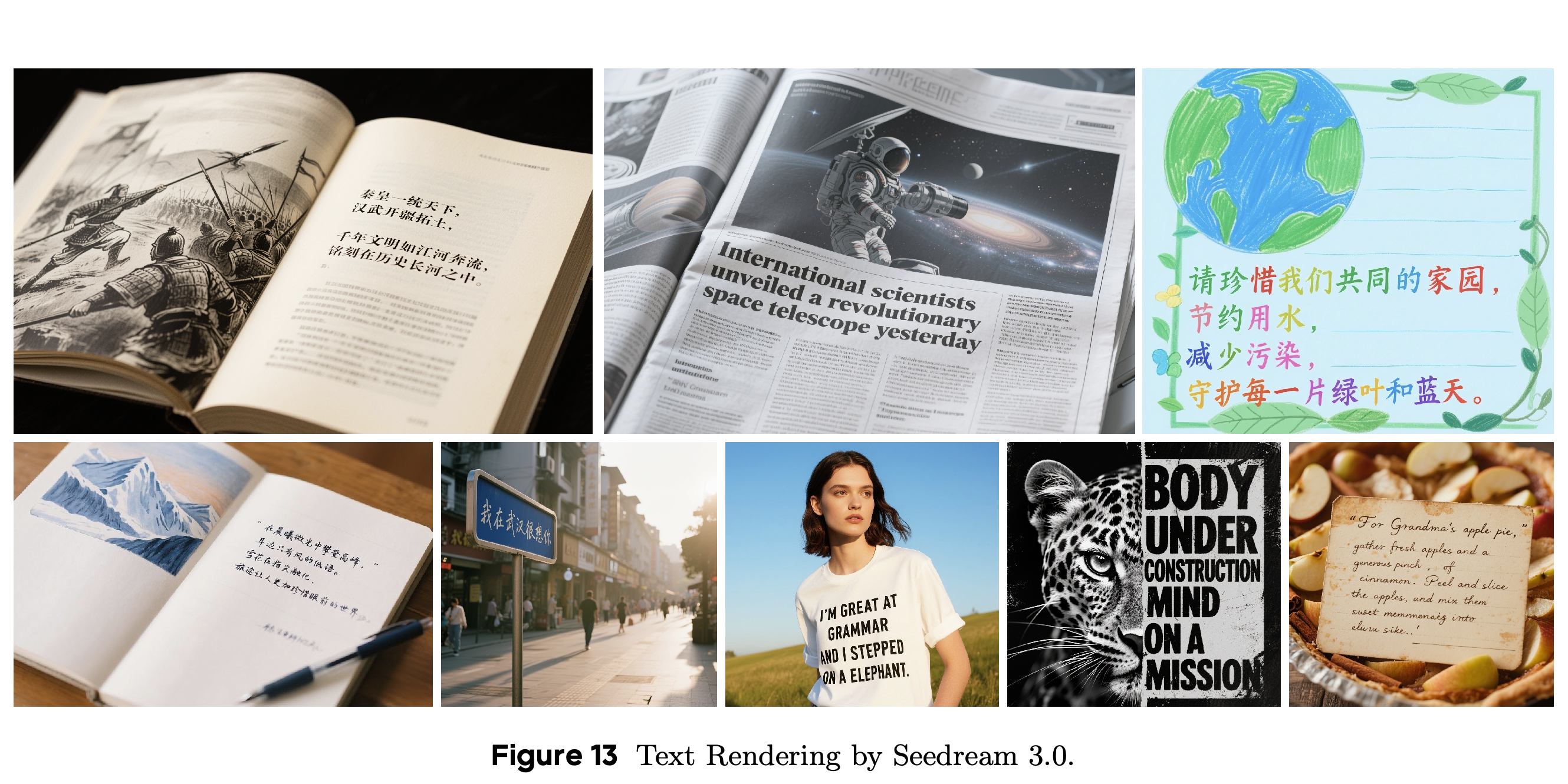
- Figures 12 and 13 illustrate text distributed across objects and dense text, meaning long passages of small characters, on books, newspapers, clothing, signs, and handwritten materials. The 94% availability result applies to this benchmark and still includes rendering failures.
Chinese availability increases from 78% to 94%, while English availability increases from 86% to 94% relative to Seedream 2.0. Accuracy and hit rate also improve, separating character correctness from overall image acceptability.
Seven mugs must carry distinct requested strings while retaining a felt-like appearance and coherent composition. Spellings such as “mircoles” and “sbado” are present in the source prompt and should be judged against that request.
The examples place text on books, newspapers, clothing, signs, and handwritten materials. They illustrate integration with perspective and physical media beyond isolated lettering.
3.4 Photorealistic Portrait
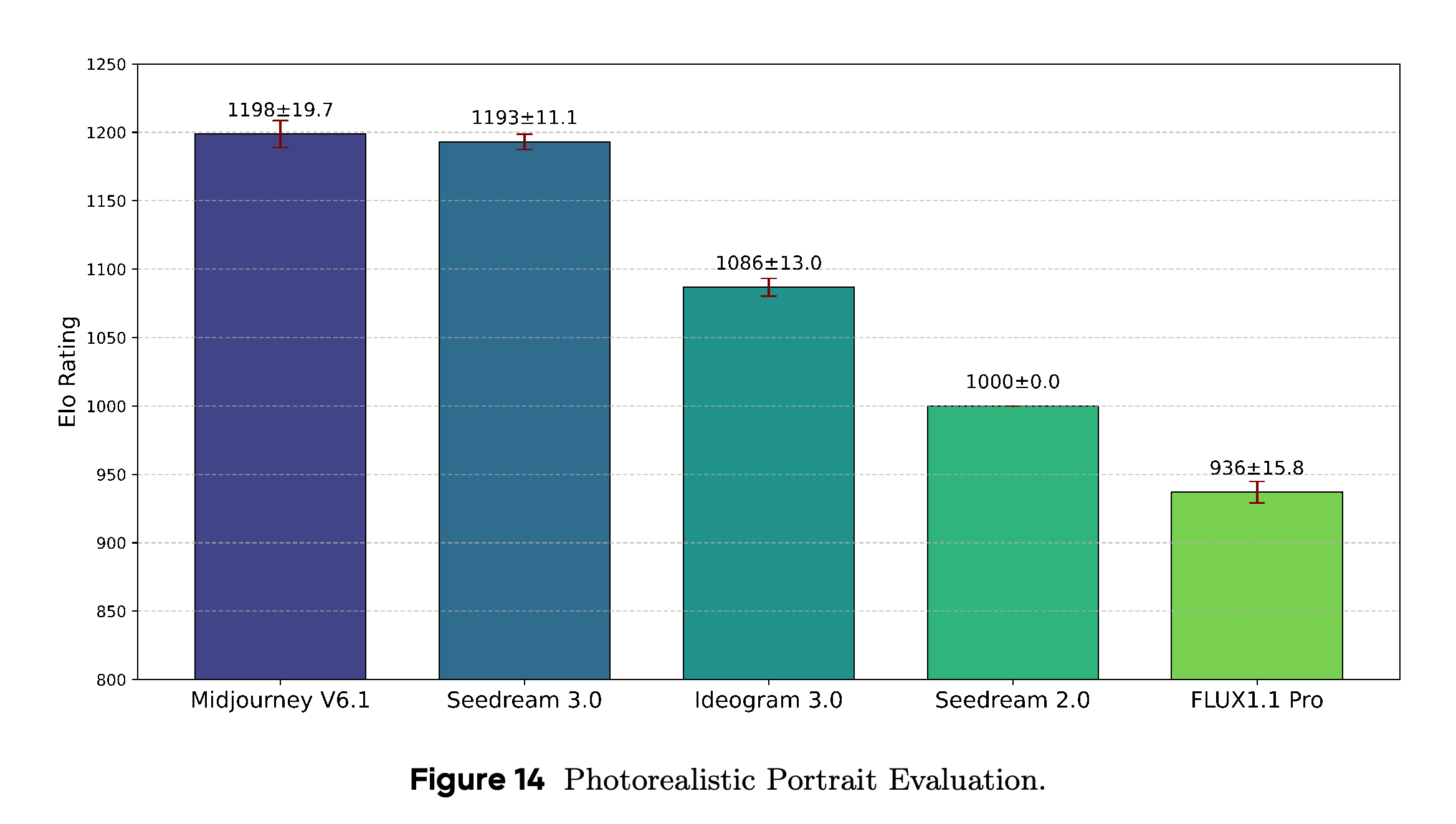
Portrait evaluation uses 100 prompts covering expressions, poses, viewpoints, hair, skin texture, clothing, and accessories, with more than 50,000 public pairwise comparison rounds focused on realism and emotion. Seedream 3.0 scores 1193±11.1 Elo and Midjourney v6.1 scores 1198±19.7, compared with Ideogram 3.0 at 1086±13.0, Seedream 2.0 at 1000±0.0, and FLUX1.1 Pro at 936±15.8.
- Seedream 3.0 and Midjourney v6.1 have close point estimates and overlapping displayed uncertainty ranges; the authors describe both as ranking first. They attribute stronger skin texture to Seedream 3.0 and stronger emotional expression to Midjourney.
- Midjourney images were generated over multiple rounds to avoid overly artistic or abstract outputs. This model-specific selection procedure affects how the comparison should be interpreted.
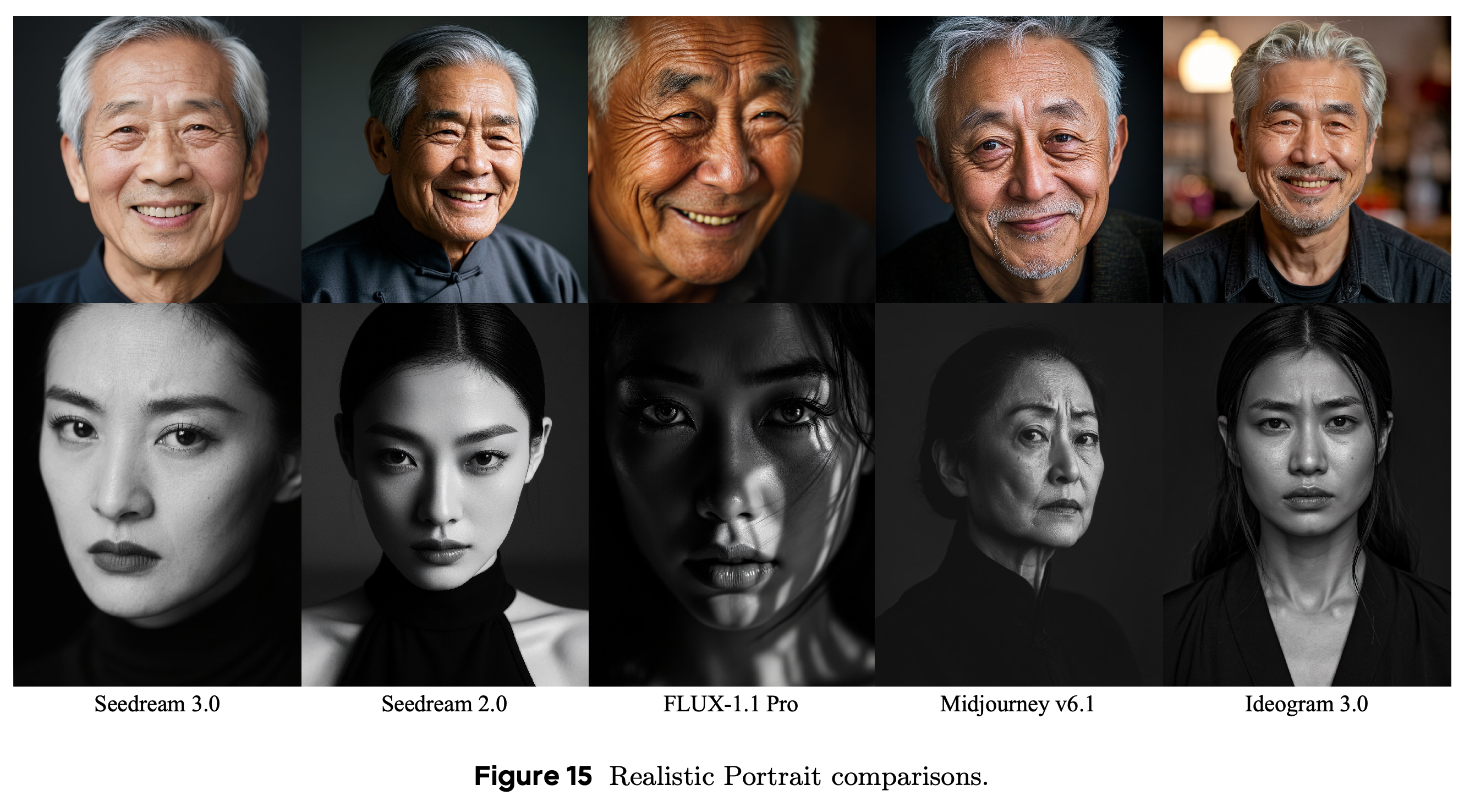
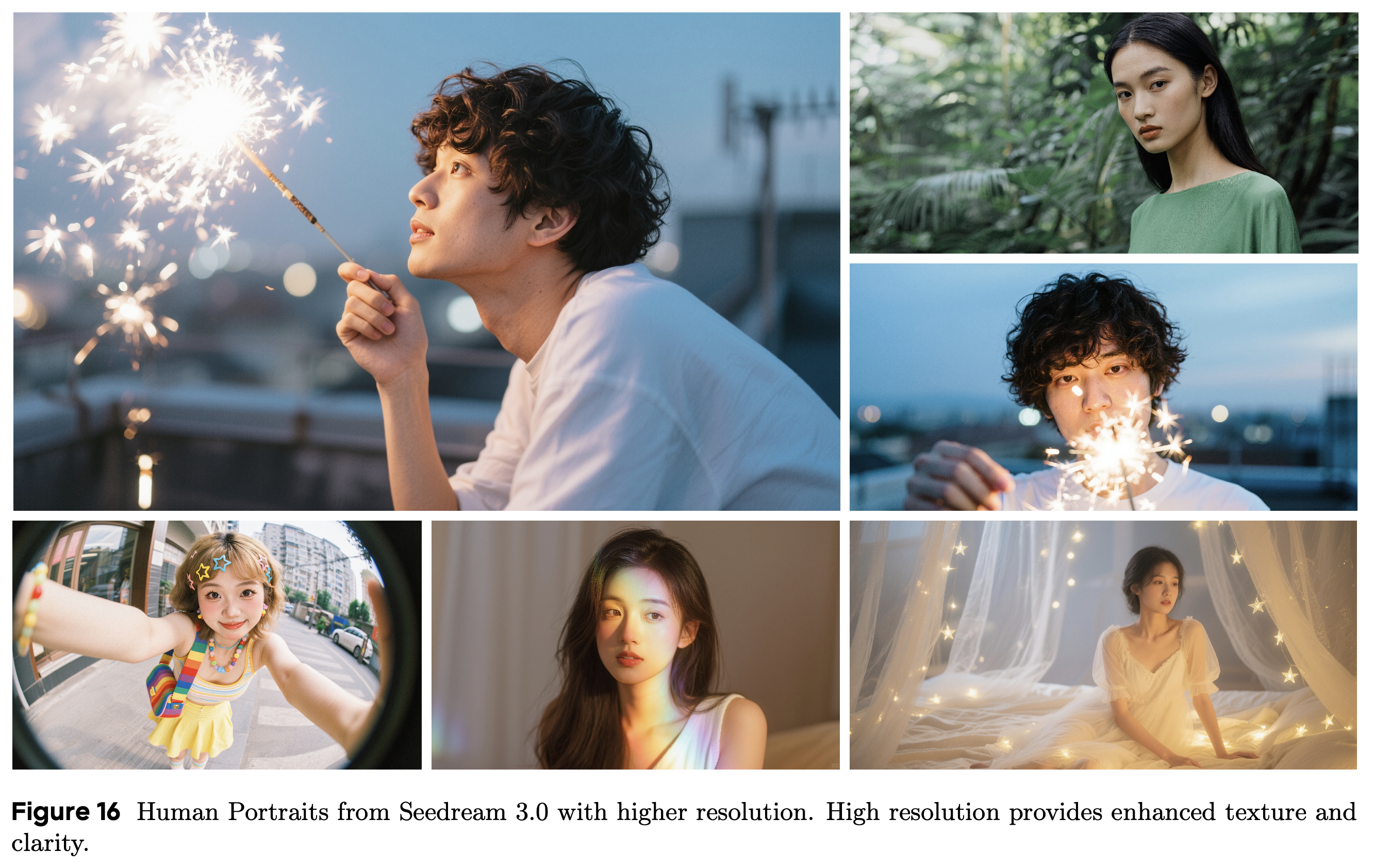
- Figures 15 and 16 illustrate portrait texture and native high-resolution outputs, including 2048×2048 generation. They provide no paired experiment isolating resolution’s effect.
Seedream 3.0 at 1193±11.1 and Midjourney v6.1 at 1198±19.7 have overlapping displayed uncertainty ranges. Both have substantially higher point estimates than the other displayed models in this portrait preference evaluation.
The portraits illustrate differences in skin texture, lighting, and expression across models. These factors vary together, so the examples do not isolate texture’s contribution to preference.
The portraits show varied lighting, framing, and skin detail in native high-resolution generation. No paired lower-resolution baseline quantifies the benefit of increased resolution.
3.5 Comparison with GPT-4o
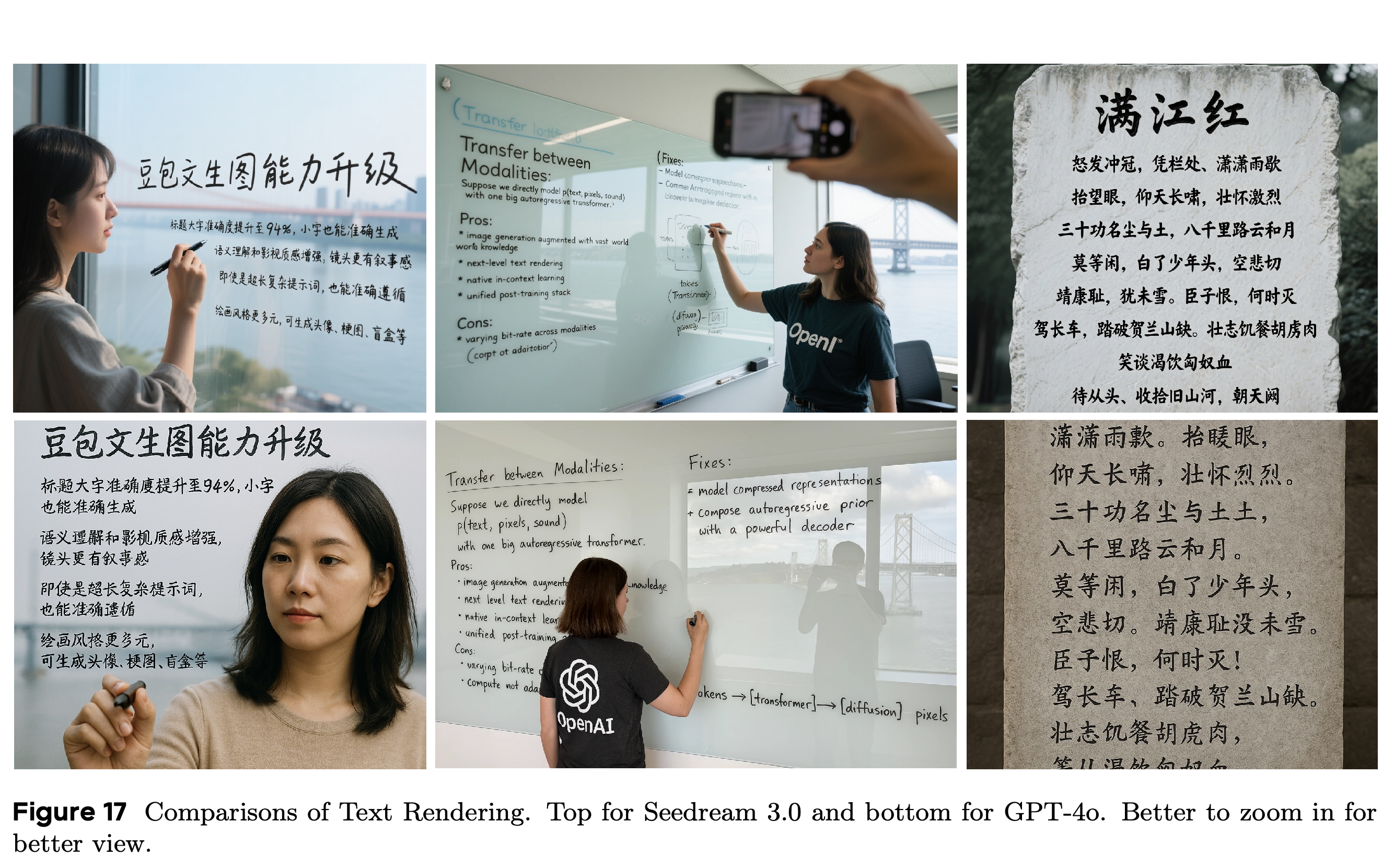
The report limits its direct GPT-4o comparison to selected cases because an application programming interface (API) for large-scale image generation was unavailable during the study. In 3.5.1 Dense Text Rendering, the authors describe GPT-4o as strong on small English characters and some LaTeX mathematical typesetting symbols, while the displayed examples favor Seedream 3.0 for dense Chinese text, typesetting, and composition.
The pairs compare dense writing on glass, a whiteboard, and stone. They illustrate the authors’ observations about Chinese text and layout within a comparison explicitly limited to selected cases.
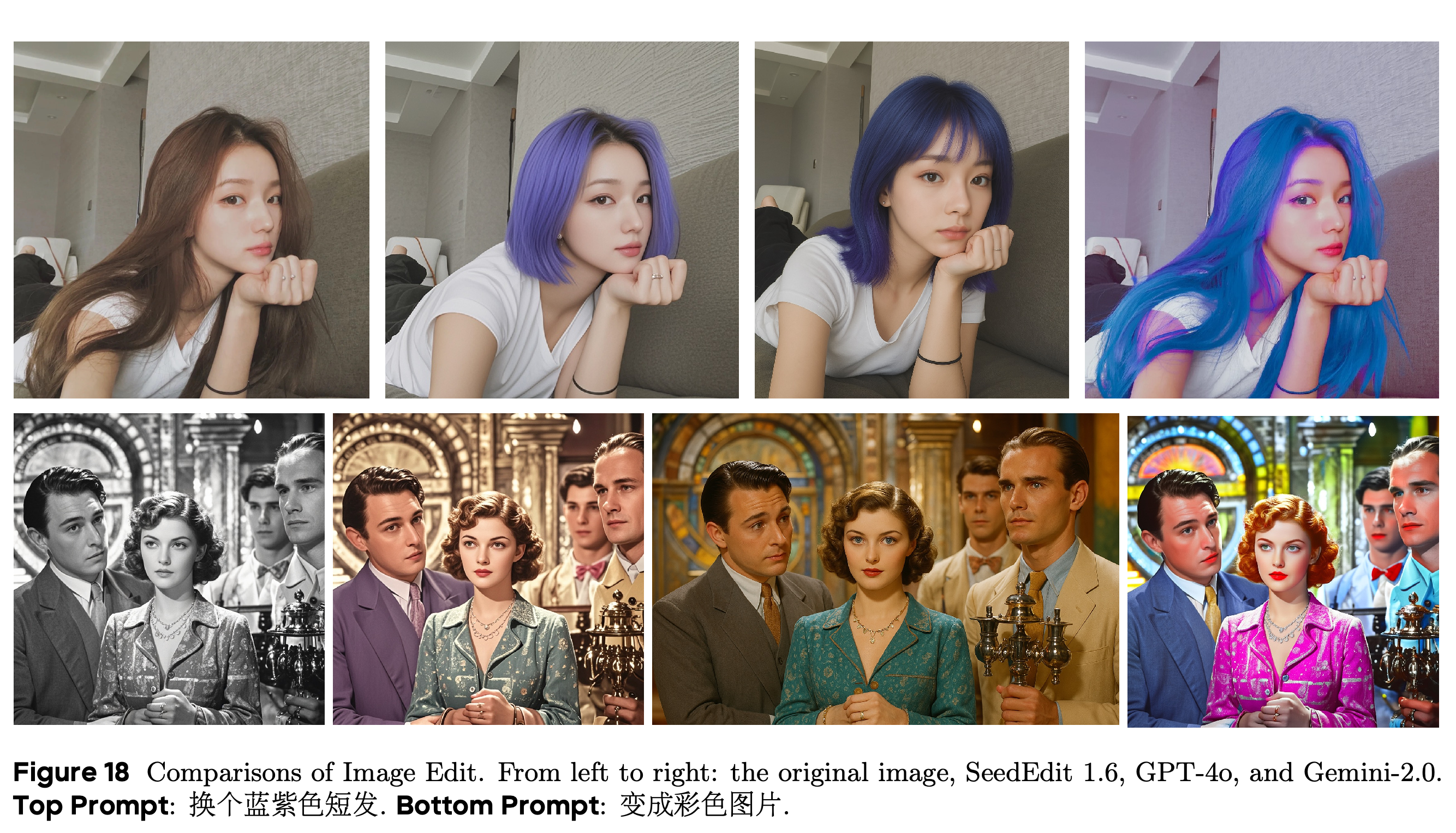
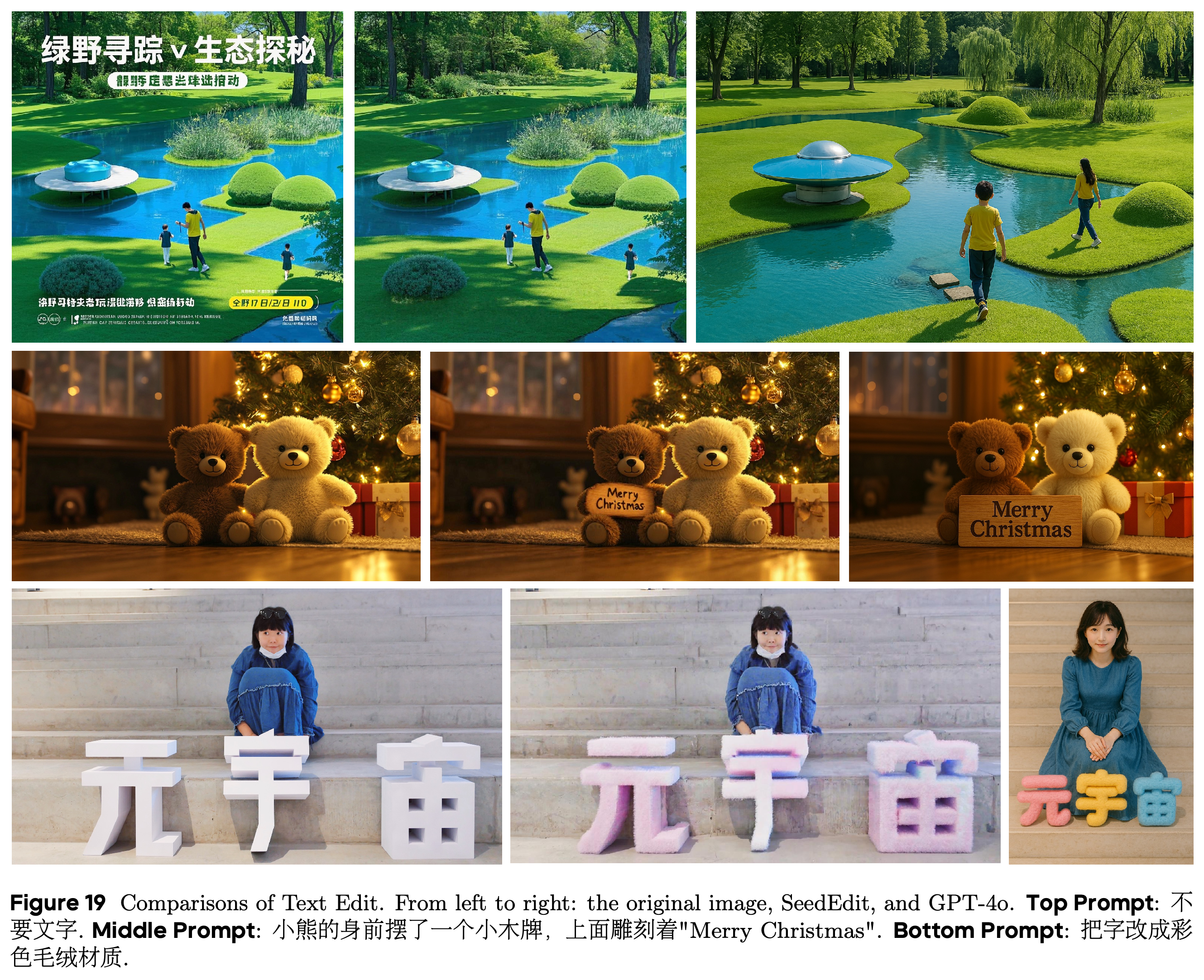
3.5.2 Image Editing compares SeedEdit 1.6, an editing model derived from Seedream, with GPT-4o and Gemini-2.0 using selected single-round edits. Examples cover hairstyle changes, colorization, text removal, text addition, and changing text material; the authors favor SeedEdit’s preservation of identity and surrounding image content.
- The report describes GPT-4o as flexible in following editing requests but prone to changing the original image, and Gemini-2.0 as preserving image content while sometimes producing unnatural colors or lower image quality.
- SeedEdit still has limitations with multiple reference images and multiround editing. These observations concern the derived editing model.
The hairstyle and colorization edits reveal differences in changes to faces, scene content, and color. The SeedEdit 1.6 examples evaluate the derived editing model rather than editing by the base Seedream 3.0 generator.
The examples test removing text, adding a wooden “Merry Christmas” sign, and changing existing characters to colorful plush material. They show how fulfilling the requested edit can coincide with changes to surrounding image content.
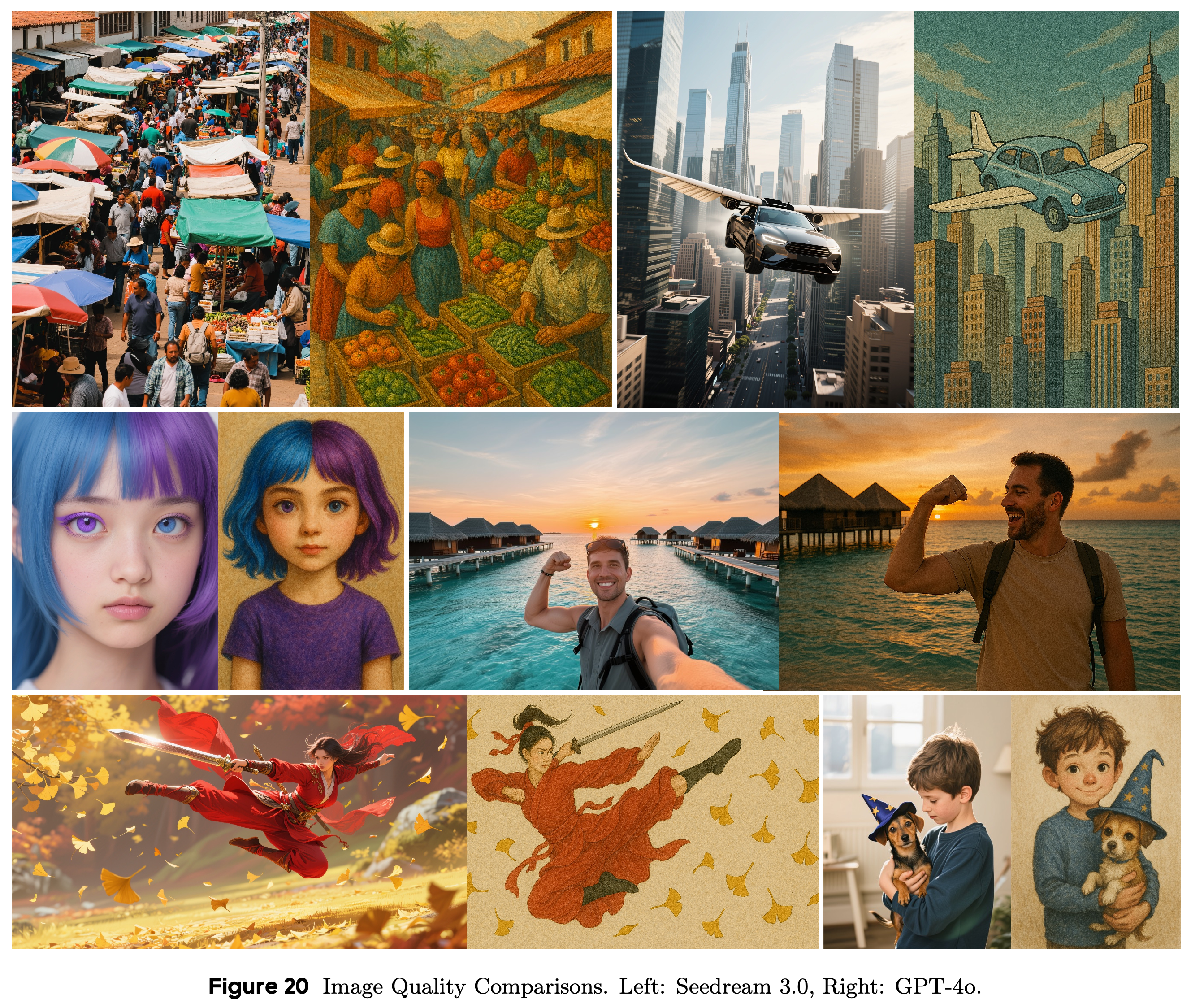
3.5.3 Generation Quality presents paired examples in which the authors identify a darker yellow hue and more visible noise in GPT-4o outputs. These selected cases illustrate differences in color, texture, clarity, and style, but provide no systematic estimate of how frequently those differences occur.
The selected pairs show differences in color, texture, and rendering style that motivate the authors’ quality discussion. Their selection does not establish a general quality ranking across prompts.
4 Conclusion
The conclusion attributes improved prompt adherence, typography, aesthetics, native high-resolution output, and generation speed to coordinated changes across the full pipeline. It also notes deployment through Doubao and Jimeng.
Appendix
- A Contributions and Acknowledgments lists participants alphabetically by surname under A.1 Core Contributors and A.2 Contributors. The appendix contains contributor credits and no additional experiments or implementation details.
Brief Thoughts
Recovering clean regions from otherwise discarded images, connecting positional information across image and text, and supervising aesthetics through detailed captions are concrete engineering ideas in this report. The bilingual rendering results support the complete system, while the absence of component ablations, generator size, training compute, and detailed acceleration measurements limits reproducibility and attribution of the gains. The reported evaluations support improvements over Seedream 2.0. The near-tied Arena snapshot and selected direct comparisons do not establish a decisive advantage over GPT-4o.