

Gamma-World: Generative Multi-Agent World Modeling Beyond Two Players | Summary
27 May 2026 | Paper Review Multi-Agent World Models Interactive World Models Sparse Attention Diffusion AccelerationContents
- Summary
- 1. Introduction
- 2. Related Work
- 3. Method
- 4. Experiments
- 5. Discussion
- Appendix
- Brief Thoughts
This article explains the key points of Gamma-World: Generative Multi-Agent World Modeling Beyond Two Players.
- 2026-05-27 (arXiv)
- Liu, Fangfu, He, Kai, Shen, Tianchang, Cao, Tianshi, Fidler, Sanja, Duan, Yueqi, Gao, Jun, Gilitschenski, Igor, Wang, Zian, Ren, Xuanchi.
- NVIDIA, Tsinghua University, University of Toronto, Vector Institute
- Paper
- Project Page
Summary
- Gamma-World: Generative Multi-Agent World Modeling Beyond Two Players addresses synchronized, action-conditioned video generation for agents acting in a shared environment. The model must maintain agreement across agent perspectives and time while allowing independent control without learned per-player slot identities.
- γ-World combines Simplex Rotary Agent Encoding, which assigns agents distinct phases from a regular simplex, with Sparse Hub Attention, which routes cross-agent communication through shared hub tokens. A bidirectional teacher, a separately pretrained causal student, and conditional Self-Forcing distillation support few-step, KV-cached streaming generation reported at 24 FPS.
- Minecraft evaluations report lower FVD and FID than frame concatenation and Solaris across five evaluation categories, while qualitative examples demonstrate generalization from two to four players without additional training. Four-player generation and real-world robotic coordination are evaluated qualitatively; the model does not explicitly enforce geometry or physical constraints.
1. Introduction
The introduction identifies two obstacles to extending video world models beyond two agents: dense joint attention scales quadratically with agent count, and learned per-slot identities bind exchangeable agents to a fixed roster. γ-World replaces these choices with simplex-based rotary identities and hub-mediated communication.
- Shared-world consistency requires an action in one stream to have compatible consequences in other agents’ observations, in addition to ordinary temporal coherence.
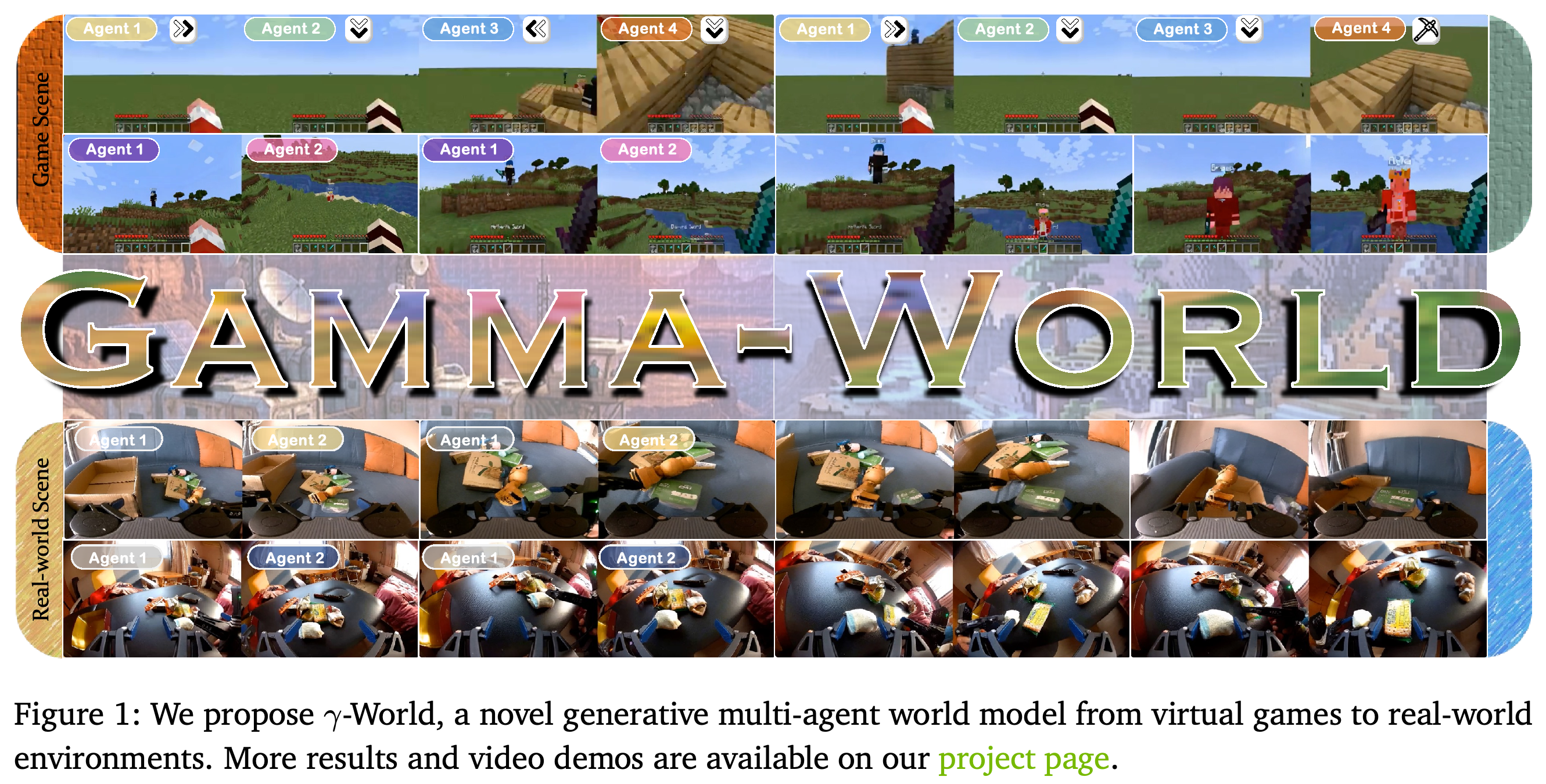
- Figure 1 previews multiplayer Minecraft and real-world robotic examples. The project page is research.nvidia.com/gamma-world.
The montage separates gameplay from real-world robotic examples and presents multiple agent observations rather than one merged output. It previews two- and four-player gameplay and paired robotic views, but provides no controlled comparison.
2. Related Work
The related work connects γ-World to latent video generation, action-conditioned video world models, and diffusion distillation. Its contribution is a multi-agent representation and communication design built on existing video diffusion and causal rollout methods, rather than a new video backbone.
- Video generation. Latent diffusion provides efficient visual synthesis, while autoregressive approaches support extending generation over time.
- Video world models. The paper distinguishes direct prediction of future visual observations from compact abstract-state models used for planning, and reviews applications in robotics, games, driving, and physical simulation.
- Video diffusion model distillation. The review contrasts adversarial and score-distillation approaches, then discusses CausVid’s bidirectional-to-causal transfer and Self-Forcing’s use of generated histories to reduce rollout exposure bias.
3. Method
The task is to predict the next observation for each of P agents from synchronized observation and action histories. Observations at a given time are different perspectives of the same underlying world; γ-World jointly generates the streams using an explicit agent axis, rotary identity encoding, and constrained cross-agent attention.
- Initial observations provide visual context, while each agent supplies a separate action sequence.
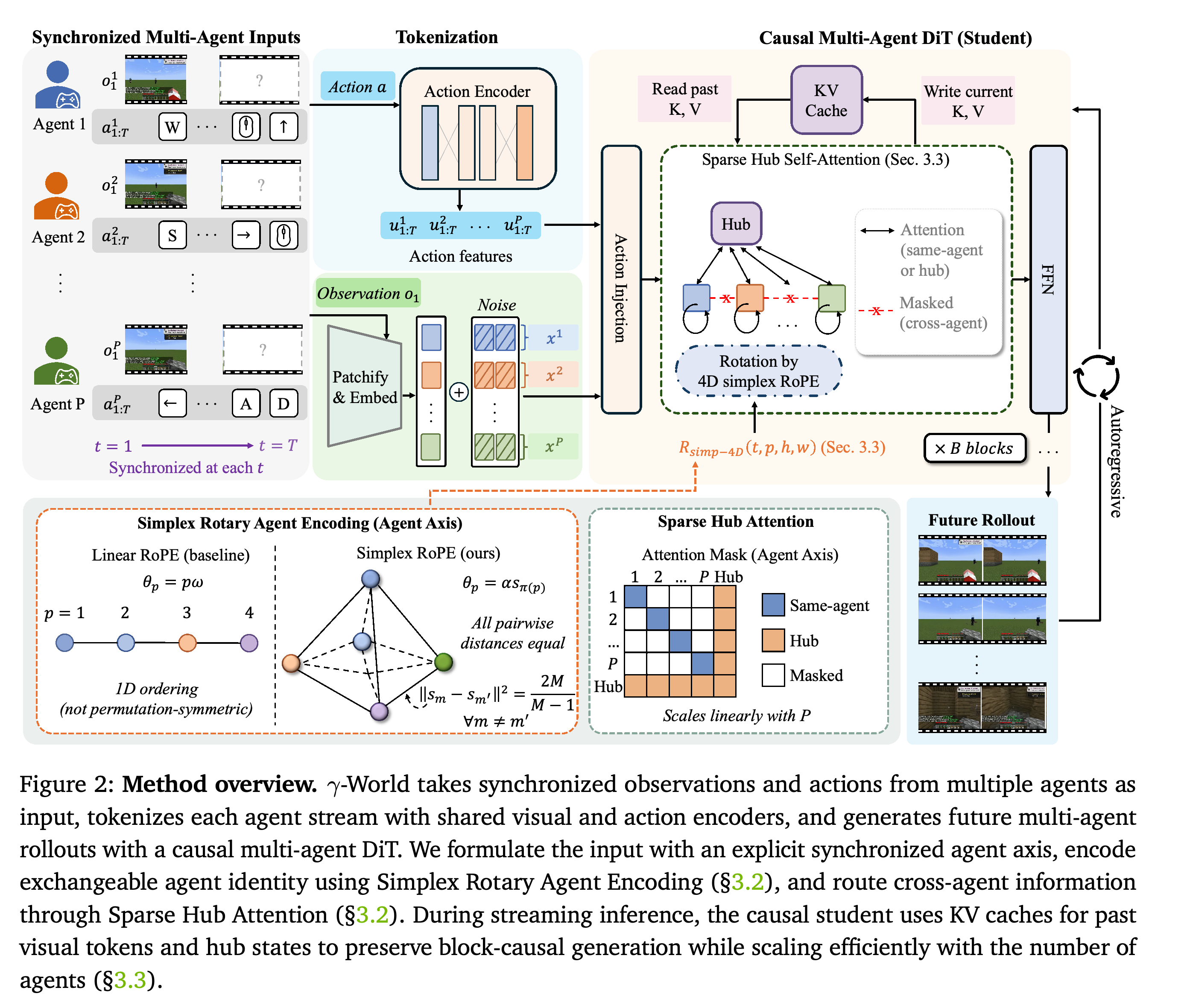
- Figure 2 connects shared visual and action tokenization to the causal multi-agent DiT, simplex rotations, hub-mediated attention, and streaming KV caches. Section 3.3 gives the detailed three-stage training recipe.
The diagram traces independent action inputs through shared encoders into per-agent visual streams. Its lower panels show simplex-based rotary identity and the attention mask that replaces direct cross-agent links with hub communication; cached visual and hub states carry history into subsequent causal blocks.
3.1. Preliminaries
Latent video diffusion uses flow matching: zσ = (1 − σ)z0 + σε, where ε is Gaussian noise and σ ∈ [0, 1]. The velocity model predicts ε − z0 under conditioning that includes initial observations and agent actions.
- Causal autoregressive video generation. Temporal blocks receive independently sampled noise levels; attention is bidirectional within a block but cannot access future blocks.
- Rotary Position Embedding (RoPE). Standard video RoPE separates temporal, height, and width rotation bands. The multi-agent model extends this factorized position encoding with an agent band.
3.2. Model Design
Action conditioning. A shared encoder maps each agent’s actions to hidden features, and layer-specific projections add these features as biases to the corresponding agent and frame tokens before self-attention. Sharing the encoder and projections gives the same action the same representation regardless of agent slot.
- The multi-agent latent has shape P × T × H × W × Cz, preserving separate streams rather than enlarging a single spatial canvas.
- Discrete or multi-component controls are embedded and combined with lightweight MLPs; action biases are broadcast across the spatial tokens of the relevant frame.
Simplex Rotary Agent Encoding extends RoPE with an agent rotation band and assigns active agents to distinct vertices of a fixed regular simplex pool. For pool size V, the construction requires V ≤ dp/2 + 1; vertices have unit norm and squared pairwise distance 2V/(V − 1), with agent angles θp = αsπ(p).
- Random injective assignments during training discourage fixed-slot specialization. Additional agents use unused pool vertices at inference, so supported agent count remains bounded by the configured pool.
- The implemented pool has four vertices. Training activates two randomly selected vertices and additionally permutes agent slots.
- Following ReRoPE, the agent band uses low-frequency temporal RoPE dimensions while retaining high-frequency temporal and spatial bands. The equidistance proof concerns the encoding geometry, not permutation equivariance of the entire trained network.
Sparse Hub Attention masks direct attention between different agent streams. Agent tokens attend to their own stream and shared hub tokens, while hubs attend to all agents and other hubs, producing an agent → hub → agent communication path.
- The hub topology is composed with block causality. Hubs use the temporal phase of their associated frame and identity rotations for agent and spatial bands.
- With L = HW spatial tokens per frame, dense attention costs O(P²n²L²), whereas hub attention costs O(PnL(nL + nK)) + O(nK(PnL + nK)). This is linear in P for fixed n, L, and K.
- The implementation uses K = 8 learnable hub tokens per latent frame. Hubs are internal communication states and are removed from the output.
3.3. Model Training and Inference
Training begins with two separately pretrained models. The bidirectional teacher learns conditional multi-agent denoising with dense full-context attention and one shared noise level; the causal student receives full multi-step Diffusion Forcing training with block-causal Sparse Hub Attention.
- Bidirectional teacher. First-frame observations and per-agent actions condition the teacher, which can access future frames and all agent streams and is therefore not suitable for online generation.
- Causal student. Each temporal block receives an independent noise level. The student is trained as a complete multi-step generator before distillation, rather than receiving only a short causal warm-up.
Conditional Self-Forcing distillation trains the few-step student on its own autoregressive rollouts using distribution matching distillation (DMD). Teacher and student receive the same first-frame observations and per-agent actions so that distribution matching retains the specified conditional generation task.
- Generated blocks are written into KV caches and reused as subsequent history, matching the deployment rollout process.
- KV-cached streaming inference maintains separate agent caches and a shared hub cache. Agents read their own history and hub states; hubs read all agent histories and previous hub states.
- The paper reports streaming at 24 FPS. A rolling window of 24 latent frames per view bounds cache growth independently of rollout length, but the PDF does not specify the hardware or active agent count for the 24-FPS claim.
4. Experiments
Experimental setup. Synchronized Minecraft trajectories are collected through scripted episodes, coordinated bots, and aligned visual-action recording. Teacher and student start from Cosmos-Predict2.5-2B TI2V and train on two-agent gameplay at 320 × 480 per view; four-agent scenes test generation beyond the training agent count.
- FVD and FID assess generated video and image distributions; LPIPS, PSNR, and SSIM assess perceptual and reconstruction quality.
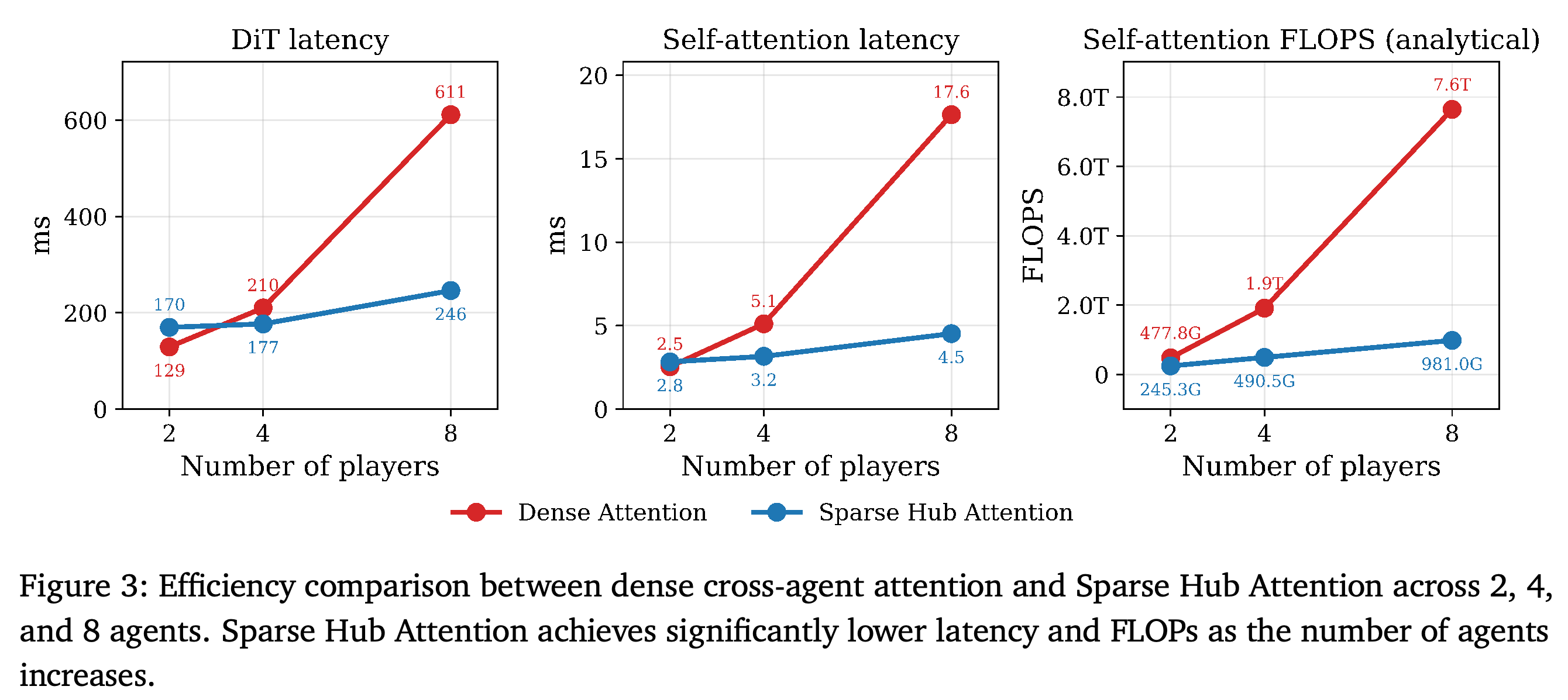
- Scalability measurements include DiT latency, self-attention latency, and analytical self-attention FLOPs as agent count changes.
- The PDF does not specify dataset size, evaluation sample counts, or detailed definitions of the five evaluation protocols, limiting reproducibility and interpretation of protocol-level results.
4.1. Quantitative Results
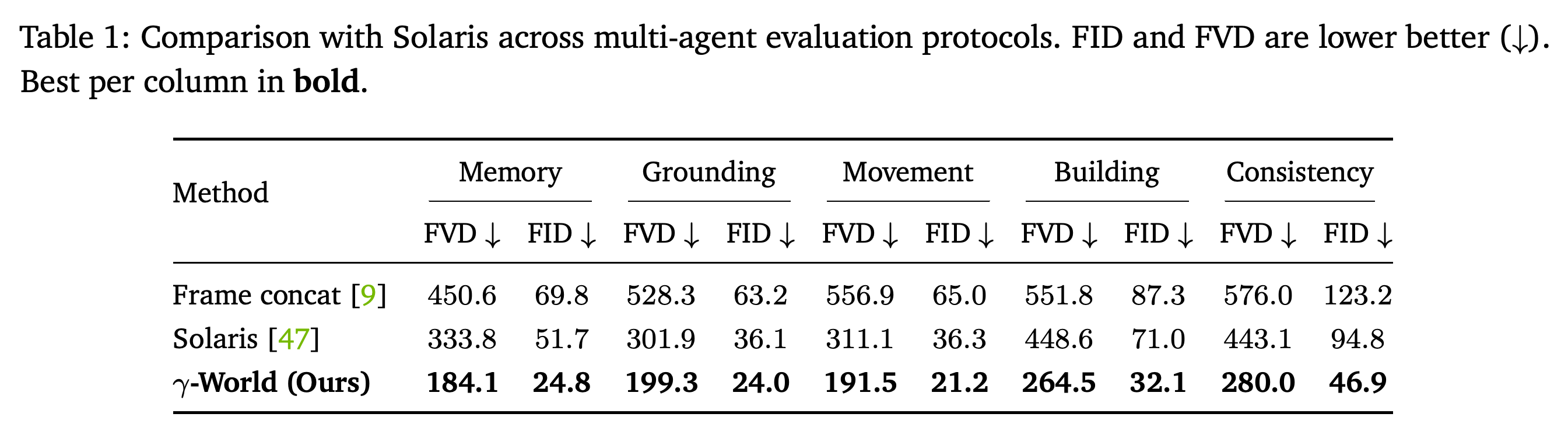
Comparison with multi-agent baselines. Table 1 reports the lowest FVD and FID for γ-World in Memory, Grounding, Movement, Building, and Consistency. In that order, its FVD values are 184.1, 199.3, 191.5, 264.5, and 280.0, compared with Solaris values of 333.8, 301.9, 311.1, 448.6, and 443.1.
- γ-World’s corresponding FID values are 24.8, 24.0, 21.2, 32.1, and 46.9; Solaris reports 51.7, 36.1, 36.3, 71.0, and 94.8.
- Frame concatenation performs worse than both methods in every reported column.
- These results demonstrate improvements in the reported visual distribution metrics. The PDF provides no dedicated numerical measures of action adherence or cross-view geometric consistency.
γ-World has lower FVD and FID than both baselines in all five categories. In Consistency, Solaris’s FVD 443.1 and FID 94.8 fall to 280.0 and 46.9; these remain visual distribution metrics under a named evaluation protocol, not direct geometric consistency measurements.
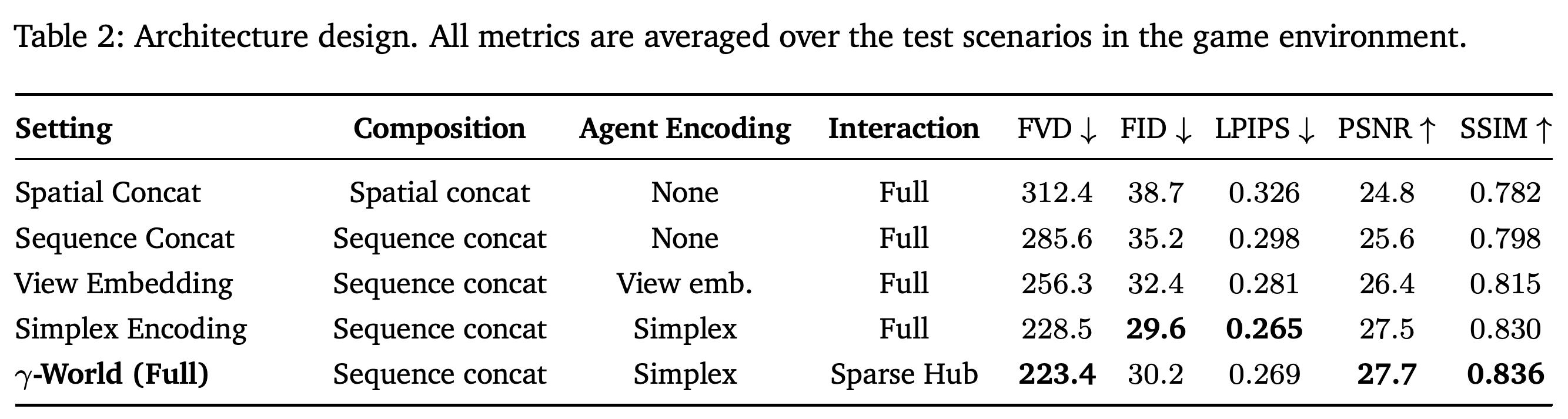
Architecture ablations. Table 2 reports FVD 312.4 with Spatial Concat, 285.6 with Sequence Concat, 256.3 with learned View Embedding, and 228.5 with Simplex Encoding under full attention. Adding Sparse Hub Attention yields FVD 223.4, PSNR 27.7, and SSIM 0.836.
- Keeping streams separate improves all reported metrics over spatial concatenation, and simplex encoding improves all five metrics over learned view embeddings.
- Hub attention does not improve every metric over dense simplex attention: FID changes from 29.6 to 30.2 and LPIPS from 0.265 to 0.269.
- The sparse design therefore preserves competitive quality rather than producing uniform metric gains.
The ablation separates input composition, identity encoding, and interaction topology. Simplex encoding improves all five metrics over learned view embeddings. Replacing dense simplex attention with hubs improves FVD, PSNR, and SSIM but slightly worsens FID and LPIPS.
Efficiency of Sparse Hub Attention. Figure 3 averages latency over 3 full rollouts to 24 latent frames with full KV cache; FLOPs are analytical estimates using average rollout token length. At 8 agents, hub attention reduces DiT latency from 611 ms to 246 ms and self-attention latency from 17.6 ms to 4.5 ms.
- At 2, 4, and 8 agents, dense self-attention FLOPs are 477.8G, 1.9T, and 7.6T; hub attention uses 245.3G, 490.5G, and 981.0G.
- The sparse implementation is slower at 2 agents: DiT latency is 170 ms versus 129 ms, and attention latency is 2.8 ms versus 2.5 ms. At 4 agents, the corresponding sparse and dense values are 177 ms versus 210 ms and 3.2 ms versus 5.1 ms.
- The 8-agent measurement is a computational benchmark, not evidence of validated 8-agent generation quality. The documented checkpoint’s identity pool supports up to 4 agents.
Analytical FLOPs grow quadratically for dense attention and linearly for the hub topology. Measured latency shows a crossover: hubs are slower at two players, but at eight players reduce DiT latency from 611 ms to 246 ms and attention latency from 17.6 ms to 4.5 ms.
4.2. Qualitative Results
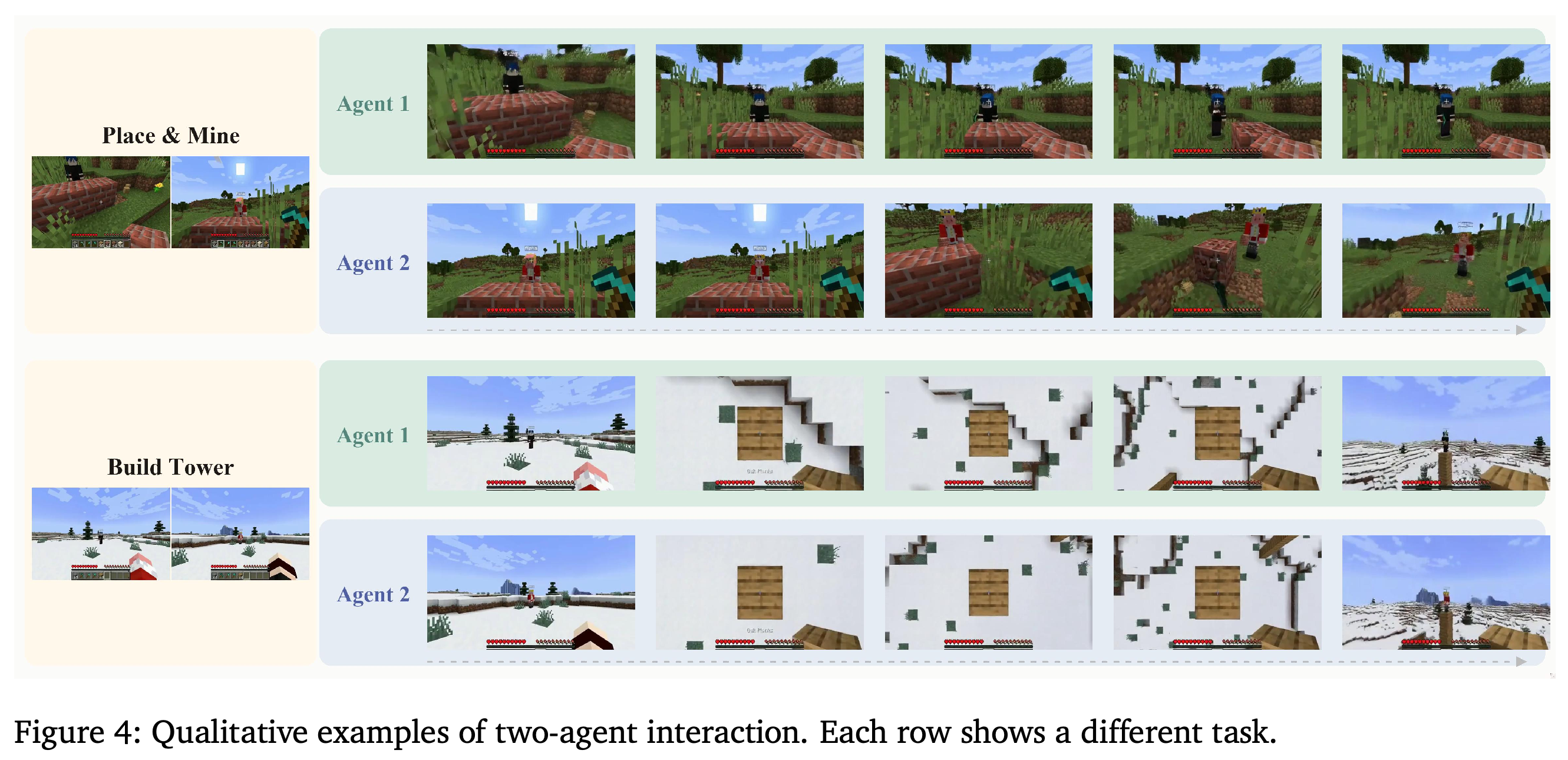
Two-agent interaction. Figure 4 shows paired rollouts for Place & Mine and Build Tower, illustrating changes in a shared scene from distinct viewpoints. The authors also report that objects and agents remain grounded when temporarily outside another agent’s field of view.
- These examples support qualitative cross-view coupling, but do not establish an explicit shared physical state or quantify long-horizon consistency.
The Place & Mine and Build Tower panels pair two agent streams as the environment changes. They illustrate cross-view interaction, but the selected frames do not quantify action adherence or long-term consistency.
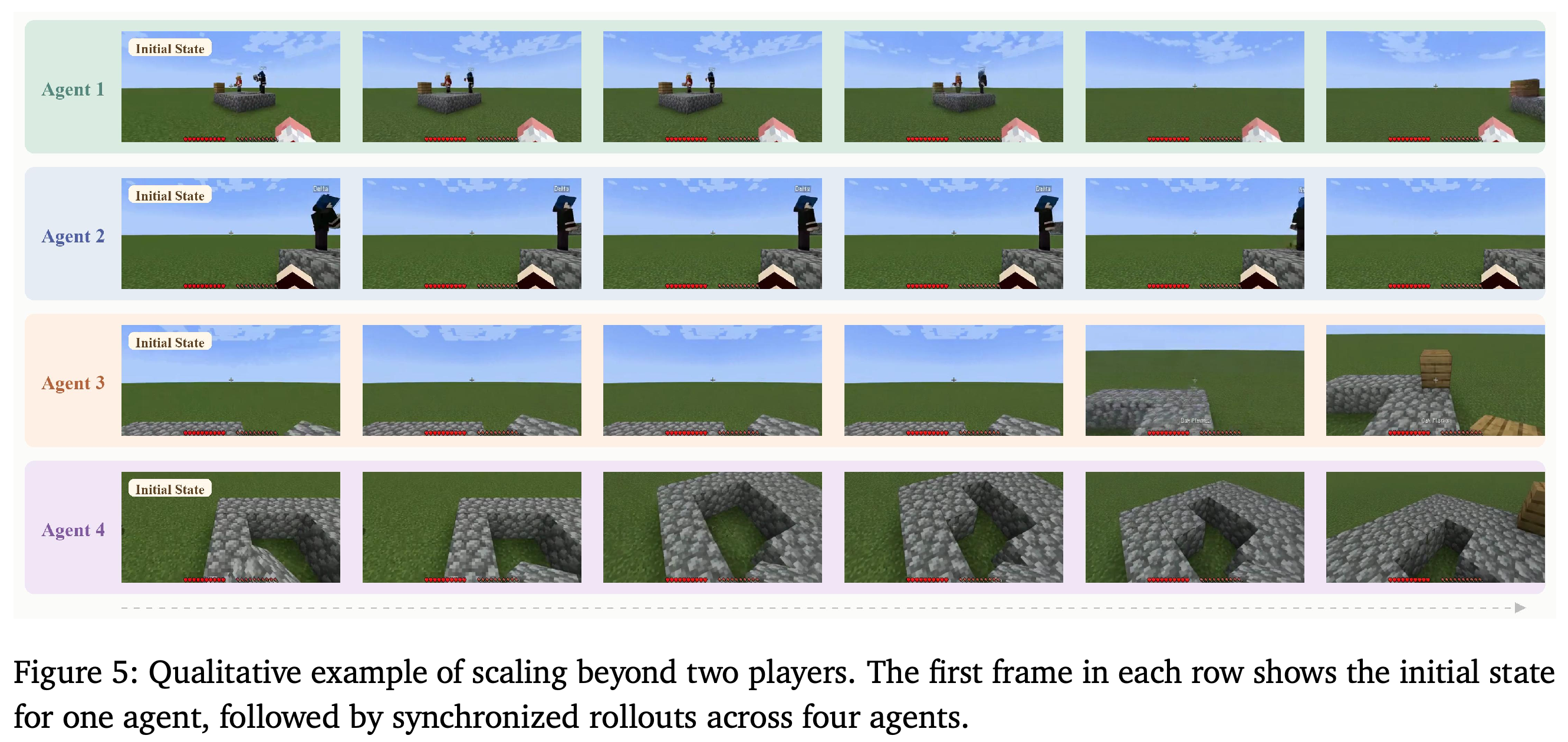
Scaling beyond two players. Figure 5 presents four synchronized agent streams generated by a checkpoint trained only on two-agent data. Additional agents occupy unused simplex vertices, while hubs provide communication without changing the transformer architecture.
- This is zero-shot generalization in active agent count within a four-vertex pool, not unrestricted population scaling.
- The PDF provides illustrative four-player rollouts but no separate four-player quantitative quality comparison.
Four rows show initial observations followed by synchronized generated views from a model trained with only two active agents. The example illustrates activating additional identities within the four-vertex pool, without providing a quantitative four-player evaluation.
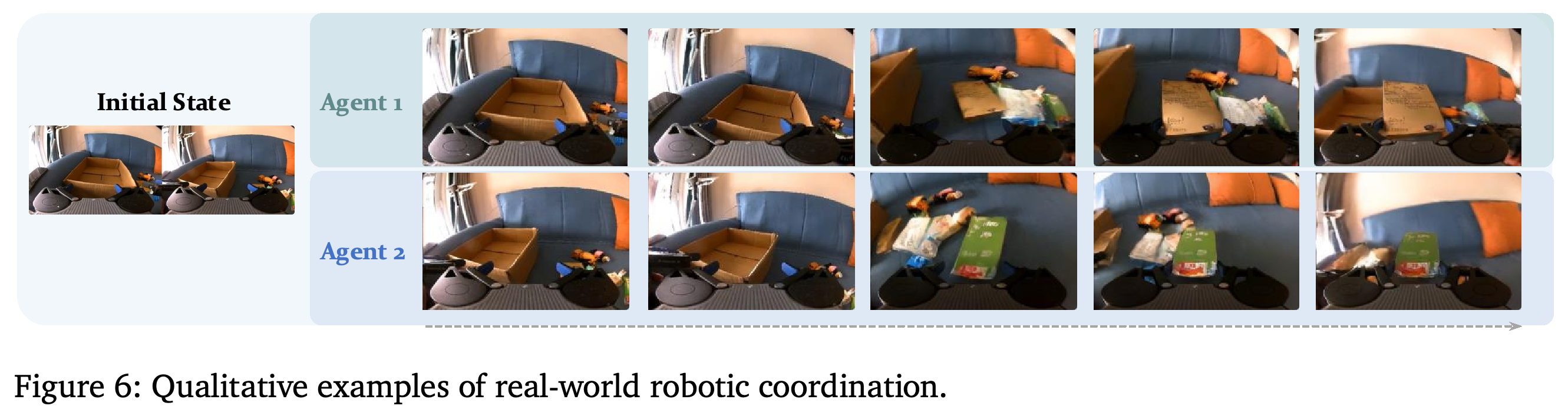
Real-world robotics applications. Figure 6 uses the RealOmin-Open Dataset, treating left and right robot arms as two interacting agents. The generated examples depict coordinated manipulation around shared objects.
- The robotic examples extend the formulation beyond Minecraft, but the PDF does not report robotics-specific quantitative metrics or detailed training conditions.
- They do not establish that the gameplay checkpoint transfers to robotics without domain training.
The paired streams depict robotic manipulation around shared objects from an initially specified scene. The paper treats left and right robot arms as interacting agents, but the visualization does not measure task success or physical accuracy.
5. Discussion
The discussion attributes multi-agent streaming generation to the combination of rotary identity encoding, sparse communication, conditional distillation, and KV caching. Limitations. Evaluation is concentrated on gaming and robotic examples, the identity pool bounds supported agent counts, and the absence of explicit 3D geometry or physical constraints leaves long rollouts vulnerable to accumulated inconsistencies.
- Broader validation in complex, heterogeneous, and long-horizon settings remains future work in the paper.
- Very large populations may require wider rotary bands or hierarchical agent grouping; activating unused vertices only extends generation within the existing pool.
Appendix
- A. More Visualizations describes supplementary videos containing extended 24-second multi-agent rollouts, baseline comparisons, and real-world robotic coordination. These supplement the static examples, but the PDF does not provide numerical long-horizon consistency measurements.
- B. Proof of Simplex Equidistance derives unit-norm simplex vertices with inner product −1/(V − 1) for distinct vertices and squared distance 2V/(V − 1). Equidistance is exact in angle space; in complex RoPE space it is approximate for sufficiently small coordinate-wise angle differences in the general embedding, and exact for the stated zero-padded centered one-hot construction when dp/2 ≥ V.
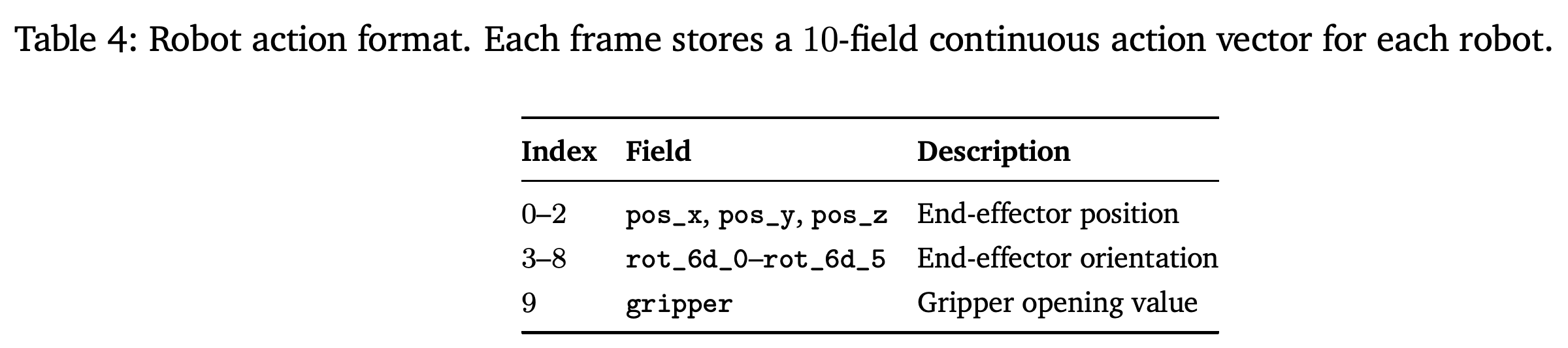
- C. More Architecture and C.1. Action Design specify domain-dependent action traces synchronized with frames and supplied separately for each agent. Game action format. Table 3 defines 25 fields: 23 discrete controls plus cameraX and cameraY. Robot action format. Table 4 defines 10 continuous fields: pos_x, pos_y, pos_z, rot_6d_0–rot_6d_5, and gripper.
- D. Additional Implementation Details—Architecture. Teacher and student use hidden dimension 2048, 28 transformer blocks, 16 attention heads of dimension 128, MLP ratio 4, and AdaLN-LoRA rank 256. The rotary head split is (64, 32, 16, 16) over (t, p, h, w); the student uses 8 hubs per latent frame and a 24-latent-frame local attention window per view. The gameplay action encoder uses two 128-dimensional modality branches, a fusion MLP, a 4×-stride 1D temporal convolution, and a projection to hidden dimension 2048.
- Stages 1 and 2 – Bidirectional teacher and causal student pretraining. The teacher trains for 10,000 iterations on 93-frame clips, then 6,000 iterations on 189-frame clips; the student trains for 15,000 iterations on 93-frame clips. Each uses 32 NVIDIA GB200s, AdamW with learning rate 3×10⁻⁵, weight decay 10⁻³, (β1, β2) = (0.0, 0.999), a 100-step warm-up, and gradient clipping at 0.1. Inference omits classifier-free guidance.
- Stage 3 – Self-Forcing distillation uses a trainable student, a frozen real score from the teacher, and a trainable fake score initialized from the teacher. Training runs for 400 iterations on 32 NVIDIA GB200s with 189-frame clips, denoising timesteps {1000, 750, 500, 250} warped by flow shift 5.0, context-noise level 128 for cache writes, and generator-to-critic updates at 1:4. AdamW uses student and critic learning rates of 2×10⁻⁶ and 4×10⁻⁷, weight decay 10⁻², and (β1, β2) = (0.0, 0.999). Inference retains the four-step schedule, training block size, and rolling 24-latent-frame cache window.
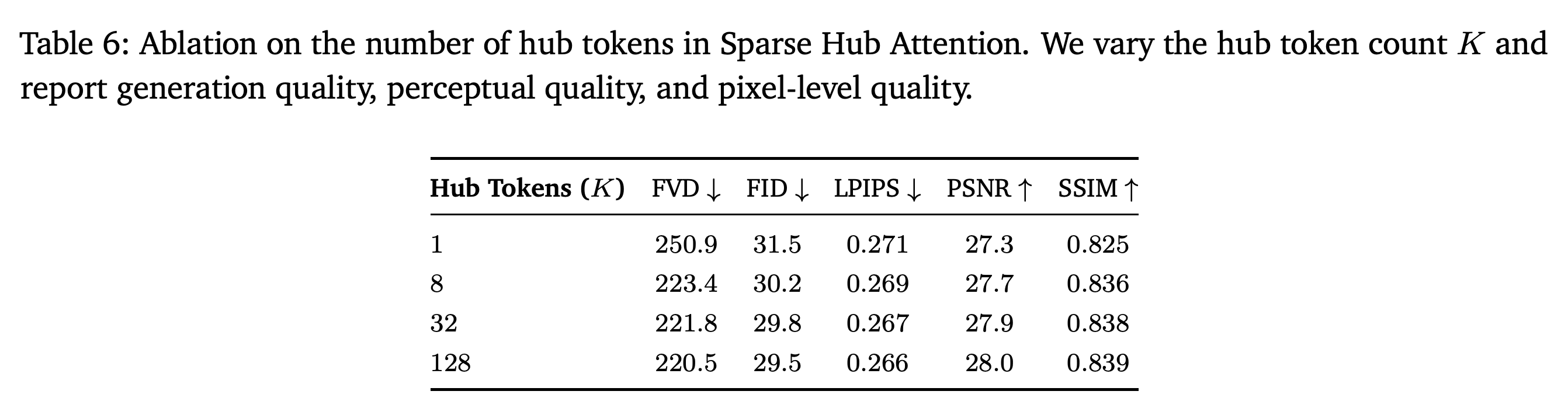
- E. Additional Ablations compares model variants in Table 5 and hub capacity in Table 6. Increasing K from 1 to 8 improves FVD from 250.9 to 223.4; further increases to 32 and 128 yield 221.8 and 220.5, with improvements in the other reported metrics. The sweep shows diminishing quality gains beyond K = 8, but does not report latency or memory for each hub count.
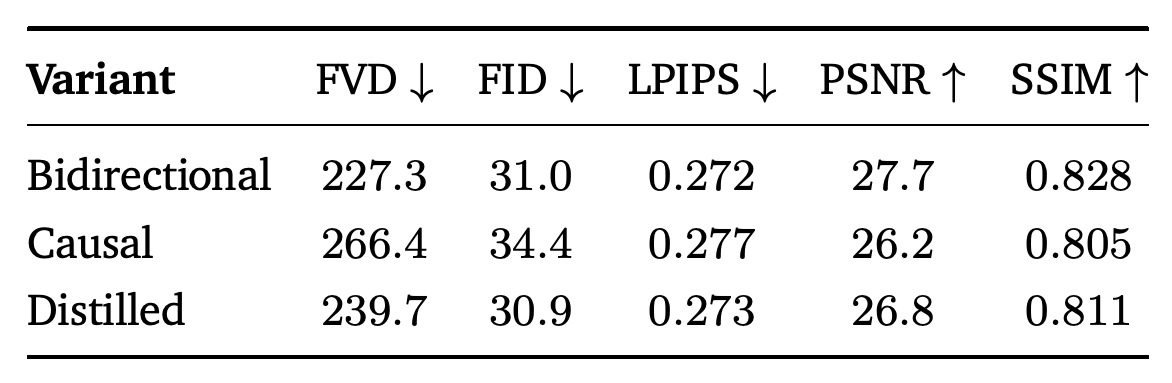
- F. More Experimental Results—F.1. Training Stage Comparison shows that distillation partially recovers the quality lost under causal generation. Table 5 reports FVD 227.3 for the bidirectional model, 266.4 for the causal model, and 239.7 for the distilled model. The distilled variant has the lowest FID at 30.9, while the teacher retains the best LPIPS, PSNR, and SSIM.
Brief Thoughts
The strongest contribution is the combination of a reusable identity pool with an attention topology whose agent-count cost is explicitly controlled. Tables 3 and 4 make independent agent conditioning concrete, while Table 2 and Figure 3 show competitive visual quality and lower computation at larger agent counts. The two-agent latency overhead is important when deciding whether sparsity benefits a particular deployment.
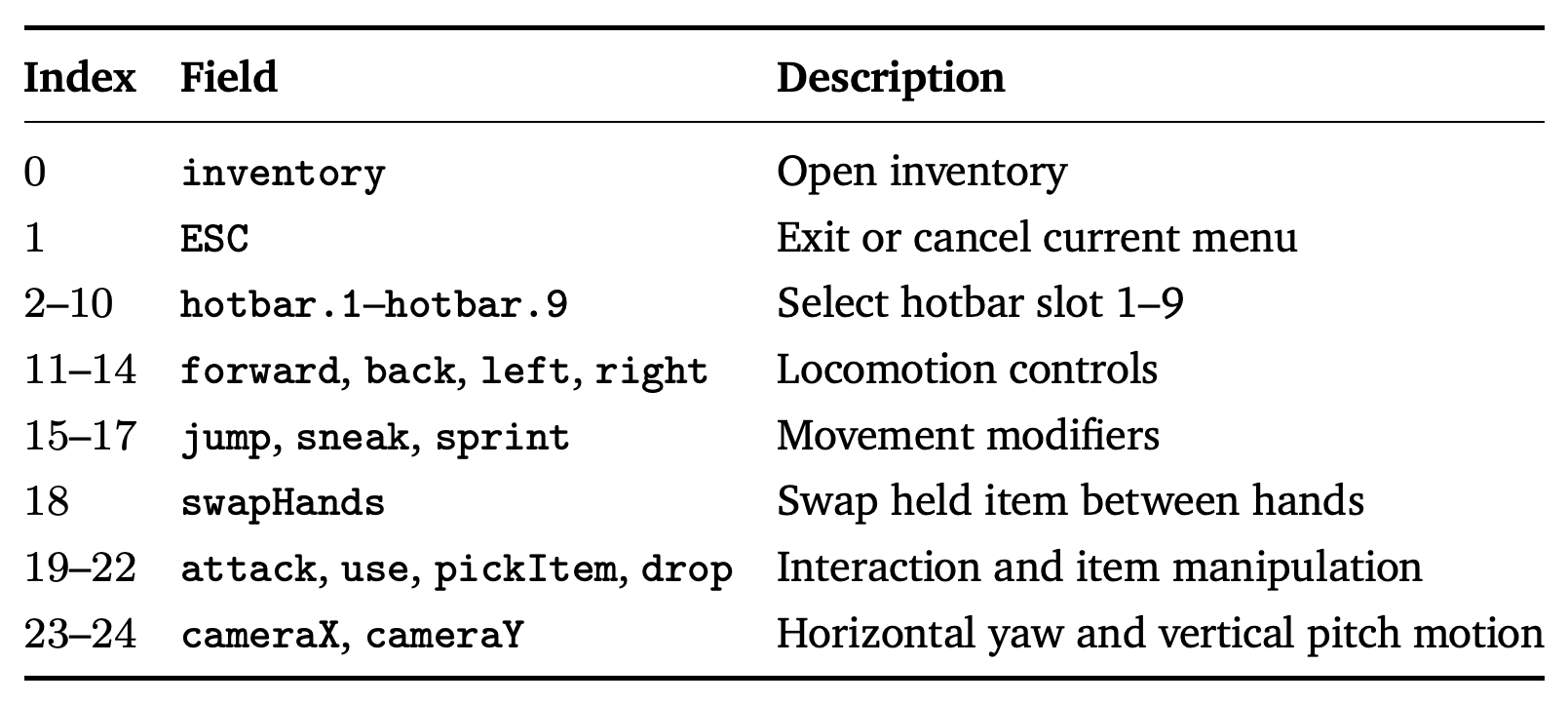
Indices 0–22 specify discrete controls for inventory, hotbar selection, locomotion, movement modifiers, and interaction. Indices 23–24 are cameraX and cameraY. Each agent receives its own temporally aligned 25-field action vector.
The robot schema supplies continuous end-effector conditioning: position occupies indices 0–2, 6D orientation occupies 3–8, and gripper opening occupies index 9. The same schema is used separately for the left and right robots.
The evidence supports a multi-view video generator more directly than a physically consistent multi-agent simulator: four-player and robotic results are qualitative, evaluation protocols are incompletely specified, and simplex equidistance does not prove full-network permutation equivariance. Tables 5 and 6 clarify distillation quality and hub capacity, but neither establishes long-horizon physical correctness or the deployment conditions behind the reported 24 FPS.
Distillation lowers causal FVD from 266.4 to 239.7, approaching but not matching the bidirectional value of 227.3. The distilled model has slightly better FID than the teacher, 30.9 versus 31.0, but worse LPIPS, PSNR, and SSIM, indicating partial rather than complete quality recovery.
Increasing hub count improves every reported metric, with the largest FVD improvement between K = 1 and K = 8. Increasing K from 8 to 128 changes FVD from 223.4 to 220.5 and SSIM from 0.836 to 0.839, showing diminishing quality returns without measuring the associated runtime cost.