


Monthly AI Papers: December 2025
31 Dec 2025 | Paper Review Monthly Papers Model Adaptation Residual Architectures Hierarchical Reinforcement LearningContents
Trends
December 2025’s theme is structured learning and control: the three selected papers examine how the placement of trainable components or constraints affects model behavior, stability, and cost. The agent-adaptation survey organizes changes to models, tools, and persistent memory; mHC constrains the residual stream, the representation passed between model layers; and the temporal-abstraction study learns controllers around a frozen action predictor. Together, they make the location of a change central to interpreting its effects. 1, 2, 3
Two papers connect reusable behavior with selective adaptation. The survey treats skills as procedural content that can be stored, invoked, and refined, and distinguishes tools trained independently from tools adapted using a fixed host model’s outputs. The temporal-abstraction study demonstrates a related separation inside a model: temporal abstractions, behaviors that persist across multiple timesteps, are discovered around a frozen predictor and then selected through reinforcement learning, learning from task rewards. This experimental support comes from controlled navigation tasks; it does not establish comparable benefits for large language models or general agent workflows.
The evidence also separates component diagnostics from complete-system outcomes. mHC measures amplification along residual connections alongside training loss and downstream scores; the temporal-abstraction study combines behavioral interventions with controller-switching ablations and sparse-reward learning curves. The survey recommends assessing tool quality separately from its contribution to final task performance. Cost comparisons require equally explicit boundaries: mHC’s small arithmetic overhead still creates memory-traffic costs, while the survey’s retrieval-efficiency comparison changes model backbones and architecture alongside the adaptation method.
Top Papers in December 2025
1. Adaptation of Agentic AI: A Survey of Post-Training, Memory, and Skills
- https://arxiv.org/abs/2512.16301
- Adaptation of Agentic AI: A Survey of Post-Training, Memory, and Skills | Summary
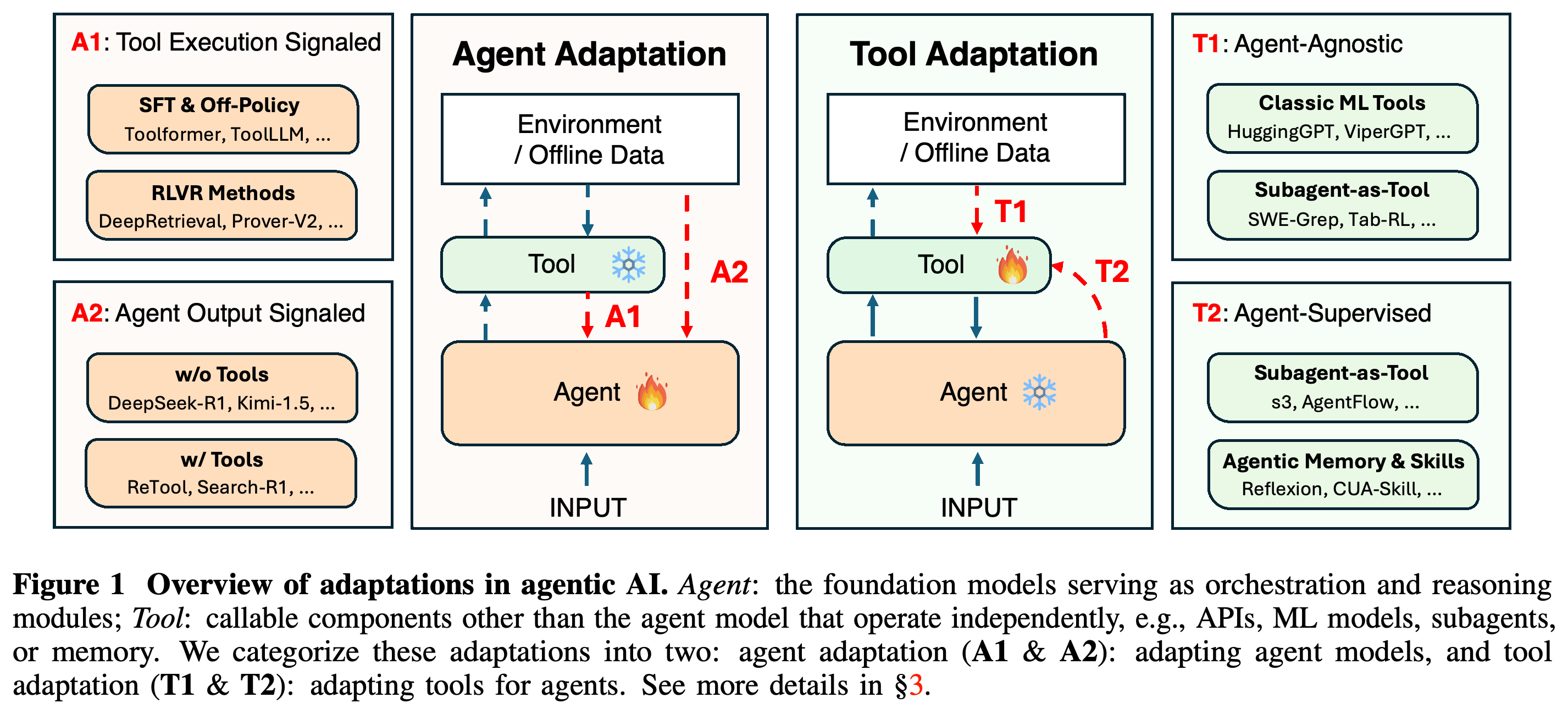
- Adaptation of Agentic AI: A Survey of Post-Training, Memory, and Skills classifies agentic systems, foundation models combined with planning, tools, and memory for multi-step tasks, by what changes and where supervision originates. A1 adapts the agent using evaluated tool-execution results; A2 uses evaluated agent outputs; T1 trains tools independently of the consuming agent; T2 adapts tools using a fixed agent’s supervision or downstream utility.
- The framework connects model updates with external memory and reusable procedural skills. A component’s training stage matters: a trained agent can later be frozen and deployed as a T1 tool, while external memory updated from a fixed host’s outputs predominantly falls under T2. Parametric memory, information retained in model parameters, and hybrid memory can cross these boundaries.
- Its retrieval case study reports s3 at 58.9% average accuracy with 2.4k training samples, compared with roughly 170k examples for Search-R1. Different host models, trained components, and architectures prevent attributing the efficiency gap solely to T2 versus A2. The survey recommends evaluating execution quality, final task utility, learning dynamics, cost, safety, and alignment separately.
2. mHC: Manifold-Constrained Hyper-Connections
- https://arxiv.org/abs/2512.24880
- mHC: Manifold-Constrained Hyper-Connections | Summary
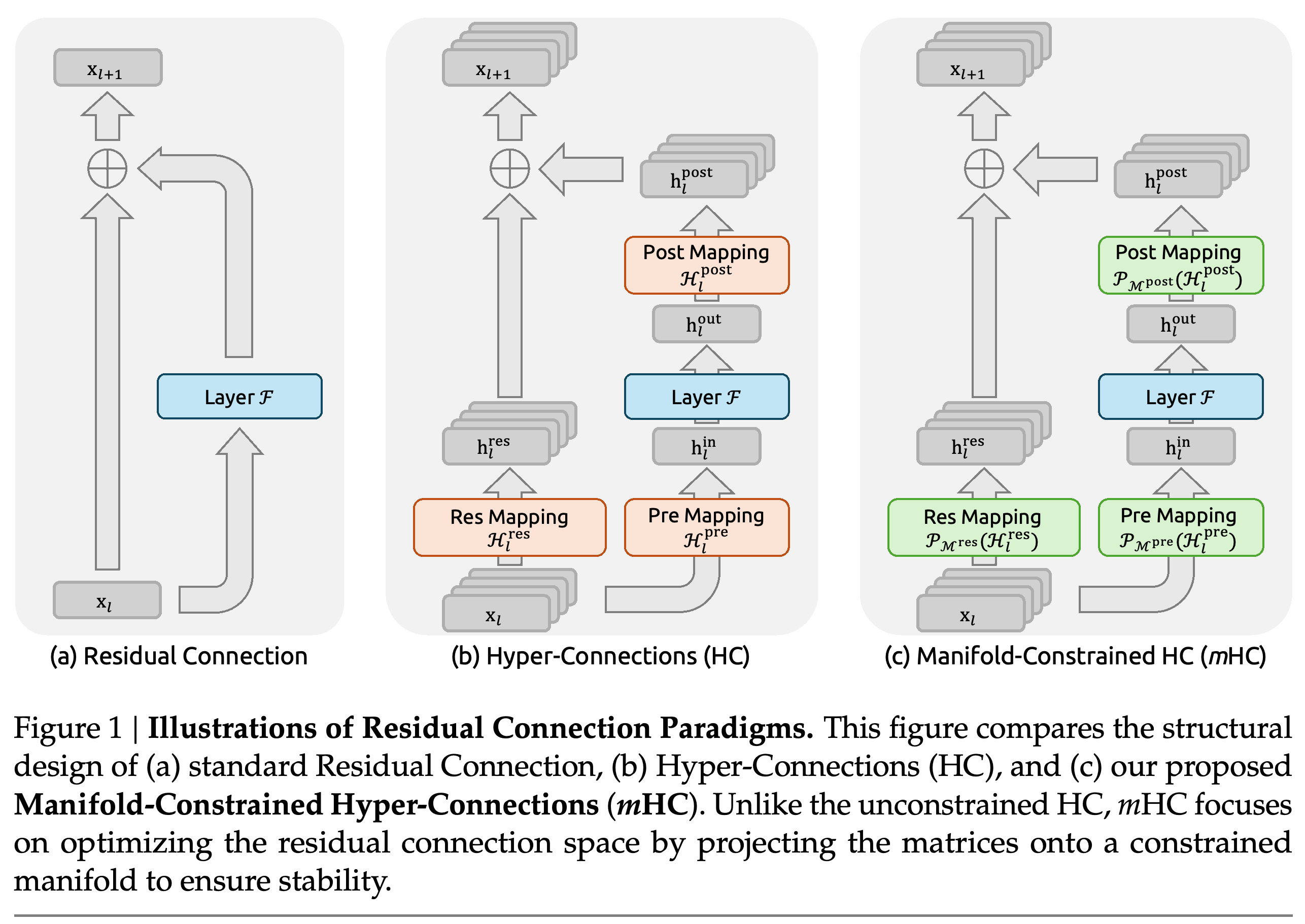
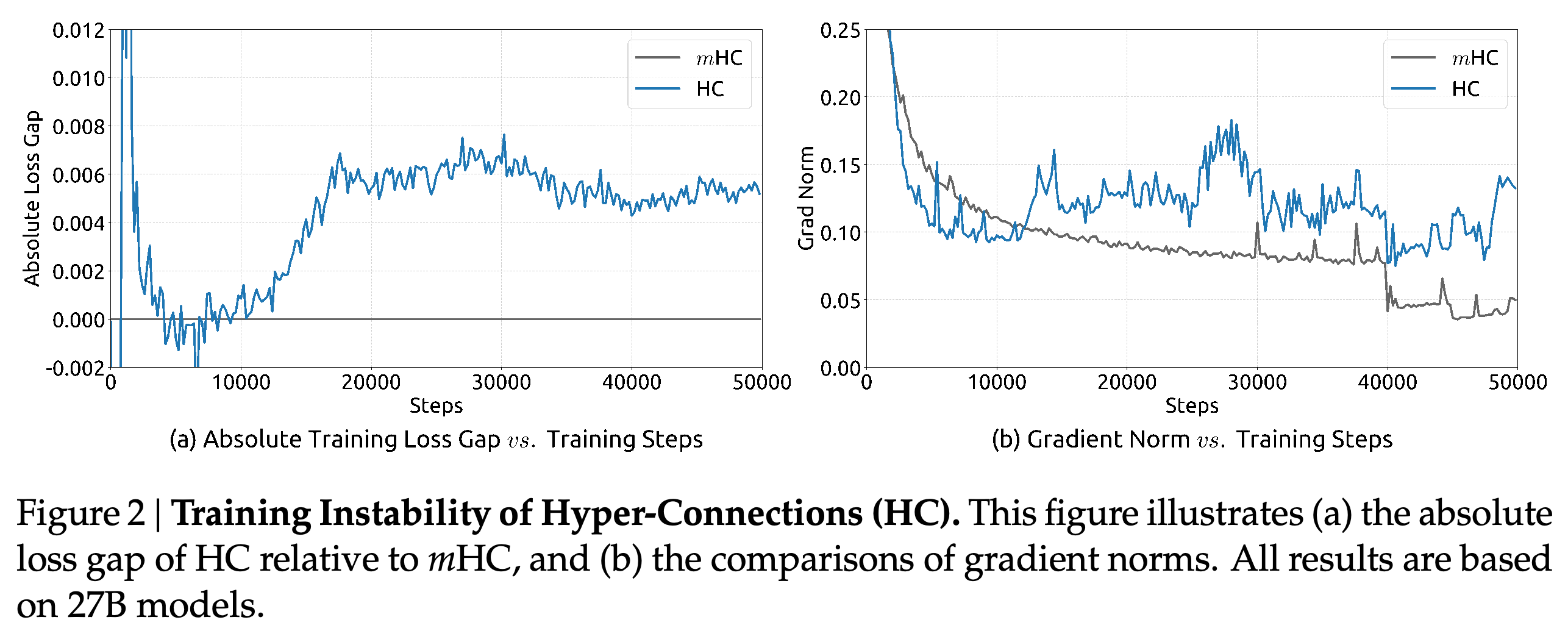
- mHC: Manifold-Constrained Hyper-Connections addresses instability in Hyper-Connections (HC), learned aggregation, redistribution, and mixing across parallel residual streams. Unconstrained residual-matrix products can amplify signals across depth. mHC uses Sinkhorn-Knopp normalization, alternating column and row normalization, to approximate doubly stochastic matrices, non-negative matrices whose rows and columns each sum to one. Exact constraints conserve stream averages and make residual mixing non-expansive.
- At residual expansion rate n = 4, fused mixed-precision kernels, selective activation recomputation, and an extended DualPipe pipeline schedule address the wider state’s memory and communication costs. The authors report 6.7% additional training time in in-house large-scale training. Detailed hardware timing and model configurations for that result are absent, limiting assessment of its portability.
- The 27B model finishes with training loss 0.021 below the standard residual baseline and improves all eight evaluated downstream benchmarks. It exceeds HC on seven: BBH 3-shot exact match rises from 48.9 to 51.0, and DROP 3-shot F1, a precision-and-recall overlap measure, rises from 51.6 to 53.9. MATH 4-shot exact match falls from HC’s 26.4 to 26.0, while remaining above the baseline’s 22.0.
3. Emergent temporal abstractions in autoregressive models enable hierarchical reinforcement learning
- https://arxiv.org/abs/2512.20605
- Emergent temporal abstractions in autoregressive models enable hierarchical reinforcement learning | Summary
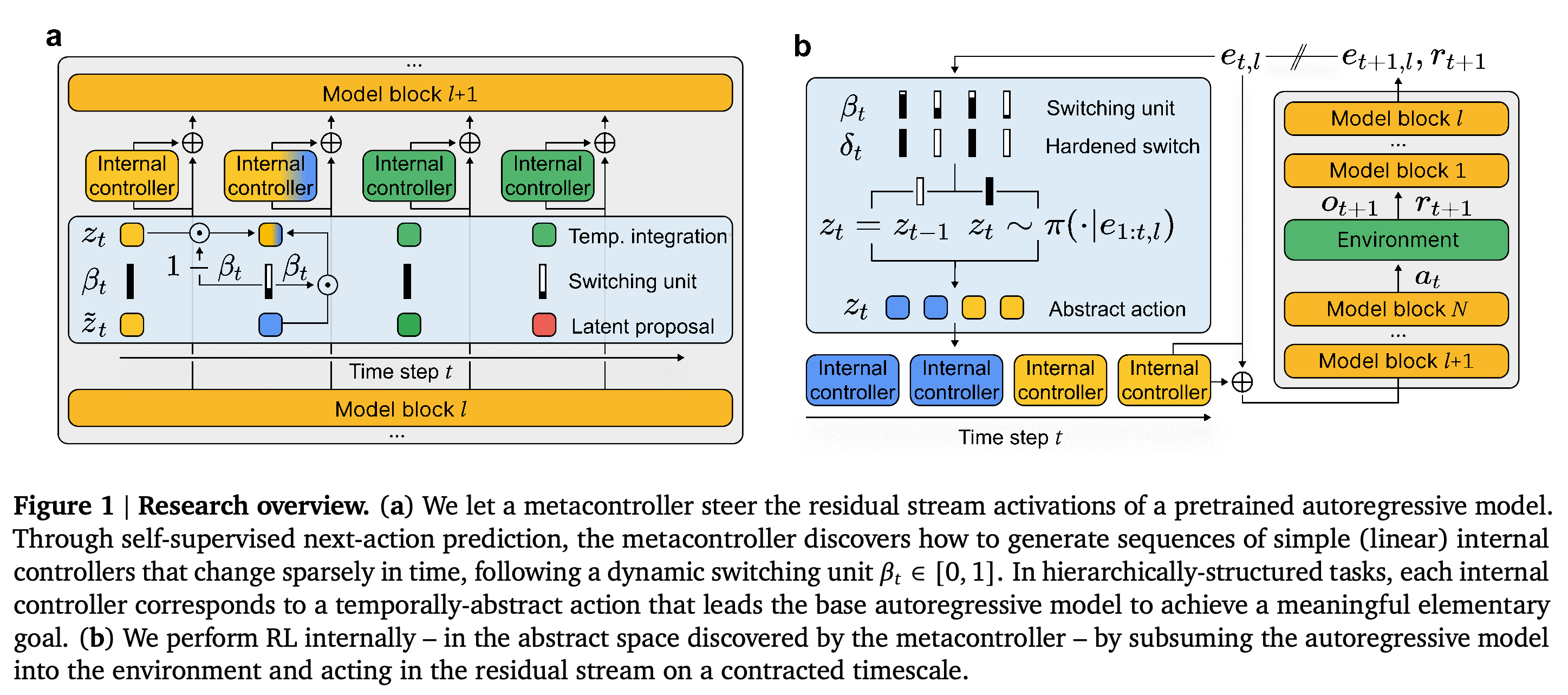
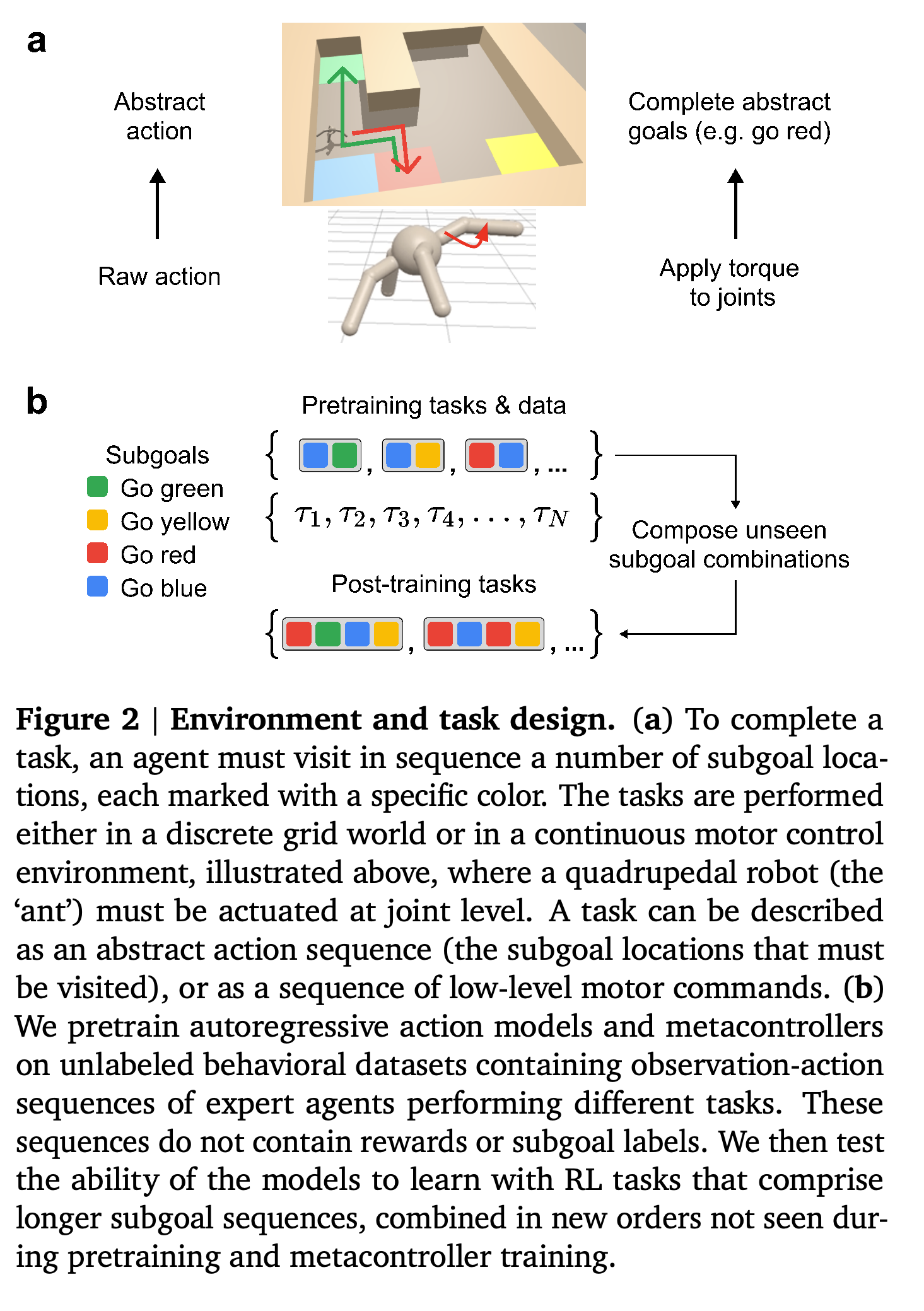
- Emergent temporal abstractions in autoregressive models enable hierarchical reinforcement learning tests whether next-action prediction develops reusable multi-step behavior. Experiments use discrete gridworld navigation and continuous MuJoCo ant control, with post-training tasks requiring longer, unseen combinations of familiar subgoals. Pretraining uses expert observation-action trajectories without rewards, task descriptors, or subgoal labels.
- A metacontroller, a learned module that generates and switches internal controllers, discovers linear interventions in the frozen predictor’s residual stream. Its encoder uses future trajectory information during offline discovery, while its switching unit remains causal. A variational objective regularizes controller codes toward a standard normal prior without subgoal or boundary labels; cleaner demonstrations are used for this discovery stage.
- Internal reinforcement learning replaces the future-conditioned encoder with a causal recurrent policy over 8-dimensional controller codes, compared with a 256-dimensional residual stream. The base model, controller decoder, and switching mechanism remain fixed. Decisions occur at learned switching events, allowing each controller to persist across multiple raw-action steps and shortening the effective policy horizon.
Sources
[1] Adaptation of Agentic AI: A Survey of Post-Training, Memory, and Skills
[2] mHC: Manifold-Constrained Hyper-Connections
[3] Emergent temporal abstractions in autoregressive models enable hierarchical reinforcement learning