


Monthly AI Papers: August 2026
31 Aug 2026 | Paper Review Monthly PapersContents
Trends
Adaptive environments are being treated as a trainable layer around fixed agents: SPADE generates executable MDPs online, EnvHarness rewrites interaction conditions through interface-level wrappers, and Zetta evolves runtime critics and recovery playbooks while retaining the underlying policy. 1, 2, 3
All three works place validation inside the adaptation loop. SPADE rejects invalid generated programs and measures hinted versus unhinted returns; EnvRigger accepts, rejects, or revises wrappers using fresh rollouts; Zetta promotes harness updates only after replay, fresh-rollout, cluster, and held-out checks. For harness, see this post. For harness, see this post.
The reported evaluations emphasize adaptation without direct base-policy fine-tuning, but their scope differs: SPADE covers reasoning games and tool use, EnvHarness evaluates text-based agent benchmarks, and Zetta’s physical-intelligence results are limited to simulation.
Top Papers in August 2026
1. SPADE: Self-Play in Adaptive Synthetic Executable Environments
- https://arxiv.org/abs/2608.19197
- SPADE: Self-Play in Adaptive Synthetic Executable Environments | Summary
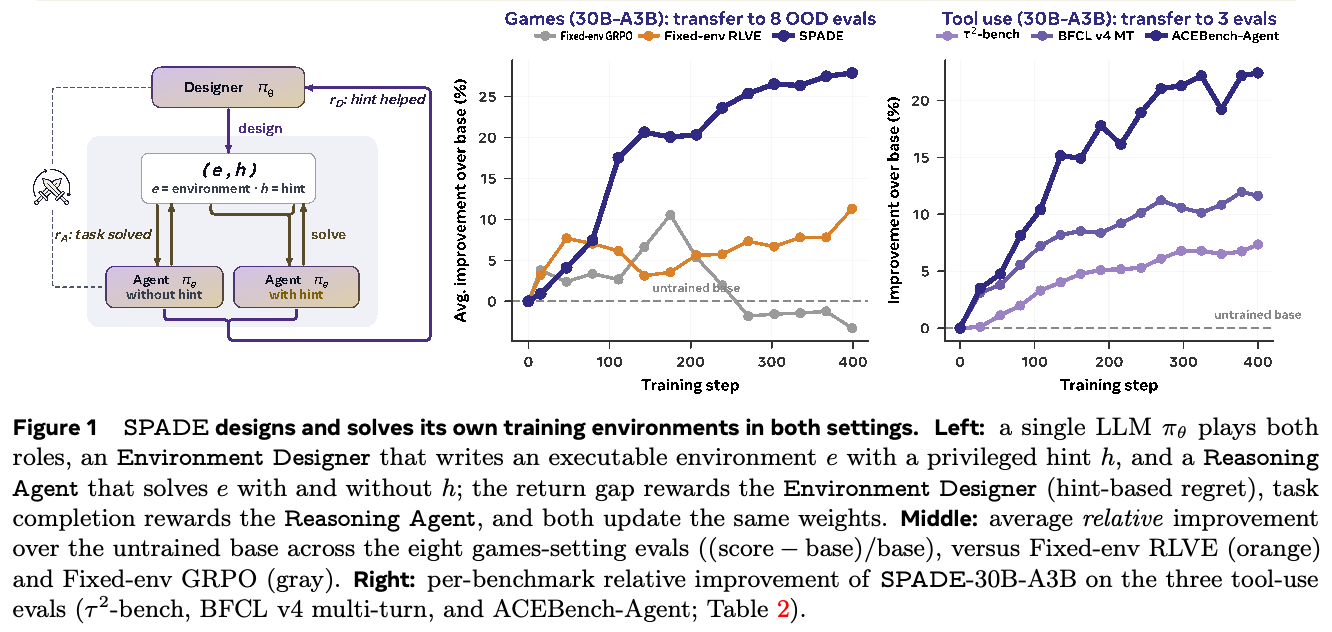
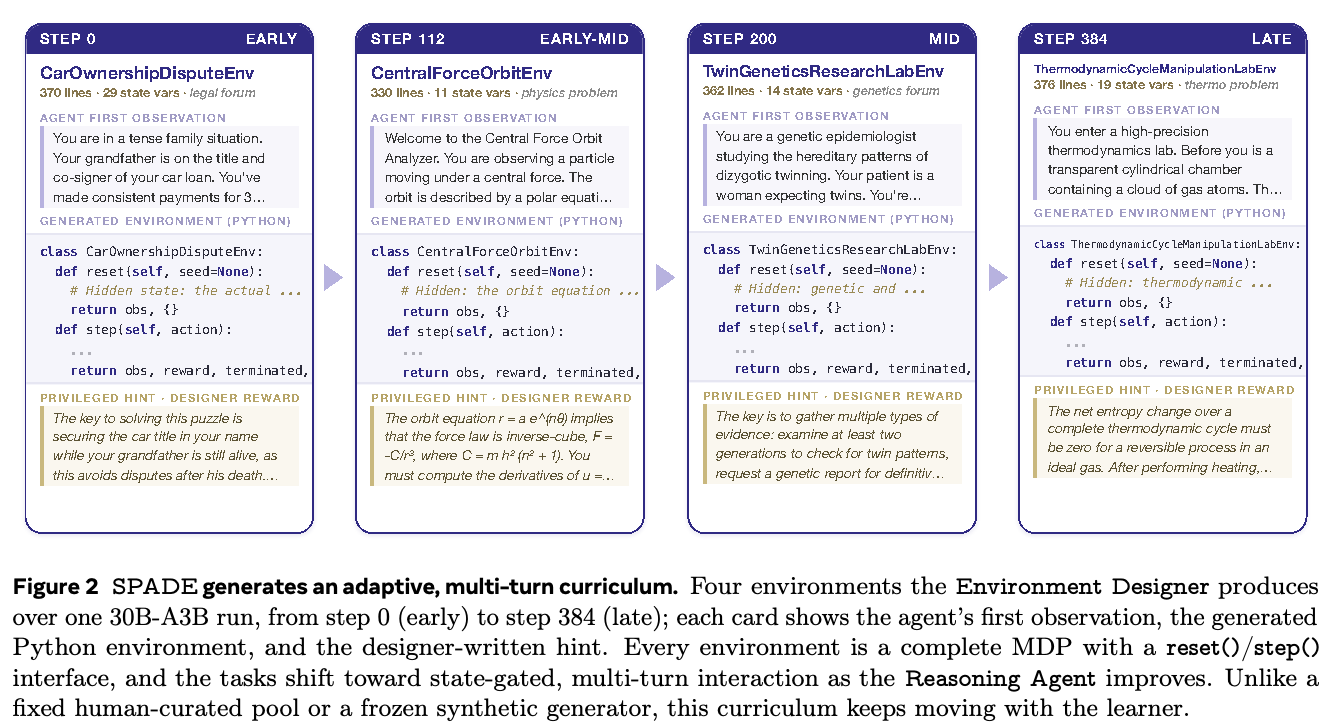
- SPADE trains one shared LLM in two roles: an Environment Designer writes validated, executable Python MDPs and privileged hints, while a Reasoning Agent solves paired hinted and unhinted rollouts. The Designer is rewarded by the return gap, with corpus grounding, memory, and a difficulty anchor intended to keep tasks near the agent frontier.
- At Qwen3-30B-A3B, the paper reports a games-suite average of 58.3, versus 50.2 for the base model and 53.0 for Fixed-env RLVE. On tool use with the same backbone, it reports gains of +5.7 on BFCL v4 multi-turn, +3.6 on τ²-bench, and +13.9 on ACEBench-Agent; external reference rows are not protocol-matched.
- Ablations report that removing memory lowers the selected eight-benchmark average from 58.3 to 53.2 and removing corpus grounding lowers it to 53.5. The authors also report limitations from environment-generation validity, base-model and generation-budget constraints, and fixed-task evaluation rather than direct measurement of open-ended growth.
2. EnvHarness: Awakening Static Worlds for Agent Learning
- https://arxiv.org/abs/2608.19880
- EnvHarness: Awakening Static Worlds for Agent Learning | Summary
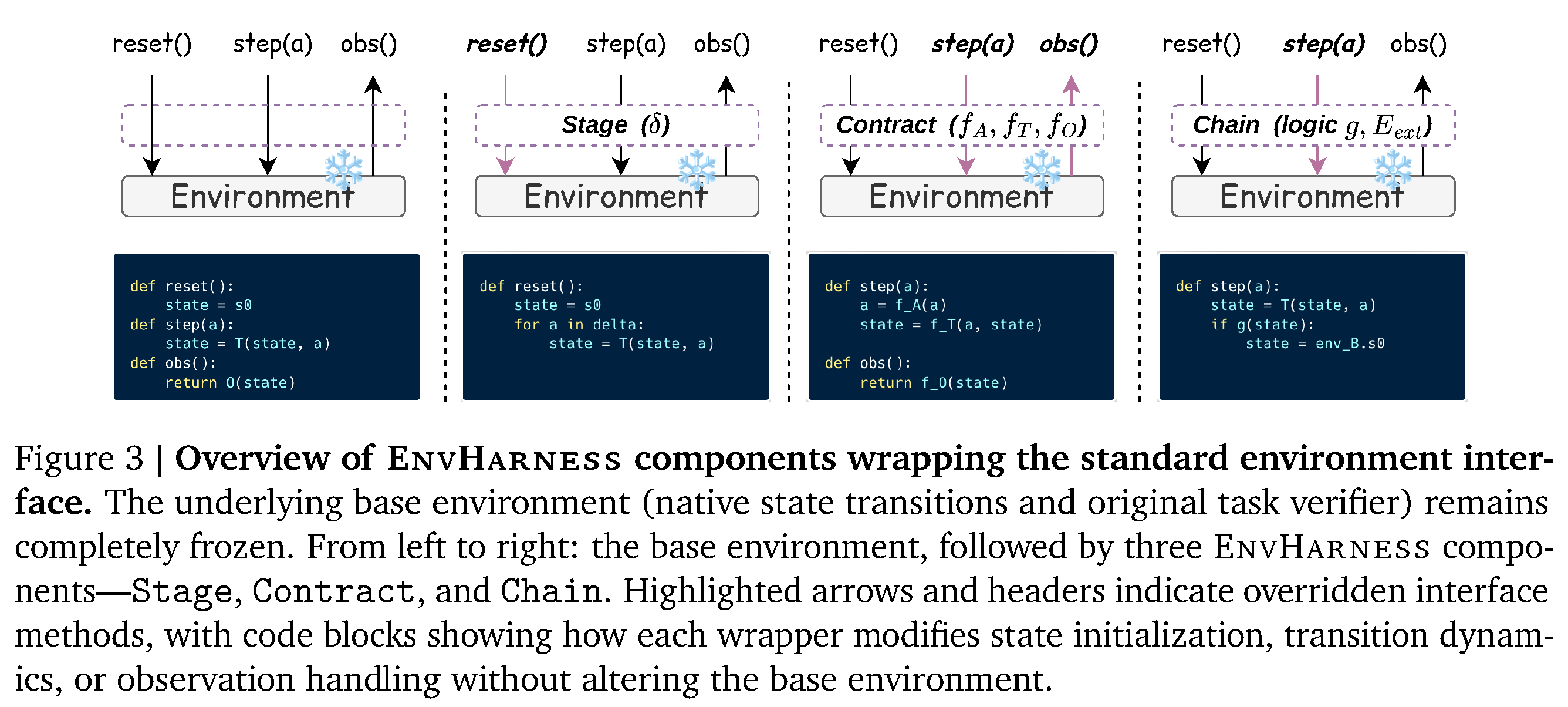
- EnvHarness adapts an existing environment externally rather than replacing its simulator or verifier. Its Stage, Contract, and Chain wrappers modify reset-derived state, step-time actions or observations, and episode composition; EnvRigger diagnoses a black-box policy from rollouts, writes candidate wrappers, and validates them on fresh rollouts.
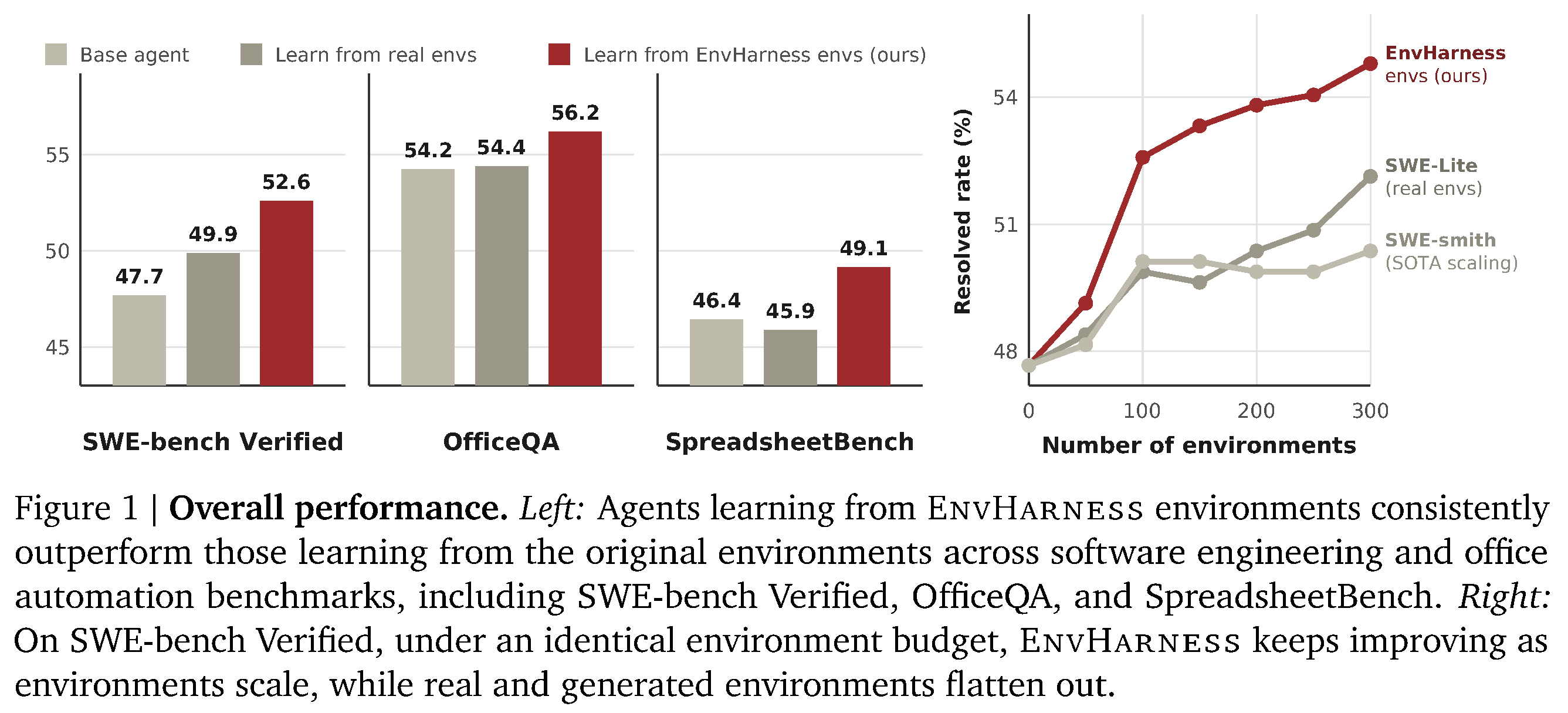
- Across ALFWorld, WebArena, SWE-bench Verified, OfficeQA, and SpreadsheetBench, EnvHarness-derived skills exceed skills extracted from original environments in the reported comparisons. On SWE-bench Verified, it reports 52.58 success rate and 49.61 average steps, versus 49.88 and 55.01 for Original Envs.
- The scaling experiment reports a SWE-bench Verified resolved rate of 54.79 at 300 EnvHarness environments, compared with 52.13 for original environments and 50.37 for generated environments under the stated common budget. Results remain limited to resettable, predominantly text-based settings, small rollout-validation samples, and transfer that is positive on average but not uniform.
3. Zetta $\zeta$: An Efficient Closed-Loop Embodied Harness for Self-Evolving Physical Intelligence
- https://arxiv.org/abs/2608.16590
- Zetta $\zeta$: An Efficient Closed-Loop Embodied Harness for Self-Evolving Physical Intelligence | Summary
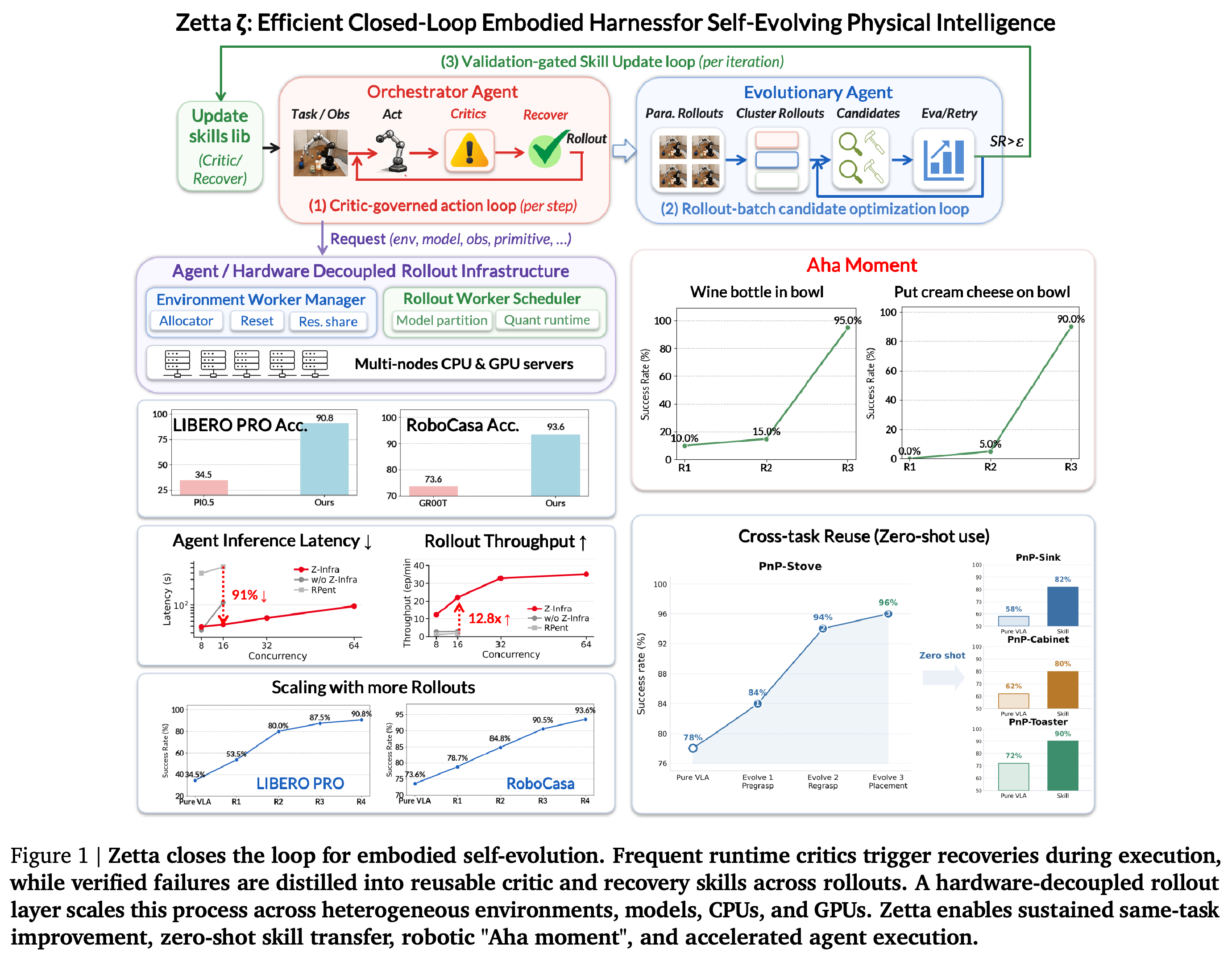
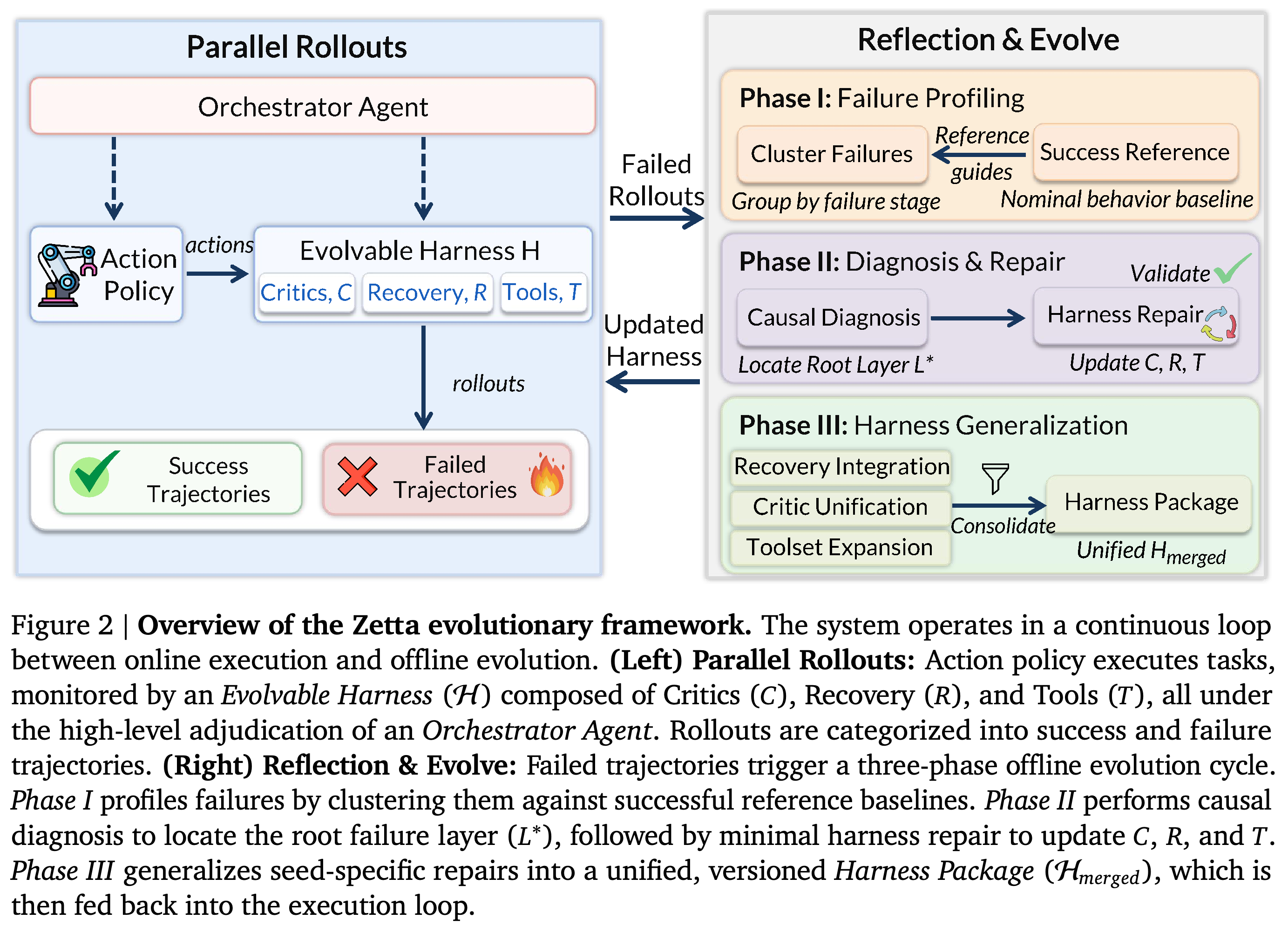
- Zetta keeps a VLA/WAM action policy and an Orchestrator fixed while evolving a code-based harness of runtime critics, recovery playbooks, and tools. Critics supply physical-deviation evidence, but the Orchestrator must validate it before permitting an intervention or return to the frozen policy. For harness, see this post. For harness, see this post.
- On simulation benchmarks, the paper reports that Zetta raises the 18-task RoboCasa Atomic-Seen macro-average from 73.56% for frozen GR00T N1.5 to 93.56%. Across 40 LIBERO-Pro task-setting pairs, it reports a rise from 32.00% for frozen π0.5 to 71.13%, improving 32 pairs and matching the baseline on eight.
- Z-Infra separates environment execution from model inference and batches heterogeneous rollouts. On LIBERO Goal with 8×A100 GPUs, it reaches 35.1 episodes/min at concurrency 64; at concurrency 16, the reported 22.09 episodes/min is 7.7× the harness without Z-Infra and 12.8× RPent. The evidence remains confined to simulation and infrastructure experiments, not real robots.
Sources
[1] SPADE: Self-Play in Adaptive Synthetic Executable Environments
[2] EnvHarness: Awakening Static Worlds for Agent Learning
[3] Zetta $\zeta$: An Efficient Closed-Loop Embodied Harness for Self-Evolving Physical Intelligence