


Echoverse: Deep, Evolving Environments for Training Computer-Use Agents at Scale | Summary
30 Jul 2026 | Paper Review Computer-Use Agents Synthetic Environments Reinforcement Learning Supervised Fine-TuningContents
This article explains the key points of Echoverse: Deep, Evolving Environments for Training Computer-Use Agents at Scale.
- 2026-07-30 (arXiv)
- Pandya, Yash, Gupta, Sahil, Harne, Sarthak, Yadav, Archana, Chourasia, Kavyansh, Mozannar, Hussein, Vineet, Vibhav, Abdali, Sara, Rosset, Corby, Lara, Yash, et al.
- Microsoft Research
- Paper
Summary
- Echoverse constructs stateful, resettable synthetic applications for training computer-use agents, with task outcomes checked against application database state rather than screenshots. It defines depth relative to target workflows through behavioural fidelity, coherent state, workflow dependencies, authoritative verification, and domain value; a 9B model trained on 21,009 verified trajectories improves from 36.5% to 67.1% across fourteen evaluation splits.
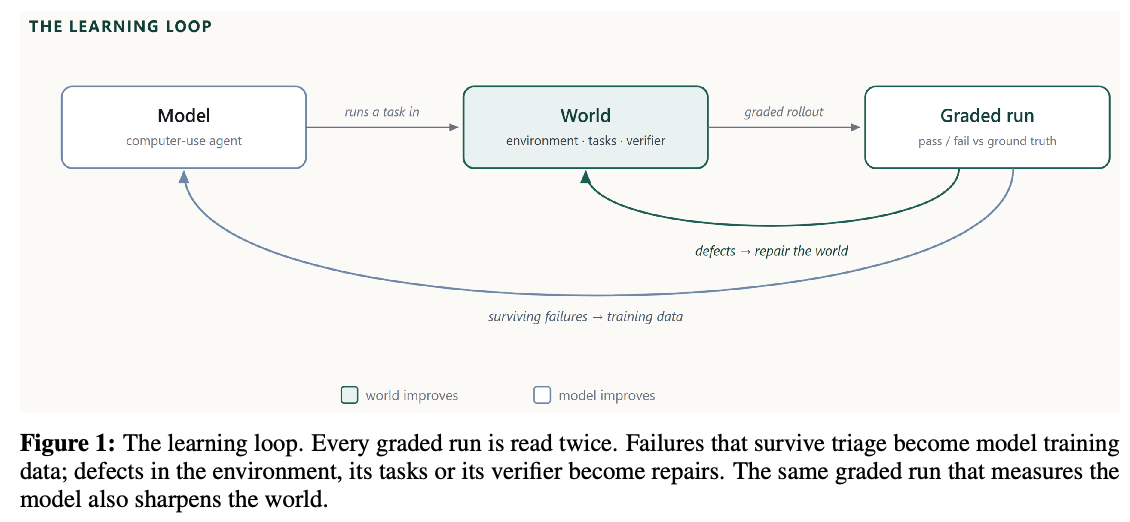
This diagram expresses the co-evolution mechanism: one rollout yields a graded result and two downstream paths, namely repair of defects in the world or use of validated agent failures as training data.
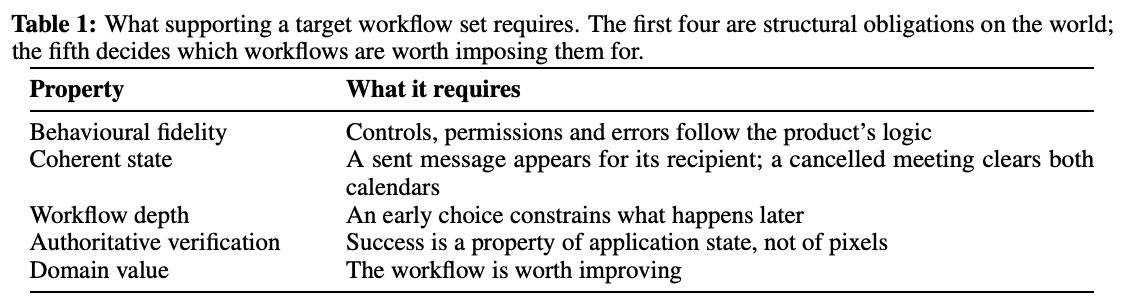
The table operationalizes depth as workflow completeness, distinguishing four structural requirements from the choice of whether a workflow has sufficient domain value to justify building it.
4 Echoverse: the factory and the co-evolution loop
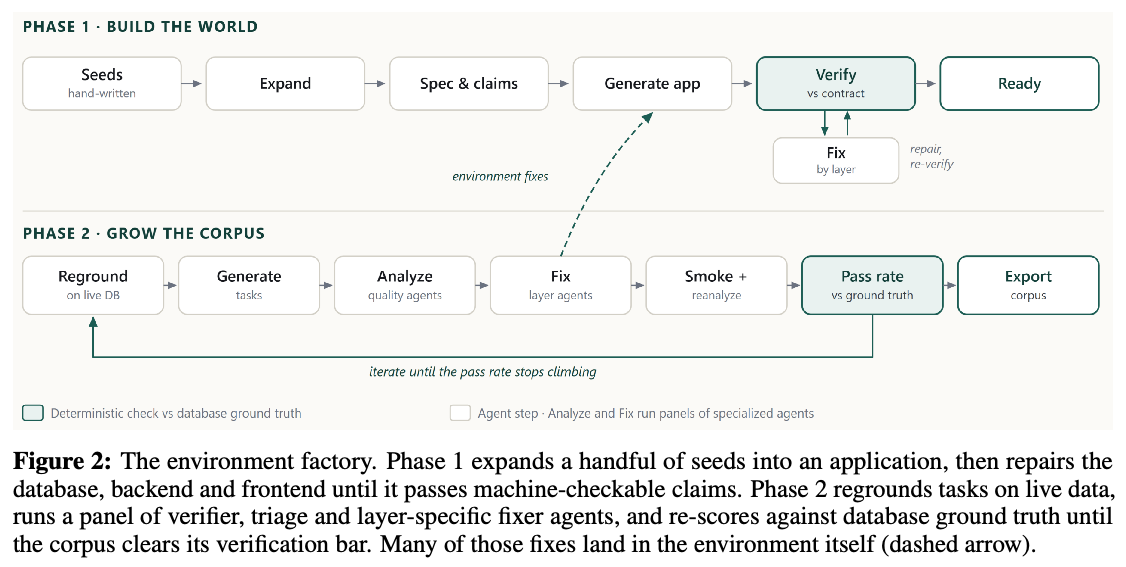
The factory produces both full-domain worlds and narrow capability worlds. Builders, verifiers, triagers, and layer-specific fixers construct applications and task corpora; each graded rollout is inspected for environment, task, or verifier defects before valid model failures are retained as training signal.
The factory comprises linked repair loops: application claims drive database, backend, and frontend repair in Phase 1, while regrounded task validation drives task- and environment-level repairs in Phase 2.
4.2 Phase 1: building the environment
Phase 1 expands hand-written seeds into a specification and machine-checkable claims, then generates a FastAPI and SQLite backend beneath a React interface. Verifier agents exercise routes, state, and behaviour through the running application and database; a world advances only when at least 95% of claims pass and no hard blocker remains.
4.3 Phase 2: growing the corpus
Phase 2 regrounds goals in entities present in the live database and checks their plausibility, difficulty, and feasibility. White-box verifier agents use Playwright, source inspection, and database queries to distinguish impossible tasks from hard ones; the surviving corpus is re-scored until at least 95% passes verification, and every exported task includes its database-grounded check.
4.6 One rollout, two signals
A failed rollout is not automatically evidence of an agent weakness: it can expose an unreachable goal, broken application behaviour, or an incorrect verifier. Echoverse routes failures through triage, prefers repair when attribution is unclear, and treats goal weakening to raise pass rates as a regression; repairing a shared root cause can restore many tasks at once.
5 The environment suite
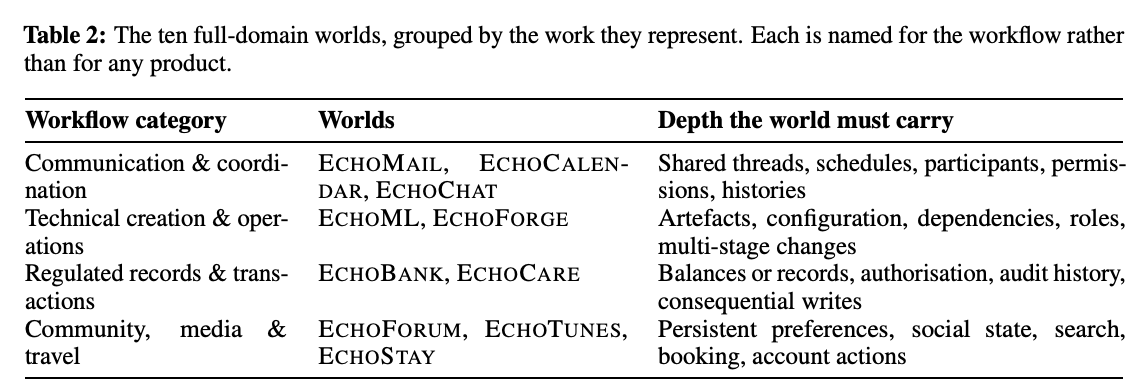
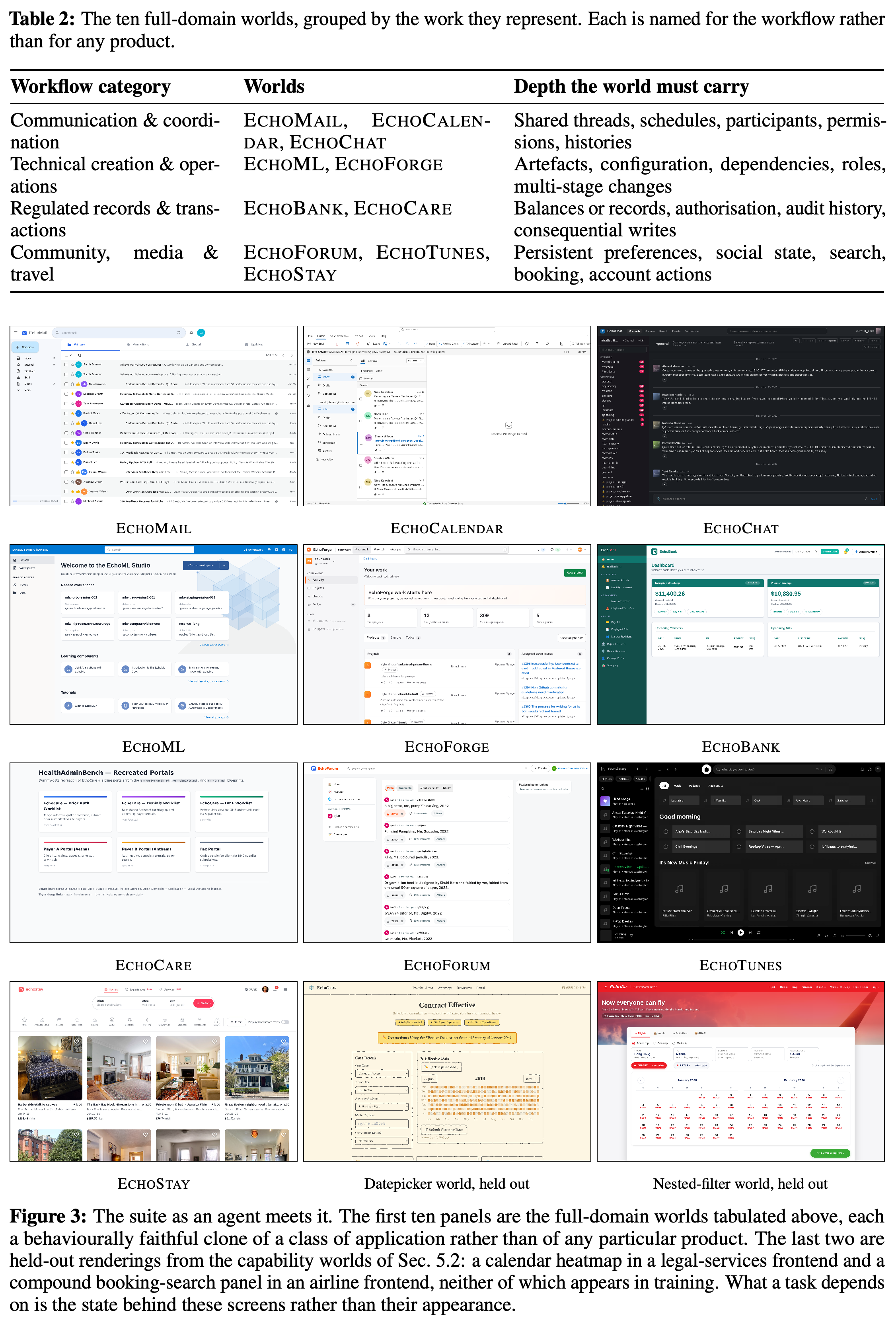
The suite contains ten deep domains spanning communication, technical operations, regulated records and transactions, community, media, and travel, plus two capability worlds. Training uses all twelve worlds, while evaluation averages unweighted performance over fourteen splits because each capability world has in-distribution and held-out splits.
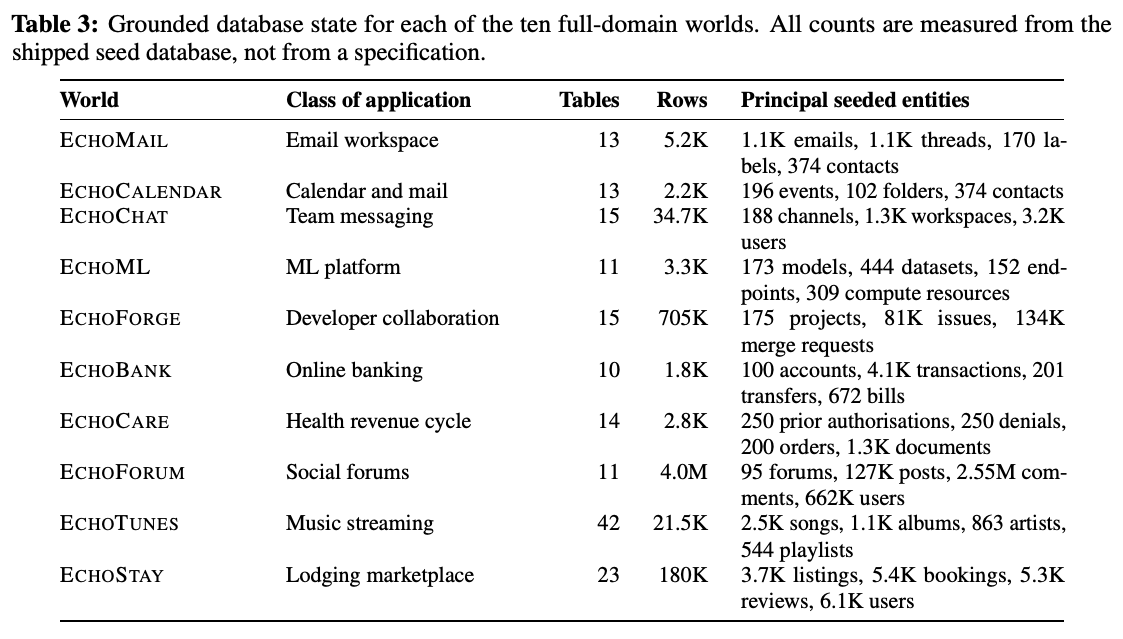
The table connects each full-domain world to persistent, multi-actor state and workflow dependencies, which distinguish the target workflows from superficial interface replicas.
The panels show visual variety across the ten full-domain worlds and two held-out capability renderings. Task correctness is determined by state behind the interfaces rather than visual similarity to a particular product.
Database scale varies substantially across worlds, from 1.8K rows in ECHOBANK to 4.0M in ECHOFORUM, documenting dense seeded state rather than sparse placeholders.
5.2 Two capability worlds
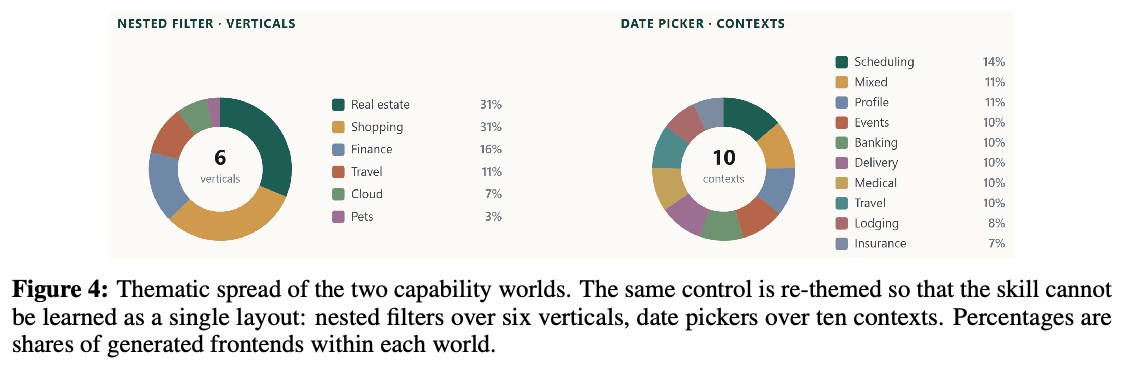
The capability worlds isolate datepicker and nested-filter interaction skills rather than reproduce another complete application. The datepicker world trains on six widget types across 100 frontends and holds out ten unusual widgets across 80 frontends; the nested-filter world trains on twenty widget families across 200 frontends and holds out nine compound panel families across 100 frontends.
The donut charts show that each capability world distributes the same control across multiple verticals and contexts, reducing dependence on a single theme-specific layout.
6 Supervised experiments
Supervised experiments compare a browser-action-aligned Qwen3.5-9B base policy, the same 9B model fine-tuned on the full corpus, and GPT-5.4, which generated the passing demonstrations. Rollouts are capped at 100 actions; synthetic tasks use database-grounded grading, whereas held-out WebVoyager and Online-Mind2Web use their published judges under hosted and datacentre browser conditions.
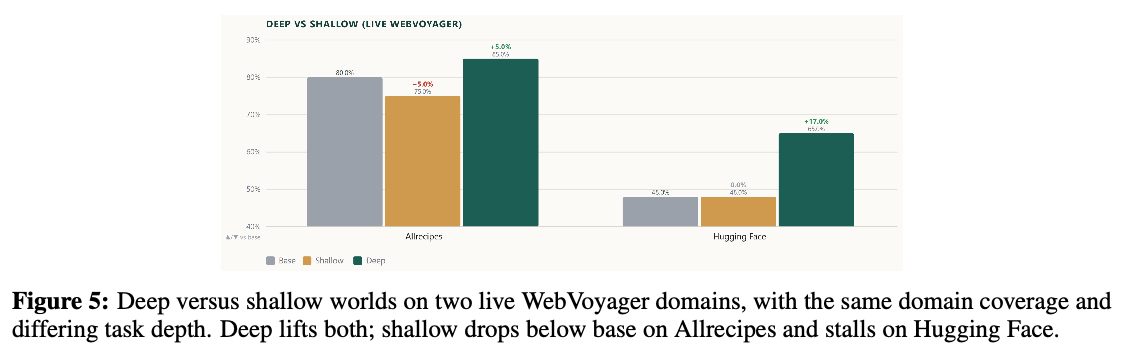
6.2 Deep worlds transfer; shallow worlds set the model back
On matched-domain live-WebVoyager ablations, shallow training reduces Allrecipes accuracy from 80.0% to 75.0% and leaves Hugging Face at 48.0%, whereas deep training reaches 85.0% and 65.0%, respectively. Because the comparison covers only two domains with corpora of comparable rather than identical size, it supports a directional claim about workflow-preserving depth rather than a general quantitative estimate.
With the same two target domains, deep-world training is the only condition that improves both live-WebVoyager domains; shallow-world training regresses Allrecipes and does not improve Hugging Face.
6.3 The full scorecard: base, our model and a frontier reference
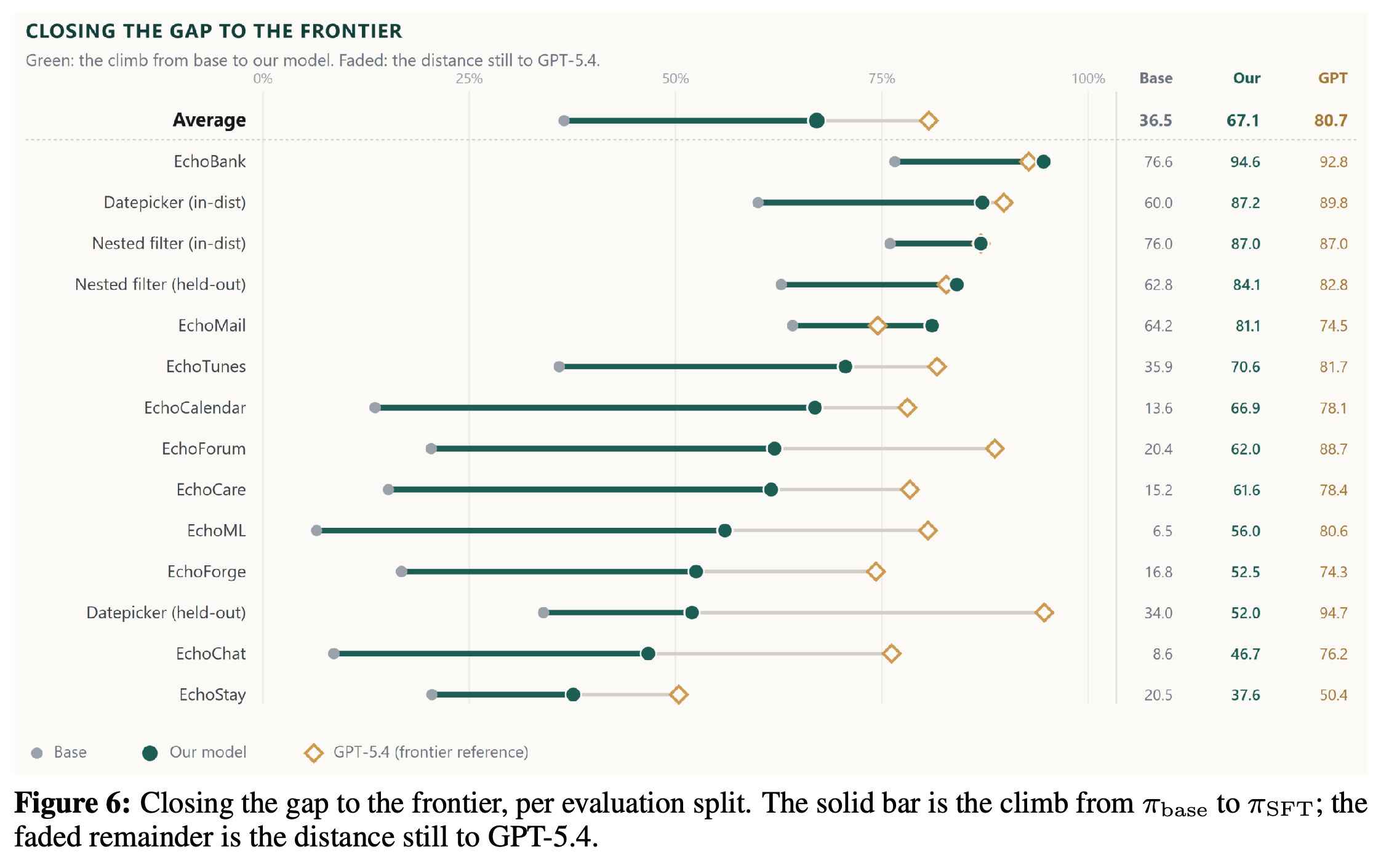
Across fourteen database-grounded splits, the full supervised model raises average success from 36.5% to 67.1%, compared with GPT-5.4’s 80.7%. The 9B model matches or exceeds the frontier reference on ECHOBANK, ECHOMAIL, and both nested-filter splits, while remaining substantially behind on held-out datepickers, ECHOCHAT, ECHOSTAY, and several other domains.
The chart decomposes each split into improvement from the base policy to the supervised model and remaining distance to GPT-5.4, showing large gains alongside unresolved difficult splits.
6.4 Precision about one skill
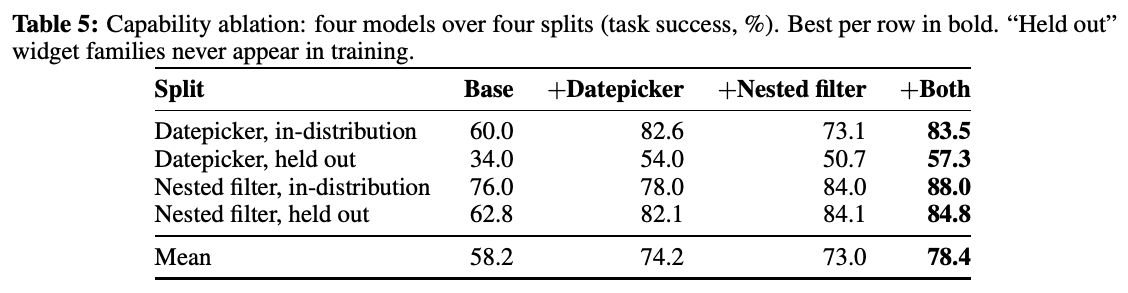
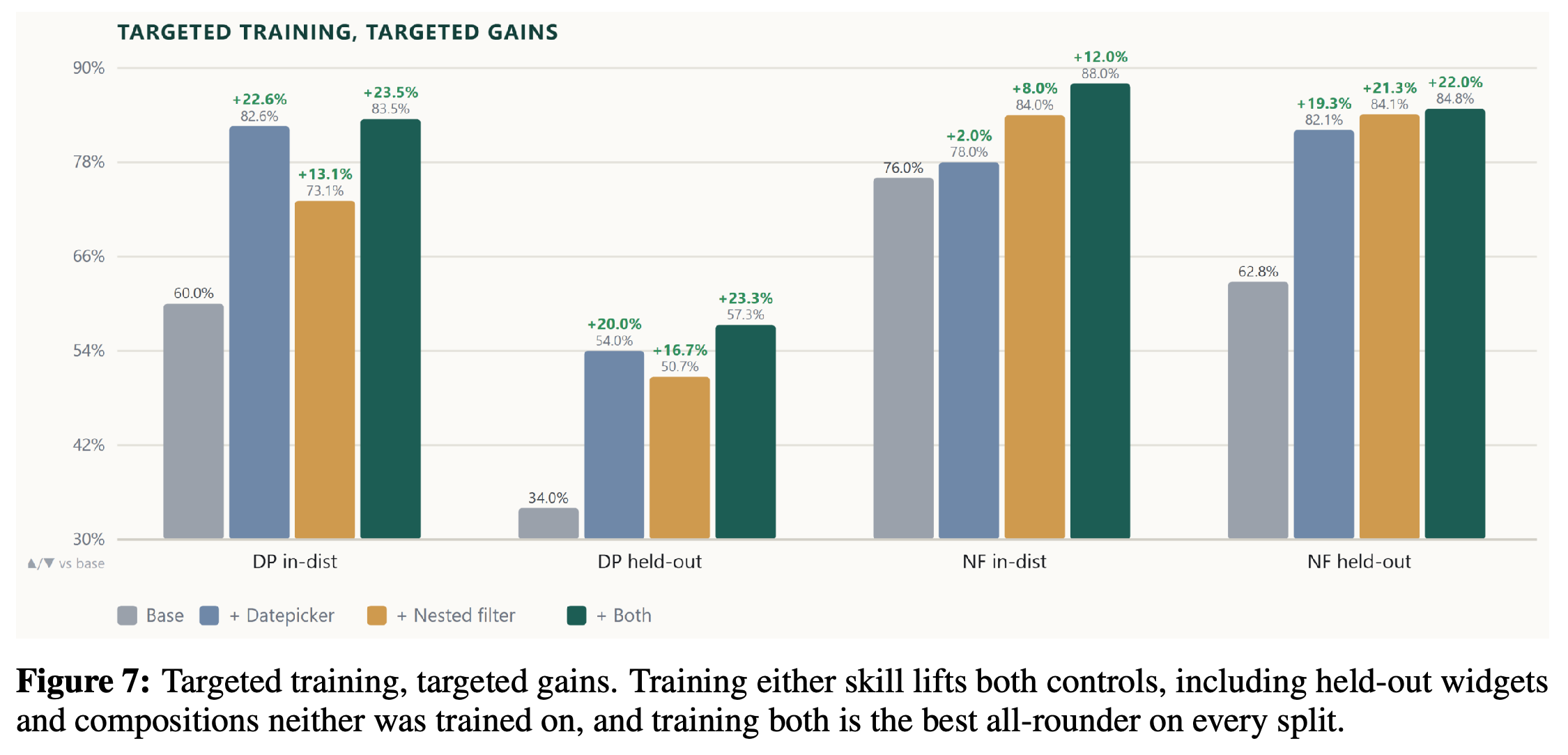
Targeted capability training generalizes beyond trained layouts: the jointly trained capability model raises held-out datepicker success from 34.0% to 57.3% and held-out nested-filter success from 62.8% to 84.8%. Training either control also improves the other, while joint training is strongest on every reported capability split and lifts Online-Mind2Web from 29.5% to 34.3% in the capability-only ablation.
This ablation isolates targeted skill training: both single-skill models transfer somewhat across controls, while joint training achieves the best score on every in-distribution and held-out capability split.
The grouped bars show that targeted capability training improves performance on unseen widget families and compositions, not only on the layouts used for training.
6.6 What scaling buys, and what it does not
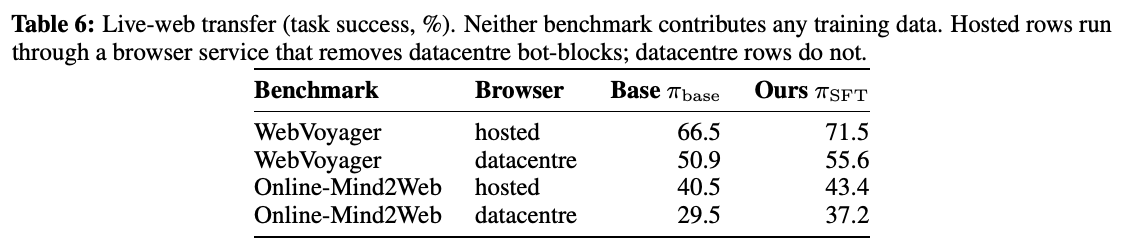
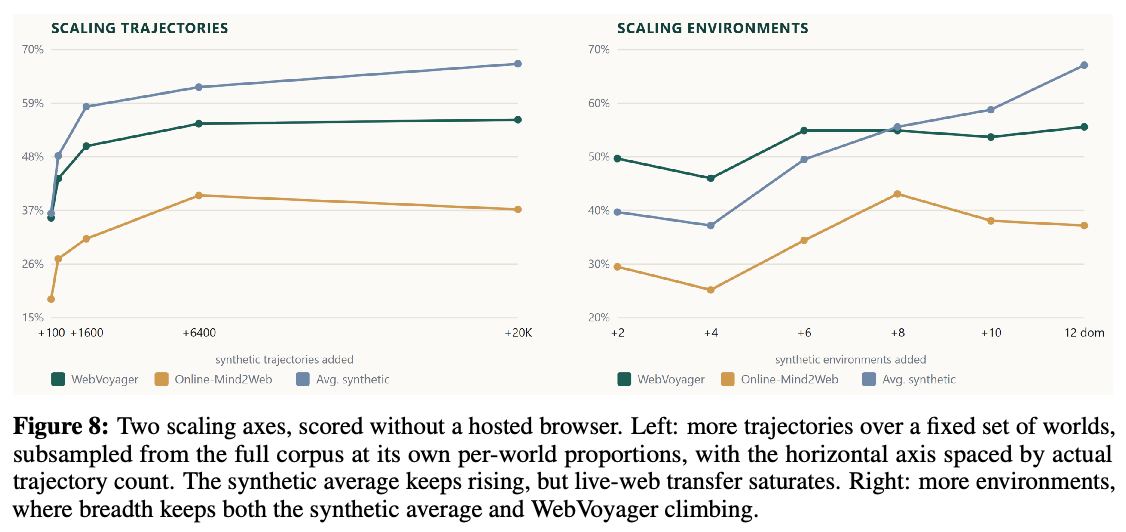
On held-out live-web benchmarks, the full supervised model improves WebVoyager from 66.5% to 71.5% in hosted browsing and from 50.9% to 55.6% in datacentre browsing; Online-Mind2Web rises from 40.5% to 43.4% hosted and 29.5% to 37.2% datacentre. With fixed world composition, increasing trajectories from 6,400 to 20,000 does not materially improve live-web transfer, whereas adding distinct environments continues to help in the reported sweep.
The table separates hosted and datacentre browsing, showing held-out live-web improvements while revealing that infrastructure and bot blocking affect absolute scores.
The left panel shows in-domain synthetic performance rising as trajectory volume grows while live-web transfer saturates; the right panel shows that adding environments continues to improve breadth-dependent transfer in the sweep.
6.7 The model is not the only thing that learns
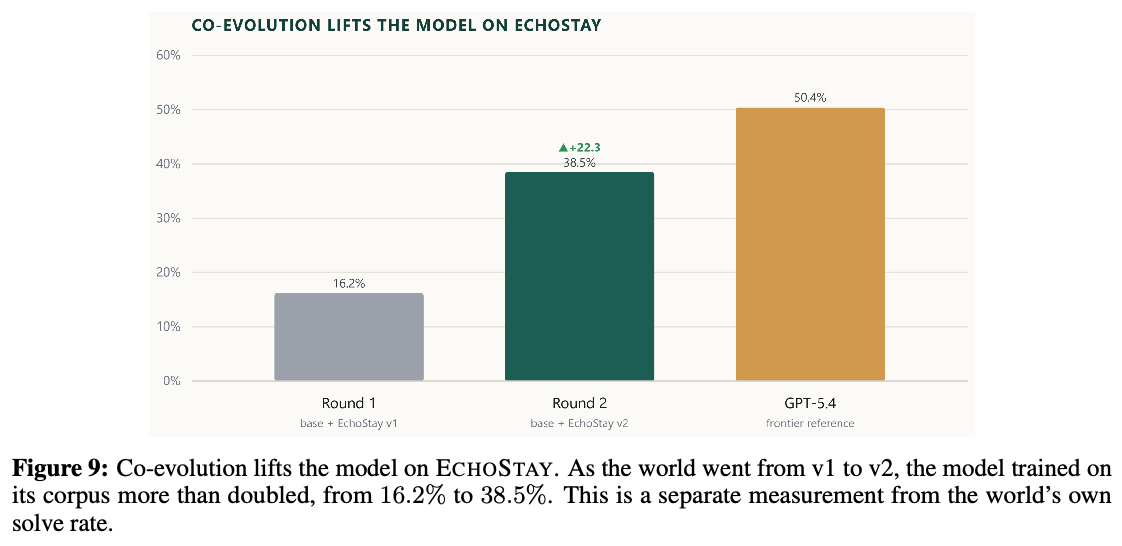
Co-evolution repairs the coupled environment, corpus, and verifier rather than isolating a single factor. In ECHOSTAY, fixing a guest-count control raised completable bookings from 48% to 78%, and a model trained after the revised round improved from 16.2% to 38.5%; the authors note that an environment-only ablation is not well defined because repair changes which tasks can be posed and grounded.
The figure measures the outcome of a complete ECHOSTAY co-evolution round: revising the world and regenerating its corpus increases the trained model's score by 22.3 points, without attributing the gain to an individual repair.
7 Reinforcement learning on the worlds
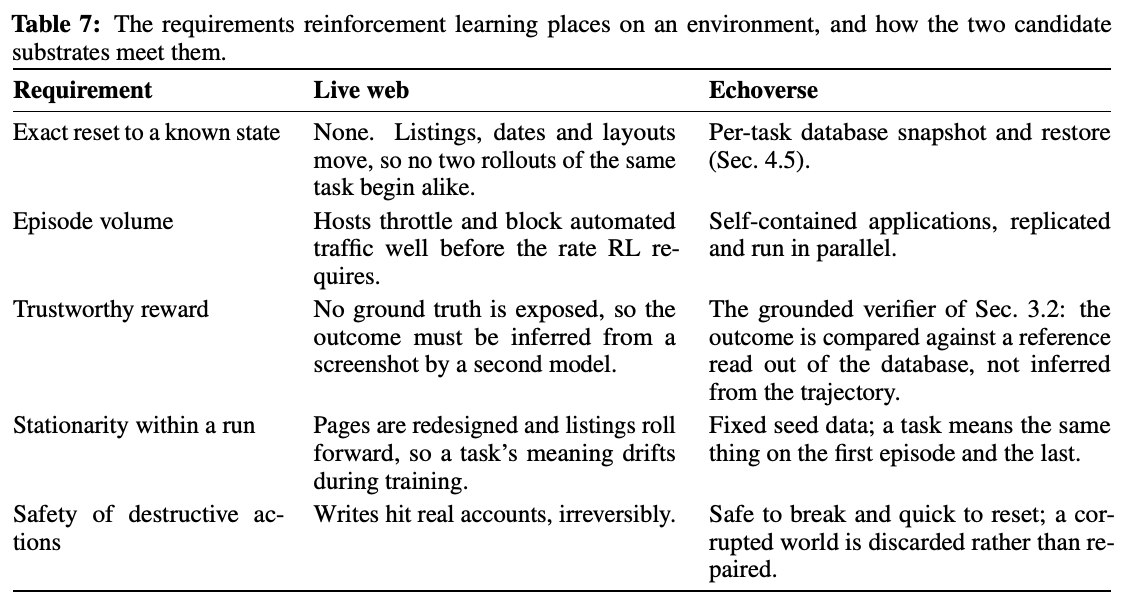
The paper argues that imitation of successful GPT-5.4 trajectories does not teach recovery from the student’s own errors or reliable stopping. Echoverse supplies RL conditions that the live web lacks: exact per-task database reset, parallel episode throughput, database-grounded outcomes, stationarity, and safety for destructive actions.
The comparison clarifies why the authors use controlled synthetic worlds for RL: the live web lacks exact reset, high-volume safe interaction, stationary tasks, and directly grounded rewards.
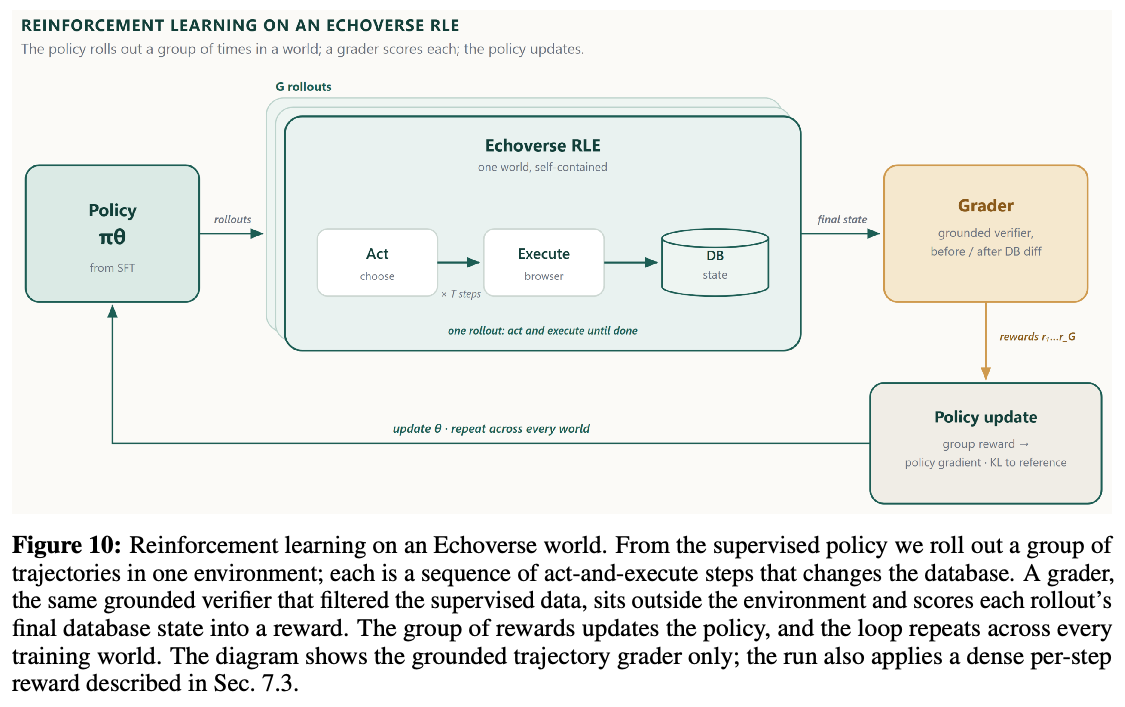
The diagram shows grouped policy rollouts, grounded final-state grading, and policy updates. It depicts the terminal reward channel; the text separately specifies the dense per-step training signal.
7.3 Method
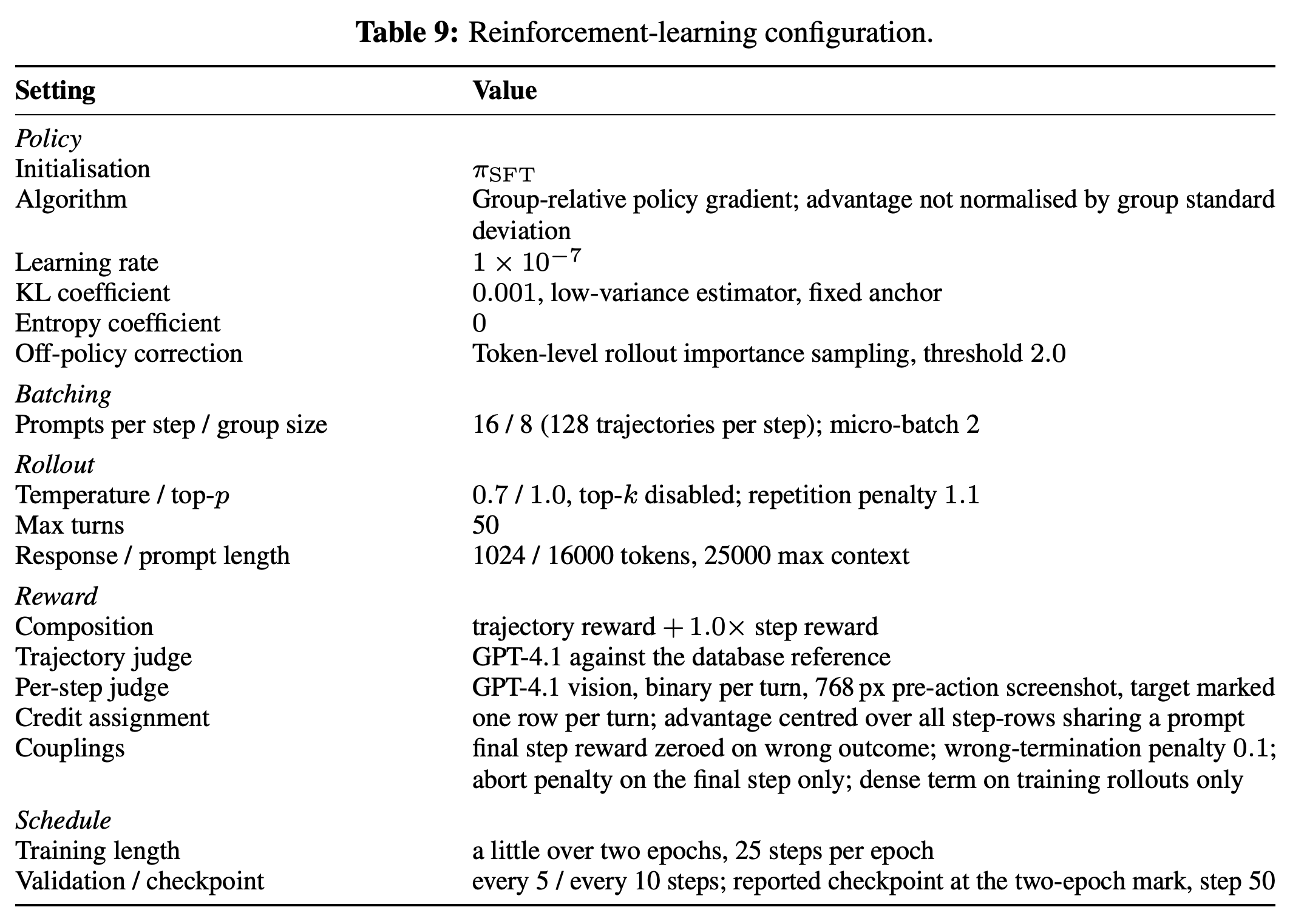
Starting from πSFT, the authors use group-relative policy gradient with a fixed-reference KL penalty. Each turn receives Rrow = Rtraj + λ Rstep with λ = 1: Rtraj is a GPT-4.1 comparison of final database outcome against the database reference, and Rstep ∈ {0, 1} is a GPT-4.1-vision judgment of whether the marked action demonstrably advanced the task; advantages are centered over all step rows sharing a prompt without standard-deviation normalization.
7.5 Results
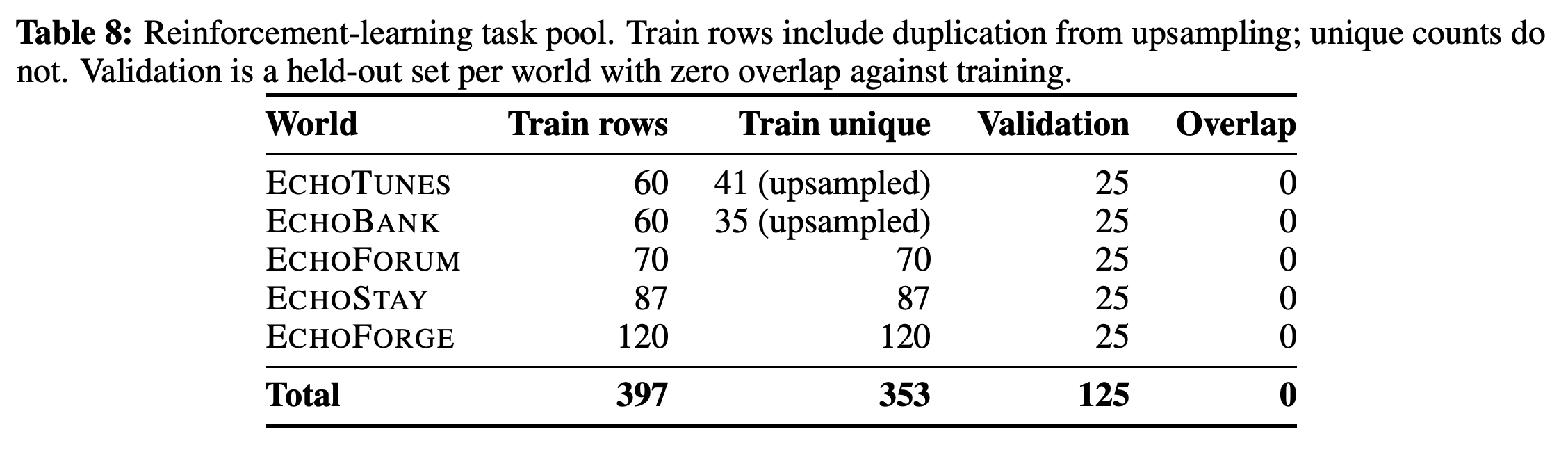
RL trains on five worlds using 353 unique filtered tasks, sampled to exclude tasks solved zero or four times in four initial-policy rollouts, with 125 disjoint validation tasks. At step 50 after a little over two epochs, held-out grounded judged score rises from 58.8% to 68.0%; the denser per-step reward is used only during training and is not part of the reported validation metric.
The task-pool table records the five-world RL mixture, including upsampling and zero training-validation overlap. It establishes that the 68.0% result is evaluated on disjoint per-world validation tasks.
The configuration specifies a 32-GPU group-relative policy-gradient run, including group size 8, a 1 × 10⁻⁷ learning rate, 50-turn rollouts, and the trajectory-plus-step reward design.
Appendix
- The appendix documents naming conventions, the 21,009-trajectory supervised corpus, verifier prompts for read and write tasks, and the capability-widget catalogue. The release provides environment code and evaluation tasks for ECHOSTAY, ECHOFORGE, and the two capability worlds, with seed data and grounded verifiers, at https://aka.ms/echoverse.
Brief Thoughts
The paper’s central evidence is the controlled comparison in which shallow synthetic worlds can reduce live-site performance while deeper workflow-preserving worlds improve it. Its conclusions remain bounded by generated environments, LLM-based semantic comparison of database-derived references and observed outcomes, and a five-world RL experiment, so the work demonstrates a promising environment-design approach rather than universal superiority across computer-use settings.