


Monthly AI Papers: July 2025
31 Jul 2025 | Paper Review Monthly Papers Reasoning Model Safety Local Inference Efficiency Reinforcement LearningContents
Trends
July 2025’s theme is how model design shapes practical reliability: the three selected papers examine how architecture and training affect reasoning visibility, local execution efficiency, and reward-based training stability. Chain of thought (CoT), the intermediate reasoning text generated before an answer or action, can expose some harmful intentions. SmallThinker connects selective computation with memory-aware execution, while Group Sequence Policy Optimization (GSPO) aligns reward-based updates with whole responses. Together, these papers make the case for assessing model behavior alongside the mechanisms that produce and execute it. 1, 2, 3 For Chain of thought (CoT), see The CoT Encyclopedia: Analyzing, Predicting, and Controlling how a Reasoning Model will Think | Summary.
Mixture-of-Experts (MoE), which activates only a subset of expert networks for each token, connects deployment efficiency with training stability. SmallThinker selects experts before attention so their weights can be fetched from storage while attention runs, and exploits inactive neurons inside selected experts. GSPO addresses a different consequence of selective computation: expert selections can change after a training update, disturbing token probabilities. Its reported stable training without replaying earlier expert selections suggests that the optimization rule can reduce dependence on a routing-specific stabilization mechanism in the tested setting.
The evidence supports conditional engineering gains rather than universal improvements. SmallThinker’s largest decoding gains occur under tight memory limits, and its larger model trails its comparator on the fully resident PC test. GSPO reports stronger training curves at matched compute and consumed queries but supplies no numerical compute budgets or repeated-run uncertainty. The CoT paper synthesizes prior monitoring results without new experiments and warns that readable traces can disappear under training or architectural changes. Efficiency, stability, and monitoring therefore need evaluation under the intended operating conditions.
Top Papers in July 2025
1. Chain of Thought Monitorability: A New and Fragile Opportunity for AI Safety
- https://arxiv.org/abs/2507.11473
- Chain of Thought Monitorability: A New and Fragile Opportunity for AI Safety | Summary
- Chain of Thought Monitorability: A New and Fragile Opportunity for AI Safety examines whether automated inspection of intermediate reasoning can reveal misbehavior that actions alone miss. It draws on cited studies, presenting no new experiment or quantitative comparison of monitoring methods.
- The central distinction is necessity versus propensity: a model may need written intermediate reasoning to solve a task, or may write it despite being able to proceed internally. Generated text can provide working memory for sufficiently long serial computations, but neither condition guarantees that harmful reasoning will appear or remain understandable.
- Monitorability may weaken through outcome-based reinforcement learning (RL), training that rewards final results; process supervision, training that directly shapes intermediate reasoning; indirect optimization pressure; or latent reasoning architectures, which perform intermediate computation in continuous internal representations. These are proposed degradation mechanisms, with their magnitudes unresolved.
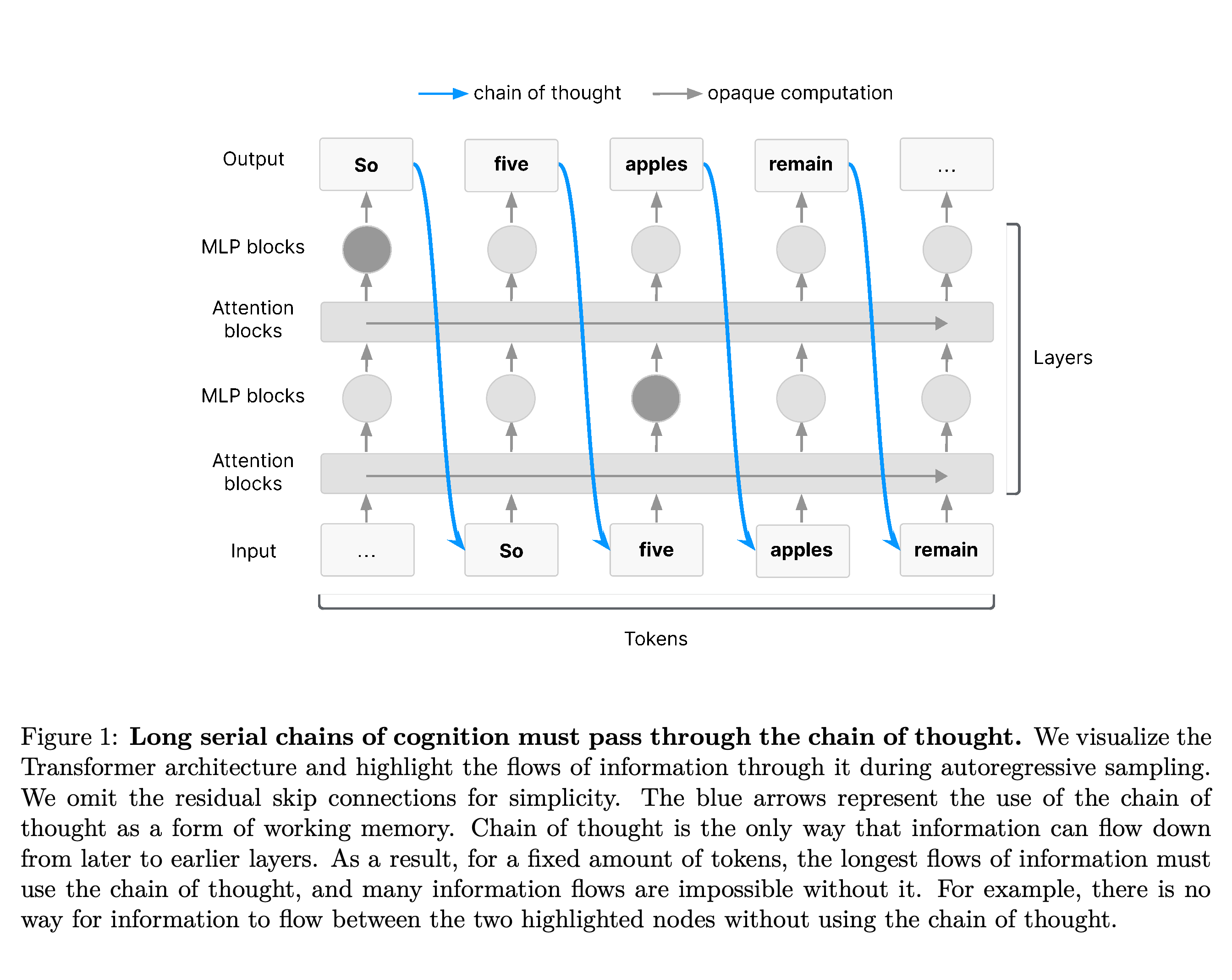
Information flow through a Transformer during autoregressive generation, distinguishing chain-of-thought feedback from opaque internal computation. Residual skip connections are omitted.
2. SmallThinker: A Family of Efficient Large Language Models Natively Trained for Local Deployment
- https://arxiv.org/abs/2507.20984
- SmallThinker: A Family of Efficient Large Language Models Natively Trained for Local Deployment | Summary
- SmallThinker: A Family of Efficient Large Language Models Natively Trained for Local Deployment combines expert selection, inactive neurons within experts, early routing, and mixed global and local attention. Early routing overlaps expert-weight loading with attention computation; local attention reduces the key-value (KV) cache, the stored attention states used during generation.
- Using PowerInfer, the inference system used for the measurements, with Q4_0 quantization, the reduced-precision weight format, SmallThinker-21B-A3B reaches 20.30 tokens/s on an i9 14900K PC under an 8 GiB memory limit, versus 10.11 for Qwen3-30B-A3B. Their MMLU general-knowledge evaluation scores are 84.4 and 85.1, respectively. With weights resident in memory, the PC throughput ranking reverses: 30.19 versus 33.52 tokens/s.
- The strongest reported gain for the 21B model occurs on OnePlus 13 under the 8 GiB limit: 15.50 versus 0.18 tokens/s, approximately 86.1×. Missing component ablations, experiments isolating individual changes, and unspecified prompt length, generation length, batch size, thread settings, storage characteristics, and measurement variability limit attribution and reproduction of these gains.
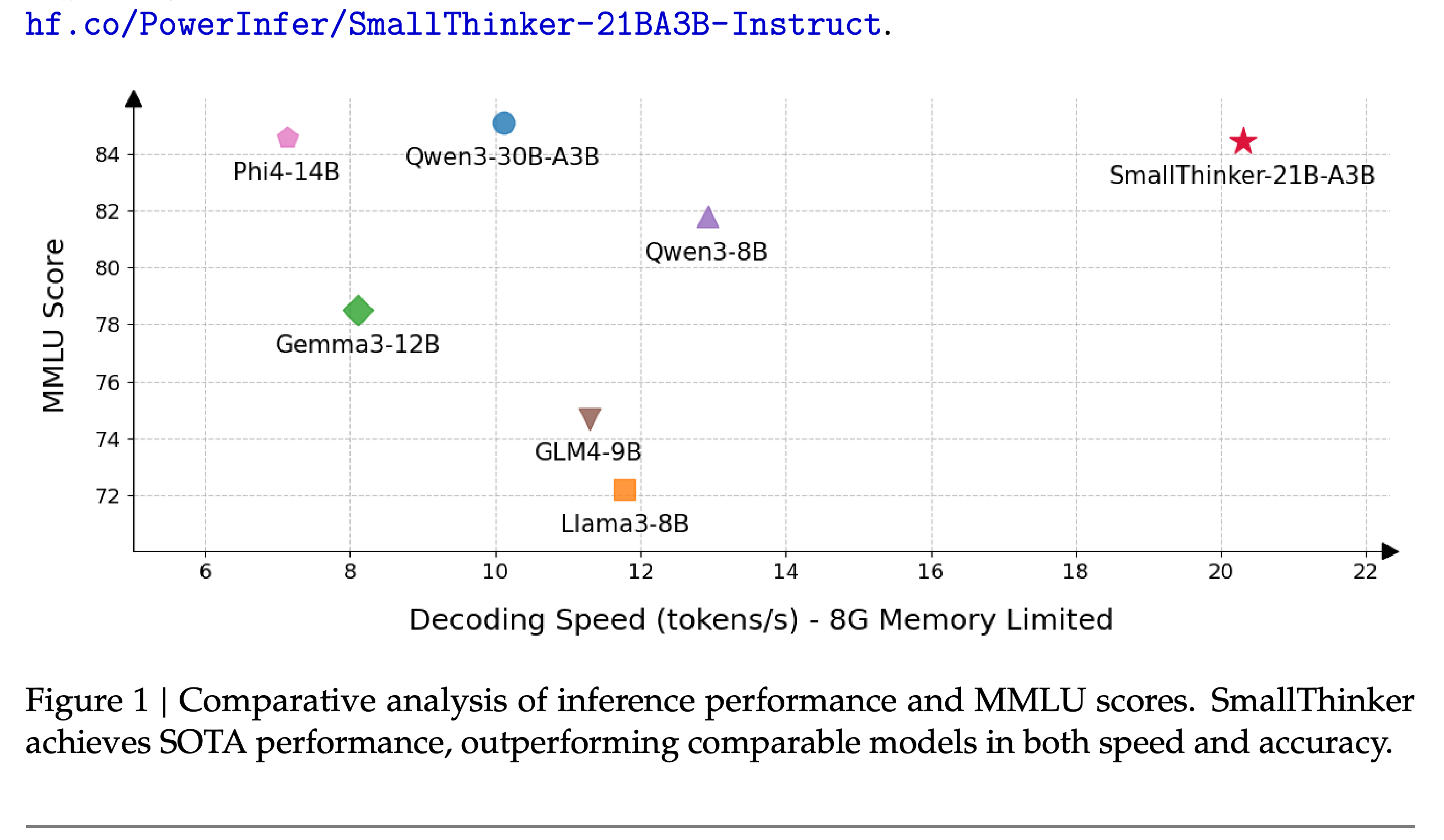
MMLU scores versus decoding speed under the plotted 8G memory limit.
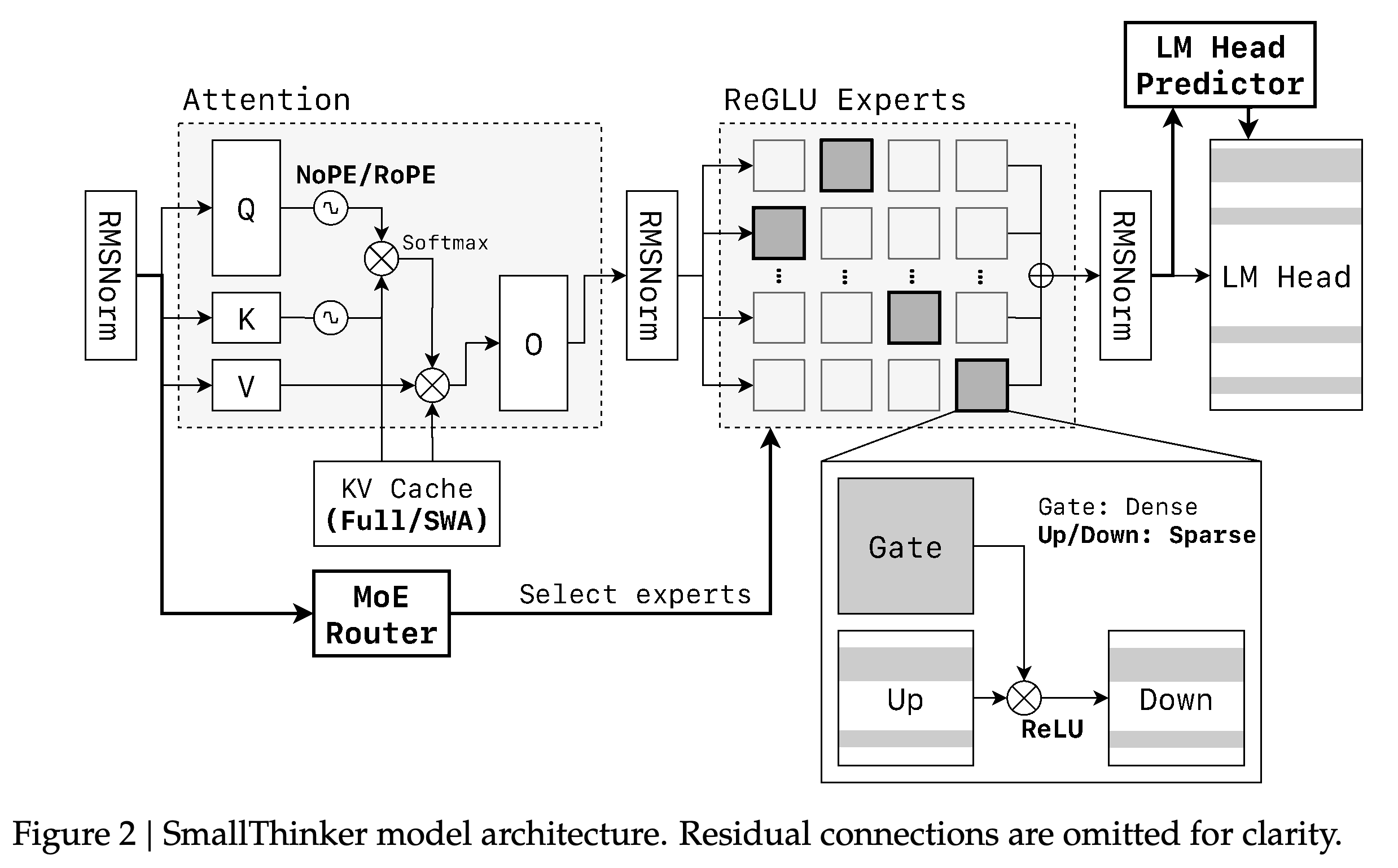
SmallThinker architecture showing early routing, hybrid attention, sparse experts, and language model head prediction; residual connections are omitted.
3. Group Sequence Policy Optimization
- https://arxiv.org/abs/2507.18071
- Group Sequence Policy Optimization | Summary
- Group Sequence Policy Optimization uses rewards normalized within groups of responses to the same query and a length-normalized whole-response probability ratio. This ratio is the geometric mean of token probability ratios between the current and data-generating models. Clipping, which suppresses selected updates when a ratio crosses a threshold, acts on whole responses rather than individual tokens.
- Starting from a model fine-tuned from Qwen3-30B-A3B-Base, GSPO reports higher reward and mathematics and programming benchmark performance than Group Relative Policy Optimization (GRPO), which uses per-token probability ratios, at matched training compute and consumed queries. GRPO includes Routing Replay, which reuses the data-generating model’s expert selections during updates; GSPO trains stably without it in the reported comparison.
- Average clipped-token fractions are 0.15 for GSPO and 0.0013 for GRPO, despite GSPO’s higher reported training efficiency. This observation shows that retaining more tokens for gradient estimation does not ensure better learning in this comparison; it does not directly measure gradient noise. Experiments name one starting model, omit numerical compute scales and repeated-run uncertainty, and provide no measured infrastructure savings.
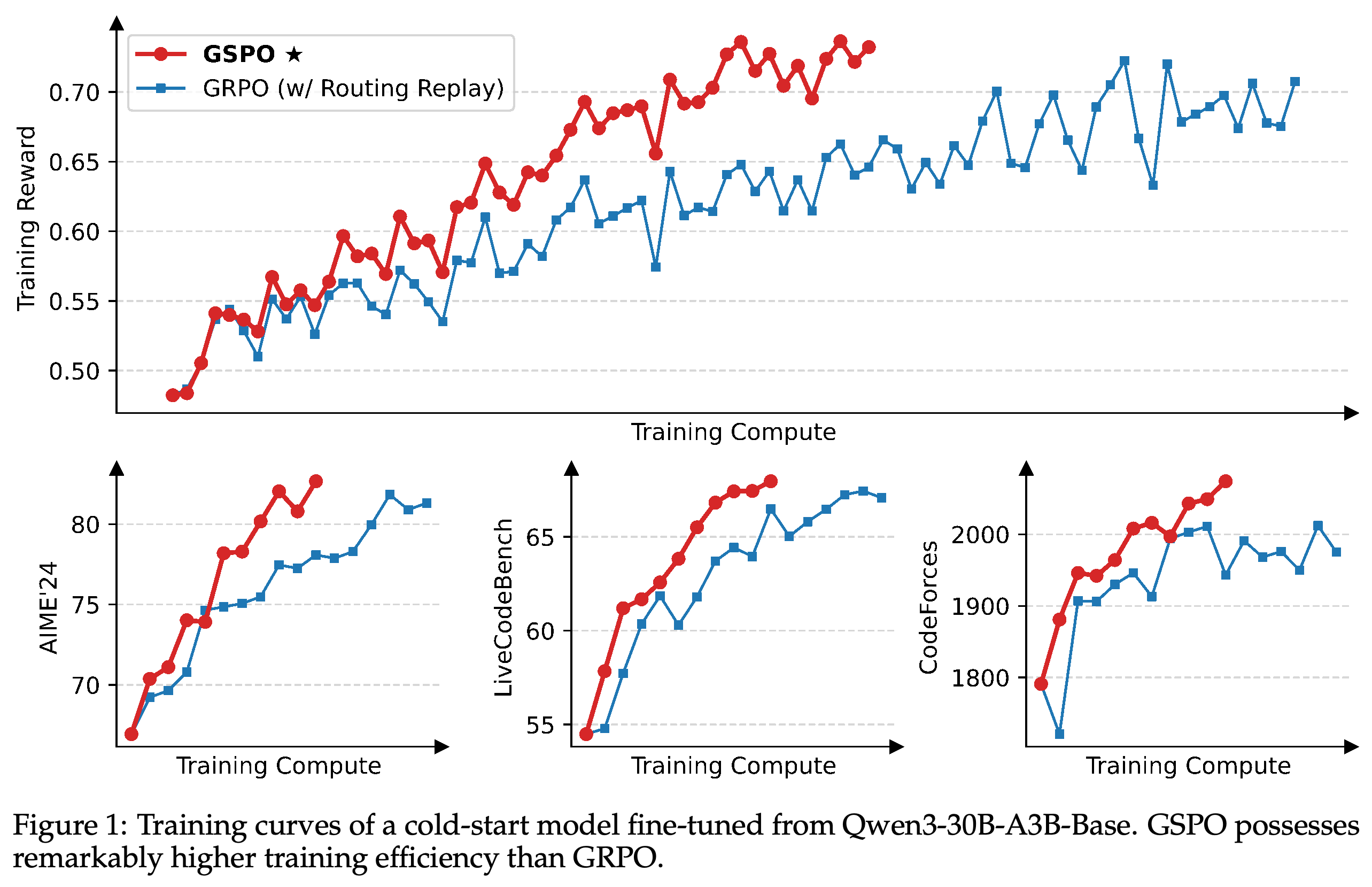
Training reward and benchmark performance versus training compute for a cold-start model fine-tuned from Qwen3-30B-A3B-Base, comparing GSPO with GRPO using Routing Replay.
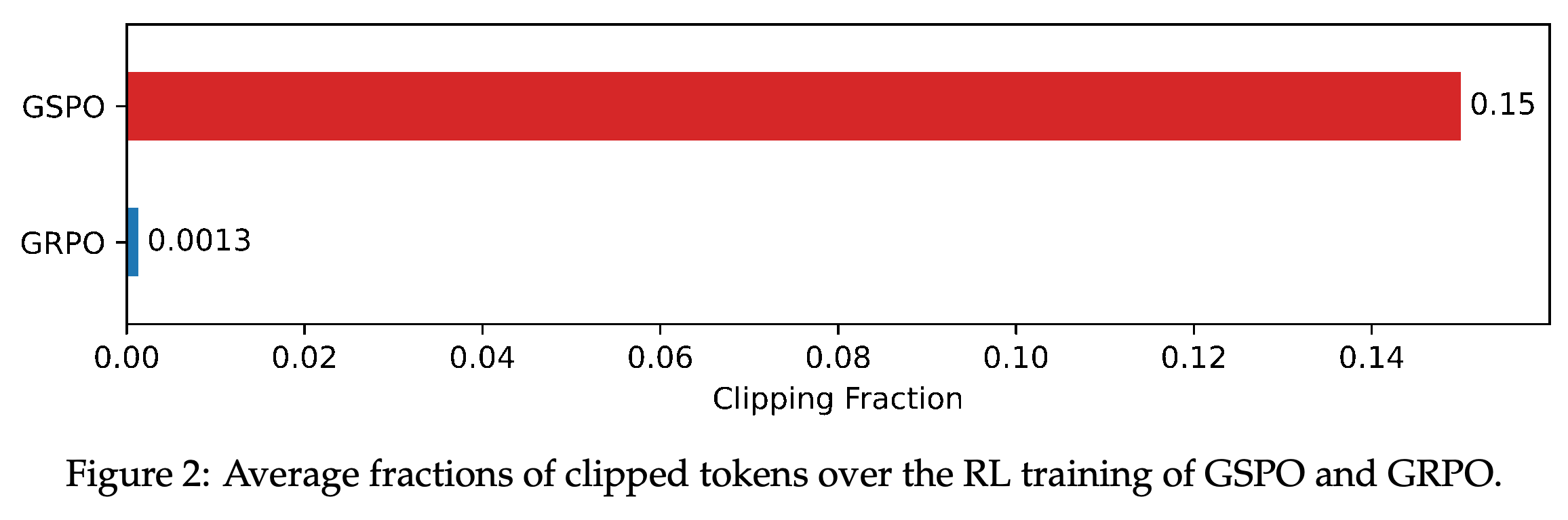
Average fractions of clipped tokens during GSPO and GRPO reinforcement learning training.
Sources
[1] Chain of Thought Monitorability: A New and Fragile Opportunity for AI Safety
[2] SmallThinker: A Family of Efficient Large Language Models Natively Trained for Local Deployment