


Looped World Models | Summary
16 Jun 2026 | Paper Review World Models Looped Transformers Deferred Decoding Adaptive ComputationContents
- Summary
- 1 Introduction
- 2 Related WORK
- 3 Looped World Model
- 4 Results
- 5 Conclusions
- 6 BROADER IMPACTS
- Appendix
- Brief Thoughts
This article explains the key points of Looped World Models.
- 2026-06-16 (arXiv)
- Lu, Hongyuan Adam, Wei, Z. L. Victor, Zhang, Qun, Zeng, Jinrui, Cao, Bowen, Meng, Lingwei, Li, Mocheng, Wang, Zezhong, Yin, Haonan, Xue, Naifu, et al.
- FaceMind Research Asia
- Paper
Summary
- Looped World Models (LoopWM; arXiv:2606.18208) proposes action-conditioned latent dynamics based on repeated applications of a parameter-shared transformer block. An inner loop refines each transition estimate, while an outer loop propagates the latent state across environment steps.
- The architecture combines spectrally constrained linear state retention, stochastic training depth, adaptive early exit, and deferred decoding. Deferred decoding processes an action sequence in latent space and produces observation, reward, and continuation predictions only at its terminal step.
- For five-action ScienceWorld prediction, the approximately 1B-parameter model reports 68.4% exact match, compared with 47.2% for claude-opus-4-6-max. On AlfWorld, LoopWM obtains the highest reported BLEU-4 score, 71.6%, but not the highest exact match, Token F1, or Entity score.
- The reported results support competitive short-horizon prediction, but matched ablations do not isolate the contributions of looping, spectral constraints, or deferred decoding. The claimed up to 100× parameter efficiency and large FLOPs savings lack controlled measurements, and contraction of the linear retention matrix alone does not establish stability of the complete nonlinear dynamics.
1 Introduction
The introduction identifies two difficulties: prediction errors accumulate across imagined trajectories, and increasing conventional network depth increases parameters and deployment cost. LoopWM instead reuses a transition-refinement operator across depth, making iterative latent computation a proposed scaling axis independent of parameter count.
- The paper distinguishes inner-loop refinement from physical time: repeated transformer applications refine a single transition estimate rather than simulate successive environment steps.
- Parameter sharing reduces stored parameters, but additional iterations still require computation. Inference savings depend on transition difficulty, useful minimum depth, and early-exit overhead.
2 Related WORK
The related-work discussion connects latent world models, parameter-shared recurrent-depth transformers, and input-dependent computation. LoopWM combines these ideas for action-conditioned environment prediction; parameter sharing and adaptive halting each have established precedents.
2.1 World Models for Reinforcement Learning and Embodied Ai
The paper traces latent world modelling through World Models, PlaNet, Dreamer, and MuZero, then discusses transformer, diffusion, and video-generation approaches including IRIS, TransDreamer, DIAMOND, and Genie. It identifies compounding prediction error as a persistent limitation and reviews mitigation strategies such as replanning, self-correction, and physics-informed modelling.
- These methods define the surrounding design space. The reported experiments do not compare LoopWM with their dynamics backbones under matched training and evaluation conditions.
2.2 Looped and Recurrent-Depth Transformer Architectures
Universal Transformer and ALBERT provide precedents for sharing weights across depth, while subsequent recurrent-depth models study latent iterative computation and test-time depth scaling. The paper also reviews theoretical computational expressivity, adaptive loop counts, elastic-depth training, and mixture-of-recursions designs.
- LoopWM draws on the prelude–recurrent–coda organization and Parcae’s negative-diagonal state-retention parameterization. Results from the cited language models motivate this transfer but do not establish LoopWM’s world-model efficiency.
2.3 Adaptive Computation and Early Exit
Adaptive Computation Time, intermediate-layer early exit, stochastic loop-depth training, and hidden-state convergence criteria motivate variable computation per transition. The paper argues that predictable transitions should require fewer refinement iterations than complex events, but reports neither event-specific loop counts nor an accuracy–compute curve.
3 Looped World Model
LoopWM combines action-conditioned latent prediction, shared iterative refinement, and adaptive depth. The method section also introduces deferred decoding, which separates multi-step latent evolution from terminal observation prediction.
3.1 Overall Architecture
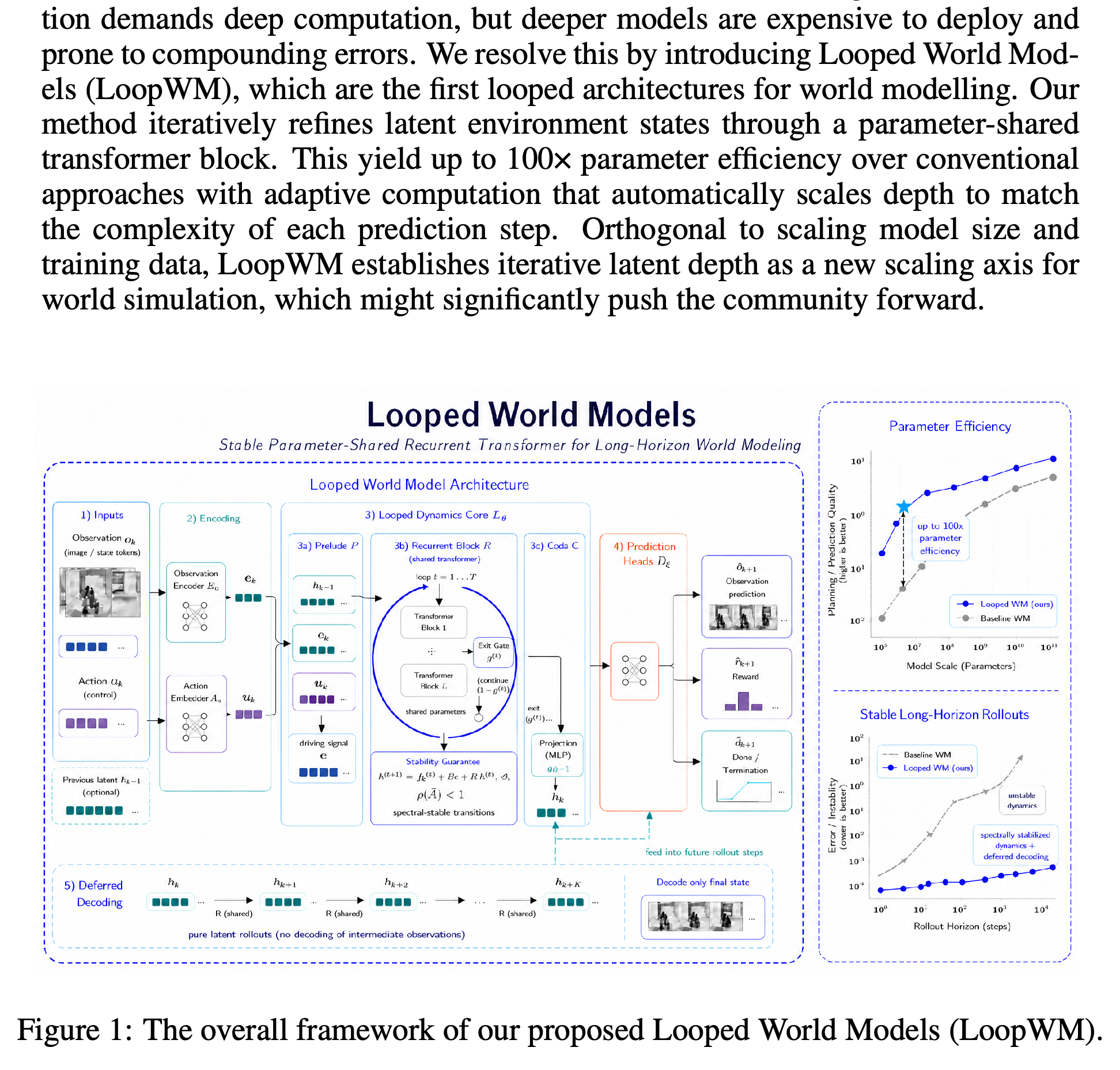
The architecture contains four modules: Observation Encoder Eϕ., Action Embedder Aψ., Looped Dynamics Core Lθ., and Prediction Heads Dξ. At environment step k, observation and action embeddings condition the dynamics core, and lightweight prediction heads produce the next observation or latent target, reward, and continuation flag.
- Observation Encoder Eϕ. uses a convolutional or vision-transformer encoder to compute ek = Eϕ(ok); Action Embedder Aψ. computes uk = Aψ(ak) in the same d-dimensional latent space.
- Looped Dynamics Core Lθ. combines the previous latent state, observation embedding, and action embedding through T shared-block iterations.
- Prediction Heads Dξ. decode the resulting state. During imagined rollouts, real-observation encoding is bypassed, with observation injection omitted or replaced by the model’s prediction.
- Figure 1 depicts this data flow, the shared recurrent block and exit gate, and terminal-only decoding. Its efficiency and rollout-error plots illustrate the proposed benefits without a documented experimental protocol.
The diagram separates observation and action encoding, the prelude–recurrent–coda dynamics core, prediction heads, and terminal decoding. The recurrent block and exit gate identify where parameter reuse and adaptive computation occur. The adjacent parameter-efficiency and rollout-error plots lack an accompanying measurement protocol and should be read as illustrations of the proposed benefits.
3.2 Looped Dynamics Core with Spectral Stability
The core uses Prelude P., Recurrent Block R., and Coda C., with the recurrent update h^(t+1) = Āh^(t) + B̄e + R̄(h^(t), e). Spectral Stability Constraint. parameterizes A := diag(−exp(a)) and Ā = exp(Δ·A), with positive learnable Δ, so all diagonal entries of Ā lie in (0, 1).
- Prelude P. processes the concatenated previous state, observation embedding, and action embedding; layer normalization controls the conditioning signal’s magnitude.
- Recurrent Block R. shares its transformer parameters across T iterations. Initialization is Gaussian or inherited from the previous environment step.
- Spectral Stability Constraint. makes the linear retention component contractive by construction. The manuscript does not bound the nonlinear transformer term sufficiently to establish contraction or boundedness of the complete update.
- Coda C. applies non-shared transformer layers after a learned projection of the terminal recurrent state.
- Cross-Timestep State Propagation. carries the terminal state into the next transition, creating separate inner refinement and outer temporal loops. The linear spectral constraint alone does not guarantee stability across either complete loop.
3.3 TRAINING OBJECTIVE
Variable-Depth Training. samples T ∼ Poisson(µrec) independently for each sequence within a micro-batch, with learnable mean µrec. World Model Loss. combines observation, reward, and continuation prediction losses, with backpropagation through recurrent iterations truncated to µbwd = ⌈µrec/2⌉ steps.
- Observation loss depends on the observation space, such as MSE for continuous states or cross-entropy for discrete tokens; λr and λc weight the reward and continuation terms.
- Entropy-Regularised Adaptive Depth. adds −α times the expected summed binary entropy of exit probabilities to discourage deterministic gate collapse.
- The paper attributes fewer loss spikes to per-sequence depth sampling, but supplies no training curves or controlled comparison for this claim.
3.4 Adaptive Early Exit for INFERENCE
Adaptive inference uses the learned sigmoid gate g^(t) = σ(wg⊤h^(t) + bg), stopping when its probability exceeds threshold τ. The inference maximum Tmax can exceed the training mean µrec, allowing additional refinement at test time.
- The illustrative comparison of a 100-layer baseline with one iteration of a 4-layer recurrent block gives approximately 25× fewer recurrent layer applications for that step. It excludes other modules and is not a measured end-to-end speedup.
- The claimed aggregate savings of up to two orders of magnitude depend on transition simplicity and depth allocation. The manuscript reports no measured latency, FLOPs, exit-depth distribution, or quality-versus-depth sweep.
3.5 DEFERRED DECODING: Action-Conditioned Latent Rollout
Deferred decoding advances an initial encoded state through K action-conditioned latent transitions and invokes Dξ exactly once at the terminal state. Unlike the standard baseline, it produces no intermediate observation, reward, or continuation outputs; with T refinement iterations per action, the nested rollout uses K × T shared-parameter transformer applications.
- 3.5.1 MOTIVATION: skipping intermediate decoding reduces decoder work and removes the requirement for detailed observation reconstruction at every transition.
- 3.5.2 FORMULATION: Standard per-step decoding (baseline). applies the dynamics and prediction heads at every action step; Deferred decoding. applies only latent dynamics between terminal decodes. Interaction between inner and outer loops. preserves action injection at each outer step and shared refinement within it.
- 3.5.3 TRAINING OBJECTIVE FOR DEFERRED DECODING: Terminal prediction loss. supervises the final observation, reward rK−1, and continuation cK−1. Latent trajectory regularizer. aligns projected intermediate states with stop-gradient embeddings from a frozen encoder and penalizes cumulative state displacement above K·Cmax.
- 3.5.4 CURRICULUM OVER DEFERRAL HORIZON K: training starts at K = 1 and increases the horizon according to K(step) = min(Kmax, 1 + ⌊step/Δ⌋), where Δ is the interval between increments. The intermediate consistency loss contains 1/(K−1), so its stated formula requires a separate convention at K = 1 that the paper does not specify.
- 3.5.5 INFERENCE MODES: Planning mode. evaluates candidate sequences using terminal predictions, saving approximately (K−1)×cost(Dξ) decoder FLOPs. Monitoring mode. uses the lightweight projection gω for intermediate summaries, with full decoding available diagnostically.
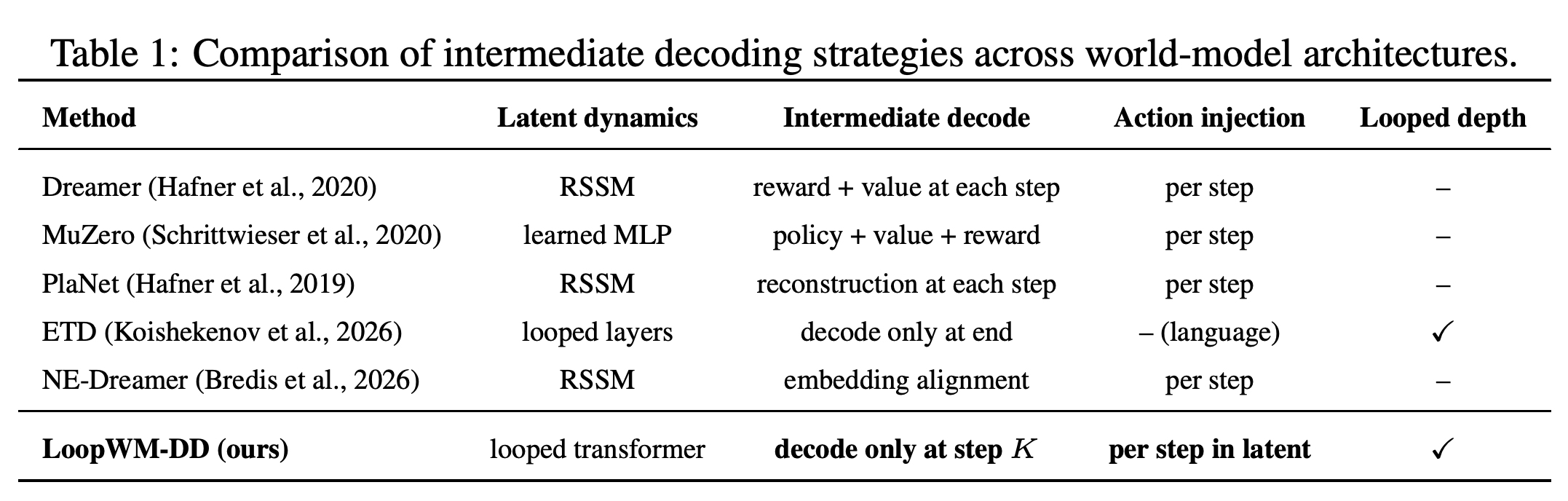
- 3.5.6 RELATIONSHIP TO PRIOR WORK: Table 1 distinguishes LoopWM-DD from RSSM-based models, MuZero, and language-oriented encode-think-decode methods. Terminal-only predictions do not directly provide intermediate rewards or termination checks for planning objectives that require them.
The comparison identifies LoopWM-DD by its combination of looped depth, per-step latent action injection, and decoding only at step K. It distinguishes this design from methods that omit observation reconstruction but still predict reward, value, or policy at intermediate steps.
4 Results
The main evaluation predicts the final environment output after five consecutive actions on ScienceWorld and AlfWorld. It reports EM, Token F1, BLEU-4, and Entity scores for an approximately 1B-parameter LoopWM and the baselines claude-opus-4-6-max, qwen-3.5-flash, and gemini-3-flash-preview-thinking.
- The manuscript does not specify dataset splits, evaluation sample counts, baseline prompts, training-data composition, optimizer settings, actual loop-depth settings, or uncertainty estimates.
- These are environment-prediction scores, not policy success rates, reinforcement-learning returns, or quantitative tests of continuous physical simulation.
4.1 Main Results on ScienceWorld
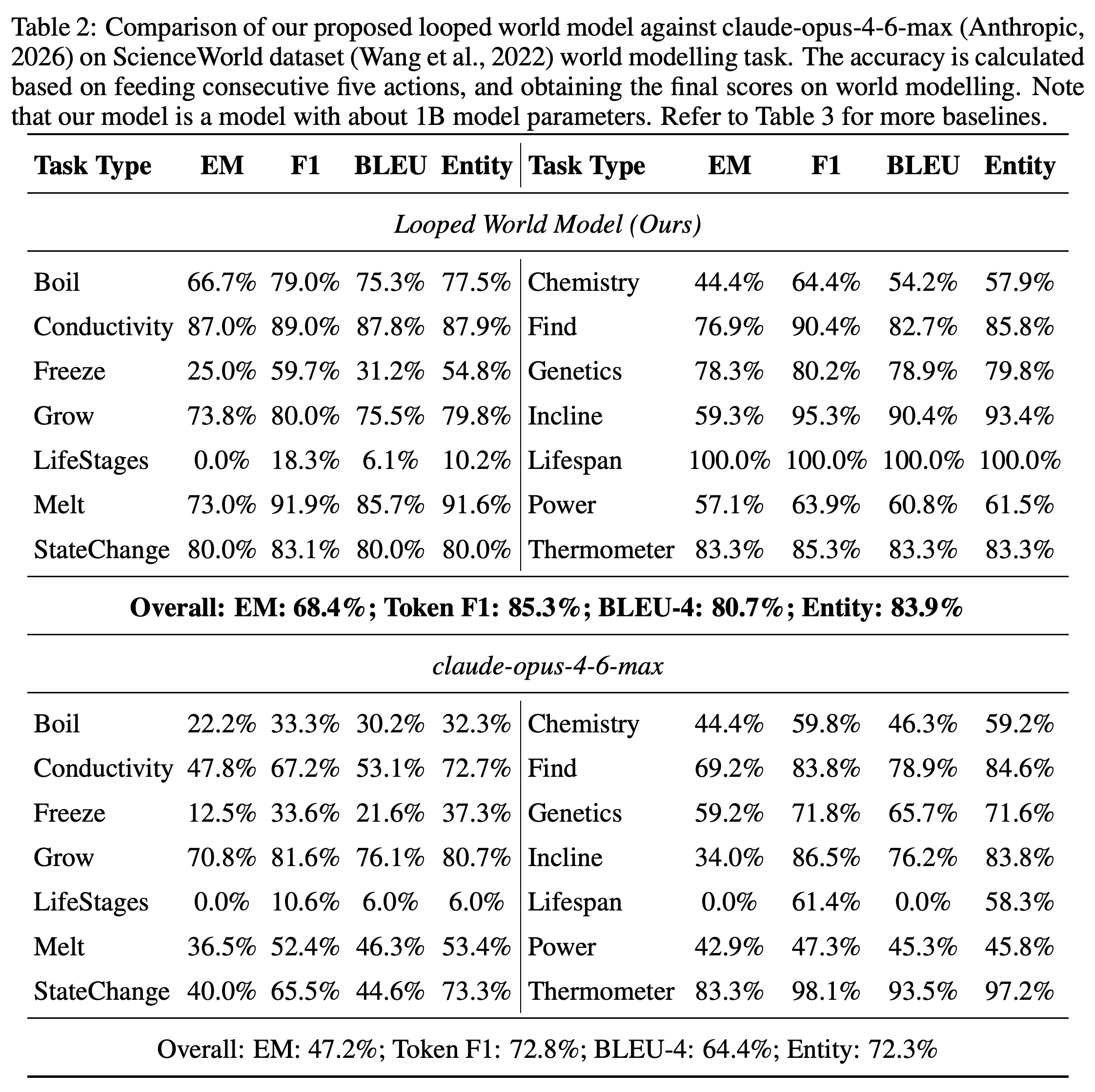
Tables 2 and 3 report ScienceWorld overall scores of 68.4% EM, 85.3% Token F1, 80.7% BLEU-4, and 83.9% Entity for LoopWM. claude-opus-4-6-max obtains 47.2%, 72.8%, 64.4%, and 72.3%, respectively; the EM difference is 21.2 percentage points, not a 21.2% relative improvement.
- LoopWM raises Lifespan EM from the Claude baseline’s 0.0% to 100.0%, but LifeStages remains at 0.0% EM and 18.3% F1. Aggregate superiority does not imply an advantage on every task and metric.
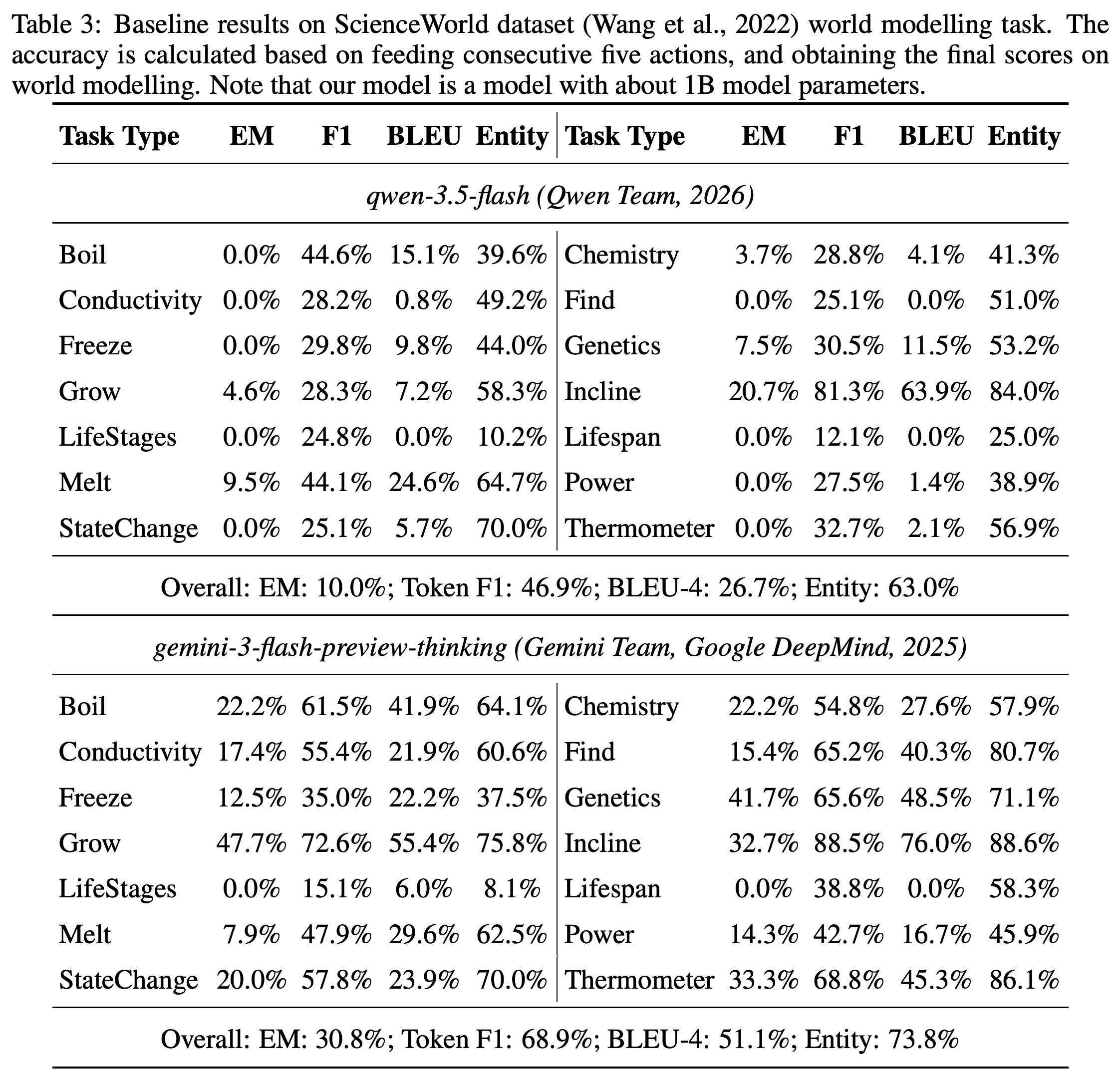
- qwen-3.5-flash reports 10.0% EM and gemini-3-flash-preview-thinking reports 30.8% EM in Table 3. These are reported task comparisons rather than a controlled test of architectural advantage.
- The paper’s more than 100× model-size comparison depends on an undisclosed parameter count for the closed-source baseline. The approximately 1B LoopWM size alone does not establish that ratio.
LoopWM exceeds claude-opus-4-6-max on all four aggregate ScienceWorld measures after five actions, including a 21.2-percentage-point EM advantage. Task-level results vary substantially: Lifespan reaches 100.0% EM, whereas LifeStages remains at 0.0%, and some task-level overlap or Entity scores favor Claude.
The additional ScienceWorld baselines report overall EM of 10.0% for qwen-3.5-flash and 30.8% for gemini-3-flash-preview-thinking, below LoopWM's 68.4%. The table supplies neither baseline parameter counts nor matched training conditions, so it does not establish a parameter-efficiency ratio.
4.2 Main Results on AlfWorld
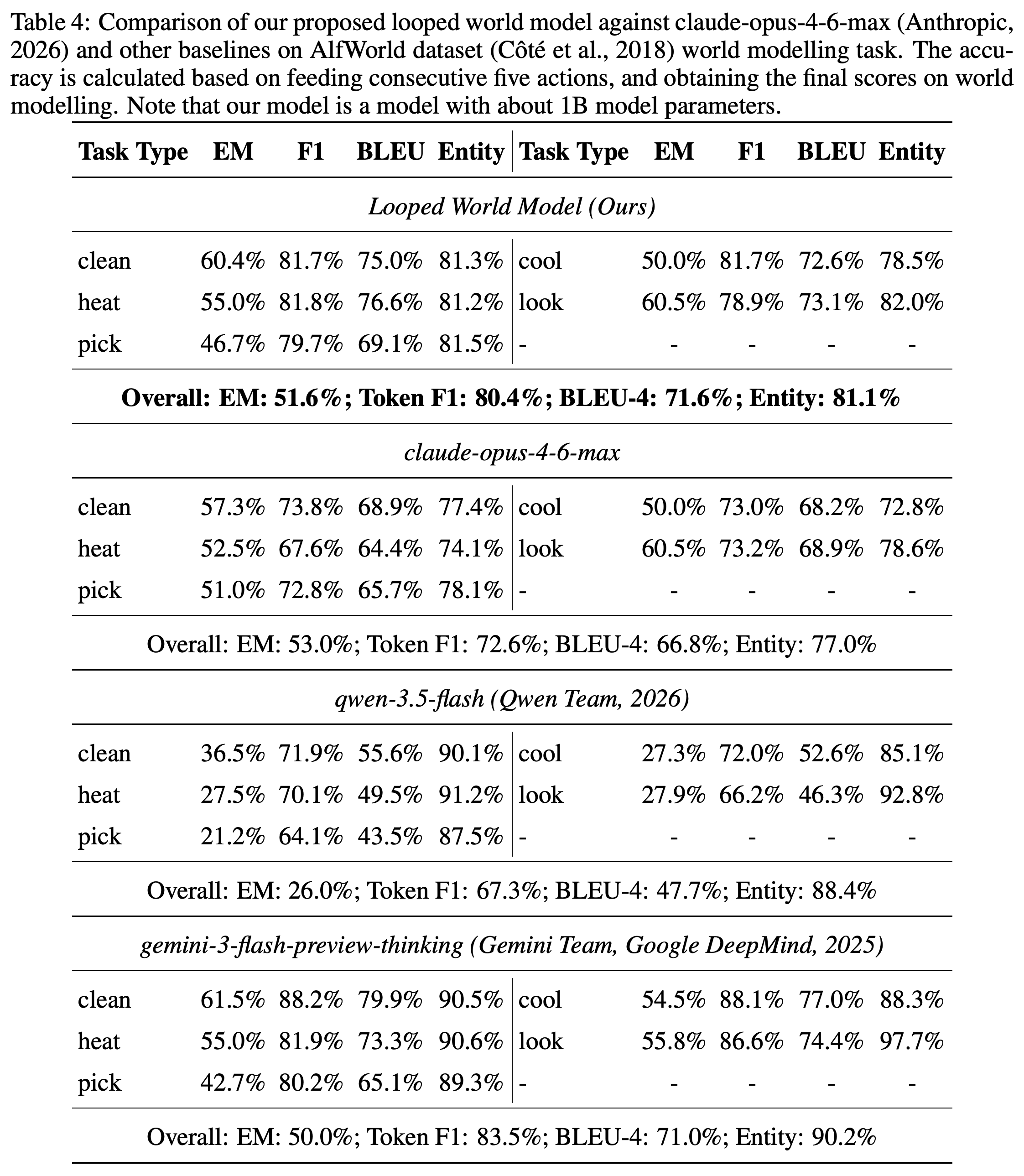
Table 4 reports AlfWorld scores of 51.6% EM, 80.4% Token F1, 71.6% BLEU-4, and 81.1% Entity for LoopWM. It ranks second on EM behind claude-opus-4-6-max at 53.0%, second on Token F1 behind gemini-3-flash-preview-thinking at 83.5%, and first on BLEU-4.
- Its Entity score is below qwen-3.5-flash at 88.4% and gemini-3-flash-preview-thinking at 90.2%, although it exceeds Claude’s 77.0%.
- LoopWM therefore leads one aggregate metric rather than uniformly outperforming the baselines. The paper identifies entity prediction as a target for improvement.
LoopWM has the highest aggregate BLEU-4 at 71.6%, but Claude leads EM and Gemini leads Token F1 and Entity. LoopWM's 81.1% Entity score is below Qwen's 88.4% and Gemini's 90.2%, limiting the claim of superiority to particular metrics.
4.3 Deep Analysis on DEFERRED DECODING
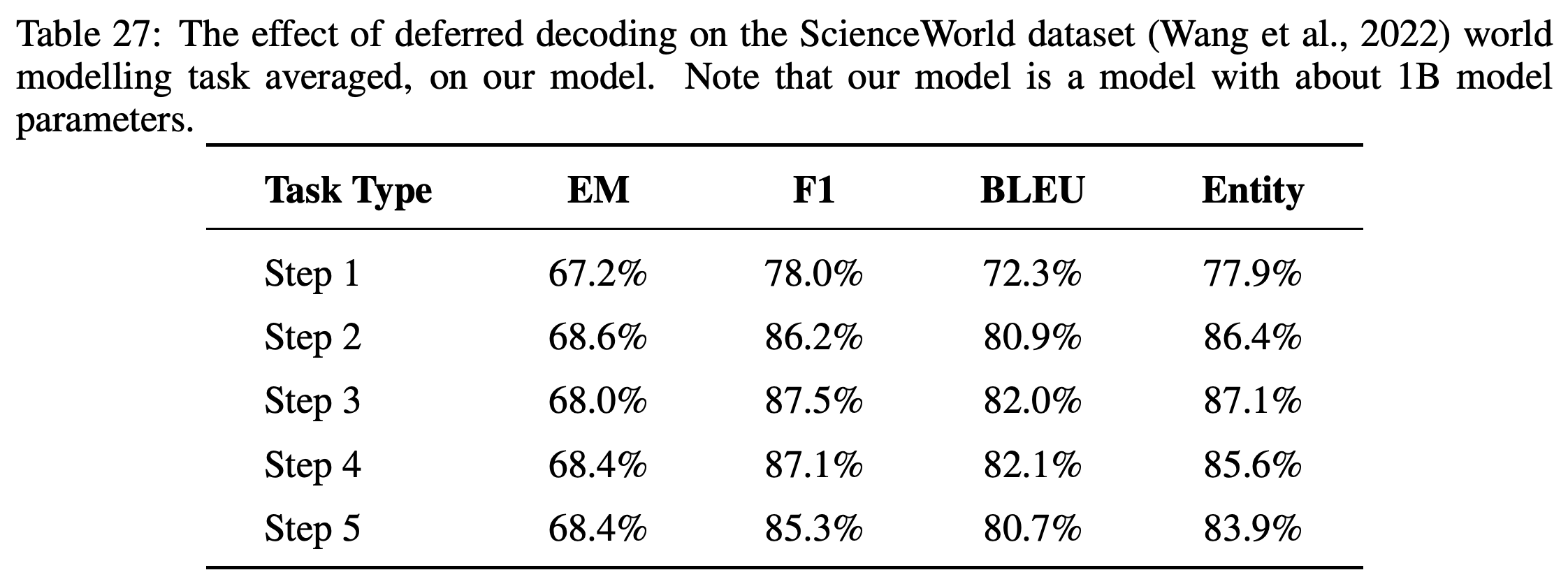
The deferred-decoding analysis reports ScienceWorld predictions for Step 1 through Step 5, using both relative gains over Gemini and Qwen and absolute-score tables. Table 27 shows LoopWM EM between 67.2% and 68.6%, while Token F1 rises from 78.0% at Step 1 to 87.5% at Step 3 before declining to 85.3% at Step 5.
- Table 5 reports relative EM gains over Gemini of +73.2%, +54.5%, +103.6%, +82.9%, and +113.8%. The gains are non-monotonic and do not show that absolute accuracy consistently improves with action horizon.
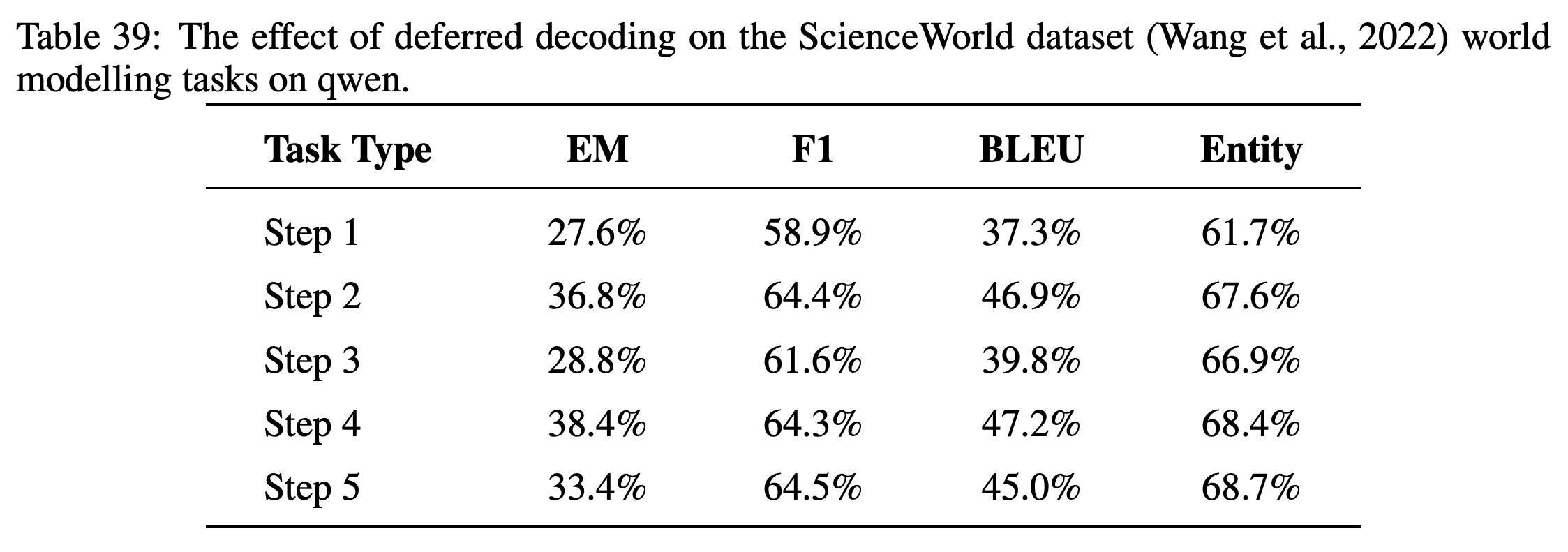
- Tables 33 and 39 report Step 5 EM of 32.0% for Gemini and 33.4% for Qwen, compared with 30.8% and 10.0% in Table 3. Task-level baseline scores also differ between the main and horizon tables, so aggregation alone cannot account for all discrepancies; the manuscript does not explain the evaluation differences.
- Table 16 provides aggregate relative gains over Qwen; Tables 6–15 and 17–26 provide task-level relative gains. Tables 28–32, 34–38, and 40–44 provide per-task absolute scores for LoopWM, Gemini, and Qwen. Some task-metric gains are negative, and large relative gains can arise from small baseline scores.
- No matched LoopWM comparison with versus without deferred decoding is shown. These tables therefore do not isolate the effect of skipping intermediate decoding, and varying the outer action horizon K does not establish scaling with inner-loop depth T.
LoopWM's aggregate EM changes little across the five horizons. Token F1 and Entity peak at Step 3, while BLEU peaks at Step 4; the results do not demonstrate monotonic improvement with action horizon.
Qwen's Step 5 EM is 33.4% in the horizon analysis, compared with 10.0% in the main ScienceWorld baseline table. Differences also occur at the task level, so these aggregates cannot be treated as interchangeable or reconciled solely by changing aggregation.
5 Conclusions
The conclusion presents iterative latent depth as a scaling axis for compact world models and attributes efficiency and stability to parameter sharing, spectral constraints, and adaptive depth. The reported prediction results do not establish the stronger claims of arbitrary-horizon stability, measured 100× parameter efficiency, or a depth-scaling law.
6 BROADER IMPACTS
The section titled 6 BROADER IMPACTS discusses selective disclosure, architectural positioning, scaling, and optimization rather than societal impacts. It states that training has also been tested in continuous visual environments, but provides no quantitative evaluation of those environments.
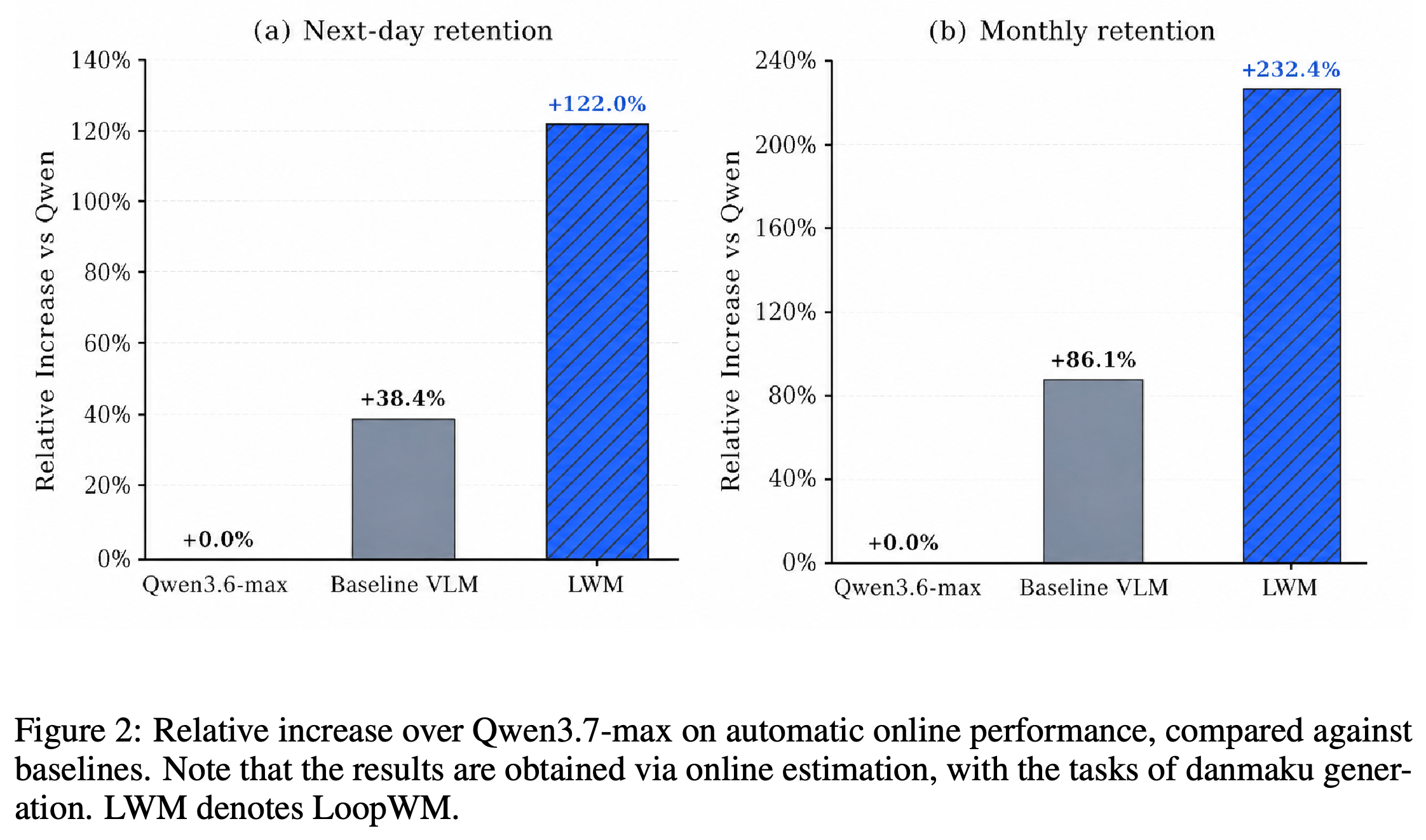
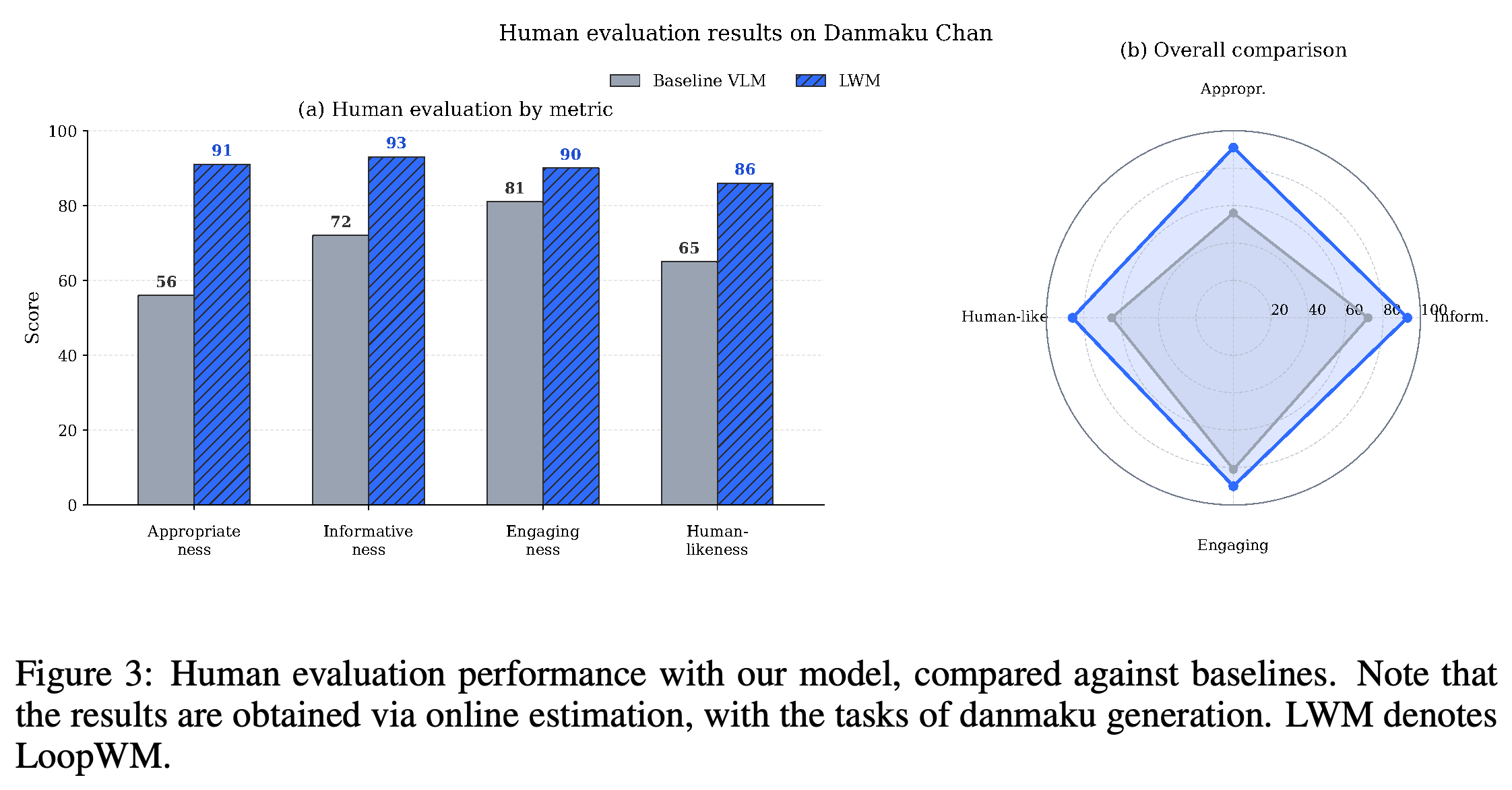
- Figures 2 and 3 present danmaku-generation results outside the main environment-prediction evaluation: online retention estimates and human judgments favor LWM over a Baseline VLM.
- Figure 2 reports +122.0% next-day retention and +232.4% monthly retention for LWM, compared with +38.4% and +86.1% for Baseline VLM. Its caption names Qwen3.7-max, while its axes name Qwen3.6-max.
- Figure 3 reports LWM scores of 91, 93, 90, and 86 for appropriateness, informativeness, engagingness, and human-likeness, compared with 56, 72, 81, and 65 for Baseline VLM.
- Neither figure supplies sample sizes, uncertainty, or sufficient evaluation procedures to attribute these application results specifically to looped dynamics or deferred decoding.
The online danmaku comparison reports LWM retention gains of +122.0% for next-day retention and +232.4% for monthly retention, exceeding the Baseline VLM gains of +38.4% and +86.1%. The axes identify Qwen3.6-max as the reference, whereas the source caption identifies Qwen3.7-max. Cohort sizes, assignment procedures, and uncertainty are not disclosed.
The bar chart and radar plot show higher LWM scores on all four displayed dimensions: 91 versus 56 for appropriateness, 93 versus 72 for informativeness, 90 versus 81 for engagingness, and 86 versus 65 for human-likeness. Without evaluator counts, rating procedures, or uncertainty, the chart is descriptive application evidence rather than a controlled test of the world-model architecture.
Appendix
- The PDF contains no explicitly headed appendix. Additional ScienceWorld tables and danmaku figures appear before REFERENCES and are discussed above under the relevant main-body sections.
Brief Thoughts
The central design combines shared transition refinement with action-conditioned, terminal-decoded latent rollouts. Its individual components remain difficult to assess because the paper lacks matched fixed-depth and non-deferred baselines, measured compute trade-offs, and sufficient training detail for reproduction. The linear spectral construction is precise, but the complete update includes nonlinear transformer operations and temporal conditioning. Stability of the full system requires assumptions or bounds beyond the spectrum of Ā. Controlled loop-depth sweeps, decoder ablations, longer action horizons, and tests of intermediate reward and termination handling would directly assess the paper’s efficiency and planning claims.