


Monthly AI Papers: October 2025
31 Oct 2025 | Paper Review Monthly Papers Image Editing Optical Compression Reinforcement LearningContents
Trends
October 2025’s theme is engineering model pipelines for scale: the three selected papers address quality-controlled training data, compact input representations, and efficient training updates. Pico-Banana-400K organizes text-guided image editing, modifying images according to natural-language requests, into accepted edits, preference pairs, and consecutive editing sessions. DeepSeek-OCR studies optical compression, encoding document text through images represented by relatively few vision tokens, the image representations consumed by a text decoder. Ring-1T tackles stability and response-generation cost in reinforcement learning, training from rewarded model outputs. Together, these papers make data acceptance, token allocation, and training execution explicit parts of model development. 1, 2, 3
Their strongest evidence concerns specific pipeline outcomes. Pico-Banana-400K reports dataset composition and automated editing success rates; it leaves downstream training gains unmeasured. DeepSeek-OCR demonstrates document transcription and parsing with restricted token budgets, while long-context retrieval and reasoning remain untested. Ring-1T reports restrained training diagnostics and faster training steps with similar measured task scores, but its broader benchmark results combine changes in model scale, data, algorithms, and infrastructure. For engineering decisions, these distinctions favor evaluating the intended edit types, document distribution, or application tasks separately.
Top Papers in October 2025
1. Pico-Banana-400K: A Large-Scale Dataset for Text-Guided Image Editing
- https://arxiv.org/abs/2510.19808
- Pico-Banana-400K: A Large-Scale Dataset for Text-Guided Image Editing | Summary
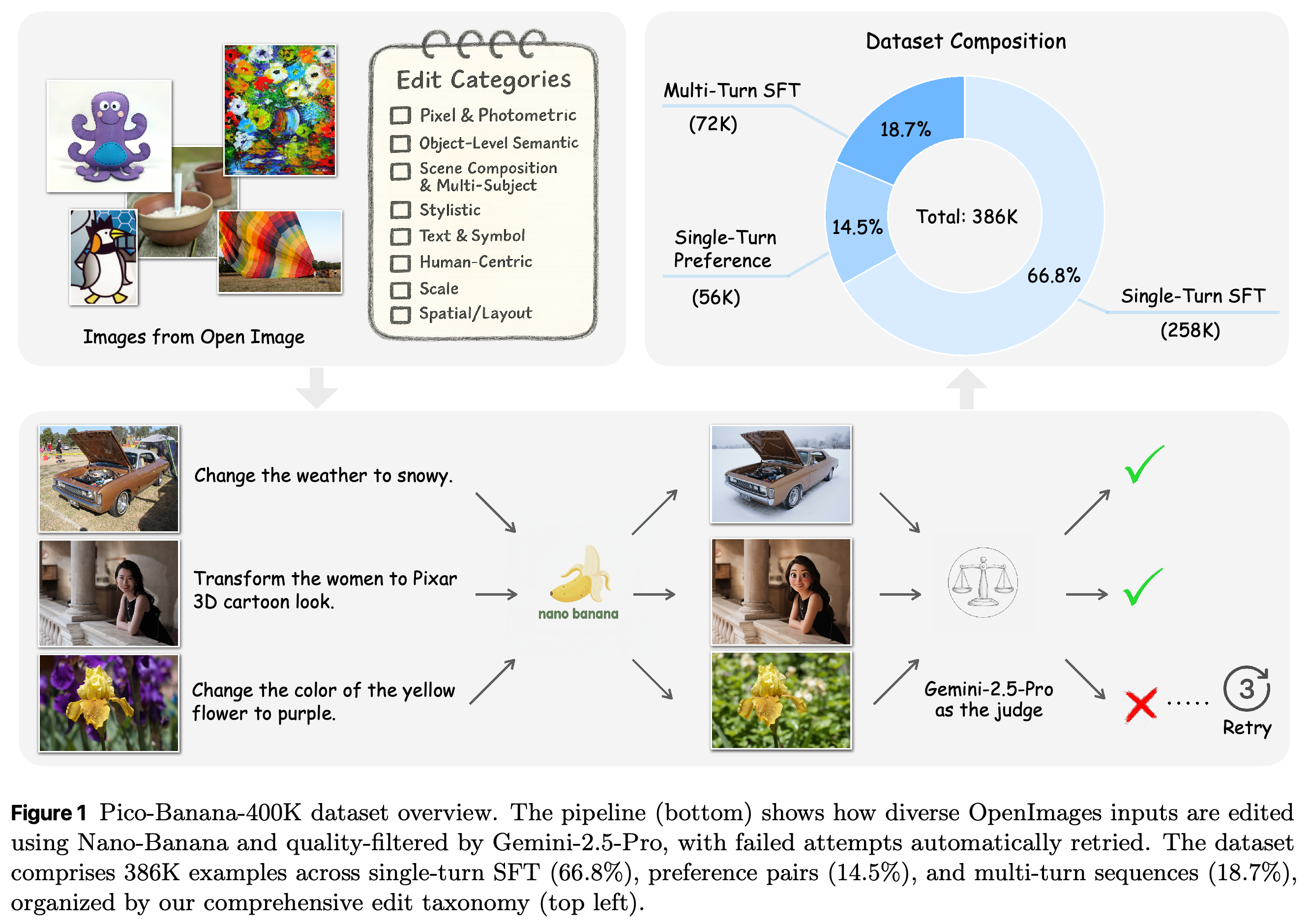
- Pico-Banana-400K: A Large-Scale Dataset for Text-Guided Image Editing reports 386K examples: 258K single-turn supervised fine-tuning records, training examples containing an instruction and its input/output images; 56K preference pairs linking successful and failed outputs; and 72K multi-turn sequences. The approximately 400K title combines different record types. Its comparison with MagicBrush’s approximately 10K human-annotated editing triplets establishes a difference in scale and structure, without measuring comparative editing quality.
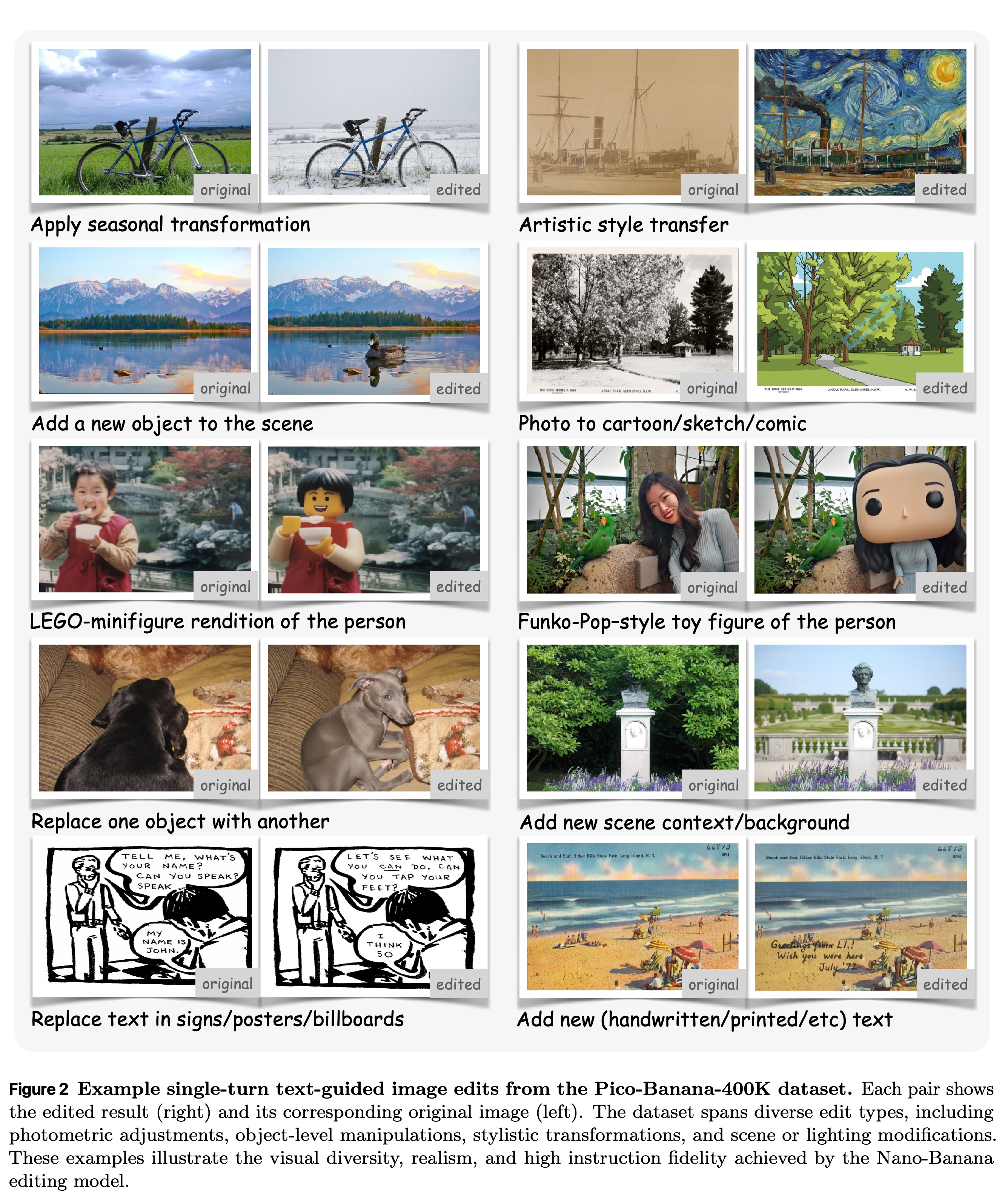
- The construction pipeline uses photographs from OpenImages, a public image dataset. Gemini-2.5-Flash generates detailed requests, Qwen2.5-7B-Instruct rewrites concise versions, and Nano-Banana, the Gemini-2.5-Flash-Image model, performs edits. Gemini-2.5-Pro evaluates instruction compliance, integration quality, preservation of unchanged regions, and technical quality with weights of 40%, 25%, 20%, and 15%. Outputs above an empirically chosen threshold of approximately 0.7 are accepted. The edit taxonomy, a classification of operations, covers 35 types across eight categories.
- Reliability varies substantially by operation under the automated evaluator: strong artistic style transfer, changing an image’s rendering to an artistic style, reaches 0.9340 success, object relocation reaches 0.5923, and changing visible text’s font style or color reaches 0.5759. Several unreliable operations were excluded, and retained sample counts are uneven. These rates describe the generation pipeline and its filtering decisions; broad categorical coverage does not establish balanced coverage of editing difficulty.
2. DeepSeek-OCR: Contexts Optical Compression
- https://arxiv.org/abs/2510.18234
- DeepSeek-OCR: Contexts Optical Compression | Summary
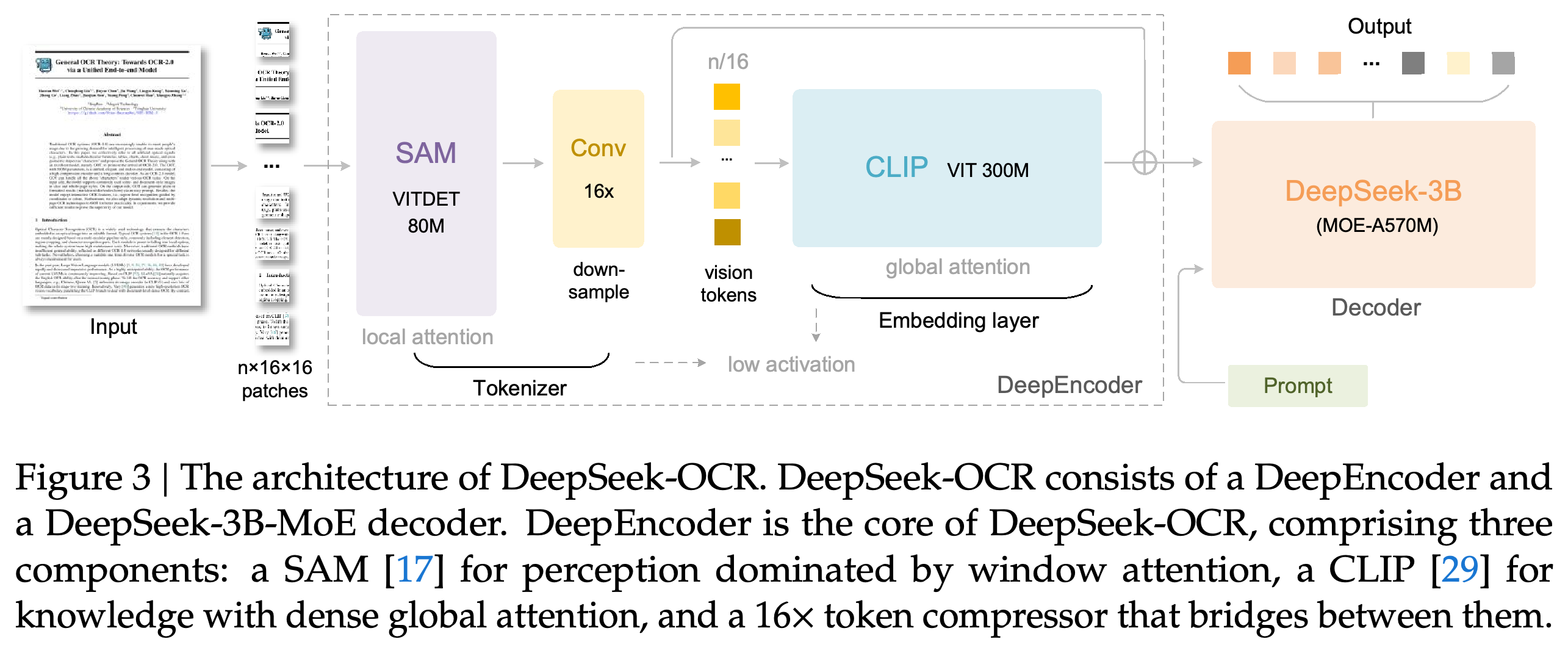
- DeepSeek-OCR: Contexts Optical Compression tests text reconstruction through optical character recognition (OCR), recovering text from images. DeepEncoder applies local image processing, 16× token downsampling, and global image processing before a 3B mixture-of-experts (MoE) decoder, which routes inputs through selected expert networks and activates approximately 570M parameters. A 1024×1024 image’s 4096 patch tokens become 256 tokens before global attention, which lets tokens interact across the full sequence.
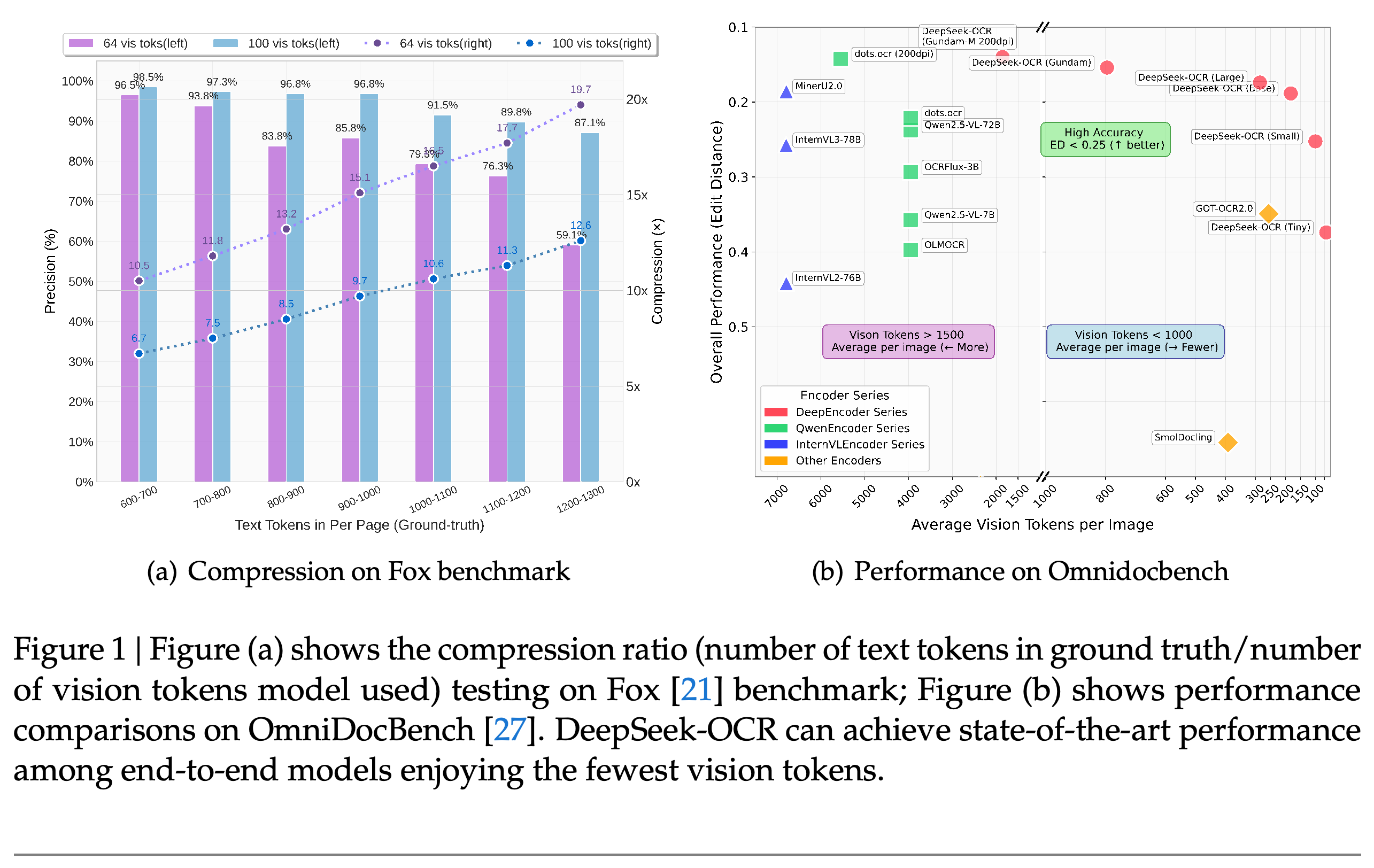
- On OmniDocBench, a document-parsing benchmark, Gundam mode combines local image crops with a global view and uses 795 vision tokens per page on average. It achieves English/Chinese overall edit distances of 0.127/0.181, compared with MinerU2.0’s 0.133/0.238 using 6790 tokens; lower edit distance means fewer differences from reference outputs. Resolution benefits depend on document type: newspaper edit distance falls from 0.744 in Small mode to 0.122 in Gundam, while financial-report edit distance is 0.022 in Large and 0.289 in Gundam.
- The compression study covers 100 English pages from Fox, a document-understanding benchmark, containing 600–1300 reference text tokens. Compression is the reference text-token count divided by the vision-token count. With 100 vision tokens, precision ranges from 96.8% to 98.5% across bins at 6.7×–9.7× compression. At 19.7× compression, the 64-token Tiny mode reaches 59.1% precision in a bin containing only four pages. Changing modes also changes image resolution and preprocessing, so the experiment varies visual detail alongside the token budget.
3. Every Step Evolves: Scaling Reinforcement Learning for Trillion-Scale Thinking Model
- https://arxiv.org/abs/2510.18855
- Every Step Evolves: Scaling Reinforcement Learning for Trillion-Scale Thinking Model | Summary
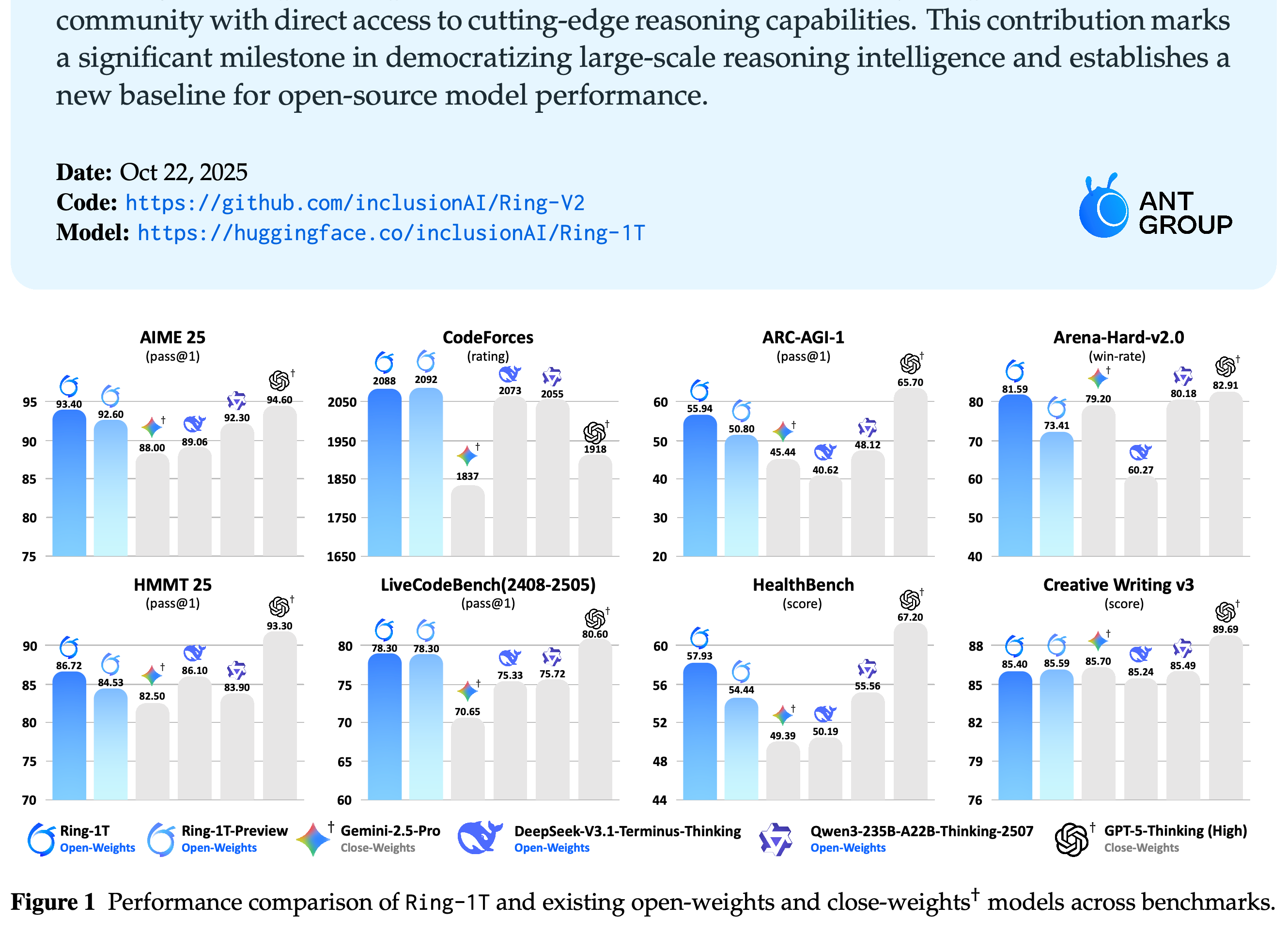
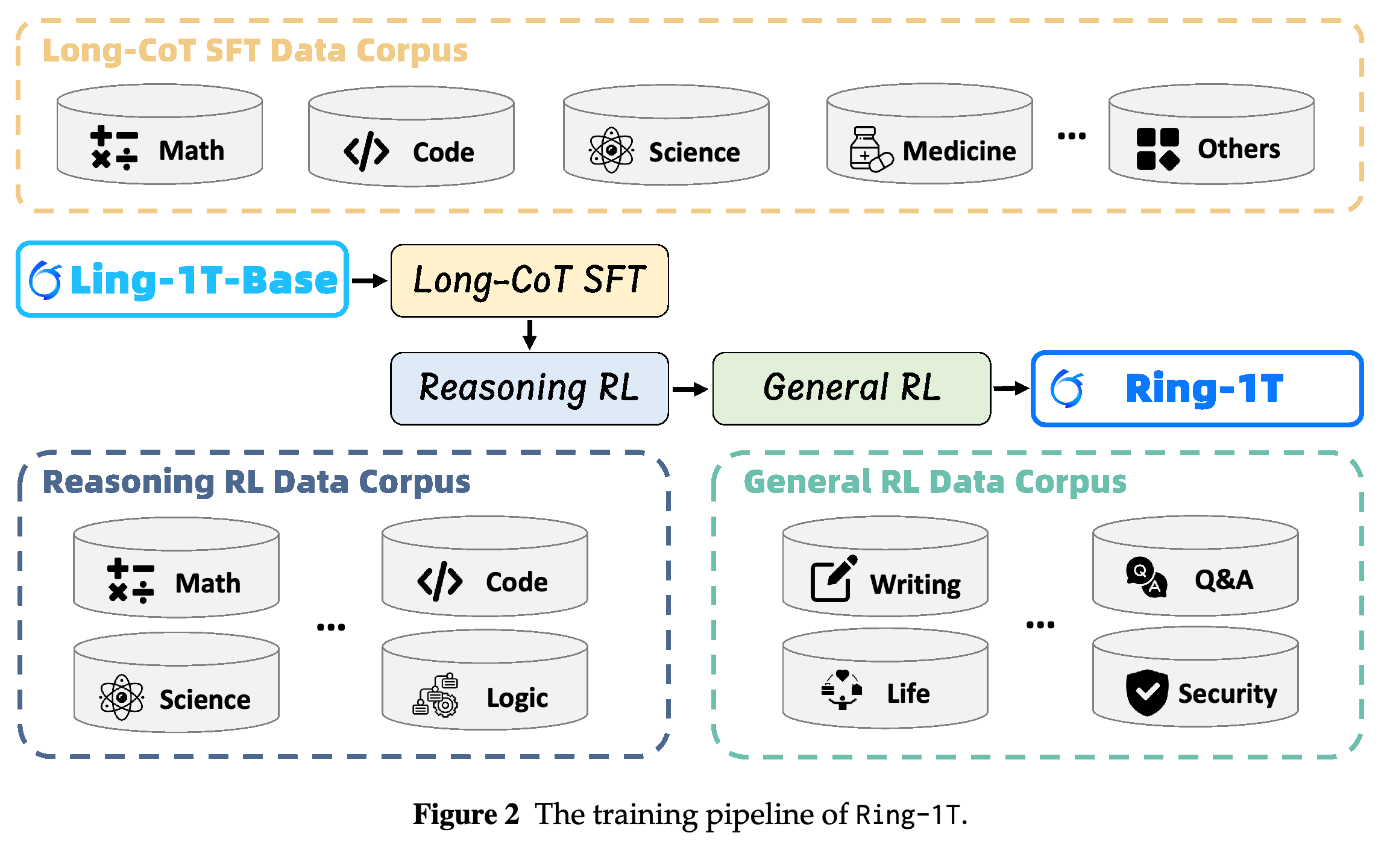
- Every Step Evolves: Scaling Reinforcement Learning for Trillion-Scale Thinking Model presents Ring-1T, with 1 trillion total parameters and approximately 50 billion activated parameters per token through MoE routing. Training combines supervised learning from extended step-by-step reasoning, reasoning reinforcement learning with verifiable outcomes, and general reinforcement learning informed by human preferences. The paper addresses unstable updates and the cost of generating long reasoning responses.
- IcePop weights token updates using the training engine’s probability divided by the inference engine’s probability at the old model parameters, and discards updates when that ratio falls outside the chosen interval. The reasoning recipe uses α = 0.5 and β = 5. On Ring-1T, its diagnostics restrain the sharp late increases in gradient norm, the magnitude of the update gradient, and extreme engine disagreement observed in the comparison run. Residual numerical disagreement remains, and the theoretical mismatch-amplification result depends on stated assumptions.
- C3PO++ partitions rollouts, generated response trajectories, across model updates. Completed trajectories trigger training when their accumulated lengths reach a token budget; unfinished trajectories resume under updated parameters and can therefore contain segments from multiple model versions. Against a baseline without budget-controlled partitioning, the paper reports approximately 2.5× faster rollouts and about 1.5× faster end-to-end execution per step. Baseline/C3PO++ scores are 92.29/92.29 on AIME25, 2084/2085 on CodeForces, and 53.62/53.25 on ARC-AGI-1, without confidence intervals for these differences.
Sources
[1] Pico-Banana-400K: A Large-Scale Dataset for Text-Guided Image Editing
[2] DeepSeek-OCR: Contexts Optical Compression
[3] Every Step Evolves: Scaling Reinforcement Learning for Trillion-Scale Thinking Model